
What AI visibility means
AI visibility is a measure of how often, and how favorably, an AI assistant mentions or cites your brand when someone asks a question in your category. The assistants that matter in 2026 are ChatGPT, Google AI Overviews and AI Mode, Gemini, Perplexity, Microsoft Copilot, and Claude.
Traditional SEO asks one question: where do we rank for this keyword? AI visibility asks a different one. When a buyer describes their problem in a full sentence, does the model name us, link to us, and describe us correctly?
Four numbers capture most of it. Mention rate is the share of tracked prompts where your brand appears. Citation rate is the share where your domain is linked as a source. Average position tells you whether you are named first or fifth. Sentiment tells you whether the model recommends you or warns about you.
Why it matters in 2026
The audience moved. Industry roundups citing OpenAI and Google data put ChatGPT at roughly 900 million weekly active users in early 2026, with AI Overviews reaching well over two billion people a month. Those answers now sit above the classic blue links, and often replace them.
When the answer is complete, the click never happens. Being the recommended brand inside the answer now does the job that a number one ranking used to do. If the model names three competitors and skips you, you were never in the buyer's shortlist.
Answers are also unstable. The same prompt can surface different brands on different days as models and retrieval systems update. That volatility is exactly why manual spot checks fail and why daily automated sampling is the only reliable way to know where you stand.

How we picked the tools
There are more than thirty AI visibility products on the market. We narrowed to five that cover the full budget range, from a $29 pilot to an enterprise contract, and that represent clearly different approaches. Each tool was judged on the six criteria below, and each review section now includes verified user feedback collected from G2 in September 2026.
| Criterion | What we checked | Why it matters |
|---|---|---|
| Engine coverage | Which assistants the base plan tracks and which ones cost extra | A tool that only watches ChatGPT hides what Google AI Mode or Perplexity say about you |
| Prompt depth | How many prompts you can track and whether you can write your own | Ten prompts produce noise, fifty or more produce a trend you can trust |
| Citation data | Whether it shows the exact URLs and domains the model relied on | Citations tell you which pages to fix and which third-party sites to earn a mention on |
| Actionability | Whether it recommends fixes or only reports the score | A score without a next step becomes a slide nobody acts on |
| Price transparency | Whether plans and limits are public without a sales call | Public pricing lets small teams pilot without a procurement cycle |
| User sentiment | What verified reviewers on G2 praise and criticize after months of use | Vendor pages describe the promise, reviews describe the experience |
The 5 best AI visibility tools
The list runs from the most enterprise-focused platform to the most affordable. None of them is the best tool for everyone, so each review ends with real user feedback and a clear description of who should buy it.
Profound
Best for enterprise teams
Profound positions itself as the analytics and workflow layer for AI search at large brands. Image: Profound.
| Best for | Enterprise brands and large agencies that need executive reporting and compliance |
| Starting price | $99 per month for Starter, $399 per month for Growth, custom pricing for Enterprise |
| Engines in base plan | ChatGPT only on Starter, three engines on Growth, full coverage on Enterprise |
| Free trial | 7 days on the Growth plan |
| Standout feature | Prompt Volumes, a dataset of what people actually ask AI assistants, with volume estimates |
| G2 rating | 4.5 out of 5 from 1,128 reviews, September 2026 |
| Website | tryprofound.com |
What it is
Profound is the most heavily funded company in the category. It closed a $96 million Series C in February 2026 at a one billion dollar valuation, bringing total funding to $155 million. The company reports more than 700 enterprise customers, and press coverage names brands such as Ramp, Figma, MongoDB, and US Bank.
What it does well
The core module, Answer Engine Insights, tracks mentions, citations, sentiment, and share of voice across a configured prompt set. Prompt Volumes is the differentiator: instead of guessing which prompts matter, you see estimated demand for real conversational queries in your category.
Agent Analytics shows which AI crawlers visit your site and what they read, which closes the loop between visibility and technical access. A Shopping module tracks product placement inside ChatGPT shopping results, and agent workflows draft content briefs from the gaps the platform finds.
Where it falls short
The self-serve tiers are thin. Starter covers ChatGPT only with 50 prompts and one seat, and Growth caps you at three engines, 100 prompts, and three seats, with both billed annually. Third-party reviews place real enterprise deployments between $2,000 and $5,000 a month, which is where the platform's depth actually lives.
What real users say
The following are summarized from verified reviews on G2. Ratings and dates are as published by the reviewers.
Georgie K., SEO and AI Search Lead Mid-market company, 4.5 out of 5, May 2026, via G2
Her standout feature is topical tracking with daily LLM updates, because AI rankings move fast and she needs to know when a position changed, not only where it started. She also values seeing which competitors, prompts, and cited sources drive each result. Her main wish is broader coverage of LLMs and a clearer breakdown by model and by country.
Haley T., SEO Manager Enterprise company, 4.0 out of 5, May 2026, via G2
She relies on the visibility, citation, and sentiment tracking, and especially on the record of every actual AI answer stored for each prompt, which makes deep dives easy. Two frustrations: the average position report fills up with generic entries such as unnamed bank categories rather than real brands, and her Canadian tracking often pulls US results with no way to filter by country.
Richard S., SEO Marketing Manager Enterprise company, 4.5 out of 5, May 2026, via G2
He chose Profound over competitors because it focuses on taking action rather than only measuring, and because it puts real volume numbers behind prompts. He rates the onboarding materials and support as the best he has seen. His caution is cost, which is higher than the competition, and a pricing structure that tempts teams to track far more topics than they can act on.
Kimberly P., Senior Manager, Content Strategy Mid-market company, 5.0 out of 5, May 2026, via G2
She gets daily feedback on how her content performs with answer engines, including AI bot activity and AI referral visits, and uses the Ask assistant when she does not understand a metric. She reports a visibility score up 6 percent and AI referral traffic up 147 percent. On the downside, the tool is sometimes buggy enough to require logging out and back in, and the Opportunities feature had not yet produced relevant suggestions.
Who should buy it
Buy Profound if you run AI visibility as a company program with budget, a security review (it is SOC 2 Type II certified), and stakeholders who expect board-level reporting. A five-person marketing team will pay for capacity it never uses.
Semrush AI Toolkit
Best for existing Semrush users
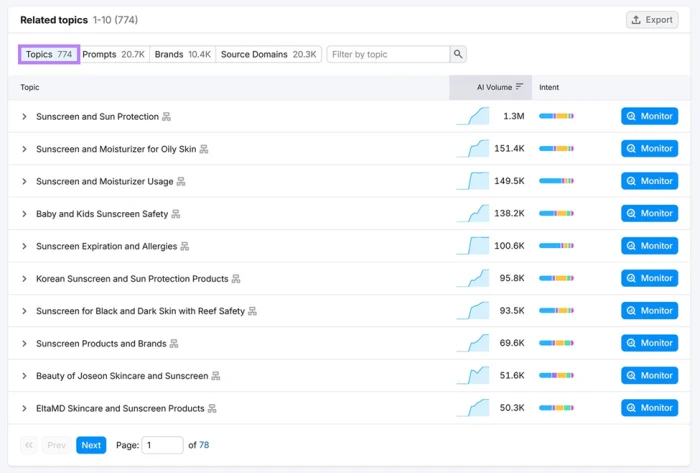
The Related Topics view in Semrush groups prompts by theme and estimates AI volume for each. Image: Semrush.
| Best for | Teams already paying for Semrush who want AI tracking in the same login |
| Starting price | $99 per month per domain standalone, or bundled in Semrush One from $199 per month |
| Engines in base plan | ChatGPT, Google AI Overviews and AI Mode, Gemini, and Perplexity |
| Free trial | Free trial available on Semrush plans |
| Standout feature | Prompt research with AI volume estimates next to your existing keyword data |
| G2 rating | 4.4 out of 5 from 4,035 reviews for the Semrush platform, September 2026 |
| Website | semrush.com/lp/ai-toolkit |
What it is
The AI Toolkit is Semrush's answer to the category, sold either as a standalone add-on or inside the Semrush One bundle. Adobe completed its acquisition of Semrush in April 2026, which points to deeper integration with enterprise marketing stacks over time.
What it does well
The standalone plan tracks 25 custom prompts with daily checks across four engines, and the Semrush One tiers raise that to 50 or 100 daily checks. Brand performance reports show mentions, sentiment, and how the models describe you compared with competitors.
The prompt research module is the strongest part. It clusters conversational queries into topics, estimates AI volume for each, and lets you push any prompt straight into monitoring. Because it sits next to keyword rankings and backlink data, you can see AI visibility and organic visibility for the same topic in one workspace.
Where it falls short
Prompt caps are low compared with dedicated tools, and Claude and Copilot are not covered. Citation detail is lighter than Profound or Ahrefs, and the reporting is designed around the Semrush interface rather than agency white-label needs.
What real users say
Semrush reviews on G2 cover the whole platform, so the four below were selected because they discuss the AI visibility features specifically.
Navanita D., Head of Marketing Small business, 4.5 out of 5, June 2026, via G2
She uses Semrush as her main content strategy tool and says the recent AI Overview tracking, which shows where her site is cited in AI answers, has become the basis of her AEO plan. She finds the interface productive without training. Her biggest complaint is data freshness: on the Pro plan, ranking updates arrive weekly, and for less popular keywords as rarely as once a month.
Mark C., Business Development Manager Small business, 4.5 out of 5, December 2025, via G2
He calls out the AI Visibility module, and in particular the Perception and Narrative Drivers reports, which helped him write new FAQs and content that language models pick up. He compares Semrush favorably with Ahrefs for day-to-day work. What irritates him is the number of expensive add-ons, which can climb into thousands of dollars a month and clutter the interface.
Pedro M., AEO Coordinator Small business, 5.0 out of 5, August 2026, via G2
He works with Semrush mostly outside the interface, using the API, MCP, and scheduled workers to run prompt research, keyword research, and ranking monitoring for agency clients. He calls the monitoring pricing too expensive and hopes competition pushes Semrush to include more tracked prompts in each plan.
Melissa K., Owner Small business, 5.0 out of 5, June 2026, via G2
A fifteen-year Semrush user who still rates it the best all-in-one SEO tool, she is critical of the Semrush One tier. At its higher price she expected more actionable recommendations, and she finds the AI-related insights poorly structured, with irrelevant suggestions and no easy way to export or summarize prompt and topic data by brand.
Who should buy it
If your team already lives in Semrush, this is the lowest-friction way to start. If you use neither Semrush nor Ahrefs, a dedicated tracker will give you more prompts and engines for the same money.
Peec AI
Best for agencies and multi-market teams
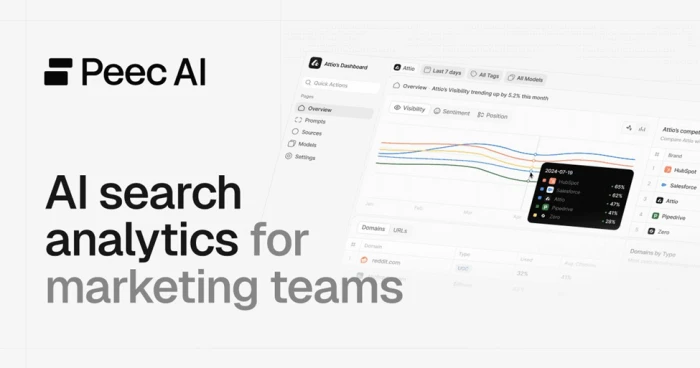
Peec AI's overview screen plots visibility over time against a chosen set of competitors. Image: Peec AI.
| Best for | Agencies and mid-market teams that need clean multi-country reporting with unlimited seats |
| Starting price | From about 70 euros per month billed annually after the August 2026 repricing, with Pro around 180 euros |
| Engines in base plan | Three models chosen from six, typically ChatGPT, Perplexity, and Google AI Overviews, with extra engines as paid add-ons |
| Free trial | 7 days, card required |
| Standout feature | Unlimited seats on every tier and fast, well-designed dashboards |
| G2 rating | 4.8 out of 5 from 20 reviews, September 2026 |
| Website | peec.ai/pricing |
What it is
Peec AI is a Berlin-based analytics platform built specifically for marketing teams. It raised about $29 million and, according to its G2 profile, passed $10 million in annual recurring revenue within sixteen months of launch, which makes it the fastest-growing challenger in the category.
What it does well
The product is fast and focused. You get visibility, sentiment, position, source domains, and competitor comparison in a few clicks, with country-level tracking so a brand can see how it performs in Germany versus the United States. Shopping appearances are tracked too.
Unlimited seats on every plan is a real advantage for agencies, because every strategist and client contact can log in without a per-seat bill. Prompt allowances run from 50 on Starter to 150 on Pro and 350 on Advanced.
Where it falls short
Peec measures first and recommends second. Its Actions module is newer and, as reviewers note below, not yet fully trusted. Engine add-ons run from roughly 20 to 140 euros a month each, and Claude tracking is reserved for the Enterprise tier, so the real bill grows quickly if you want full coverage.
What real users say
Peec's G2 review base is small but recent, and most reviews are organic rather than vendor-invited.
Rinaldi J., Growth Manager Small business, 5.0 out of 5, August 2026, via G2
He prepares AI visibility reports with Peec and praises the reliable prompt tracking and the breadth of comparisons built from it. The AI-generated starter prompts needed little editing, and the tool revealed competitors in LLM answers that differ from his SEO competitors. He remains cautious about the Earned and Owned Actions recommendations, which he does not yet trust to understand his business well enough to say what content to write.
Riley M., Digital Marketing Strategist Mid-market company, 4.0 out of 5, April 2026, via G2
She finds Peec straightforward and calls it the best tool she has used for measuring presence in AI overviews and explaining traffic shifts to the executive team. She likes that it delivers what pricier vendors bundle into large packages. Her wish is coverage of more models such as Grok and Claude, which is where the price jumps significantly.
Verified user in the tobacco industry Enterprise company, 4.0 out of 5, August 2026, via G2
This reviewer values the core job: seeing how AI models recommend the business and what they cite, with comprehensive data that adds a dimension SEO tools never had. The dislike is the subscription wall between models, with only a few AI engines available per tier, which feels limiting at times.
Chaitanya M., VP of Growth Small business, 5.0 out of 5, July 2026, via G2
He checks the multi-day visibility trend lines daily and finds the source retrieval and citation feature useful for building brand visibility. His only complaint is that he still has to rely on Semrush for prompt volume research, since Peec does not replace that step.
Who should buy it
Choose Peec if your job is accurate, multi-market reporting for several stakeholders and you already know how to turn insight into content. Skip it if you want the tool to tell you exactly what to fix.
Ahrefs Brand Radar
Best for prompt research at scale

Brand Radar lives inside Ahrefs and draws on a large index of real AI prompts. Image: Ahrefs.
| Best for | Data-heavy SEO teams already on Ahrefs, and category leaders sizing AI demand |
| Starting price | Ahrefs base plan from $129 per month, plus $199 per AI platform per month or $699 per month for all platforms |
| Engines in base plan | Seven AI indexes including ChatGPT, Gemini, Perplexity, Copilot, Claude, Meta AI, and Google AI Overviews and AI Mode, each sold per platform |
| Free trial | No free trial; paid Ahrefs plan required |
| Standout feature | A prompt database in the hundreds of millions, built from real AI conversations rather than synthetic tests |
| G2 rating | 4.5 out of 5 from 713 reviews for the Ahrefs platform, September 2026 |
| Website | ahrefs.com/brand-radar |
What it is
Brand Radar is the AI visibility product inside Ahrefs. Its defining asset is data volume. Published figures cite a prompt database of more than 260 million entries, with more recent counts above 400 million prompts across seven AI indexes.
What it does well
Most tools run a fixed list of prompts you wrote yourself. Brand Radar lets you search a corpus of prompts people actually typed, so you can discover demand you did not know existed and see which brands and pages get cited for it.
Citation analysis and competitor investigation are strong, and everything connects to Ahrefs backlink, keyword, and traffic data. The Agent A assistant lets analysts query the full dataset in plain language, which suits teams that prefer asking questions to clicking through dashboards.
Where it falls short
It is the most expensive option here. Reviewers put realistic all-in costs between $828 and $1,148 a month once you add platforms to a base plan, and some question whether day-to-day tracking accuracy justifies that price. There is no self-serve trial.
What real users say
Ahrefs reviews on G2 cover the entire suite. The four below were chosen because they discuss Brand Radar and the AI visibility data directly.
Verified user in IT services Enterprise company, 4.0 out of 5, May 2026, via G2
After about eight months of use across several brands, this reviewer credits Brand Radar with coverage that few rivals match: multiple LLMs, countries, and languages, which makes it useful for seeing which sources AI prioritises in non-English markets. The serious drawback is consistency. Each time Ahrefs updates its index, historical metrics change retroactively, so tracking progress over time is unreliable and the only workaround is to lean on tracked prompts.
Iván F., Fractional CMO Small business, 5.0 out of 5, April 2026, via G2
He uses Brand Radar to understand how visible his client's brand is in AI answers, which competitors dominate, which topics surface most, and which websites feed the models for different purposes. His reservations are the high price and the sheer number of sub-tools, which he finds overwhelming even after years on the platform.
Zubair P., SEO Team Lead Mid-market company, 4.0 out of 5, July 2026, via G2
He rates the backlink data and the AI Overview data as very good and pulls organic visits, keyword rankings, and country-level detail from the platform. His objection is pricing, and specifically that the AI Overview data carries a separate charge on top of the main subscription.
Bas S., Freelance Marketer Small business, 4.0 out of 5, January 2026, via G2
He likes the dashboard overview that puts competitor information in one place for weekly prioritisation, and he found setup easy. He is unhappy with the AI citations reporting, saying it does not make clear what to change in order to rank better in AI search.
Who should buy it
Buy Brand Radar if evidence from real prompts is decisive for your strategy and you already pay for Ahrefs. If you mainly need to monitor a known prompt list every day, a cheaper tracker does that job just as well.
Otterly.AI
Best value and best for small teams
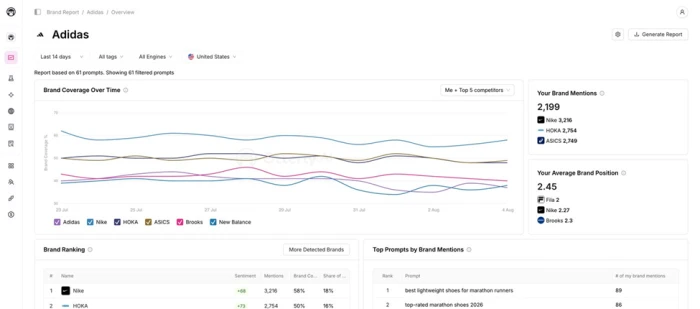
An Otterly.AI brand report tracks coverage over time against named competitors and lists the top prompts driving mentions. Image: Otterly.AI.
| Best for | Startups, small marketing teams, and agencies running a first pilot |
| Starting price | $29 per month for Lite, $189 for Standard, $489 for Premium, custom for Enterprise |
| Engines in base plan | Four engines on Lite, with AI Mode, Gemini, and Claude available as add-ons; seven engines in total |
| Free trial | 14 days, no credit card required |
| Standout feature | Monitoring plus optimization in one product: crawlability checks, content audits, and prioritized recommendations |
| G2 rating | 4.7 out of 5 from 54 reviews, September 2026 |
| Website | otterly.ai |
What it is
Otterly.AI is an Austrian AI search monitoring platform used by more than 30,000 marketing professionals. It was named a Gartner Cool Vendor in 2025 and won the Best AI Search Analytics Software category at the European Search Awards in 2026.
What it does well
Coverage is broad for the price. Otterly tracks ChatGPT, Google AI Overviews, Google AI Mode, Gemini, Perplexity, Copilot, and Claude across more than 65 countries and languages, and checks every cited domain and URL daily with position changes over time.
It also goes past measurement. The crawlability checker confirms AI bots can reach your pages, the content audit explains why a page is not cited, and the recommendations engine turns competitor and citation data into a ranked to-do list. Agencies get workspaces per client, a Looker Studio connector, an API, and an MCP server.
Where it falls short
The Lite plan includes only 15 prompts, which is enough for a pilot but not for a program. The jump from $29 to $189 has nothing in between, and the most requested engines on lower tiers are paid add-ons. Enterprise procurement features are lighter than Profound's.
What real users say
Otterly's reviews on G2 are mostly organic and lean toward small businesses and agencies.
Sandeep J., Digital Marketing Specialist Mid-market company, 4.5 out of 5, August 2026, via G2
His team renewed without hesitation, crediting the new Recommendations section for concrete pointers on improving GEO and the price point for a clear return. Two limits: his niche industry produces a small amount of data, and because there is no direct website connector he cannot see much about visits arriving from AI.
Branko M., SEM Specialist Small business, 5.0 out of 5, June 2026, via G2
He calls the AI prompt research tool exactly what his agency needed and praises the responsive team and partner support for small agencies. His concern is pricing structure: the Lite tier does not have enough capacity for a growing workload, and the jump to the Standard tier stretches a small agency's software budget.
Anastasiia P., Content Strategist Small business, 4.0 out of 5, June 2026, via G2
She likes the intuitive interface and how accurately Otterly identifies the competitors that actually appear in AI answers, which improved her benchmarks and share-of-voice tracking. Her criticism is that the tool is stronger at monitoring than at telling her what to do, and at this price she expects more concrete strategic recommendations.
Michelle B., Founder Small business, 5.0 out of 5, September 2025, via G2
A solopreneur who tested Ahrefs Brand Radar, Ziptie, Keyword.com, and Waikay before settling on Otterly, she values that it captures the answers a real consumer would see rather than API output, with screenshots and text of every result. She started on the smallest plan, signed her first AI optimization client a month later, and upgraded. Unlimited brands per plan and direct access to the developers sealed it for her.
Who should buy it
Start here if you have never tracked AI visibility and want a real baseline in two weeks without a sales call. Agencies with many small clients also get more per dollar here than anywhere else on this list.
Side by side comparison
The table condenses the five reviews into one view. Prices are the published entry points as of September 2026 and should be confirmed on each vendor's pricing page before you budget.
| Tool | Best for | Entry price | Engines at entry | Trial | G2 rating | Main trade-off |
|---|---|---|---|---|---|---|
| Profound | Enterprise programs | $99 per month, billed annually | ChatGPT only | 7 days on Growth | 4.5 (1,128) | Real depth starts at custom enterprise pricing |
| Semrush AI Toolkit | Existing Semrush users | $99 per month per domain | Four engines | Free trial on Semrush plans | 4.4 (4,035, whole platform) | Low prompt caps, no Claude or Copilot |
| Peec AI | Agencies and multi-market teams | About 70 euros per month, billed annually | Three of six models | 7 days, card required | 4.8 (20) | Engine add-ons raise the real bill |
| Ahrefs Brand Radar | Prompt research at scale | $129 base plan plus $199 per platform | One platform per add-on | None | 4.5 (713, whole platform) | Highest total cost in the group |
| Otterly.AI | Small teams and pilots | $29 per month | Four engines | 14 days, no card | 4.7 (54) | Only 15 prompts on the entry plan |
AI visibility vs rank tracking: 12 differences
Teams often assume an AI visibility tool is a rank tracker with a new data source. It is not. The two disciplines measure different things, move at different speeds, and respond to different levers.
| Aspect | Traditional rank tracking | AI visibility tracking |
|---|---|---|
| Input | Short keywords such as "crm software" | Full conversational prompts such as "which CRM suits a ten person real estate team" |
| Unit of success | A position on a results page | A mention, a citation, or a recommendation inside a generated answer |
| Output type | A list of ten links | One synthesized answer that may name two to five brands |
| Stability | Rankings change gradually over weeks | Answers can change between two runs on the same day |
| Measurement method | One query, one observed position | Repeated sampling, reported as a rate or average over a period |
| Source signal | Backlinks, on-page relevance, and engagement | Cited third-party pages, entity consistency, and how clearly content answers the question |
| Role of third-party sites | Mainly as link sources | Often the pages the model quotes instead of your site, such as review sites and forums |
| Sentiment | Not measured | A core metric, because the model describes your brand in words |
| Competitor view | Which domains outrank you | Which brands the model names alongside or instead of you, and in what order |
| Volume data | Mature monthly search volumes | Estimated, and only available from a few vendors such as Profound, Semrush, and Ahrefs |
| Traffic attribution | Clear click-through from the results page | Partial, tracked through referral filters and AI crawler logs |
| Primary fix | Improve the page and earn links | Structure content as direct answers, keep facts consistent across the web, and earn mentions on cited sources |
How to set up AI visibility tracking in 7 steps
The process below works with any of the five tools. Budget roughly two weeks for a trustworthy baseline and a month before you judge the effect of any change.
Step 1: Write the prompts your buyers actually type
What to do. Build a list of 30 to 50 prompts grouped into three to five topics. Write them as full questions in natural language, not as keywords.
Why it matters. AI assistants answer sentences, and the wording changes the answer. A prompt like "best project management tool" produces a different brand list than "project management tool for a remote agency with hourly billing".
Example. A payroll software company might group prompts into evaluation ("best payroll software for a 20 person startup"), comparison ("Gusto vs Rippling for a small business"), and problem-solving ("how do I run payroll in two states"). Use the prompt research features in Semrush, Otterly, or Brand Radar to find phrasings you would not have guessed.
Step 2: Pick the engines where your audience already is
What to do. Start with three engines rather than all seven. Add more once you know the baseline.
Why it matters. Each engine costs money in prompt allowance or add-on fees, and each has a different audience. Tracking everything on day one buries the signal in noise.
Example. A B2B software brand usually starts with ChatGPT, Perplexity, and Google AI Mode. A consumer or local business starts with Google AI Overviews, ChatGPT, and Gemini, because that is where shoppers and mobile users ask.
Step 3: Add three to five competitors
What to do. Enter the competitors that a buyer would compare you against, not the ones you wish you competed with.
Why it matters. AI visibility is relative. A 40 percent mention rate is excellent if the leader has 45 percent and poor if the leader has 90 percent. Share of voice only exists when competitors are tracked.
Example. A mid-size CRM vendor tracks HubSpot and Pipedrive because those appear in almost every answer, plus two direct rivals of similar size. The gap between the two groups tells them whether the problem is category authority or head-to-head positioning.
Step 4: Run a 14 day baseline before drawing conclusions
What to do. Let the tool run daily for two weeks and record the average mention rate, citation rate, position, and sentiment per topic and per engine.
Why it matters. A single run is a coin flip. The same prompt can include you on Monday and skip you on Tuesday. Averages over 14 daily runs turn that randomness into a number you can act on and defend.
Example. A team that saw a 20 percent mention rate on day one and 55 percent on day three would have drawn the wrong conclusion either way. The 14 day average of 38 percent became their honest starting point.
Step 5: Read the citations, not just the mentions
What to do. Export the list of domains and URLs the models cited across your prompt set. Sort by frequency and split them into your own pages, competitor pages, and third-party pages.
Why it matters. Citations are the map of influence. If Reddit threads, review sites, and two industry blogs account for most citations, those are the places where your brand needs to be present and accurate.
Example. An accounting software brand found that its own site was cited in only 8 percent of answers, while a single comparison article on a review site was cited in 31 percent. Getting an accurate, current listing on that page moved their mention rate more than any change to their own site.
Step 6: Close the gaps with content and off-site work
What to do. For each prompt group where you are absent, create or restructure a page that answers the question directly in the first paragraph, includes a clear feature and pricing summary, and carries a visible updated date. In parallel, correct wrong facts on cited third-party pages and earn placement in the roundups the models trust.
Why it matters. Models reward content that is easy to extract and consistent with what other sources say. A page that buries the answer under marketing copy is skipped even when it is the most accurate page on the web.
Example. Use the content audit in Otterly or the AI search audit in Semrush to check that the page is crawlable by AI bots, has structured headings that mirror the prompt, and states the facts a model would need to recommend you. Then confirm in Google's guidance on AI features in Search that nothing you did conflicts with its rules.
Step 7: Report monthly on a small set of metrics and set alerts
What to do. Report mention rate, citation rate, average position, sentiment, and share of voice by topic and engine. Add AI referral sessions from your analytics tool by filtering referrers such as chatgpt.com, perplexity.ai, and gemini.google.com. Set alerts for sudden drops and for negative sentiment.
Why it matters. Stakeholders need a stable scorecard, and volatility means you will miss a real problem without alerts. A sentiment alert can catch a hallucinated pricing claim before a sales call does.
Example. An agency ships one Looker Studio page per client with the five metrics on top, the top ten cited domains in the middle, and the month's three actions at the bottom. Clients read it in two minutes and approve the next month's work in the same meeting.
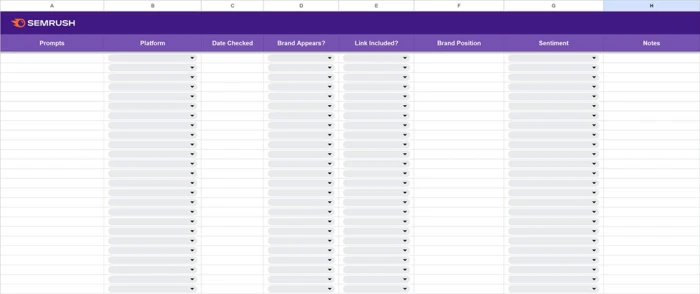
Before you buy anything, a sheet like this one from the Semrush blog is enough to run a manual pilot on ten prompts. The tools above automate the same columns daily. Image: Semrush.
8. Mistakes to avoid
Judging from one run. A single check on a single day is not data. Report averages over at least two weeks, and compare periods of equal length.
Tracking keywords instead of prompts. Pasting your SEO keyword list into an AI visibility tool produces answers nobody asked for. Rewrite each as the sentence a real buyer would type. Several Otterly reviewers describe this mindset shift as the hardest part of setup.
Ignoring sentiment. A mention that says your product is expensive and hard to set up is worse than no mention. Read the actual answer text, not only the coverage number, and hand-check sentiment tags, which reviewers of more than one tool describe as oversensitive.
Optimizing only your own site. Models cite review sites, forums, and industry publications heavily. If your listing on a frequently cited page is outdated or missing, no amount of on-site work fixes that.
Buying more than you can act on. Enterprise reviewers of Profound note that it is tempting to track far more topics than the team can fix. Match the plan to your content capacity, not to your curiosity.
Skipping the crawl check. Some AI crawlers are blocked by default in CDN and firewall settings. Confirm that GPTBot, PerplexityBot, and Google's crawlers can reach the pages you want cited before you rewrite them.
Final verdict
No single tool wins outright. The right choice depends on your budget, the software you already pay for, and whether you need the tool to recommend fixes or only to report.
| Your situation | Pick | Reason |
|---|---|---|
| First pilot with no budget approval | Otterly.AI | Baseline data in 14 days for $29 and no card, with fixes suggested in the same product |
| Already paying for Semrush | Semrush AI Toolkit | The lowest-friction path, with AI and organic data for the same topics in one login |
| Agency with many clients and stakeholders | Peec AI or Otterly.AI | Peec for unlimited seats and multi-country depth, Otterly for workspaces and Looker Studio reporting at lower cost |
| Research into what people actually ask AI | Ahrefs Brand Radar or Profound | Both hold real prompt datasets; Ahrefs suits analysts on Ahrefs, Profound suits enterprise programs |
| Enterprise program with compliance and board reporting | Profound | Deepest platform, SOC 2 Type II, and procurement support, at an enterprise price |
If you only remember one thing: run a two-week baseline on 30 real prompts before you spend more than $100. That single exercise will tell you which engines matter, which competitors own your category in AI answers, and whether you need a $29 monitor or a $2,000 platform.