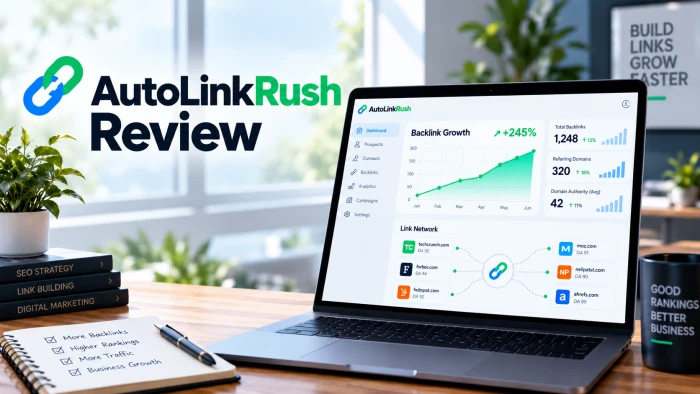
Quick answer: AutoLinkRush is a real, working website that submits your URL to ping and indexing services and shows the results as "backlinks." Most of what it generates are machine-made ping pages, not editorial links. It may help Google discover a new URL a little faster. It will not build authority or lift rankings on a competitive keyword. Safe enough for a test site, a poor idea for a business, client, or e-commerce domain.
What AutoLinkRush is
AutoLinkRush is a browser-based tool. You paste a URL, type a keyword, click start, and the system fires your URL at what it describes as 1,000+ ping and backlink services. Nothing to install, results appear within seconds, and there is a free tier.
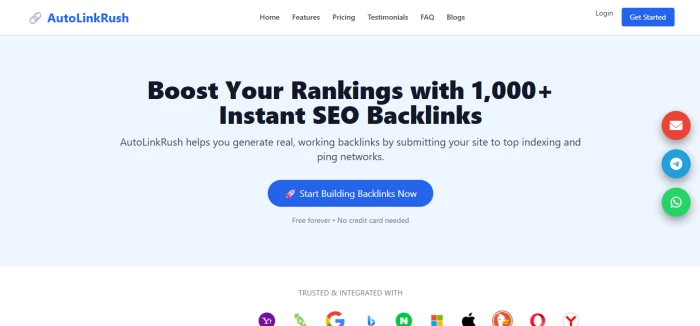
It also runs a second, separate business: paid link insertions on a list of third-party websites (tech and general-interest blogs), sold as permanent do-follow links across all niches, plus footer text-link placements. Treat these two products differently. The automated pings are cheap and mostly harmless noise. The paid do-follow and footer placements are the part that overlaps directly with Google's link-spam policy.
How it works, step by step
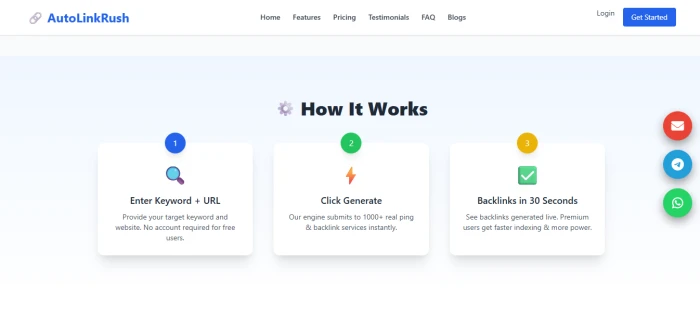
- Enter URL + keyword. The keyword may be reused as anchor text across every generated page, which is exactly the kind of exact-match pattern Google's systems are built to discount.
- Automated submission. The tool pings RSS aggregators, "website analysis" sites, bookmarking pages, and URL-info pages.
- Results page. You see a list of URLs that now mention your site. Paid plans promise more sources, faster indexing, and a link report.
Are the "1,000 backlinks" real?
Technically, yes: a page somewhere contains your URL. Practically, no. Google only counts a link it can crawl in the first place. Its own documentation on which links Google can follow explains that a link has to be a proper <a href> on a crawlable, indexable page, which many auto-generated ping pages are not. Here is what a typical generated link looks like versus what actually moves rankings:
| Generated ping link | Editorial backlink | |
|---|---|---|
| Where it lives | Auto-generated stats or ping page | Inside a relevant article |
| Who put it there | A script | A publisher who chose to cite you |
| Indexed by Google? | Usually not | Usually yes |
| Anchor text | Your exact keyword, repeated | Natural, varied |
| Ranking value | Close to zero | Real |
A good rule: ten links a human would click are worth more than ten thousand that no human will ever see.
Pricing, and the contradiction you should know about
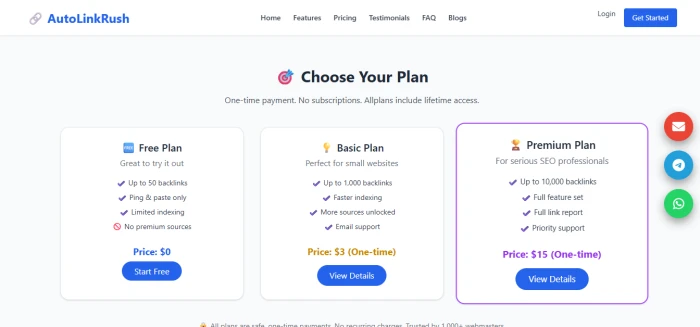
The pricing page lists four one-time plans: Free ($0), Basic ($3), Pro ($8), Premium ($15), with "lifetime access" and no subscription.
The problem is the numbers don't agree with each other. The homepage advertises up to 50 backlinks (Free), 1,000 (Basic) and 10,000 (Premium). The pricing page says every plan includes "3 backlinks in multiple sites." The homepage FAQ separately says the free plan can produce 1,000+. Before paying even $3, ask support in writing: how many links, per URL or per account, and whether pings count as "backlinks."
Is AutoLinkRush safe? What Google's policy actually says
Google's spam policies list, as examples of link spam: using automated programs or services to create links, buying or selling links that pass ranking credit, low-quality directory or bookmark links, and widely distributed footer links. AutoLinkRush's marketing touches all four.
Paid placements aren't automatically against the rules. Google's guidance on qualifying outbound links says sponsored links are fine when marked rel="sponsored" or rel="nofollow". The issue is that AutoLinkRush sells its placements specifically as do-follow, which is the version Google treats as a scheme.
Realistic outcomes, from most to least likely:
- Google ignores the links. By far the most common result. You lose nothing but time.
- The links are discounted and your anchor profile looks manufactured. Mildly negative on a site that already ranks.
- A manual action. Rare from pings alone. More plausible if you combine the paid do-follow and footer placements with other schemes on a commercial site.
Risk scales with what you're protecting. On a disposable test domain, the downside is close to zero. On a revenue-generating site, the upside is also close to zero, so the trade is bad.
Can it get a page indexed faster?
Sometimes, marginally. A ping can put a URL in front of a crawler. But discovery is not indexing, and indexing is not ranking. If a page isn't indexed, the cause is almost always on your side: a noindex tag, a canonical pointing elsewhere, no internal links, or thin content.
Google's own page on asking Google to recrawl a URL is blunt about this: even a direct request through Search Console doesn't guarantee indexing, and submitting the same URL repeatedly doesn't speed anything up. A third-party ping service has far less pull than Google's own request button, which is free.
What users think about AutoLinkRush
This is where the picture gets thin. AutoLinkRush has no Trustpilot, G2, or Capterra profile, no visible Reddit threads from people who used it, and no case studies. The only user feedback is the testimonial block on its own homepage, which uses first names and generic job titles and cannot be verified.
Independent reviewers who have looked at the service agree on the same points, whatever their angle:
- The tool does what it says mechanically. Nobody reports it failing to run or taking money without producing a results page.
- The "backlinks" are overwhelmingly ping and submission URLs, not links inside real articles.
- The value for indexing is small and the value for rankings is close to nil. One reviewer summed it up as "a minor indexing utility, not an SEO strategy."
- The pricing contradictions and anonymous ownership are the most common complaints about trust.
For a second opinion before buying, search Reddit's r/SEO and r/bigseo for the brand name and check whether any thread has appeared since this article was written. Absence of complaints is not the same as a good reputation, especially for a product with 100,000+ monthly brand searches.
Pros and cons
Pros
- Free tier, so you can see the output before spending anything.
- One-time prices of $3 to $15, no subscription.
- Nothing to install, results in seconds.
- You control the target URL and keyword.
- Public list of the sites used for paid placements, so you can inspect them.
Cons
- Automated link creation is named as link spam in Google's own policy.
- Backlink allowances differ between the homepage and the pricing page.
- Generated URLs are mostly unindexed ping pages with no ranking value.
- Repeated exact-match anchors can make your profile look manufactured.
- Do-follow and footer placements are the riskiest kind of paid link.
- No company name, address, or named team. Contact details vary across pages.
- The site's own blog is heavy on casino and betting content, which says a lot about the link neighbourhood.
How to check what you actually got
Should you use it anyway, judge the output, not the counter on the dashboard. Work through this list a week after submitting:
- Export the full results list and remove duplicates and dead URLs.
- Open a sample of 20 pages. Does your link exist, is it clickable, and does it point to the right URL?
- Search
site:for ten of those pages. When Google hasn't indexed the page, the link counts for nothing. - View source on each sample page and look for
nofollow,sponsored, or a redirect. - Run your domain through a backlink tool and count new referring domains, not new URLs.
- Check Google Search Console for impressions, clicks, and any manual action.
- Recheck the same sample after 30 and 90 days. Ping pages disappear quietly.
When fewer than 5 percent of the reported links pass steps 2 through 4, you have your answer.
Alternatives to AutoLinkRush
What you pick depends on which problem you were actually trying to solve.
For indexing problems
- Google Search Console: submit a sitemap and use URL Inspection to request indexing. Free, and it is the real front door.
- Internal links: three links from your strongest existing pages do more for discovery than any ping service.
- Fix the actual blocker: noindex tags, wrong canonicals, orphaned pages, and thin content stop indexing far more often than "Google hasn't found it yet."
For building authority
- Guest posts on sites in your real niche, with editorial review and a natural anchor.
- Digital PR and journalist requests through platforms such as Qwoted or Featured. One quote in a trade publication beats a thousand pings.
- Original data: a small survey, a scraped dataset, or a benchmark that other writers have a reason to cite.
- Resource-page and broken-link outreach, using a backlink tool like Ahrefs or Semrush to find pages already linking to similar content.
For paid links done properly
- Sponsored placements marked
rel="sponsored"on relevant sites. Disclosed, compliant, and still useful for referral traffic and brand exposure.
For anyone who still wants an automated tool
- There is no automated backlink generator that is both effective and safe in 2026. The ones that look safe are ineffective, and the ones that look effective are the ones that get discounted. Spend the $15 on a month of a rank tracker instead and measure what the methods above actually do.
Who should use it, and who shouldn't
Reasonable: SEO beginners who want to see what mass pinging actually produces, throwaway test sites, tier-2 and tier-3 link layers, curiosity.
Avoid: established brands, e-commerce, medical, legal, or finance sites, agencies working on client domains (using it without disclosure is an ethics problem, not just an SEO one), and any site that already has meaningful organic traffic.
Red flags on the site itself
- Pricing and backlink allowances conflict across pages.
- Testimonials use first names and generic titles only.
- Contact details vary between pages. The Write for Us page still contains "[your email here]" placeholder text.
- No registered company name, address, or named team.
- The blog mixes SEO, automotive guest-post guidelines, and a large amount of casino and betting content.
- Third-party reviews reference both autolinkrush.com and autolinkrush.net. Confirm which domain you're on before paying.
Verdict
AutoLinkRush is a $3 ping tool wearing a backlink generator's marketing. That is not an insult. As a ping tool it is cheap, fast, and does what it says. The problem is the gap between what it does and what its homepage implies.
What it actually delivers: a list of automated submission URLs, most of them on pages Google will never index, with your keyword repeated as anchor text. A small fraction may nudge a crawler toward a new page. None of them carry the kind of editorial weight that moves a ranking on a keyword anyone else is competing for.
What it costs beyond the price: on a test domain, nothing. On a real business site, the cost is a slightly uglier backlink profile, an exact-match anchor pattern you would not have chosen, and a link neighbourhood that includes casino and betting blogs. Google will most likely ignore all of it, but "most likely ignored" is a poor return on any amount of money, even $3.
Where it sits against the alternatives: every goal the tool promises has a free or cheaper route that works better. Indexing is handled by Search Console and internal links. Authority comes from relevant editorial mentions. Even paid links are fine when marked sponsored and placed on a relevant site. AutoLinkRush is the worst option for each of those goals, and the only reason to pick it is that it is the easiest to click.
Use it when: you are learning SEO and want to see for yourself what a mass ping campaign produces, you have a throwaway domain, or you are building a tier-2 layer and already understand the trade-off.
Skip it when: the site earns money, belongs to a client, or already has rankings worth protecting. In that situation the upside is close to zero and the downside is not.
Rating: 3 out of 10. Two points for being free to try and honest about the mechanics, one for the one-time pricing. Points lost for the conflicting backlink numbers across its own pages, the anonymous ownership, the do-follow and footer placements that sit squarely inside Google's link-spam examples, and the marketing that sells a ping utility as a ranking tool.
For real growth the boring answers still win: content people cite, technical hygiene, and a handful of relevant editorial links. A $15 lifetime plan is not a shortcut to any of them.