
What Is AO3, Really?
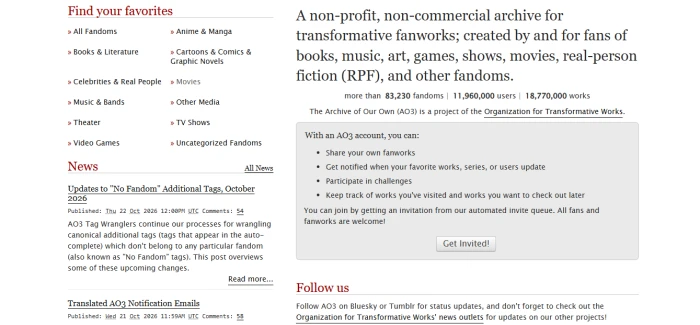
Archive of Our Own (AO3) is a huge, free, non-commercial website where fans post and read fanfiction: original stories written by fans using characters and worlds from existing books, TV shows, movies, games, and anime. It also hosts fan art, "podfic" (audio recordings of stories), and essays about fan culture.
A few things that set it apart:
- It's run by a non-profit, volunteer-powered organization called the Organization for Transformative Works (OTW), funded entirely by donations.
- It has no ads and no algorithm pushing content at users. You only see what you search for.
- It's genuinely enormous, hosting well over 18 million works across tens of thousands of fandoms.
- It's respected enough in the literary world that it won a Hugo Award, one of science fiction's most prestigious honors, in 2019.
For a neutral, encyclopedic overview of its history and structure, Wikipedia's Archive of Our Own entry is a solid starting point.
So AO3 isn't a shady corner of the internet. It's a legitimate, award-winning creative community. But it was built on a philosophy of maximum inclusiveness, which means it hosts everything from sweet, all-ages stories to graphic, adults-only content, all in the same place.
Why Teens Love AO3
Understanding the appeal helps you have a better conversation about it. Teens are drawn to AO3 because:

- It's about the things they already love. If your kid is obsessed with a show, a game, or a book series, AO3 is where the fan community keeps those stories going.
- It's a writing community, not just a reading one. Many teens post their own stories, get comments and "kudos" (the site's version of likes), and improve as writers through feedback.
- It's free, ad-free, and fast. There's nothing to buy and nothing interrupting the reading.
- It's endlessly searchable. Readers can find exactly the kind of story they want, down to specific characters, relationships, and tropes.
- It feels like a safe space for identity. Fanfiction has long been a place where young people, especially LGBTQ+ teens, explore stories that reflect them.
None of this is a bad thing. A lot of strong adult writers got their start on fanfiction sites. The concern isn't the hobby; it's the unfiltered range of content sitting alongside it.
The Short Answer: Is AO3 Safe for Kids and Teens?
Honestly? It depends on the child's age, maturity, and how they use it. AO3 was never designed with children in mind.
- For younger kids (under 13): No. AO3 doesn't verify age, has no kid mode, and makes no promises that content is appropriate. It isn't built for them.
- For older teens (16 to 18): It can be used safely, because AO3 gives readers powerful tools to filter and avoid content they don't want. But those tools only work if your teen chooses to use them, and nothing stops them from doing the opposite.
- For the 13 to 15 range: This is the gray zone where your knowledge of your own child matters most, and where an open conversation beats a hard ban.
The key thing to understand is that AO3 is a self-service platform. It labels content extensively, but it trusts the reader (and the writer) to behave responsibly. If you want a deeper look at how the platform handles privacy, data, and overall trustworthiness, this full trust, privacy, and security review of AO3 goes further than this parenting-focused guide does.
The rest of this article explains the labeling tools, because once you understand them, you can actually assess the risk instead of guessing.
Tool #1: The Rating System
Every work on AO3 carries a rating tag that signals how mature the content is. Think of it like a movie rating. There are five:
- General Audiences: Suitable for everyone; no mature content.
- Teen And Up Audiences: Mild language, some violence, mild suggestive themes. Roughly PG-13.
- Mature: Adult themes, strong content, and non-explicit sexual or violent material.
- Explicit: Graphic sexual content and/or graphic violence. Strictly adult.
- Not Rated: The author didn't assign a rating. Treat "Not Rated" as potentially anything, including the most explicit content. An unrated work is permitted to contain the highest-level material on the site.
These ratings appear as a small colored icon on every story, so they're easy to spot at a glance. AO3 spells out how it defines each level in its official Content Policy, which is worth skimming for the precise definitions.
The catch: Ratings are self-assigned by the author. AO3 doesn't pre-screen or verify them. Most writers tag accurately, but mislabeling happens.
Tool #2: Archive Warnings
Separate from the rating, every work carries Archive Warnings, which are flags for specific kinds of potentially upsetting content. AO3 has used the same core set since 2008. Writers must either apply the relevant warning or formally opt out. The built-in warnings are:
- Graphic Depictions of Violence
- Major Character Death
- Rape/Non-Con (non-consensual sexual content)
- Underage (sexual content involving fictional characters who are minors)
Plus two "opt-out" labels every parent should learn to recognize:
- "No Archive Warnings Apply": The author says none of the above are present.
- "Creator Chose Not to Use Archive Warnings": This is the one to watch. It means the author has declined to say whether any of those warnings apply. A work with this label could contain any of them. AO3's own guidance is that readers who want to avoid those elements should simply not open works marked this way.
That Underage warning is one of the clearest reasons AO3 is not built for children: the site's inclusiveness philosophy means it permits a very wide range of dark and adult fictional themes, with labeling rather than removal as the main safeguard.
Tool #3: Tags, Filters, Blocking, and Muting
This is where AO3 is genuinely powerful, and where a careful reader can shape a much safer experience.
- Additional (freeform) tags: Beyond ratings and warnings, authors add their own descriptive tags for characters, relationships, themes, and specific content notes. Serious readers use these heavily to know exactly what they're getting into before clicking. You may also hear the phrase "Dead Dove: Do Not Eat," a community tag meaning "this story contains exactly the disturbing content the tags describe, so don't be surprised."
- The filter sidebar: On any search or fandom page, AO3 lets you include tags you want and exclude tags you don't. A reader can, for example, show only "General Audiences" and "Teen And Up" works while hiding "Explicit," "Mature," and specific warnings.
- Exclude by rating and warning: This is the single most useful feature for parental awareness. Your teen can set searches to hide explicit and mature content entirely.
- Blocking and muting: Logged-in users can block or mute specific other users, which hides their comments and works.
The honest limitation: these filters are opt-in and fully reversible. They help a reader who wants to avoid certain content. They do nothing to stop a reader who wants to seek it out.
Step by Step: How to Filter Out Mature Content on AO3
If you decide to allow supervised use, sit down with your teen and walk through this together. It takes about two minutes.
- Go to any fandom page or run a search. You'll see a list of works with a filter panel on the right side (or at the top on mobile).
- Under "Rating," tick only "General Audiences" and "Teen And Up Audiences." This hides Mature and Explicit works.
- Scroll to "Exclude." In the Rating section, check "Not Rated" so unrated works disappear too.
- In the Exclude section under "Warnings," check "Creator Chose Not To Use Archive Warnings" plus any specific warnings you want hidden (for example, Rape/Non-Con and Underage).
- Add any extra tags to exclude in the "Other tags to exclude" box, such as specific themes you'd rather they avoid.
- Click "Sort and Filter." The results now show only works that fit those limits.
- Bookmark or save that filtered URL. The filter settings are baked into the web address, so your teen can return to the same safe view without redoing it.
Keep in mind this only applies to that search. There's no global "always filter" setting on AO3, which is another reason device-level controls matter.
What AO3 Deliberately Does NOT Have
This is the heart of the parental concern, so let's be direct about the gaps:
- No real age verification. The minimum age to create an account is 13 (and higher in parts of the EU under data-privacy law), but this is a checkbox, not a verification. You don't even need an account to read; anyone can browse logged out. AO3 lays out its age rules in its Terms of Service.
- No parental controls or "kid mode." There's no built-in family setting, no PIN, no safe-browsing toggle.
- No content pre-screening. AO3 explicitly does not review works before they're posted. Moderation is reactive and complaint-based, and failing to rate or warn is generally not treated as a rule violation. The usual fix is relabeling the work, not removing it.
- By default, you see everything. A logged-out visitor is shown all ratings and warnings unless they actively filter. There's a brief "this work could have adult content, proceed?" click-through on explicit works, but it's a single button with no age check behind it.
None of this is AO3 being careless. It's a deliberate design choice rooted in free expression and resistance to censorship. But for a parent, it means the safety burden sits almost entirely on the reader and the household, not the platform.
How AO3 Compares to Wattpad and FanFiction.net
Your teen may use more than one fanfiction site, and they handle mature content very differently.
FanFiction.net is the oldest major site. It officially bans explicit sexual content (the top rating allowed is "M," roughly equivalent to AO3's Mature). Enforcement is inconsistent, but the written rules are stricter than AO3's.
Wattpad is more social and app-based, popular with younger teens. It has a "mature" toggle, a dedicated app with some built-in reporting tools, and age-gated mature stories. It also has far more direct messaging and social features, which bring their own risks around strangers and contact.
AO3 allows the widest range of content of the three, has the strongest labeling and filtering tools, and has the least social interaction (no private messaging between users at all). It also has no app and no age gating.
In short: FanFiction.net restricts the most content, Wattpad has the most social contact risk, and AO3 is the most open but gives readers the most control. Knowing which site your teen uses tells you which risks to focus on.
The Real Risks for Younger Readers
Putting it together, here's what actually concerns parents of kids and teens:
- Stumbling into explicit or disturbing content through a "Not Rated" work, a "Chose Not to Warn" work, or simply by browsing without filters.
- Exposure to mature themes, including sexual content, graphic violence, abuse, self-harm, and other heavy subjects that are all present somewhere on the site.
- Mis-tagged works, because tagging is self-assigned and the occasional work is labeled inaccurately.
- Interaction via comments. Stories have comment sections, so there's some social exposure, though AO3 is far less of a social network than TikTok or Discord, and has no private messaging.
- The time-sink factor. This one gets overlooked. AO3 is endlessly scrollable and genuinely absorbing, which is why many schools block it as much for distraction as for content.
Privacy Settings Worth Checking on a Teen's Account
If your teen has an AO3 account, a few settings reduce their exposure:
- Use a pseudonym, never a real name. AO3 culture is pseudonymous by default, and that's a good thing. Make sure their username and profile contain no real name, school, city, or age.
- Turn off guest comments. In account preferences, your teen can block comments from people who aren't logged in, which cuts down on anonymous messages.
- Moderate comments before they appear. There's a setting to approve comments before they're visible on their own works.
- Hide their email. The profile email is private by default. Make sure it stays that way.
- Keep age off the profile. AO3's abuse team may delete accounts that appear to belong to underage users, so beyond privacy, there's a practical reason not to post it.
- Review their "Mark for Later" and bookmarks together. These are visible records of what they're reading and can be a natural, non-invasive conversation starter.
What Parents Can Actually Do
A hard ban often backfires. Fanfiction is deeply woven into how a lot of teens read, write, and socialize, and it's accessible from any browser. A layered approach works better:
- Use device- and network-level parental controls. Since AO3 has none of its own, your controls live on the device, router, or your family-safety app (Apple Screen Time, Google Family Link, and similar). You can block the site entirely or set time limits.
- If you allow it, teach the filters. Show an older teen how to exclude "Explicit" and "Mature" ratings and the archive warnings they'd rather avoid. A reader who knows the tools is far safer than one who doesn't.
- Explain what "Not Rated" and "Chose Not to Warn" mean. Those two labels are the practical danger zones.
- Keep it in shared space, at least early on. Browsing in common areas naturally reduces exposure to the heaviest content.
- Lead with conversation, not surveillance. Kids who feel they can tell you what they ran into are much safer than kids hiding it. For well-structured, age-specific scripts on discussing mature online content, Common Sense Media is one of the most trusted parent resources available.
Talking to Your Teen, by Age
Under 13: AO3 isn't appropriate, and it's also against the site's own age policy. Keep access blocked and redirect to age-appropriate reading platforms.
Ages 13 to 15: Have a direct, calm conversation. Acknowledge that fanfiction itself is a normal, creative hobby; the concern is specific content, not the whole site. Walk through the rating and warning system together so they can self-select. Agree on which ratings are off-limits for now.
Ages 16 to 18: Shift toward media literacy and trust. Most teens this age can handle the filters responsibly if you've equipped them. The conversation is less "can you use this" and more "here's how to curate it well, and here's what to do if something upsets you." Make clear they can come to you about anything they encounter, no judgment.
Warning Signs Worth a Closer Look
Most teens who read fanfiction are simply enjoying a hobby. Still, a few patterns are worth noticing:
- Secrecy that's out of character, such as quickly closing tabs or refusing to say what they're reading, when they're normally open with you.
- Reading that crowds out sleep, school, or friends. The time-sink risk is real, and a sudden drop in grades or late-night phone use is a common sign.
- Mood changes after reading. Dark themes like self-harm or abuse appear on AO3, and some teens seek them out during a hard time. If your teen seems upset by what they're reading, that's a conversation to have gently and soon.
- Mentions of online "friends" from comment sections who want to move the conversation to another platform. AO3 has no private messaging, so any push to take things to Discord or another app is worth asking about.
If you see these, start with curiosity rather than confrontation. Ask what they've been reading and why it matters to them.
The Bottom Line
AO3 is a legitimate, impressively built, award-winning creative archive. It is also an open platform that hosts explicit adult content with no age verification, no parental controls, and no pre-screening. It is not a children's website, and for younger kids it should simply be blocked.
For teens, the realistic goal isn't banning fanfiction out of their lives. It's making sure they understand and use AO3's rating, warning, and filtering tools, and that they know they can talk to you about anything they run into. Understand the labels, set the controls that live on your side, keep the conversation open, and you've covered the ground that actually matters.
Want me to add a meta title and description, an FAQ schema block, or swap in a DR 95+ news-outlet link?