| Detail | Info |
|---|---|
| What it is | A nonprofit archive for fanfiction and other fanworks |
| Run by | The Organization for Transformative Works (OTW) |
| Launched | 2009 (open beta); left open beta in April 2026 |
| Registered users | More than 11 million (June 2026) |
| Works hosted | More than 17 million |
| Cost | Free, with no ads and no subscriptions |
| Notable recognition | 2019 Hugo Award for Best Related Work |
| Best suited to | Readers chasing a specific fandom, pairing, or theme |
What AO3 is, and why it took off
Most sites competing for your attention run the same playbook: ads, a feed that guesses what you want, and a subscription button near the top. Archive of Our Own does none of that, and it has still pulled in tens of millions of people. No sponsored posts, no recommendation engine, no paywall between you and the library. For a platform this size, that combination is unusual.
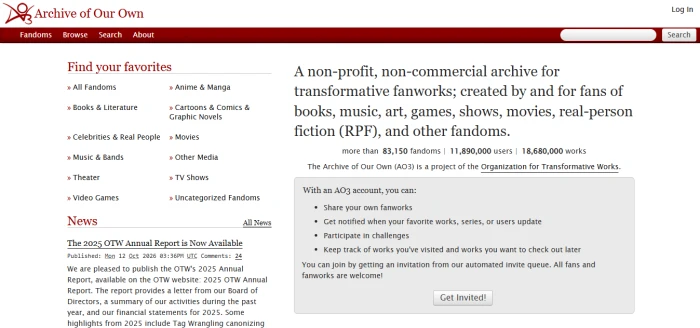
AO3 is short for Archive of Our Own, a nonprofit site built for publishing, reading, and discovering fan-made stories. Fanfiction is its bread and butter, though you will also find poetry, fanart, podfics (audio recordings of written works), and some wholly original pieces. Fanfiction takes characters, worlds, or settings that already exist and spins something new out of them. A Harry Potter reader might reimagine how the series ends, or a Marvel fan might drop the Avengers into a quiet town where nobody has powers. These are written by fans, independently, rather than commissioned by whoever owns the original.
What sets AO3 apart is its mission. It is not trying to sell you stories or turn writers into brands. It exists to collect and organize fanworks and keep them around. Most public works are readable without an account, and writers almost always post for free. The whole operation is run by the Organization for Transformative Works, a nonprofit set up to look after fan culture.
The growth is the surprising part. AO3 crossed 11 million registered users in June 2026, only a few months after passing 10 million, without any of the usual algorithmic nudging. Discovery runs entirely on tags, filters, and how you choose to sort results, so instead of waiting for software to serve you something, you go hunting for the exact character, pairing, or premise you want. Readers stay loyal for a few reasons: writers get real room to experiment, old stories remain findable long after a fandom cools, and the nonprofit structure lets the archive put fanworks ahead of ad revenue. That permanence matters most to smaller fandoms, where a story written years ago about a half-forgotten show is still sitting there, still searchable.
The story so far
AO3 began as a reaction. Fan writers were tired of trusting commercial sites that could delete stories without warning, impose new rules, or shut down overnight and take everything with them. The OTW was founded in 2007, and AO3 opened to beta users in 2009 with a blunt goal: an archive answerable to a fan-run nonprofit rather than an ad-driven company. It started tiny and climbed into the millions, and across all of that its priorities barely drifted. It never became a social network; it just kept investing in a searchable, accessible archive.
| Year | Milestone |
|---|---|
| 2007 | The Organization for Transformative Works is founded |
| 2009 | AO3 opens in open beta with 347 users and 6,598 works |
| 2019 | Wins the Hugo Award for Best Related Work |
| April 2026 | Exits open beta after 16+ years, with 10M+ users and 17M+ works |
| June 2026 | Passes 11 million registered users |
Tags, searching, and reading
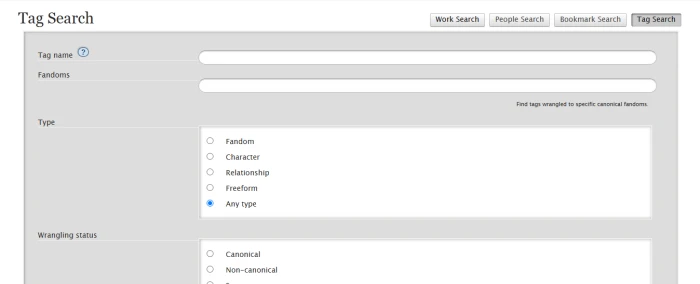
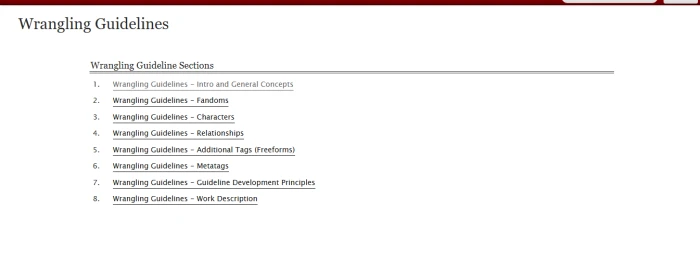
If one feature turns casual visitors into devoted users, it is the tags. A tag tells you what is inside a story before you open it, covering not just characters and relationships but genres, emotional beats, plot devices, and content you might seek out or avoid. Open a work and you might see labels like Slow Burn, Found Family, Alternate Universe, or Happy Ending. Behind the scenes, volunteers called tag wranglers link related terms together, so one relationship written half a dozen different ways still turns up under a single search. The system is not flawless: some writers bury a story under dozens of tags, others skip warnings, and AO3 even lets authors choose "Creator Chose Not To Use Archive Warnings." Treat tags as strong hints, and read the summary alongside them.
Those tags describe a huge range of storytelling. A few formats come up again and again:
| Story format | What it means |
|---|---|
| Alternate Universe (AU) | Familiar characters placed in a completely different setting |
| Canon Divergence | A changed event from the original, and the fallout that follows |
| Crossovers | Characters from different fictional worlds meeting in one story |
| Character or relationship study | A close focus on personalities, dynamics, or emotional conflict |
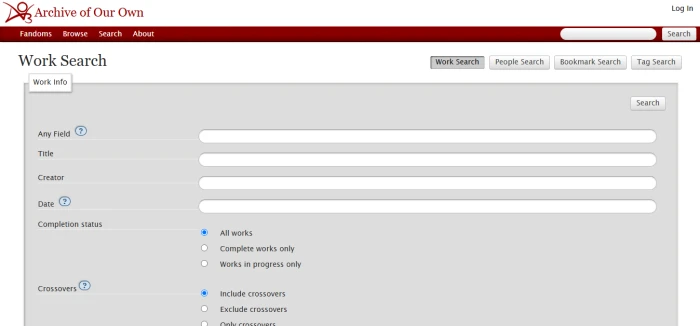
Finding something good is less about recommendations and more about knowing how to search. Say you want a finished fantasy story, in English, built around two specific characters, at least 20,000 words long. AO3 lets you stack all of those conditions at once instead of wading through noise.
| Filter | What it does |
|---|---|
| Fandom | Limits results to one fictional universe or community |
| Relationship | Finds stories built around specific character pairings |
| Word count | Separates short fiction from longer works |
| Completion status | Shows finished or still-ongoing works |
| Ratings and warnings | Screens out content categories you want to avoid |
| Sorting | Orders results by date, kudos, bookmarks, and more |
The exclusion filters are the real advantage, letting you strip out an unwanted pairing, theme, or rating without abandoning a whole fandom. One catch: sorting by kudos tends to let the same hugely popular stories crowd the top, so exploring newer works or quieter tags often surfaces better matches. Once you have found something, you can read chapter by chapter or load a whole work on one page, and most stories can be downloaded for offline reading. AO3 also has its own small vocabulary for engaging with works:
| Reader tool | What it is for |
|---|---|
| Kudos | A one-tap way to show appreciation, no words needed |
| Comments | Discussing a chapter or reaching the author directly |
| Bookmarks | Saving works to revisit (registered users) |
| Subscriptions | Getting notified when a new chapter is posted |
| Downloads | EPUB, PDF, MOBI, and HTML for reading offline |
Signing in unlocks subscriptions, reading history, and private bookmarks, though the history feature is basic next to dedicated ebook apps. The interface overall is plain rather than pretty, which takes some getting used to but keeps anything from competing with the story for your attention.
Posting, community, and content safety
AO3 makes self-publishing refreshingly low-barrier. You do not need an agent, prior credits, or an existing following. Getting in usually means requesting an invitation through AO3's invite system, after which you can create works, write summaries, set ratings, and arrange chapters however you like. Someone planning a five-part mystery can post chapter one, mark the work as in progress, and release the rest whenever it is ready, using series to link related stories and collections to group works. Subscribers get notified of updates, which is how ongoing stories build a returning audience. Posting does not guarantee a crowd, though, and AO3 bars most commercial promotion, since it is for sharing fanworks rather than running a paid-content business.
A real social culture has grown up around the archive. Readers leave comments dissecting a character's choices or guessing where the plot is headed, and authors often reply or add notes explaining their decisions. There are gift exchanges, themed collections, and prompt-based events, and writing under a pseudonym is the norm, which frees people to move between genres without building a public personal brand. It is not always harmonious; disagreements over ships, warnings, and interpretations can get heated, and blocking, muting, and comment moderation give you some control over your corner of it.
On safety, AO3 allows a wide range of fictional content, including mature and genuinely dark material. That openness is central to its purpose, but it puts some responsibility on the reader. Every work carries a rating, archive warnings flag certain sensitive themes, and additional tags fill in detail, but authors can opt out of warnings and not every upsetting subject will be labeled.
| Rating | Roughly means |
|---|---|
| General Audiences | Suitable for all readers |
| Teen And Up Audiences | Mild mature themes |
| Mature | Adult themes handled without full explicitness |
| Explicit | Fully explicit adult content |
You can browse more comfortably by checking ratings, excluding themes you would rather avoid, and reading summaries first. There are reporting tools for things like harassment that cross AO3's rules, but content some people simply find offensive is not automatically against those rules. That distinction matters for younger readers in particular: AO3 is not a walled, child-safe garden, and its filters are no substitute for parental controls.
Is AO3 legit?
Yes. Archive of Our Own is a genuine, well-established site, not a scam or a fly-by-night operation. It is run by the Organization for Transformative Works, a registered nonprofit founded in 2007 to support and preserve fan culture, and AO3 itself has been online since 2009. The archive is funded by donations rather than advertising, and in 2019 it won a Hugo Award for Best Related Work, which is a real mark of standing in the science fiction and fantasy world.
Its legal footing is clearer than many people assume. AO3 hosts noncommercial transformative fanworks, and its content policy allows any fanwork that is legal in the United States. Writers are not selling the stories, and the archive is built on the position that transformative works are a legitimate form of creative expression. The OTW even maintains a legal team devoted to defending fan creativity.
The one place legitimacy genuinely matters day to day is the web address. Because AO3 is popular, scammers have set up lookalike sites using slightly altered or disguised domain names to harvest logins or push ads and malware. The real archive lives at archiveofourown.org, and is also reachable at ao3.org and secure.ao3.org. If a site asks you to pay, log in through an unfamiliar domain, or install something just to read a story, close the tab, because the genuine AO3 never does any of that.
How AO3 handles your privacy
Privacy is one of AO3's strongest points, and it is built into how the OTW runs the site. The archive does not sell the data you post or share, and it does not carry paid third-party advertising, which removes the main reason most free sites track their users. There is no behavioral ad network quietly profiling you as you read.
You also do not have to hand over your identity. AO3 lets you register and publish under a pseudonym, so your real name never needs to appear anywhere on the site. Creating an account asks for an email address, and the archive keeps the operational data any website needs to run, but its published Privacy Policy sets out what is collected, how long it is kept, your rights under data protection laws, and the limited situations in which information is shared.
| Privacy question | Where AO3 lands |
|---|---|
| Does it sell your data? | No, selling user data to third parties is not part of how it operates |
| Does it run third-party ads? | No, there is no paid advertising and no ad-tracking |
| Can you stay anonymous? | Yes, pseudonyms are standard and your legal name is not required |
| What does it collect? | An email for your account plus basic operational data, as set out in its Privacy Policy |
| Can you delete your account? | Yes, account termination and data retention are covered in the policy |
None of this makes AO3 invisible. Anything you post publicly is public, comments are tied to your username, and logged-in reading history is stored if you leave it switched on. But compared with the typical ad-funded platform, AO3 asks for little and monetizes none of it.
Account safety and security
On the technical side, AO3 is reasonably solid, and its track record is reassuring rather than alarming. The site runs over an encrypted HTTPS connection, and across its long history it has not suffered any publicly known breach of user data.
The one incident worth knowing about was a distributed denial-of-service attack in July 2023, when a group calling itself Anonymous Sudan flooded the archive with traffic and knocked it offline for more than a day. The attackers demanded a 30,000 US dollar ransom in Bitcoin, which the OTW did not pay, and the team restored the site after strengthening its defenses. A DDoS is a traffic flood rather than a hack of stored data, and AO3 confirmed at the time that no user information was compromised and that there was no need to change passwords.
That distinction is the key point for your own safety. The biggest risk to your AO3 account is not the archive being breached, but ordinary account hygiene and phishing. A few sensible habits cover most of it.
| Risk | How exposed you are | What to do |
|---|---|---|
| Data breach of the site | Low, no known breach to date | Nothing special, AO3 stores little about you |
| Service outage | Occasional, as with the 2023 DDoS | Wait it out, do not hunt for mirror sites |
| Phishing and fake sites | The main real threat | Only log in at archiveofourown.org |
| Weak or reused password | Up to you | Use a unique, strong password |
Account access still relies on a password rather than app-based two-factor login, so a strong, unique password matters more here than on sites that offer extra login protection.
Content safety and warnings
This is where "safe" depends entirely on what you mean. AO3 deliberately allows a very wide range of fiction, including mature, explicit, and genuinely dark themes, as long as a work is legal in the United States. That openness is central to the archive's purpose, but it means the site is not curated for comfort, and some stories carry content many readers would find upsetting.
The archive manages this with a rating and warning system rather than removal. Every work gets a rating, archive warnings flag certain sensitive themes, and additional tags fill in the detail.
| Rating | Roughly means |
|---|---|
| General Audiences | Suitable for all readers |
| Teen And Up Audiences | Mild mature themes |
| Mature | Adult themes handled without full explicitness |
| Explicit | Fully explicit adult content |
The catch is that the system depends on authors using it honestly. Writers are allowed to choose "Creator Chose Not To Use Archive Warnings," and not every upsetting detail will be tagged, so the labels are a strong guide rather than a guarantee. You can make browsing far safer by filtering out ratings and themes you want to avoid, reading the summary and tags before opening a work, and using the block and mute tools on accounts you would rather not see.
One point deserves to be stated plainly: AO3 is not a child-safe environment. It does not screen for age at the content level, explicit material is freely accessible, and its filters are no substitute for parental supervision. Parents should treat it as an adult-accessible site, not a children's reading app.
What readers actually say
Outside opinion is worth a look. On Trustpilot the review pool is small, so the numbers below are a rough snapshot rather than a verdict on overall satisfaction. Based on 25 ratings at the time of writing, the split skews toward the extremes:
| Rating | Share of reviews |
|---|---|
| 5 stars | 52% |
| 1 star | 28% |
| Everything in between | 20% |
Reddit discussions are more specific. Praise tends to land on the search filters, download options, the absence of ads, and the ability to find very particular kinds of stories, with tagging repeatedly singled out as the standout strength. Complaints center on managing long tag lists, navigating tangled crossover categories, and a learning curve that feels steep next to polished commercial apps. The reviews below capture those recurring themes; they are a representative sampling of the sentiment that shows up across these platforms rather than quotes tied to specific named users.
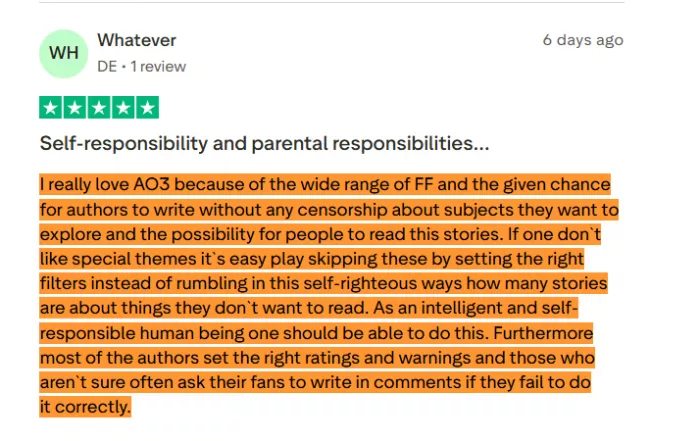
What fans love:
| Rating | Reviewer | What they said |
|---|---|---|
| ★★★★★ | Longtime reader | A relief to finally have a stable archive; once you learn the filters, you find the exact story you want in minutes |
| ★★★★★ | Daily commuter | No ads and no paywall, and downloads make offline reading easy |
| ★★★★★ | Hobby writer | The creative freedom is the whole point, and thoughtful readers find niche work through the tags |
| ★★★★☆ | Returning user | Best-in-class tagging; the only downsides are the invite wait and the bare interface |
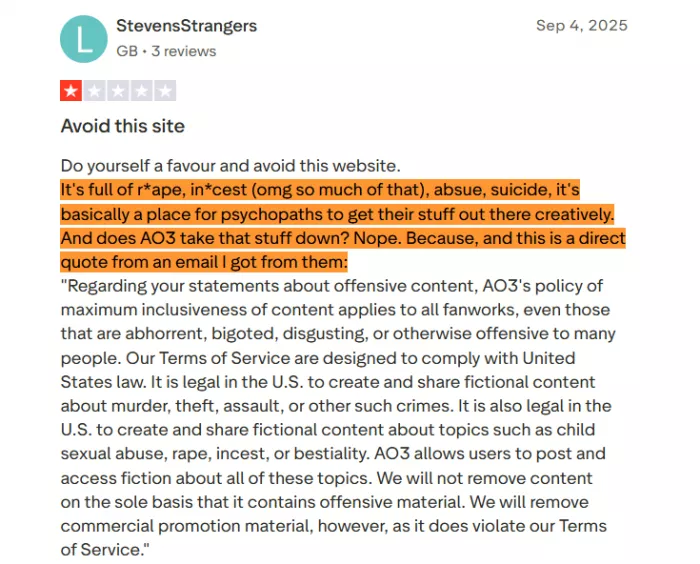
Where it frustrates people:
| Rating | Reviewer | What they said |
|---|---|---|
| ★★☆☆☆ | New reader | The learning curve is real and feels overwhelming next to a simple feed |
| ★☆☆☆☆ | Cautious reader | Skipped warnings can lead to unwanted content, since filters only work when people tag honestly |
| ★★☆☆☆ | Casual browser | Long tag lists and tangled crossover categories are hard to navigate |
| ★☆☆☆☆ | Former lurker | Account and invite problems at the start, and community debates that turn heated fast |
The pattern is consistent: the same depth and openness that power users celebrate are exactly what newcomers find intimidating, and the hands-off content policy reads as freedom to some and risk to others.
AO3 vs Wattpad
People often compare the two, since both let you read and share stories online, but they are built for different things. Wattpad leans commercial and social and suits writers growing an audience around original fiction; AO3 leans toward the archive and suits readers who already know the characters, pairings, or themes they want. Neither promises better writing, as both host the full spectrum from first-timers to seasoned authors.
| Feature | AO3 | Wattpad |
|---|---|---|
| Main focus | Fanworks and fandom archives | Original fiction and social storytelling |
| Discovery | Detailed tags and search filters | Search and recommendations |
| Business model | Nonprofit, donation-supported | Commercial platform |
| Monetization | No paid-story marketplace | Select creator monetization programs |
| Reading experience | Archive-focused | Social-reading focused |
| Best for | Readers with specific fandom interests | Readers exploring broader fiction |
How to stay safe on AO3
A few simple habits cover almost every risk on the archive:
• Check the address bar. Only log in at archiveofourown.org, ao3.org, or secure.ao3.org, and ignore lookalike domains that use odd spellings or extra words.
• Use a unique, strong password. Since AO3 relies on password login, do not reuse a password from another account, and consider a password manager.
• Never pay or install anything to read. The real AO3 is free and asks for no payment and no downloads, so any site that does is not AO3.
• Set your content filters. Exclude the ratings, warnings, and tags you want to avoid so explicit or dark works do not appear unexpectedly.
• Read the tags and summary first. Treat them as your early-warning system, especially on works that opted out of archive warnings.
• Keep personal details out of your profile and comments. A pseudonym only protects you if you do not reveal who you are elsewhere on the site.
• Supervise younger readers. Because the archive is not age-screened at the content level, treat it as an adult-accessible site.
Verdict: is AO3 safe and legit?
For most adult readers, AO3 is both safe and completely legitimate. It is a long-running nonprofit with a genuine mission, it does not sell your data or bombard you with ads, it has no known history of leaking user information, and it handled its one serious security incident openly. The things that can go wrong are mostly within your control.
| Reassuring | Worth caution |
|---|---|
| Legitimate nonprofit, free, and donation-funded | Content is uncurated and includes explicit material |
| Strong privacy stance, with pseudonyms and no data selling | Not a child-safe environment on its own |
| No known data breach, and the 2023 DDoS compromised no data | Lookalike scam sites try to impersonate it |
| Encrypted connection and transparent incident handling | Password-only login, so your password hygiene matters |
So the honest answer is yes, with conditions. AO3 is safe and legit as a nonprofit platform, and whether it is safe for a particular reader comes down to age, content filters, and sticking to the real web address. If you are an adult who sets your filters and watches the address bar, you can use it with confidence.