
Here is the uncomfortable truth most marketing teams are only now waking up to: your page can sit at position one on Google, and the moment someone asks ChatGPT, Gemini, or Google AI Mode the same question, your brand may not exist.
That gap has a name. It is called AI visibility, and in 2026 it has quietly become the metric that decides who gets recommended, who gets cited, and who gets forgotten.
Quick Answer (TL;DR)
- AI visibility is how often, how prominently, and how positively your brand appears in AI-generated answers on platforms like ChatGPT, Google AI Overviews, AI Mode, Gemini, Perplexity, and Copilot.
- It is not the same as SEO rankings. Only a fraction of pages ranking on Google's first page get pulled into AI answers.
- The core metrics are mentions, citations, share of voice, position, sentiment, accuracy, and AI referral traffic.
- You can measure it manually with a prompt list and a spreadsheet, with the free AI reports in Google Search Console and Bing Webmaster Tools, or at scale with dedicated AI visibility tools
- The fastest way to improve it: answer real questions directly, publish original data, structure content for extraction, and earn mentions on sources AI already trusts.
What Is AI Visibility?
AI visibility is the measure of how present your brand is inside the answers that AI systems generate. Three questions sit at its core:
- Does the AI mention you at all when someone asks about your category?
- Does it cite your website as a source, with a clickable link?
- How does it describe you, and where do you sit compared to competitors?
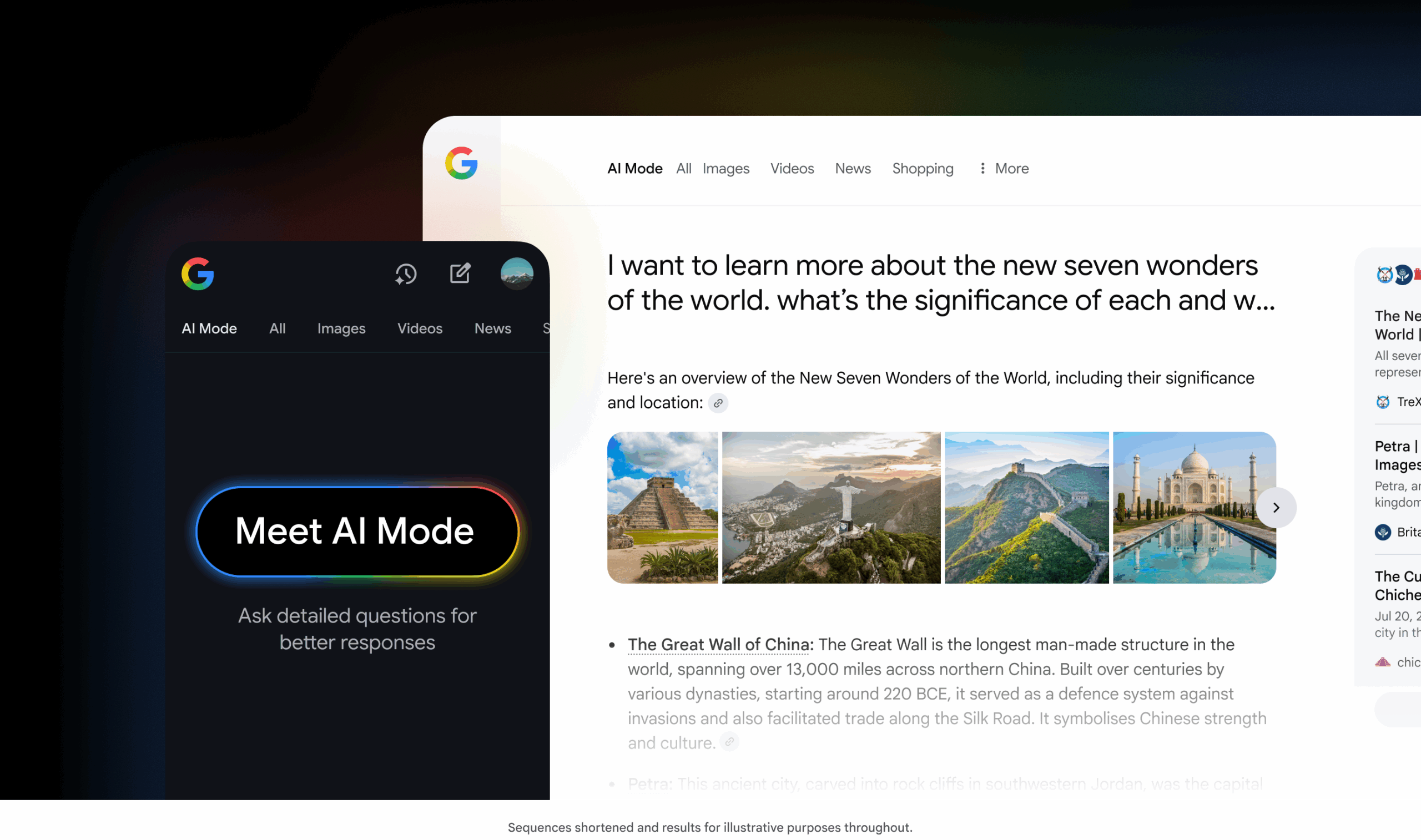
Picture a buyer typing "best project management software for small agencies" into ChatGPT. The answer names five tools, summarizes each, and links to a few review sites. If you are one of those five, you have AI visibility. If you are not, that buyer may never discover you, no matter how well your landing page ranks on Google.
The broader discipline of earning that presence is often called generative engine optimization (GEO). GEO is one of the names given to the practice of structuring digital content and managing online presence to improve visibility in responses generated by generative AI systems, and related terms include answer engine optimization (AEO) and artificial intelligence optimization (AIO). You can read the full background on Wikipedia's generative engine optimization page.
One important distinction: AI visibility is the outcome you measure. GEO is the work you do to improve it.
Why AI Visibility Matters in 2026 (The Numbers Are Hard to Ignore)
For a few years, "AI search" was something marketers could file under "watch this space." That window closed in 2026.
AI search went mainstream
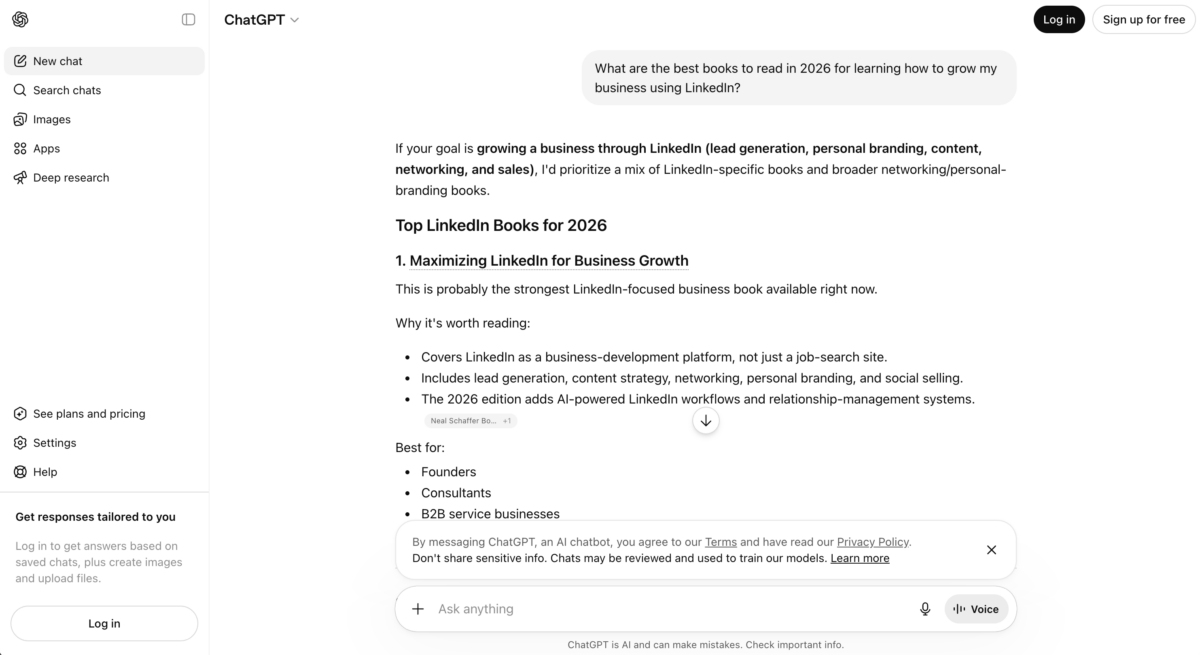
Google reports that AI Mode has surpassed a billion monthly active users globally, and AI Mode queries have more than doubled every quarter since launch. At the same event, Google revealed that the broader AI Overviews feature now reaches 2.5 billion users globally.
On the chatbot side, ChatGPT boasts over 900 million weekly active users as of February 2026, up from 500 million in March 2025. By mid-year, OpenAI's app crossed 1 billion global monthly active users, roughly three years after launch, according to estimates from Sensor Tower.
That is billions of people getting answers instead of links.
People ask AI different questions
This is the part most guides miss. AI search is not just Google with a chat window. According to Google's own data, the average AI Mode search is triple the length of a traditional Search query, and AI Mode queries related to planning have grown faster than AI Mode queries overall by 80% in the past 6 months. You can read the full breakdown in Google's report on how AI Mode is changing search.
Longer, more specific, more decision-oriented questions. Exactly the kind of query where a brand recommendation carries real weight.
Ranking on Google does not guarantee AI citations
A widely shared 2026 analysis compared the pages ranking in Google's top 10 with the pages cited by four AI platforms. Only 44.3% of the pages ranking in Google's top 10 traditional search results appeared in at least one AI-generated answer, and the overlap with ChatGPT was just 2.1%.
Read that again. Fewer than half of top-ranking pages made it into any AI answer, and almost none made it into ChatGPT.
The traffic that does come through is worth more
Fewer clicks, but better ones. Google notes that when people click from search results pages with AI Overviews, these clicks are higher quality, meaning users are more likely to spend more time on the site. Semrush's own research goes further, estimating that AI search visitors convert 4.4x better than traditional organic search visitors, likely because AI visitors arrive having already researched their options.
Back in 2024, Gartner predicted traditional search engine volume would drop 25% by 2026 as search marketing lost share to AI chatbots and virtual agents. Whether or not the exact figure lands, the direction is no longer in dispute.
AI Visibility vs. Traditional SEO: What Actually Changed

SEO is not dead. It is the foundation AI visibility is built on. But the scoreboard looks different.
| Traditional SEO | AI Visibility | |
|---|---|---|
| Goal | Rank a page in the top 10 | Get mentioned or cited inside the answer |
| Unit of competition | Keyword | Prompt (often long and conversational) |
| Output | A list of links | One synthesized answer with a few sources |
| Winning signal | Position 1 to 3 | Being one of the handful of brands named |
| Key metrics | Rankings, clicks, CTR | Mentions, citations, share of voice, sentiment |
| Stability | Rankings shift slowly | Answers can change prompt to prompt and day to day |
| Off-site influence | Backlinks | Mentions across reviews, forums, news, and listicles |
| Tracking | Search Console, rank trackers | Prompt tracking, AI referral analytics, visibility tools |
The practical takeaway: a brand with strong SEO and weak AI visibility is leaving a growing share of buyers on the table. The two need to be tracked side by side.
The 7 AI Visibility Metrics That Actually Matter
Not every number a dashboard shows deserves your attention. These seven are the ones that connect to real outcomes.
1. Mention rate
The percentage of tracked prompts where your brand appears in the answer at all. This is your baseline. If you are mentioned in 12 out of 100 prompts, your mention rate is 12%.
2. Citation rate
The percentage of answers that include a link to your domain. Mentions build awareness. Citations build traffic and trust. Track them separately, because a brand can be named frequently without ever being linked.
3. Share of voice
Your mentions as a share of all brand mentions across your tracked prompts. If AI answers name five brands and you appear in 20% of those slots, your share of voice is 20%. This is the number to benchmark against competitors.
4. Position
Where you appear when you are mentioned. First in a list of recommendations is not the same as fifth. Many AI answers lead with a "best overall" pick, and that slot carries disproportionate weight.
5. Sentiment
Is the AI describing you as "a reliable, well-reviewed option" or "a budget tool with limited support"? Sentiment analysis across hundreds of answers reveals what the models believe about you.
6. Accuracy
Are the facts right? Wrong pricing, outdated features, or a discontinued product described as current can quietly cost you deals. Accuracy tracking is the metric most teams forget until it bites.
7. AI referral traffic and conversions
Google now offers a dedicated report. Google announced the launch of new Search Generative AI performance reports in Search Console, including dedicated reports for Search and Discover, to help site owners understand their visibility within generative AI features on Search. Read the full announcement on the Google Search Central blog. Note that this report shows impressions only; clicks from AI Overviews and AI Mode are still counted inside your overall Web totals.
Microsoft went a step further. AI Performance in Bing Webmaster Tools shows how publisher content appears across Microsoft Copilot, AI-generated summaries in Bing, and select partner integrations, and Microsoft describes it as an early step toward Generative Engine Optimization tooling. Details are in Microsoft’s Bing Webmaster blog announcement.
Chatbot traffic from ChatGPT, Perplexity, and Claude still shows up as referral traffic in your analytics platform, so you need both sources to see the full picture.
A note on standards. Measurement in this space is young, and that creates noise. The IAB points out that more than 20 companies now sell AI visibility measurement tools, each using different methodologies that can produce different answers for the same brand or publisher. Their framework introduces the idea of "decision-grade" versus "directional" data. Treat any single tool's score as directional until you have validated it against your own prompt tests.
How to Measure AI Visibility: A Step-by-Step Process
You do not need a six-figure platform to get started. Here is a process that works at any budget.
Step 1: Pick the platforms your audience actually uses
Do not try to track everything on day one. Start with the two or three that matter for your market:
- Google AI Overviews and AI Mode (largest reach, pulls heavily from Google's index)
- ChatGPT (largest standalone chatbot audience)
- Perplexity (citation-heavy, popular with researchers and B2B buyers)
- Gemini, Claude, and Microsoft Copilot (worth adding once the basics are covered)
A quick shortcut: open your analytics and look for referrals from AI domains. Wherever traffic is already trickling in, start there.
Step 2: Build a prompt list that mirrors real buyer questions
Prompts are the new keywords. Build a list of 30 to 100 that cover the full journey:
- Discovery: "What is [category]?" "How does [solution] work?"
- Comparison: "Best [category] tools for [audience]" "[Your brand] vs [competitor]"
- Decision: "Is [your brand] worth it?" "[Your brand] pricing and reviews"
- Problem-led: "How do I fix [pain point your product solves]?"
Pull inspiration from support tickets, sales call notes, Google's People Also Ask boxes, and the top threads in relevant subreddits. Write them the way a human would type them, in full sentences.
Step 3: Run the prompts and log the results
For each prompt on each platform, record:
| Column | What to log |
|---|---|
| Prompt | The exact question asked |
| Platform | ChatGPT, AI Mode, Perplexity, etc. |
| Date | AI answers drift, so always timestamp |
| Mentioned? | Yes / No |
| Cited? | Yes / No, plus the URL cited |
| Position | Rank in the list, if listed |
| Competitors named | Every other brand in the answer |
| Sentiment | Positive / Neutral / Negative |
| Accuracy issues | Any wrong facts |
Pro tip: AI answers vary between runs. Run each prompt two or three times and record the average. One lucky mention is not visibility.
Step 4: Calculate your baseline
From your spreadsheet, compute mention rate, citation rate, share of voice, and average position. This is your starting line. Everything from here is measured against it.
Step 5: Add AI referral tracking in analytics
In GA4, create a channel group or a custom segment for AI referrers (chatgpt.com, perplexity.ai, copilot.microsoft.com, gemini.google.com, claude.ai). Tag conversions.
Then switch on the free first-party reports: open the Generative AI performance report in Google Search Console to see which pages are appearing in AI Overviews and AI Mode, and verify your site in Bing Webmaster Tools to see citation counts across Copilot. Both are free, and together they give you platform-side data that no third-party tool can replicate.
Now you can connect visibility to revenue, which is the only conversation your CFO cares about.
Step 6: Repeat on a schedule and track the trend
Weekly for competitive categories, monthly at minimum. Visibility is a trend line, not a snapshot. Watch for competitors gaining ground on prompts you used to own, new prompts where nobody from your market shows up yet, and sudden sentiment shifts after a product launch or PR moment.
Step 7: Scale with a dedicated tool when the spreadsheet breaks
Manual tracking works up to roughly 50 prompts on two platforms. Beyond that, a tool pays for itself in hours saved.
Best AI Visibility Tools in 2026
There is no single best tool, only the best fit for your budget and team size. Here is a quick comparison of popular options.
| Tool | Best for | Standout feature | Starting price |
|---|---|---|---|
| Google Search Console (Generative AI report) | Every site owner | Official impressions data for AI Overviews and AI Mode | Free |
| Bing Webmaster Tools (AI Performance) | Every site owner | Official citation counts across Copilot and Bing AI answers | Free |
| Semrush AI Visibility Toolkit | Teams already using Semrush for SEO | Prompt tracking plus actionable recommendations | ~$99/month |
| Profound | Enterprise marketing teams | Deep analytics and custom research agents | ~$99/month |
| Peec AI | Agencies with multiple clients | Unlimited user seats | ~$95/month |
| Athena HQ | Ecommerce brands | Google Analytics, Search Console, and Shopify integrations | ~$295/month |
Prices change often, so confirm on each vendor's site. And remember the IAB's warning: different tools will give you different numbers. Pick one, stay consistent, and validate with manual checks.
How to Improve AI Visibility: 8 Proven Tactics
Measuring is step one. Here is what moves the needle.
1. Answer the question directly, then elaborate
Open every section with a clear, quotable answer. AI systems extract passages, not pages. A heading that asks the question and a first sentence that answers it is the single highest-leverage formatting change you can make.
2. Put a summary or comparison table at the top
A 2026 test on five tool listicles found that adding a comparison table at the top of each page delivered a 16.1% increase in citations across all models and a 21.6% boost in ChatGPT. TL;DR boxes work the same way.
3. Publish original data and first-hand experience
AI systems prefer sources that add something new. Surveys of your customers, internal benchmarks, case studies with real numbers, and documented experiments give models a reason to cite you instead of the generic page next door.
4. Keep content fresh
Nearly 90% of pages crawled by AI bots were published within the last three years, according to a Seer Interactive study. Refresh your cornerstone pages, update dates and stats, and prune content that no longer reflects reality.
5. Get the technical basics right
Google's official guidance is refreshingly simple. Ensure that crawling is allowed in robots.txt and by any CDN or hosting infrastructure, make your content easily findable through internal links, and provide a great page experience for users. The full checklist is in Google's guide to AI features and your website.
Also worth knowing: no special file is required to appear in AI search results, and Google's advice is to organize content for your human audience with clear paragraphs, logical sections, and descriptive headings rather than contorting your structure around AI systems. Google's dedicated guide to optimizing for generative AI features goes deeper on this.
6. Earn mentions on the sources AI already trusts
Models learn about brands from the wider web: review sites, industry publications, Reddit threads, YouTube, LinkedIn, and news coverage. A brand mentioned consistently across credible third-party sources shows up in answers far more often than one that only talks about itself.
7. Keep your brand story consistent everywhere
If your homepage, G2 profile, LinkedIn page, and Crunchbase entry each describe you differently, AI systems stitch together a confused picture. Audit every owned and third-party profile and align the core message.
8. Use structured data and clear entity signals
Schema markup for products, organizations, FAQs, and reviews helps machines understand exactly what you are, what you sell, and who vouches for you.
5 Common AI Visibility Mistakes to Avoid
- Treating one answer as proof. A single mention in a single chat session is noise. Track across prompts, platforms, and time.
- Chasing "GEO hacks." Keyword stuffing for LLMs, hidden text, and fake "AI-optimized" files do not work and can hurt you in regular search.
- Ignoring sentiment and accuracy. Being mentioned with the wrong pricing or a negative framing can be worse than not being mentioned.
- Measuring visibility without measuring revenue. Connect AI referrals to conversions or the program will be the first thing cut.
- Abandoning SEO. AI systems, especially Google's, still lean heavily on traditional search signals. Strong SEO is the entry ticket.
Final Thoughts: The Brands That Measure First Will Win First
AI visibility in 2026 is where SEO was in 2010: wide open, poorly measured, and about to become the main event. The brands that build a prompt list this week, log a baseline this month, and improve it every quarter will own the recommendations their competitors are still trying to understand.
Start simple. Pick ten prompts your buyers actually ask. Run them through ChatGPT and Google AI Mode today. If your brand is missing, you have found your biggest growth opportunity for the year.
And if it is there? Now you know what to protect.