What Peec AI does well
Peec AI is a Berlin based AI search analytics platform. It runs a set of prompts every day across AI assistants, records whether your brand is mentioned, where you rank in the answer, how the answer talks about you, and which websites the assistant cited.
Its core engines are ChatGPT, Perplexity, Gemini, Microsoft Copilot, Google AI Overviews and Google AI Mode. Every self serve plan lets you track three of those at a time. Extra engines are paid add ons, and Claude sits behind the custom Enterprise tier.
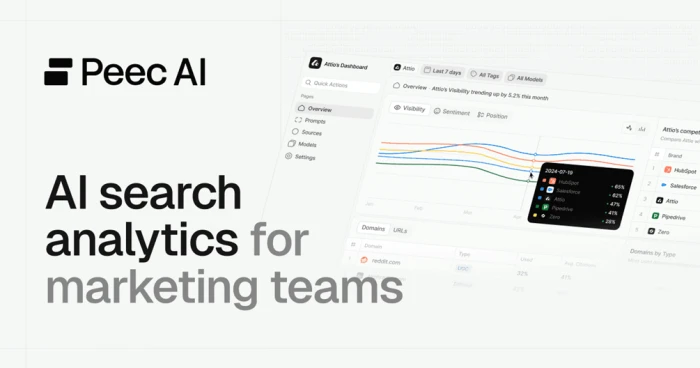
Peec AI positions itself as AI search analytics for marketing teams. Image source: peec.ai
The things people consistently praise are easy to list. The dashboard is quick to read. Every paid plan includes unlimited user seats. Multilingual and country level tracking is included at no extra prompt cost. Sentiment scoring is among the best in the category. There is a Looker Studio connector, a CSV export, and a native MCP server that pipes visibility data into tools like Claude and n8n.
Pricing is public. As of August 2026 the self serve plans are Starter at $95 per month for 50 prompts, Pro at $245 for 150 prompts, and Advanced at $495 for 350 prompts. Annual billing takes about 15 percent off, and there is a 7 day free trial with no card required. You can confirm current figures on the Peec AI pricing page.
In short, Peec is a focused monitoring product. It measures and benchmarks. It does not write content, audit your site, or change what AI crawlers see. That focus is exactly why some teams love it and why others go looking elsewhere.
Why teams look for a Peec AI alternative
Most Peec customers are not unhappy with the product. They hit a wall that the product was never designed to clear. The five reasons below come up again and again in reviews, on G2, and in threads on r/GEO_optimization.
The three engine cap
Starter, Pro and Advanced all track three AI models at once. Moving up a tier raises prompts and projects but not engines. A team that wants ChatGPT, Perplexity, Gemini, Copilot and AI Overviews together pays for add ons on every plan, which changes the real monthly cost quite a bit.
Claude and DeepSeek are Enterprise only
For B2B software, developer tools and finance, Claude users can be a high value audience. Peec keeps Claude behind a sales conversation. Several alternatives include it on a self serve plan or as a priced add on you can switch on yourself.
Monitoring stops at the dashboard
Peec tells you where you are missing. Someone still has to write the comparison page, fix the schema, pitch the publisher and measure the change. Peec's Actions feature helps prioritise that work, but it does not produce content or push changes to your site.
No prompt volume data
Peec tracks the prompts you enter. It does not estimate how many people are actually asking each question. Tools built on large prompt databases can tell you which questions are worth chasing before you spend a single content dollar.
API and reporting live at the top
API access is Enterprise only. The Looker Studio connector starts on the $495 Advanced plan. Agencies also miss white label reporting, which Peec does not offer at any tier.
A fair caveat: none of these are bugs. Peec is deliberately a pure play tracker. If you want clean daily measurement, unlimited seats and strong sentiment data, it remains one of the best options. This guide is for teams whose needs have moved past that scope.
3. How we picked these five tools
There are at least sixteen products that now call themselves Peec AI alternatives. We narrowed the list to five using six tests. Every tool below passes all six, and each one answers a different reason for leaving Peec.
• Engine coverage. The tool must track at least four major AI surfaces on a plan a normal team can buy, or offer a clear path to nine or more.
• Data depth. It must capture mentions, answer position, cited sources and competitor share, not just a yes or no on brand presence.
• Actionability. It must do at least one thing Peec does not: prompt demand data, content generation, site audits, or crawler level fixes.
• Pricing transparency. A published entry price with clear prompt and seat limits. Custom quote only products were excluded.
• Fit for a real team size. The list deliberately spans a $29 plan and an enterprise platform, so a solo marketer and a 40 person SEO team both find a match.
• Integrations. Exports, Looker Studio, GA4 or an API, so the numbers can leave the tool and reach the people who fund the work.
All pricing was read from vendor pages and cross checked against independent 2026 reviews between August and early September 2026. Tiers in this category move often, so treat every figure as a starting point and confirm on the vendor's own page before you buy.
4. Quick comparison of the five alternatives
Use this table to shortlist. The detailed sections that follow explain the trade offs behind each row.
| Tool | Entry price | Engines on entry plan | Standout capability | Best for |
|---|---|---|---|---|
| Peec AI (baseline) | $95 per month, 50 prompts | Pick 3 of 6 | Sentiment scoring, unlimited seats, MCP server | Teams that want clean daily tracking and nothing else |
| Profound | $99 per month billed annually, 50 prompts | ChatGPT only. Growth at $399 adds Perplexity and AI Overviews | Prompt volume data, crawler analytics, content agents | Enterprise and growth stage brands with a dedicated AEO owner |
| Ahrefs Brand Radar | $199 per month per AI index, plus an Ahrefs plan from $129 | 1 index per $199, or all 6 for $699 | Prompt database in the hundreds of millions, long history | SEO teams already paying for Ahrefs |
| Semrush AI Visibility Toolkit | $99 per month per domain billed annually, 25 prompts | ChatGPT, Google AI Overviews and AI Mode, Gemini, Perplexity | AI Visibility Score and prompt research beside classic SEO | Semrush users who want AI and SEO reporting in one place |
| Otterly.AI | $29 per month, 15 prompts | ChatGPT, AI Overviews, Perplexity, Copilot | GEO site audit, unlimited seats on every tier, 50 plus countries | Small teams and agencies starting on a budget |
| Scrunch AI | $300 per month, or $250 billed annually | ChatGPT, Perplexity, AI Overviews, Copilot. Enterprise adds 5 more | Agent Experience Platform that changes what AI crawlers receive | Brands whose sites AI crawlers cannot read properly |
The 5 best Peec AI alternatives
Each tool gets the same treatment: what it is, how the key features work, what it costs, where it beats Peec, and where Peec still wins.
Profound
Best enterprise grade alternative
Profound is the platform most often named alongside Peec, and it sits one rung up the market. It tracks how AI answer engines mention and cite your brand, then layers on demand data, crawler analytics and content agents so the same team can act on what it finds. G2 named it a Leader in its first Answer Engine Optimization report in Winter 2026, and the company has raised $58.5 million, including a Sequoia led Series B.
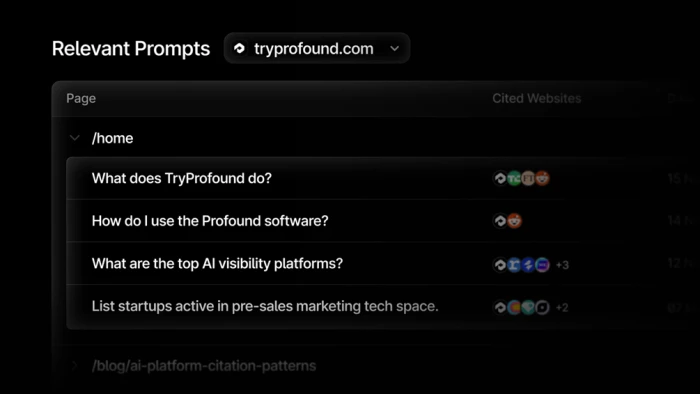
Profound maps prompts to the specific pages AI engines cite. Image source: tryprofound.com
How the key features work
Answer Engine Insights is the tracking core. It runs your prompts daily, records mentions, citations, sentiment and share of voice against competitors, and keeps a time series so you can tie a visibility change to a content release, a PR push or a model update.
Conversation Explorer is the feature no direct rival matches. It estimates how often real people ask each prompt, so you can rank opportunities by demand rather than guessing. This turns AI visibility from a vanity score into an input for content planning.
Agent Analytics tracks the AI bots themselves. Once connected to Cloudflare, Vercel, Akamai, AWS or Netlify, it shows which crawlers hit which pages and how often, which tells you whether your content is even being fetched before you worry about whether it is cited.
Agents use a credit system to research and draft citation ready content from the gaps the tracker finds. The Growth plan includes 400 credits a month. Output is not a fixed article count because complex briefs consume more credits.
Shopping tracks product level visibility inside ChatGPT shopping results, which matters for ecommerce brands that Peec only started serving with its June 2026 shopping analytics.
| Starter | $99 per month billed annually. ChatGPT only, 50 prompts, 1 seat, 100 Agent credits. |
| Growth | $399 per month billed annually. ChatGPT, Perplexity and Google AI Overviews, 100 prompts, 3 seats, 400 Agent credits. 7 day free trial available on this tier. |
| Enterprise | Custom. Nine or more engines including Claude, Gemini, Grok, Copilot, Meta AI and DeepSeek, multi company tracking, SSO and SAML, SOC 2, 24 hour support SLA. |
| Agencies | Separate agency plans from $99 with client workspaces and pitch audits as add ons. |
| Website | tryprofound.com/pricing |
Where it beats Peec AI Prompt volume estimates tell you which questions are worth chasing. Crawler analytics show whether AI bots reach your content at all. Content agents close the gap between insight and a published page. Enterprise tier reaches nine or more engines, including Claude. The most developed historical view in the category for long term reporting. | Where Peec AI still wins Peec's $95 plan covers three engines. Profound's $99 plan covers one. Peec includes unlimited seats. Profound Starter includes one. Meaningful multi engine coverage on Profound starts at $399. Peec is easier to learn. Profound rewards a dedicated AEO owner. Peec includes multi country tracking earlier and at lower cost. |
| Verdict: choose Profound when AI search is a funded channel with an owner, and the budget starts at $399 a month. The Starter plan is only sensible if ChatGPT is the single surface you care about. |
Ahrefs Brand Radar
Best for SEO teams already on Ahrefs
Brand Radar is the AI visibility layer inside Ahrefs. Instead of only re running your own prompt list, it works from Ahrefs' indexes of AI answers, built on a prompt database that Ahrefs puts in the hundreds of millions. That gives it two things dedicated trackers struggle with: breadth across an entire market, and a long history you can chart back over months.
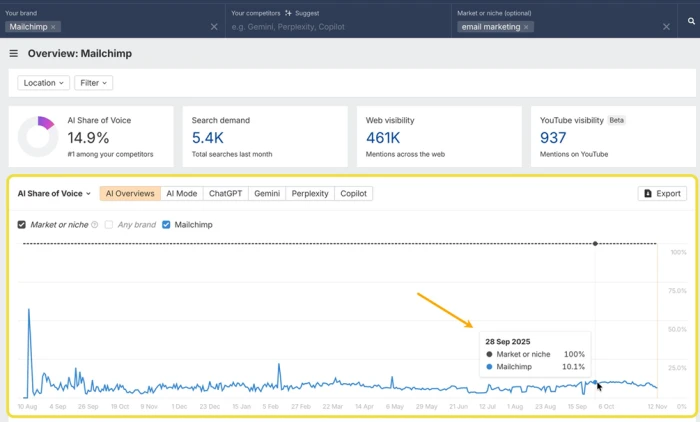
Brand Radar overview combining AI share of voice, search demand and web mentions. Image source: ahrefs.com/blog
How the key features work
Four core metrics. Mentions count how often AI names you. Citations show which URLs the answer linked. Impressions weight each mention by estimated search demand. AI Share of Voice expresses your slice of the category conversation. You can flip between them per engine or across all platforms.
Flexible queries. Because the whole prompt index is exposed, you can build filters like "answers that mention my brand but cite a competitor's site" to find authority gaps, or "prompts about a topic where competitors get cited and we do not" to find content gaps.
Search demand and web visibility side by side. The same view shows classic search volume, web mentions and YouTube mentions, so a brand can see whether AI visibility is tracking with or diverging from the rest of its footprint.
Custom prompts. You can add your own prompts and Brand Radar re runs them so week over week movement shows up. Default allowance is around 2,500 prompt checks a month, where one check equals one prompt on one engine in one location.
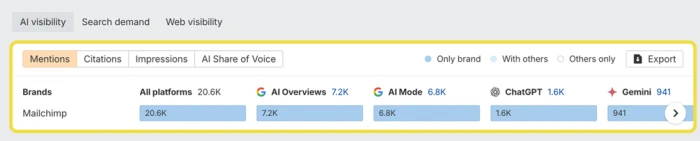
Mentions broken out per AI platform inside Brand Radar.
| Base requirement | An active Ahrefs plan. Lite starts at $129 per month. |
| AI indexes | $199 per month per platform, or $699 per month for all six: Google AI Overviews, Google AI Mode, ChatGPT, Perplexity, Gemini and Copilot. |
| Video and social module | YouTube, TikTok and Reddit tracking, priced at an additional $199 per month after beta. |
| Realistic all in | Around $828 per month for full six engine coverage on Lite, more on higher Ahrefs tiers. |
| Free trial | None for new customers. |
| Website | ahrefs.com/brand-radar |
Where it beats Peec AI Market wide research without hand building every prompt. Six engines available on any Ahrefs tier, not gated to Enterprise. Historical, longitudinal data going back further than most trackers. Search demand, backlinks and AI visibility in one login. YouTube, TikTok and Reddit visibility, which Peec does not track. | Where Peec AI still wins Peec's full price for three engines is a fraction of $828. Peec offers a free trial. Brand Radar does not. No Claude tracking on Brand Radar at any price. Independent tests have flagged undercounting on ChatGPT mentions. Peec's sentiment scoring is more developed. |
| Verdict: if your SEO team already pays for Ahrefs Standard or above, Brand Radar is the lowest friction route into AI tracking and a research database nobody else matches. As a standalone tracker, the stacked pricing is hard to justify. |
Semrush AI Visibility Toolkit
Best for unified SEO and AI reporting
Semrush treats AI visibility as a product layer rather than a checkbox. The AI Visibility Toolkit has its own reports, its own pricing and a prompt index of about 126 million prompts in the 2026 build. Adobe completed its acquisition of Semrush in April 2026, which validates the category and also means packaging may shift as the product folds into a larger suite.
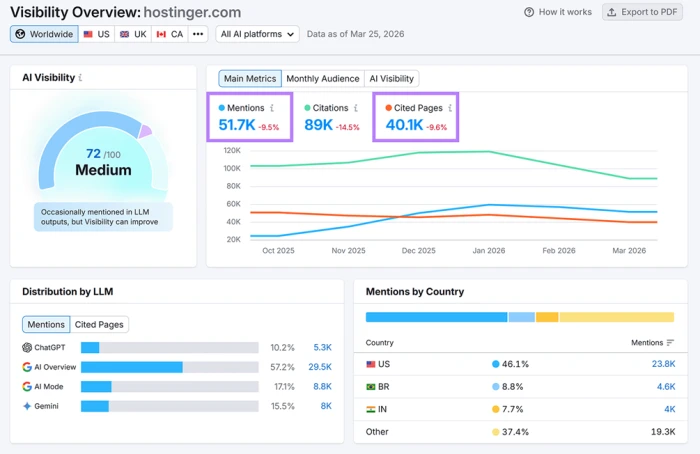
The Visibility Overview report with the AI Visibility Score, mentions trend and distribution by LLM.
How the key features work
AI Visibility Score. A single 0 to 100 score that rolls mentions, citations and cited pages into a Low, Medium or High rating. It is the number most stakeholders will actually remember, and it moves as you improve.
Prompt research with volume and intent. Semrush attaches estimated AI volume and intent labels to prompts, so you can prioritise questions the way you already prioritise keywords. Each prompt can be pushed to daily monitoring with one click.
Brand Performance. Distribution by LLM shows which engines mention you most. Mentions by country shows where you are visible. Competitor gaps show which rivals appear in answers where you are absent.
One workflow with SEO. The toolkit lives beside Keyword Magic, Site Audit and Position Tracking. A page that ranks on Google but never appears in AI answers shows up as a clear gap, which is one of the most useful views for teams that report on both channels.
| AI Visibility Toolkit | $99 per month per domain billed annually. 25 custom prompts tracked daily, 1 domain for Brand Performance, mentions from ChatGPT, Google AI, Gemini and Perplexity. |
| Semrush One Starter | $199 per month, about $165 billed annually. Bundles the SEO Toolkit with AI visibility, 5 websites, 500 tracked keywords and 50 AI prompts per day. |
| Semrush One Pro+ | $299 per month, about $248 billed annually, with higher limits. |
| Enterprise | Custom. Claude, Copilot and DeepSeek coverage sits in the separate Enterprise AIO product. |
| Free trial | None on the standalone toolkit. Semrush One offers a trial. |
| Website | semrush.com/pricing/ai |
Where it beats Peec AI Prompt volume and intent data attached to every prompt. Five Google and non Google surfaces on the entry plan with no add on math. SEO and AI visibility in one report for stakeholders. One of the largest prompt datasets in the category. Free AI Visibility Checker to sanity check a domain before buying. | Where Peec AI still wins Peec Starter tracks 50 prompts. The toolkit tracks 25. Per domain and per seat pricing stacks fast for agencies. Peec gives unlimited users. Semrush charges for seats. Competitor comparisons are limited to brands Semrush suggests. Reviewers flag less transparency about how scores are calculated. |
| Verdict: the right pick for a marketing team that already lives in Semrush and wants AI visibility beside the SEO reports it sends every month. Buy it through Semrush One rather than standalone if you need more than 25 prompts. |
Otterly.AI
Best budget alternative
Otterly.AI launched in October 2024, when most teams were still pasting prompts into ChatGPT and screenshotting the results. It turned that into an automated daily process with trend data, and it remains the cheapest credible entry point in the category. Every plan, including the $29 Lite tier, ships with unlimited team members.
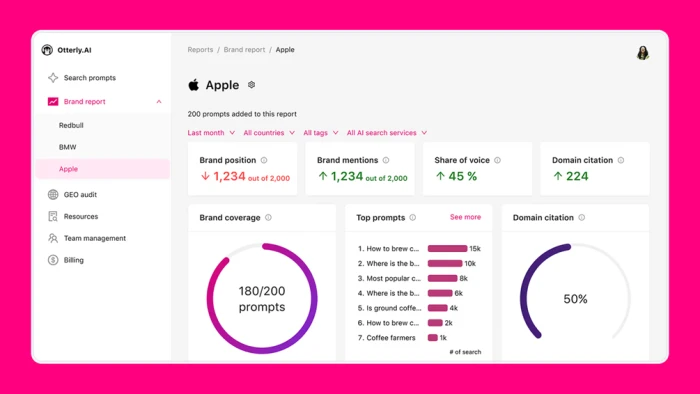
The Otterly.AI brand report with position, mentions, share of voice and domain citations.
How the key features work
Brand Visibility Index. Otterly rolls several signals into a single KPI, so a stakeholder can see one number trending up or down. Underneath it, you get brand position, mention counts, share of voice and domain citations for every prompt.
Full answer capture. The tool stores the complete text of every AI response it collects, along with the domains and URLs cited. That lets you read exactly what a buyer would have seen on a given day instead of inferring from a score.
GEO audit. This is the standout at the price. Otterly crawls your pages and scores them for AI readiness, covering crawlability, structure and the elements that make content easy for an assistant to extract and cite. Lite includes 1,000 URL audits a month.
AI Prompt Research. A research tool that surfaces the questions people ask AI in your category, so you can build a prompt list from evidence rather than guesswork.
Multi country tracking. More than 50 markets are available on every tier, which suits brands selling in several regions.
| Lite | $29 per month, about $25 billed annually. 15 prompts, four core engines, 1,000 GEO URL audits, unlimited team members. No API. |
| Standard | $189 per month, about $160 billed annually. 100 prompts, API access, MCP server and Looker Studio connector. |
| Premium | $489 per month, about $422 billed annually. 400 prompts, 10,000 audits, 5,000 API requests and a personal onboarding session. |
| Engines | ChatGPT, Google AI Overviews, Perplexity and Copilot included. Gemini and Google AI Mode are add ons from about $9 to $149 per month. Claude is an add on at $29, $109 or $439 depending on plan. |
| Overages | About $99 per extra 100 prompts. |
| Website | otterly.ai/pricing |
Where it beats Peec AI $29 gets you a working plan. Peec starts at $95. Four engines included on the entry plan versus three on Peec. Claude is available as a self serve add on, not Enterprise only. A real GEO site audit, which Peec does not offer. Looker Studio and API arrive at $189, not $495 or Enterprise. | Where Peec AI still wins 15 prompts on Lite is tight. Peec Starter gives 50. The jump from $29 to $189 is steep for teams that need 20 to 50 prompts. Sentiment analysis is weaker than Peec's. Six engine coverage on Otterly means paying for add ons too. Reports get dense once prompt volumes climb. |
| Verdict: the best way to find out whether AI visibility matters for your niche without a procurement process. Solo marketers and small agencies will be happy. Larger brands will outgrow Lite within a quarter and should price Standard from day one. |
Scrunch AI
Best for fixing what AI crawlers see
Scrunch AI does two jobs most tools keep separate. It monitors how your brand appears in AI answers, and it ships an infrastructure layer that intercepts AI crawlers at the network edge and serves them a cleaner, machine readable version of your pages. The company was founded in Salt Lake City in 2023 and serves more than 500 brands, including Lenovo, SKIMS, Penn State University and Crunchbase. On June 3, 2026, Sitecore announced it had acquired Scrunch, a deal Bloomberg reported at roughly $225 million.
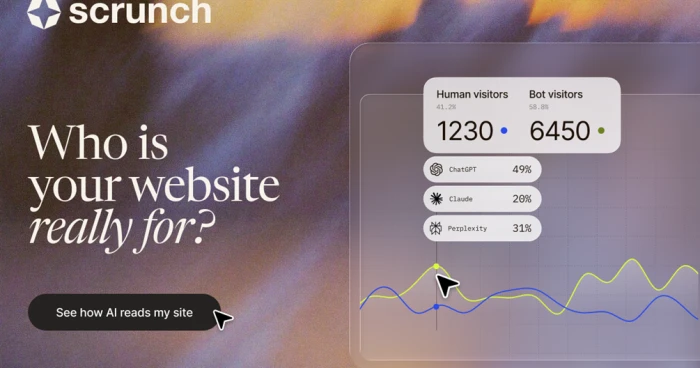
Scrunch frames the problem as human traffic versus AI bot traffic to your site.
How the key features work
Visibility monitoring. Daily tracking of mentions, citation sources, sentiment and share of voice across your prompt set, with the competitor benchmarking you would expect from a Peec class tool.
Crawler analytics. Scrunch shows which AI bots visit your site, which pages they fetch and what they were able to parse. This explains why a page that should be cited never is: often the crawler could not read it.
Agent Experience Platform. This is the differentiator. Deployed at the CDN layer, it detects AI crawlers and serves them a simplified, structured rendition of your content while humans keep seeing the normal site. It is the only tool in this list that changes what the model receives rather than only reporting it.
Site audits. Technical checks that flag JavaScript rendered content, blocked resources and structural issues that stop AI crawlers from extracting your pages.
GA4 integration. Connects AI referral traffic to sessions and conversions so visibility can be tied to outcomes.
| Starter | $300 per month, or $250 billed annually. Four engines: ChatGPT, Perplexity, Google AI Overviews and Copilot. Three user licences. 7 day free trial. |
| Growth | $500 per month, or $417 billed annually, with higher prompt allowances. |
| Enterprise | Custom. Adds Claude, Gemini, Meta AI, Google AI Mode and Grok for nine engines, plus the full Agent Experience Platform. |
| Extra seats | $25 per user per month. |
| Ownership | A Sitecore company since June 2026. Standalone plans still sold at the time of writing. |
| Website | scrunch.com/pricing |
Where it beats Peec AI It fixes crawler access at the edge. Peec only reports. Crawler analytics show whether bots ever fetch your pages. Four engines included at entry versus three on Peec. GA4 attribution links AI visibility to sessions and revenue. Enterprise reaches nine engines including Claude, Grok and Meta AI. | Where Peec AI still wins Peec costs a third of Scrunch's entry price. Peec includes unlimited seats. Scrunch charges $25 per extra user. The Agent Experience Platform is not on the self serve tiers. Scrunch does not track Reddit mentions, a growing AI citation source. Post acquisition roadmap uncertainty. Peec is independent. |
| Verdict: choose Scrunch when you already suspect AI crawlers cannot read your site, or when you are a Sitecore customer. Ask about roadmap, contract portability and data export before signing anything annual |
Peec AI vs the alternatives: 12 differences
The comparison people usually make is headline price against headline price. That hides the differences that decide whether a tool works for you. The table below puts twelve of them side by side.
| Difference | Peec AI | Profound | Ahrefs Brand Radar | Semrush AI Toolkit | Otterly.AI | Scrunch AI |
|---|---|---|---|---|---|---|
| Entry price | $95 per month | $99 per month, annual | $199 per index plus Ahrefs plan | $99 per domain, annual | $29 per month | $300 per month |
| Engines on entry plan | 3 of 6 | 1 | 1 per index, 6 for $699 | 5 | 4 | 4 |
| Prompts on entry plan | 50 | 50 | About 2,500 checks per month | 25 | 15 | Scales by tier, confirm with vendor |
| Claude tracking | Enterprise only | Enterprise only | Not available | Enterprise AIO | Paid add on | Enterprise only |
| Prompt volume data | No | Yes | Yes | Yes | Research tool | No |
| Content generation | No | Agents, credit based | No | Via Content Toolkit | No | Recommendations |
| Site or GEO audit | No | Via Agents | Ahrefs Site Audit | Yes, with SEO suite | Yes, all plans | Yes |
| Crawler analytics | No | Yes, via CDN | No | No | No | Yes |
| Changes what crawlers see | No | No | No | No | No | Yes, Enterprise |
| Seat model | Unlimited on all plans | 1 on Starter, 3 on Growth | Follows Ahrefs plan | Per seat pricing | Unlimited on all plans | 3 included, $25 each after |
| Looker Studio or API | Looker at $495, API Enterprise | Enterprise and MCP | Ahrefs API by plan | Looker on Pro+ and above | Both from $189 | GA4 and exports |
| Free trial | 7 days, no card | 7 days on Growth | None | Semrush One only | Yes | 7 days on Starter |
| Ownership | Independent, VC backed | Independent, VC backed | Ahrefs | Adobe since April 2026 | Independent | Sitecore since June 2026 |
Two patterns stand out. First, the cheapest headline is rarely the cheapest total once you price the engines you actually need. Second, only two of the six tools do anything about crawler access, and only one changes what the crawler receives.
How to switch from Peec AI in 7 steps
Switching trackers is easy to do badly. If you cancel first and rebuild later, you lose the baseline that proves the new tool is any better. Follow these steps in order and you keep a continuous record.
Step 1 - Export your Peec prompts and a 90 day baseline
Before touching anything else, export every prompt you track in Peec along with its tags, the competitor set, and the last 90 days of visibility, position and citation data. Use the CSV export on every plan or the Looker Studio connector on Advanced.
Save the export somewhere your team can reach. This is the reference you will compare the new tool against, and it is also your fallback if the migration stalls.
| Example: a B2B payroll brand exports 120 prompts, tagged by funnel stage, with visibility averaging 31 percent on ChatGPT and 18 percent on Perplexity over the last quarter. |
Step 2 - Decide which engines you truly need
List where your buyers actually ask questions. Consumer brands usually need Google AI Overviews and AI Mode above everything else. Developer and finance brands often need Claude. Ecommerce needs ChatGPT shopping. Write the list down before you look at any pricing page.
This single decision removes at least two tools from your shortlist. Brand Radar has no Claude. Profound Starter has only ChatGPT. Semrush's entry tier is strong on Google surfaces.
| Example: the payroll brand decides it needs ChatGPT, Perplexity, AI Overviews and Claude. That rules out Brand Radar and makes Otterly with a Claude add on or Profound Growth the leading options. |
Step 3 - Price the real total, not the headline
Build a simple cost sheet with four columns: plan price, engine add ons, extra prompts, and extra seats. Fill it in for every finalist. Compare the totals, not the entry prices.
Also check billing terms. Profound and the Semrush toolkit quote annual billing. Otterly and Scrunch quote monthly. A $99 annual plan costs $1,188 up front, which changes the conversation with finance.
| Example: Otterly Standard at $189 plus the $109 Claude add on comes to $298 per month for 100 prompts. Profound Growth is $399 per month for 100 prompts and three engines with no Claude. The sheet makes that trade off visible in one line. |
Step 4 - Run the new tool in parallel for two weeks
Load your top 20 to 30 prompts into the trial of your leading candidate while Peec keeps running. Same prompts, same competitors, same countries. Do not migrate everything yet.
After two weeks, compare mention rates prompt by prompt. Some variance is normal because AI answers change daily. A consistent gap of more than 15 points on the same prompt is a signal to investigate how each tool collects data, not a reason to celebrate or panic.
| Example: the payroll brand sees ChatGPT visibility of 29 percent in Otterly versus 31 percent in Peec on the same 25 prompts. Close enough to trust. Perplexity shows 24 percent versus 18 percent, which turns out to be a difference in how many times each tool re runs a prompt per day. |
Step 5 - Rebuild the full prompt set with intent tags
Now migrate everything. Group prompts into four intent buckets: category research, comparison, pricing and problem solving. Attach the competitor set and the countries you sell in. If the new tool offers prompt volume data, use it to retire prompts nobody asks and add ones people do.
Resist the urge to copy Peec's list exactly. A migration is the best moment you will get to fix a prompt list that grew by accident.
| Example: the brand drops 30 low volume prompts and adds 25 comparison prompts that Semrush style volume data shows are asked ten times more often. |
Step 6 - Wire up reporting before you announce the switch
Connect Looker Studio, GA4 or the API and rebuild the one dashboard your leadership already reads. Add the historical baseline from Step 1 as a static series so the trend line does not start at zero on migration day.
If you use an MCP server, point your internal assistants at the new source so questions like "which prompts did we lose this week" keep working.
| Example: the team recreates its monthly visibility report in Looker Studio with Peec history from January to August and the new tool from September onward, clearly labelled. |
Step 7 - Set a 30, 60 and 90 day action plan, then cancel Peec
The point of a better tool is to do something with the data. Write three dated commitments: at 30 days, publish two pages for the biggest gap prompts. At 60 days, fix the crawler issues an audit surfaced. At 90 days, review share of voice against the baseline and decide whether the tool earned its renewal.
Only after the parallel period ends and the report is live should you cancel Peec. Keep the export from Step 1 for at least a year.
| Example: the payroll brand ships two comparison pages in week three, fixes JavaScript rendering on its pricing page in week seven, and reports a nine point share of voice gain at the 90 day review. |
Case study: how Ramp grew AI visibility 7x with Profound
The clearest public example of a Peec alternative turning tracking into results comes from Ramp, the financial automation platform. Ramp used Profound's Answer Engine Insights to grow visibility for its accounts payable product. The full write up is on Profound's Ramp case study page, and Comcast NBCUniversal LIFT Labs summarised the outcome in a May 2026 profile of Profound.
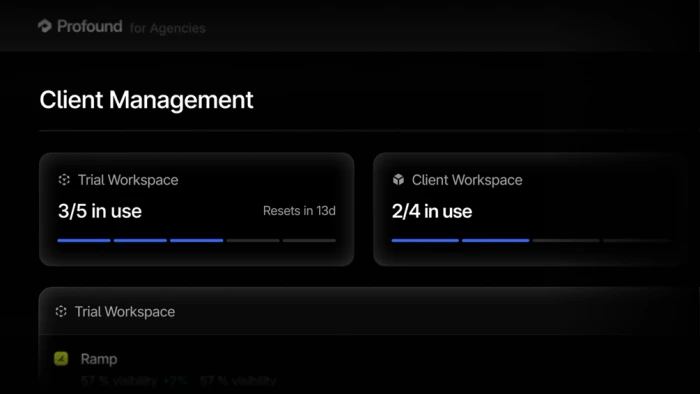
A Profound workspace view with Ramp listed as a tracked brand.
The challenge
Ramp ranked well on Google for accounts payable terms. In AI answers, the picture was different. Its accounts payable solution appeared in only 3.2 percent of relevant AI responses, and Ramp sat 19th among fintech brands for visibility in the accounts payable category. The team could see the gap but not why it existed.
The insight from the data
Using Profound's citation analysis, Ramp's SEO team noticed that AI engines were repeatedly citing content about automation, AI and software comparisons, the kind of content that traditional SEO tools had told them was low priority. About 6 percent of Ramp's existing citations already came from automation related pages, even though those pages were not built for that purpose.
That was the pattern. AI engines were not looking for the same signals Google rewarded. They were looking for structured, comparison style answers to long tail buyer questions.
What Ramp did
Ramp built two pages specifically designed to be picked up by answer engines: Accounts Payable Software for Small Businesses and Accounts Payable Software for Large Businesses. Each page answered the buyer's question directly, segmented by company size, in a format an assistant could extract and cite.
Alongside them, the team published comparison style pages such as Top 6 Accounts Payable Automation Software and AI in Accounts Payable, mirroring the content formats that Profound showed were already earning citations in the category.
The results
3.2% to 22.2% AI search visibility for the AP solution in one month | 7x Growth in overall AI visibility | 300+ Citations generated by the two targeted pages in one month | 19th to 8th Rank among fintech brands for AP visibility on AI engines |
The two targeted pages doubled Ramp's citations compared with all of its previous content combined. Ramp's team credited Profound with surfacing behavioural patterns in long tail AI queries that traditional SEO tools could not capture, which let them run more targeted tests.
What to take from it
Three things in this story transfer to any brand and any tool on this list. First, the win came from reading the citation data, not the visibility score. Second, the content that worked was narrow and buyer specific, not a rewrite of the homepage. Third, the result showed up in weeks, which is faster than most SEO programs.
For more documented examples across SaaS, agencies and legal services, HubSpot maintains a useful roundup of answer engine optimization case studies.
Which alternative should you choose
Match your situation to the row that describes it. If two rows apply, the one higher in the table usually decides.
| Your situation | Pick this | Why |
|---|---|---|
| AI crawlers cannot read your JavaScript heavy site | Scrunch AI | It is the only tool that changes what crawlers receive rather than only reporting it. |
| AI search is a funded channel with a full time owner | Profound Growth or Enterprise | Prompt volume, crawler analytics and content agents give the owner something to run. |
| Your SEO team already pays for Ahrefs Standard or above | Ahrefs Brand Radar | Six engines, market wide research and years of history without a new login. |
| You report SEO and AI visibility to the same stakeholders | Semrush One with the AI Visibility Toolkit | One report, one score, and the Google versus AI gap view. |
| You are a solo marketer or a small agency testing the channel | Otterly.AI Lite or Standard | $29 to start, unlimited seats, a real GEO audit and Claude as an add on. |
| You need Claude tracking without an Enterprise contract | Otterly.AI with the Claude add on | The only tool on this list that sells Claude on a self serve plan. |
| You want daily tracking, strong sentiment and unlimited users at a fair price | Stay on Peec AI | None of the alternatives beat Peec at the thing Peec was built for. |
Final verdict
Peec AI is a strong tracker, and if all you need is clean measurement with unlimited seats, there is no reason to leave. The alternatives earn their place by doing something Peec chose not to do.
Profound adds demand data and execution for teams with a budget and an owner. Ahrefs Brand Radar and the Semrush AI Visibility Toolkit bring AI visibility into the SEO suites teams already run. Otterly.AI opens the door for $29 and includes a real site audit. Scrunch AI is the only one that reaches into the infrastructure and changes what AI crawlers see.
Pick by the reason you are leaving, price the engines you actually need, and run the new tool beside Peec for two weeks before you cancel. That is the whole method, and it will save you from buying a dashboard that looks better and answers less.
Pricing, plan limits and engine coverage were verified against vendor pricing pages and independent 2026 reviews between August and September 2026. Vendors in this category change tiers frequently. Always confirm on the vendor's own page before purchasing. Product images are linked from the vendors' official websites and blogs and remain the property of their respective owners.