
The same question lands in my inbox on a loop. A founder, a one-person consultancy, someone running a tiny shop, and every couple of weeks another version of it arrives: is Blaze AI the genuine article, or one more tool that looks dazzling in the demo and quietly comes apart the moment you actually lean on it?
So I did the boring part properly. I pulled the platform apart to see how it is assembled, worked through a large pile of accounts from people who touch it every week, and paid the most attention to the unglamorous signals that separate software that helps from software that merely photographs well: what breaks, what silently switches itself off, what people regret, and what keeps them subscribed once the trial clock runs out.
What follows is not a hype piece or a hit piece. It is an attempt to answer the only thing that matters, whether it removes work for you specifically, and to be honest about the seams.
Here is the honest headline before all the caveats: Blaze AI works in the plain sense that it does what it says it does. It isn't sorcery, it won't retire your marketer, and it can frustrate you badly if you expect it to do your thinking. But hand it to the right person and it erases a real, costly problem. Everything below is about who that person is, and where the tool earns its price versus where it quietly charges you more than the label admits.
What Blaze AI is, and what it flatly isn’t
Blaze is an all-in-one marketing platform built on one uncontroversial truth: nearly every small business knows it ought to post consistently, and almost none of them have the hours to. So instead of dropping you in front of an empty text box, it reads your website, sketches a profile of your brand, and returns a batch of content for you to check and approve.
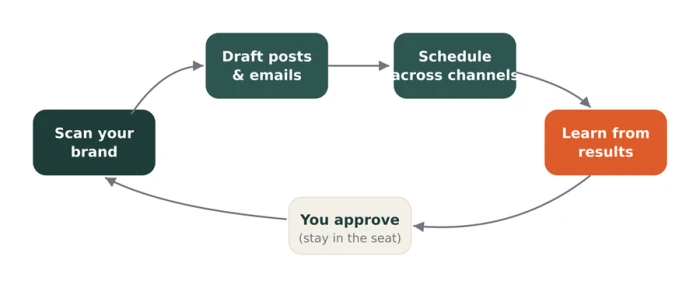
The loop, in one picture (my own diagram). It reads your brand, drafts, schedules, then watches what performs so the next round is sharper. You keep the approval seat.
Being equally clear about what it is not matters, because most of the disappointment online is really a description of that gap.
| The question | The straight answer |
|---|---|
| What is it? | An AI content and social platform that plans, writes, schedules, and publishes your marketing. |
| Who's it for? | Solo operators, small business owners, creators, and lean teams or agencies. |
| The core loop | Scan the brand, generate content, schedule it, learn from results, repeat. |
| What it makes | Social posts, carousels, short blogs, email newsletters, ad copy, and repurposed cuts of each. |
| Where it posts | The big social platforms from one dashboard, plus tie-ins like Zapier. |
| What it is not | Not a deep SEO suite, not a pro video editor, and not a strategist who understands your market. |
One thing to know about “autopilot”
There is a wrinkle worth flagging, because the word autopilot can imply that nothing moves without your sign-off. Blaze’s current documentation says automatic content generation and automatic publishing are switched on by default for connected platforms you select. You can turn either off. Growth-plan users also get a setting that forces content to be approved before it is published automatically.
So if the idea of AI copy going live without a final human glance makes you uneasy, change those settings before you rely on it, especially in regulated fields, or anywhere a single wrong sentence about a price, a statistic, or a medical or legal point costs you more than the automation ever saved.
Blaze documents publishing or integration support for the likes of Facebook, Instagram, LinkedIn, X/Twitter and WordPress, plus a TikTok integration and cross-posting between channels. Exactly what is available shifts with account type and platform permissions, so I would treat “can I actually connect my accounts” as a trial task, not an assumption.
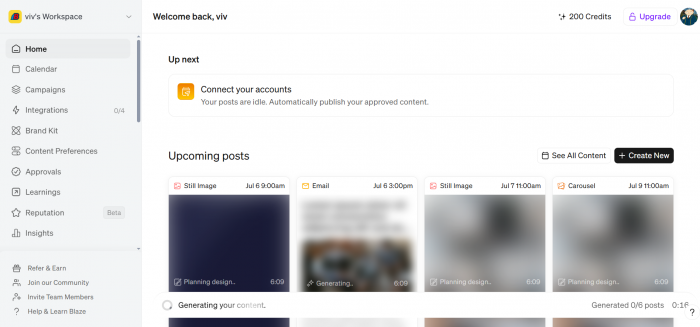
So does the autopilot really work?
Peel off the marketing and “does it work” collapses into one testable claim: does autopilot hand back usable content without me hovering over it? On that narrow, fair question, it passes. It reads your site, builds a brand profile in minutes, and returns a full week of content laid out across your channels.
The point isn't that the writing is brilliant. Tell yourself the truth here and you'll save some grief later. AI drafts are competent, not inspired. The value is that the friction vanishes. The single most repeated line across every review site is some version of the same sentence: a job that used to swallow an afternoon now takes a few minutes.
Consistency is precisely the thing small businesses fail at, not for lack of ideas but because they run out of road somewhere around week three.
That is why it matters more than it sounds. A tool that keeps the calendar full, in a voice that roughly reads like you, fixes a problem that quietly bleeds money in missed attention. So yes, it works. The honest catch is that “works” is carrying a lot of weight, and what it means for you depends entirely on what you walked in expecting.
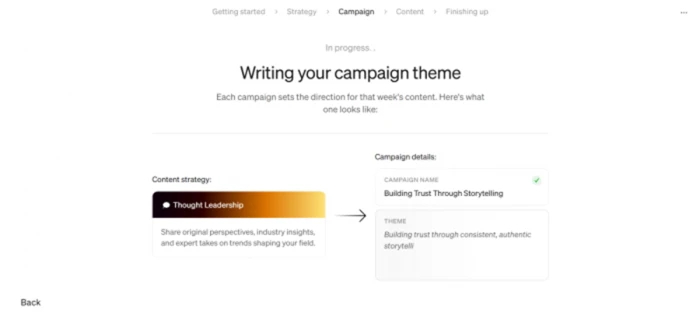
Where it genuinely delivers, and where it stumbles
Set expectations aside for a second. Here is what actually holds up when people run it day after day, and what just as reliably lets them down, drawn from the patterns that repeat across hundreds of accounts.
| What holds up | What lets it down |
|---|---|
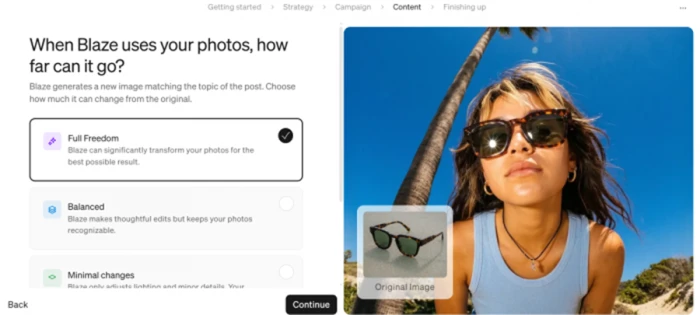
The reasons people renew Time back. Batching a week of content in one sitting is the feature people stay for. By a mile the most-repeated benefit. Brand consistency. Once setup is dialled in, feeds stop looking random. Many say the output sounds like them within a week. Repurposing. One blog becomes social snippets, an email, and ad copy. Squeezing more from a single idea is where it quietly shines. Breadth in one place. Social, short blog, email, and light design under one roof, replacing a cluttered stack of subscriptions. Approachable. The interface earns steady praise for being clean, even for people new to AI tools. | The complaints, just as consistent Output can read generic. Drafts usually need a human pass for personality. Published straight from autopilot, they tend to read flat. Setup decides everything. Rush the brand kit and the whole system goes off-brand. This is the number-one predictor of regret. It drifts. Like any AI, it sometimes ignores instructions, oversimplifies, or repeats itself. Oversight is not optional. US English by default. Writers elsewhere routinely fix spelling and phrasing to match their own market. Credits and add-ons. Every generation draws from a credit pool and extras carry fees, so the real cost can drift above the sticker. |
WORTH WATCHING BEFORE YOU PAY The harshest reviews rarely attack the content. They describe posts silently failing to publish, support that struggled to fix it, and billing that kept ticking while the feature was broken. One reviewer reported paying north of $180, cancelling after two days, and getting an $18 refund. Your run may be far smoother, but go in clear-eyed and read the cancellation terms first. |
The setup truth: you get out what you put in
If one thing predicts whether someone loves or resents this tool, it isn't the plan they chose. It's the thirty to sixty minutes they spent, or skipped, on the brand kit at the very start.
Everything autopilot produces is assembled from those inputs: your exact hex colours, your fonts, your logo, and a few clean samples of your voice. Rush that and you get slightly-off content that feels like it belongs to some other company. Do it properly and the output starts to sound convincingly like you.
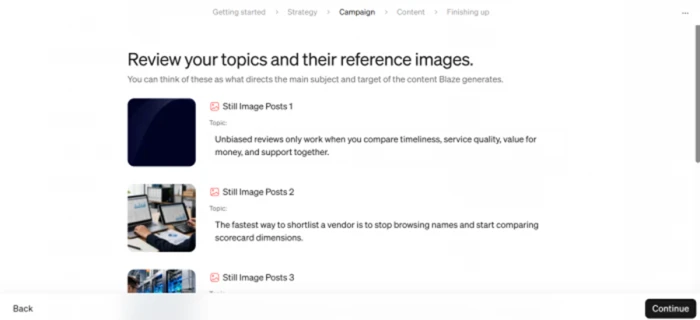
A trick experienced users repeat: draft a short brand guide somewhere else first, then transfer the details in cleanly. It's tedious, and it's the difference between a tool you trust and one you fight every week.
RULE OF THUMB The output is only ever as good as the brand kit behind it. Treat the setup as the actual job, and treat the automation as the payoff for doing it well. |
What you’ll actually pay in 2026
Blaze runs two worlds. One is do-it-yourself: you configure things and approve the content. The other is done-for-you, where a human team runs your marketing on top of the platform for a much larger flat fee. A fair warning up front: Blaze has renamed and re-priced its plans more than once, so treat any figure as a snapshot and confirm on the official page before buying.
| Current plan | Listed price | What's included |
|---|---|---|
| Starter | $79 / month | 3 posting accounts · 600 generation credits a month · 1 user |
| Growth | $149 / month | 10 posting accounts · 1,500 credits a month · unlimited users · yearly planning window |
| All-In-One | $2,499 / month | A broader managed system: website, content, lead handling, reviews, analytics and reporting |
Starter and Growth currently advertise a 7-day free trial with no card required. The permanent free plan that older write-ups mention no longer appears on the public pricing page, so do not count on it.
Credits deserve more than a footnote, because they are where two people on the same plan end up with wildly different value. Blaze’s current system charges roughly 1 credit for a static social post, 3 for an email, 3 for a blog post, and 15 for an AI video, with more available to buy. Generate a lot of video and your “included” allowance evaporates fast.
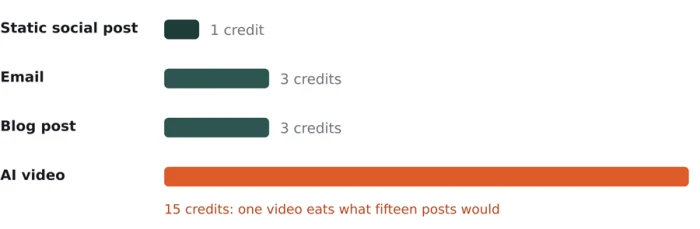
What a generation costs in credits (my own visual). Your plan’s real capacity depends on your content mix, not the number on the page. Watch video especially.
Watch the extras too. Additional posting accounts and white-label options carry their own monthly fees. If all you truly need is social scheduling, a dedicated scheduler is often cheaper than paying for a whole content engine you will underuse.
Who should use it, and who should walk away
Most of the anger online traces to one thing: the wrong person bought it. So before anything else, find yourself honestly in one of these two columns.
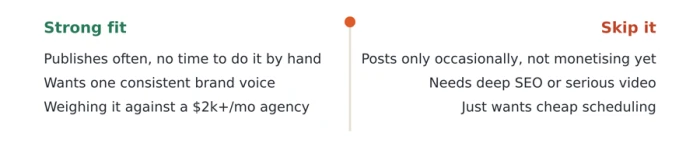
The fit test (my own scale). Same tool, opposite verdicts: the deciding factor is you, not the software.
| A strong fit if you are | Probably not for you if you are |
|---|---|
The maths is easy here A solo founder or owner who must post consistently but has no time to do it manually. A creator or consultant juggling several channels who wants a coherent voice without burning out. A small agency handling a few client brands that needs shared workflows and approvals in one hub. Anyone weighing this against an agency at thousands a month, where even imperfect automation wins on cost. | You'll pay for depth you won't use A hobbyist posting occasionally who hasn't started monetising attention. Someone whose real need is deep technical SEO or serious video production. A team that only wants cheap social scheduling, where a focused tool gives more for less. A large org already embedded in an enterprise marketing stack. |
How it stacks up against the usual alternatives
It helps to set Blaze beside the tools people actually weigh it against, because the right answer usually comes down to what you already have in hand.
| Compared with | Where Blaze wins | Where it loses |
|---|---|---|
| ChatGPT & similar | It schedules, publishes, and holds a brand voice over time. | Pure writing is cheaper elsewhere if you do not need the automation. |
| A dedicated scheduler | It generates the content, not just queues it. | Heavy, high-volume scheduling is cheaper and deeper on a focused tool. |
| A freelancer or agency | Far lower cost, and always on demand. | No human strategy, judgement, or creative direction behind the work. |
What the ratings around the web really say
Numbers are easy to cherry-pick, so here is the balanced read across the platforms people actually trust. On Capterra and its sister site Software Advice, Blaze sits near 4.8 out of 5 across roughly 700 reviews. Trustpilot, with well over a thousand, runs a touch lower at about 4.6 and is noticeably more split. G2 lands around 4.6 too, on a smaller base. Taken together the scores are consistently high without being suspiciously perfect, usually a healthier sign than a flawless five.
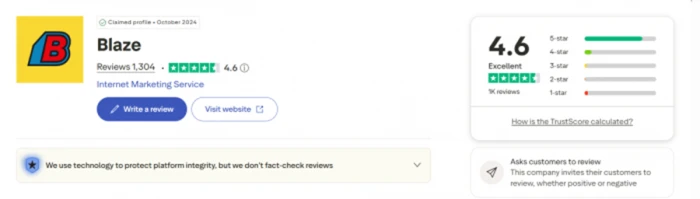
Image from the original article. Ratings across the major review platforms.
| Platform | Rating | Reviews | What the number hides |
|---|---|---|---|
| Trustpilot | 4.6 / 5 | ~1,300+ | Largest sample, most divided. Warm praise sits beside sharp billing and support complaints. |
| Capterra | 4.8 / 5 | 700+ verified | Identity-verified business users. Time saved and brand-voice accuracy dominate the positives. |
| Software Advice | 4.8 / 5 | Shared w/ Capterra | Same review network as Capterra, so it mirrors it closely, same story, same score. |
| G2 | 4.6 / 5 | Smaller base | Fewer reviews, same pattern: people like the output and want deeper editing control. |
The more interesting question is where Trustpilot’s split comes from. Read enough of the one-star reviews and a clear pattern shows up: they almost never say the content is bad. They describe support friction, publishing failures, and billing disputes. The core function tends to satisfy people; the service wrapped around it is where experiences diverge, which is exactly why a glowing average and a furious one-star can both be telling the truth.
What users actually say
An average flattens everything into one number, so here is the texture underneath. These capture the themes that repeat most, the enthusiastic and the frustrated alike, so you can weigh the spread rather than trust a single score.
★★★★★ “Two businesses' worth of posts used to eat my whole Monday. Now it's done before the coffee cools, and the brand kit keeps everything sounding like me, not a machine.” Small business owner · Trustpilot | ★★★★★ “What won me over is how well it learned my voice. I still open ChatGPT for a rough idea, but for anything on-brand this is almost eerily accurate at sounding like me.” Founder, consulting · Capterra |
★★★★★ “One in-depth blog turns into a week of LinkedIn posts, a newsletter in my tone, and a stack of short pieces. For a solo operator that is the line between staying visible and burning out.” Solo coach · G2 | ★★★☆☆ “It gets me about eighty percent of the way, which is a real win. On nuanced or emotional topics the draft reads a bit surface-level and needs a human pass before it ships.” Owner, online media · Capterra |
★★☆☆☆ “The content itself was fine. The problem was posts quietly stopping while the billing kept running, and getting anyone to fix it took far longer than it should have.” Consumer services · Capterra | ★★★☆☆ “Powerful, but there's a learning curve and credits can vanish on a failed generation. Once a post exists it's fiddly to reword or swap the stock images, which can feel generic.” Marketing manager · Trustpilot |
Quick answers to the questions I get most
| What you're wondering | Short answer |
|---|---|
| Will it fully replace my marketer? | No. It replaces the repetitive drafting and scheduling. Strategy, judgement, and the final edit are still on you. |
| Can I stop it posting on its own? | Yes. Automatic publishing is on by default but can be turned off, and Growth adds an approval-first setting. |
| Is the writing good enough to publish as-is? | Often about 80% there. Fine for routine posts; give anything nuanced or emotional a human pass. |
| Will I hit the credit ceiling? | Only if you lean on AI video (15 credits each). Text and social go a long way; measure your real mix in the trial. |
| What is the biggest cause of regret? | A rushed brand kit. Spend the setup hour and most complaints about generic output disappear. |
| Is there still a free plan? | Not on the current public pricing page, so plan around the 7-day trial instead. |
The verdict, after sitting with all of it
Blaze AI is neither the miracle its marketing implies nor the scam its angriest reviewers claim. It's a genuinely useful tool for a specific person and a poor fit for everyone else, and most of the disappointment online comes from people who were the wrong fit and only found out after paying.
If you're a solo founder, a small business owner, or a lean team that publishes often, cares about looking consistent, and simply doesn't have the hours, this is worth a serious look. It won't win prizes for your prose, but it'll keep you visible, on-brand, and off the treadmill of staring at an empty calendar. There the maths is easy, because the alternative is an agency at thousands a month or an afternoon you don't have.
If you post occasionally, need deep SEO or serious video, or mainly want a cheap scheduler, look elsewhere. You'll pay for capability you never touch and feel let down by depth that was never the point.
The most honest thing Blaze offers is the free trial, and it's the move I'd make. Spend the boring hour on your brand kit, let it run a week, and judge the output against your own standard rather than a sales page. That week will tell you more than any review, including this one.
| Criterion | Rating | Note |
|---|---|---|
| Time saved | ●●●●○ | Strong. The reason most people stay. |
| Content quality out of the box | ●●●○○ | Fair. Competent, needs a light edit. |
| Brand consistency | ●●●●○ | Strong. Good once setup is done right. |
| Ease of use | ●●●●○ | Strong. Clean and approachable. |
| Value for money | ●●●○○ | Depends. Great value or overkill, based on fit. |
| Customer support | ●●○○○ | Mixed. The most polarised part of the reviews. |