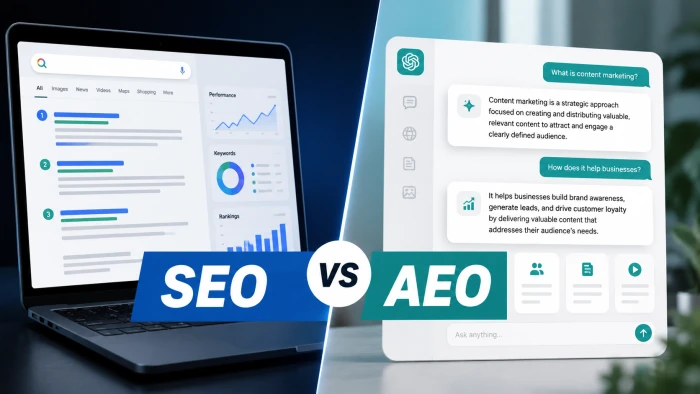
IN THE BLUE CORNER · SEO Can they find me? You compete for one of roughly ten slots on a results page. The buyer clicks, lands on a page you wrote, and you control the first impression. Twenty five years of established practice behind it. | IN THE AMBER CORNER · AEO Will they name me? You compete to be one of two to seven sources an AI quotes. The buyer reads a description of you assembled from other people’s writing, and usually never clicks at all. |
| SCORECARD · EIGHT ROUNDS SEO 4 drawn 4 AEO | ||
| ROUND 01 | Where the buyer starts | AEO |
| ROUND 02 | How many slots exist | SEO |
| ROUND 03 | Who controls the message | SEO |
| ROUND 04 | Traffic volume | SEO |
| ROUND 05 | Traffic quality | AEO |
| ROUND 06 | Durability of a win | SEO |
| ROUND 07 | Cost to compete today | AEO |
| ROUND 08 | Influence on the shortlist | AEO |
WHERE THE BUYER STARTS |
When someone needs an AI product, what do they open first? This round is about the entry point to the whole journey.
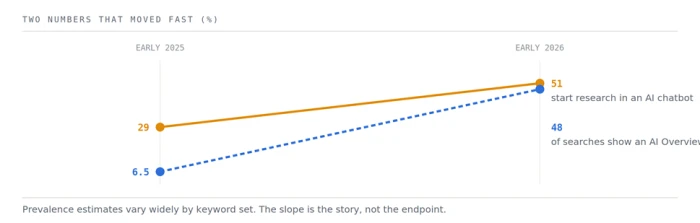
Figure 1. Two numbers that moved fast. Sources: [1], [2].
SEO SAYS Google still handles the overwhelming majority of searches, and roughly half of B2B software buyers still begin there. Search remains the largest single entry point by a wide margin. Nothing has collapsed. The base is intact. | AEO SAYS The share of B2B software buyers starting in an AI chatbot rather than Google went from 29% to 51% in eleven months.1 Very few channel shifts move that fast. 94% of B2B buyers used an LLM somewhere in their 2025 buying journey.1 For AI native products, treat that as the floor. |
RULING AEO takes it. Not because search collapsed, but because the rate of change is the thing you plan against. A channel that doubled its share of first touches in under a year is not something to review next budget cycle. |
HOW MANY SLOTS EXIST |
Simple arithmetic. How many companies get named, and therefore what are your odds of being one of them?
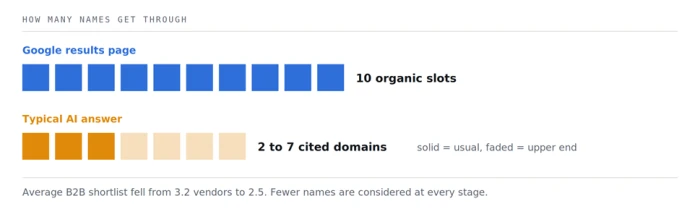
Figure 2. How many names get through. Sources: [3], [4].
SEO SAYS Ten organic slots, plus snippets, images, video and local packs. Many routes onto the page, and a position eight ranking still earns something. Room to be mediocre and survive. | AEO SAYS Most AI answers cite between two and seven domains.3 There is no equivalent of position eight. You are named or you are absent. Average shortlists shrank from 3.2 vendors to 2.5.4 |
RULING SEO takes it, comfortably. More slots means better odds and partial credit for partial effort. AEO is closer to winner takes most, which is worse if you are behind and better if you are ahead. |
WHO CONTROLS THE MESSAGE |
When a buyer forms their first impression of your product, whose words are they reading?
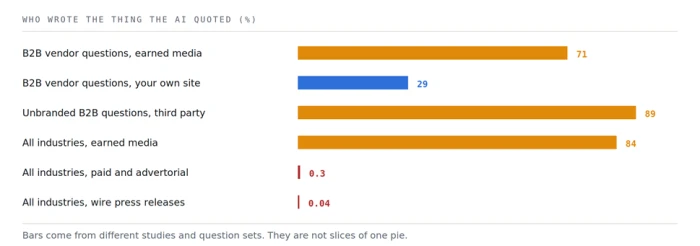
Figure 3. Who wrote the thing the AI quoted. Sources: [5], [6], [7].
SEO SAYS The buyer lands on a page you wrote, on a site you control, with your positioning, your pricing and your screenshots. If it is wrong, you fix it in an afternoon. | AEO SAYS Around 71% of AI citations for B2B vendor questions come from earned media rather than your own site.5 For unbranded questions it reaches 89%.6 Paid content is 0.3% of citations. Wire press releases are 0.04%.7 You cannot buy your way in. |
RULING SEO takes it. And this is the genuinely hard problem for AEO, not a detail. If seven in ten citations come from other people’s writing, you have limited control over your own first impression, and a failure mode with no SEO equivalent: being highly visible and described incorrectly. |
TRAFFIC VOLUME |
Strip out the excitement. How many actual humans arrive on your site from each channel today?
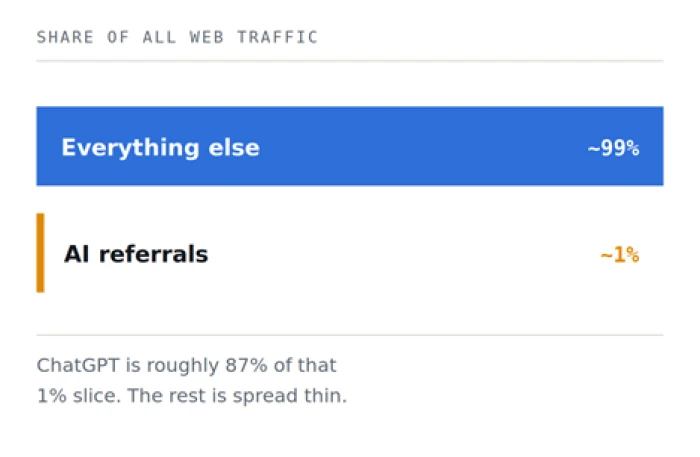 Fig. 4. Share of all web traffic. | 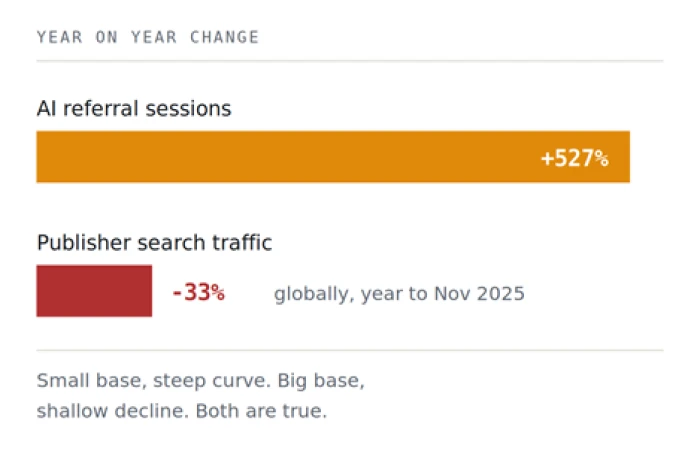 Fig. 5. Year on year change. |
SEO SAYS Around 99% of your traffic still arrives from somewhere other than an AI tool.8 Turn off SEO and you notice within a week. | AEO SAYS AI referral sessions grew 527% year on year.8 Meanwhile publisher search traffic fell about a third globally in a year.9 Small numbers, steep curve. |
RULING SEO takes it, and it is not close. Anyone telling you AI referrals are your main channel today is describing 2028, not 2026. Fund AEO from growth budget, not by cutting the thing paying the bills. |
TRAFFIC QUALITY |
Volume is one thing. What happens once those visitors actually arrive?
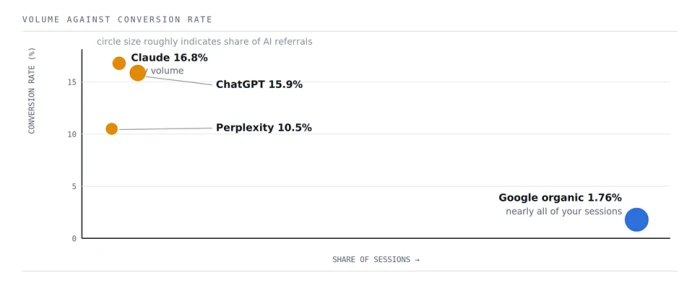
Figure 6. Volume against conversion rate. Upper bound figures, samples skew to B2B software. Sources: [10], [11].
SEO SAYS Organic converts at around 1.76%, but on a hundred times the volume. A small percentage of a large number still beats a large percentage of a small one. | AEO SAYS AI referrals convert between 10.5% and 16.8% depending on the tool.10 Semrush measured 4.4x the organic rate across 500 high value topics.11 The visitor arrives pre qualified. The AI already did the shortlisting. |
RULING AEO takes it clearly. A visitor who arrives after an AI has recommended you is at a completely different stage than someone who clicked a blue link. That said, the mechanism is selection rather than persuasion, so do not expect the rate to hold as volume grows. |
| DURABILITY OF A WIN |
You put in the work and it pays off. How long does the payoff last before you have to do it again?
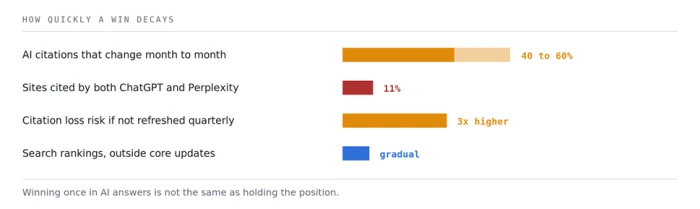
Figure 7. How quickly a win decays. Sources: [7], [12].
SEO SAYS A page that earns rank one tends to hold it for months or years. Links compound. The asset keeps paying after you stop working on it. | AEO SAYS Between 40% and 60% of citations change month to month.7 Only 11% of sites cited by ChatGPT are also cited by Perplexity.7 Pages not refreshed quarterly are about three times more likely to lose citations.12 |
RULING SEO takes it. AEO wins decay fast and do not transfer between tools. Budget for maintenance, not for a project with an end date. Anyone selling you a one off AEO engagement has not read this data. |
COST TO COMPETE TODAY |
Not what it costs in theory. What does it cost to get a result right now, given who else is trying?
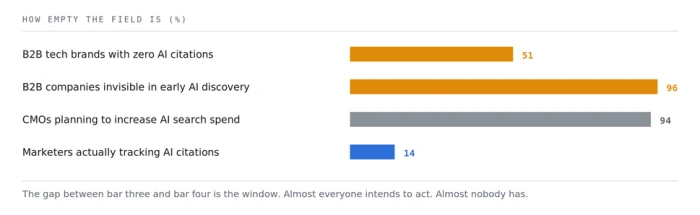
Figure 8. How empty the field is. Sources: [5], [13].
SEO SAYS Every competitor has been optimising for twenty years. The good keywords are taken, the link budgets are large, and gains are incremental and expensive. | AEO SAYS 51% of B2B tech brands have zero citations across the major tools.5 94% of CMOs plan to invest, but only 14% track citations at all.13 A spreadsheet and 25 test prompts puts you ahead of most of your category this month. |
RULING AEO takes it, on timing rather than merit. This is a window, not a permanent property. The same gap existed in SEO in 2003 and closed. The cheap advantage is available now and will not be in two years. |
INFLUENCE ON THE SHORTLIST |
The round that decides the fight. Which channel actually changes who gets bought?
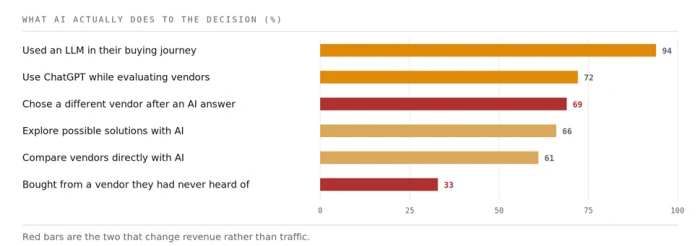
Figure 9. What AI actually does to the decision. Sources: [1], [4], [14].
SEO SAYS Search still drives the largest share of qualified visits, and a buyer who reads three of your pages is further along than one who read a paragraph about you. | AEO SAYS 69% of buyers chose a different vendor than planned because an AI pointed elsewhere. One in three bought from a company they had never heard of before the conversation.4 No sales rep logs that loss. Nobody decided to exclude you. |
RULING AEO takes it, and this is the round that matters most. Traffic is a proxy. Shortlist membership is the actual thing being bought and sold, and the evidence that AI answers change it is the strongest in this whole comparison. |
Supporting charts
Three more comparisons that did not fit cleanly into a single round.
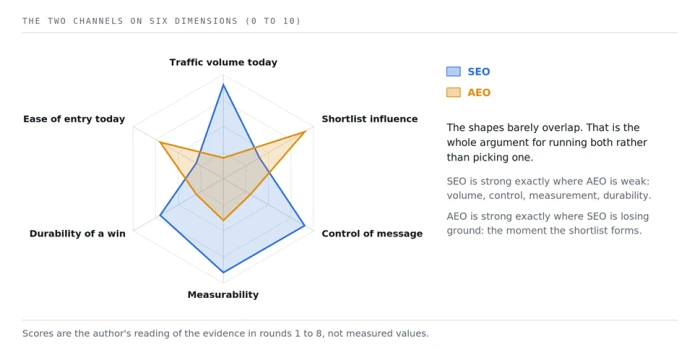
Figure 10. The two channels on six dimensions. Scores are a reading of the evidence in rounds 1 to 8, not measured values.
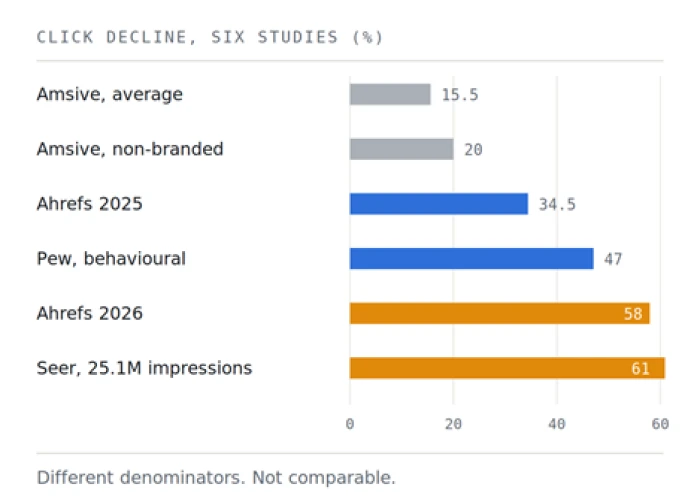 Fig. 11. Click decline, six studies. | 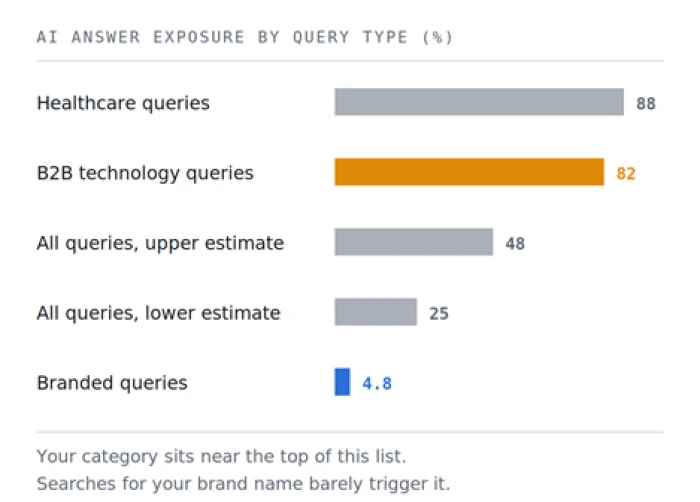 Fig. 12. AI answer exposure by query type. |
FINAL VERDICTFour all. The draw is the finding. Eight rounds scored on the evidence produced a tie, and that is not a cop out. SEO won volume, control, durability and slot availability. AEO won the entry point, traffic quality, the current cost of competing and, most importantly, influence over the shortlist. Look at figure 10 again: the two shapes barely overlap. Each channel is strongest precisely where the other is weakest, which is the definition of a portfolio rather than a choice. |
| For a company selling AI products: keep SEO funded as infrastructure, since crawlability and indexing feed both channels, and add AEO as a separate programme owned outside the content team. If your category is younger than about two years, weight it around 60% towards AEO, because keyword tools structurally understate demand for things nobody has learned to search for yet. Spend on work that would still be worth doing if AI search stalled tomorrow, which describes nearly all of the useful work anyway. |
| Decision | Call | Why |
|---|---|---|
| Make docs and benchmarks quotable | DO IT NOW | You already produce the material. Publishing it dated, crawlable and with the claim in the first sentence costs almost nothing. |
| Publish honest comparison pages | DO IT NOW | Comparison is the default question in your category. Someone will answer it with or without you. |
| Invest in earned coverage | DO IT NOW | Roughly seven in ten vendor citations come from third parties, and it pays off regardless of AI. |
| Start measuring citations | DO IT NOW | 25 prompts in a spreadsheet puts you ahead of 86% of marketers. |
| Buy an AEO platform | AT SCALE ONLY | Worth it above a certain size. Below it, manual checks give most of the signal for none of the cost. |
| Hire a specialist AEO agency | WAIT | Much of what is sold is untested. C-SEO Bench found most tactics did not help. Judge by evidence cited, not confidence expressed. |
| Cut SEO to fund AEO | NO | Search indexes feed several AI tools. An unindexable site is invisible in both channels at once. |
| Treat AEO as a one off project | NO | 40% to 60% of citations churn monthly. This is a maintenance cost, not a launch. |
Do this week
• Write 25 questions a buyer would ask before choosing between you and your closest competitor.
• Ask ChatGPT, Google AI Mode, Perplexity and Claude each one. Record whether you are named, who is named instead, and whether the description of you is accurate.
• Check which AI crawlers your robots.txt allows, per user agent. Search crawlers and training crawlers are different things.
• Open your three most commercially important pages and read one section at a time. If a section only makes sense after the one above it, rewrite it.