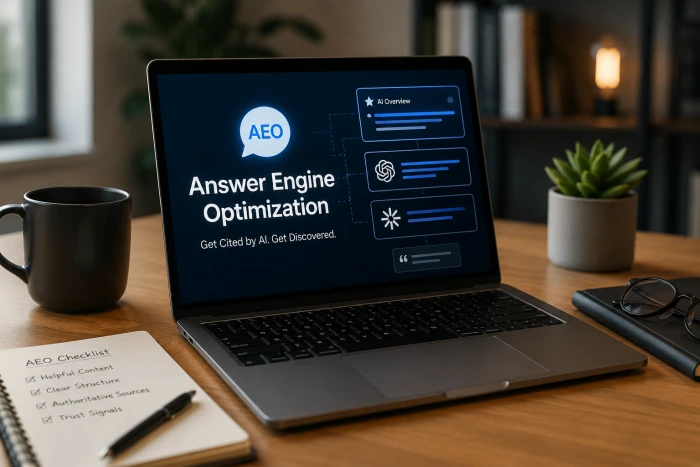
The short answer Answer Engine Optimization (AEO) is the practice of making your content, brand and product easy for AI answer engines to retrieve, understand, trust and cite when they generate a response. Where search engine optimisation competes for one of ten ranking positions, AEO competes to be one of the two to seven sources an AI names, or to be the product it recommends, in a conversation the buyer may never leave. It rests on four things you can control: quotable, current, well-sourced content; clean technical access for AI crawlers; unambiguous entity signals about who you are; and a footprint of third-party mentions that engines already trust. |
What Answer Engine Optimization actually is
The moment of discovery has changed
For twenty-five years the unit of visibility was a link on a results page. You earned a position, the buyer clicked, and everything that followed happened on a page you wrote and controlled.
An answer engine removes the page from that sequence. When someone asks ChatGPT which vector database to use, asks Perplexity to compare two observability platforms, or gets an AI Overview above Google's links, the system reads a set of sources, writes its own summary and credits a handful of them.
The buyer reads a description of you assembled from other people's writing and, in most cases, never clicks through. AEO is the discipline of shaping that description and earning a place in that short list of citations.

An answer engine reads several sources, writes its own summary and credits a few of them. The credit is the prize.
AEO is not a trick
Being cited by an AI is not something you do to a model with a special file or a magic schema type. It is the downstream result of being the clearest, most current and most corroborated source on a specific question.
Answer engines are built to minimise the chance of saying something wrong. So they gravitate towards passages that state a claim plainly, support it with evidence, sit on a site that is easy to fetch, and agree with what other trusted sources say.
If your pricing page contradicts a review site, if your product category is described three ways across your own domain, or if your best explanation is buried in paragraph nine, the engine has good reasons to pick someone else. AEO is the work of removing those reasons one by one.
What counts as an answer engine
The term covers systems that behave quite differently. Google's AI Overviews and AI Mode sit inside a search engine and draw on Google's own index. ChatGPT search runs live retrieval when a question needs fresh information and falls back on training knowledge when it does not.
Perplexity is retrieval-first and cites on almost every answer. Claude searches the web when a question calls for it. Gemini blends Google's index with the model's own knowledge, and Microsoft Copilot leans on Bing. Each has its own crawler, freshness window and citation habits, which is why a brand can be prominent in one and invisible in another.
Why AEO matters in 2026, not in some future year
The scale of the shift
The shift is no longer a forecast. OpenAI reported 900 million weekly active users for ChatGPT in February 2026, more than double the figure a year earlier, and the app was widely reported to have passed a billion monthly active users by June.
Those users send well over two billion prompts a day, and a large share are the informational and evaluative questions that used to begin as Google searches. Google itself now puts AI Overviews in front of a growing share of queries and has rolled out AI Mode as a full conversational alternative. A buyer's first encounter with your category is increasingly a paragraph written by a model rather than a page written by you.
29% → 51% The share of B2B software buyers who start their research in an AI assistant rather than a search engine, measured across eleven months of 2025. Ninety-four percent of B2B buyers used a large language model somewhere in their buying journey that year. |
Small traffic, high intent
AI referral sessions are still a small fraction of total web traffic, but they grew more than fivefold year on year through 2025. The people who arrive that way also behave differently.
Several independent analyses put AI-referred conversion rates at multiples of organic search, with Semrush measuring roughly four times the organic rate across high-value commercial topics. The reason is selection rather than persuasion: by the time someone clicks a citation, the engine has already narrowed the field for them.
The shortlist effect
The strongest evidence concerns who gets bought. Surveys of buyers who used AI in their process found that a clear majority chose a different vendor than they had planned, and roughly one in three bought from a company they had never heard of before the conversation.
No sales report records that loss, because nobody decided to exclude you. The engine simply never named you.

Buyers increasingly ask an assistant first and only open a search engine to verify what it told them.
The window is open but closing
Roughly half of B2B technology brands have no citations at all across the major engines. The large majority of marketing leaders say they intend to invest in AI visibility, yet only a small minority currently measure it.
That gap is the same one that existed in search around 2003, when a modest, disciplined effort put a company years ahead. It closed then and it will close again. The cost of a baseline audit today is a spreadsheet and an afternoon.
How answer engines choose their sources
Retrieval-augmented generation
To optimise for a system you need a working model of it. For answer engines that model is retrieval-augmented generation. When a question arrives, the engine first decides whether it can answer from what the model already knows or whether it needs fresh material.
For anything time-sensitive, commercial, obscure or specific, it retrieves. The retrieved passages go into the context the model reads, the model writes an answer, and only the sources it leaned on while writing are surfaced as citations.
Query fan-out
Google's documentation describes a technique it calls query fan-out: the original question is broken into several sub-queries, each is run against the index, and the results are pooled before the model responds. The other engines do something functionally similar.
Your single prompt becomes a bundle of searches. Each search returns candidate pages or passages, and a ranking step decides which candidates the model actually reads. A page wins by answering one of those sub-queries cleanly.

One question becomes many retrievals. A passage wins by answering one sub-question completely and verifiably.
Three consequences for your content
First, retrieval happens at the level of passages, not pages. A self-contained section with the claim in its first sentence outperforms a beautifully written essay that only makes sense in full.
Second, the candidate pool is usually drawn from a search index, so anything that hurts crawling and indexing hurts citation before your writing is ever assessed. Google's guide to optimising for its generative AI features is explicit that AI Overviews and AI Mode use the same index as classic search.
Third, the model chooses among candidates on trust signals it can observe at generation time: does the passage cite evidence, does it agree with other sources, is the site a recognisable authority on this topic, is the content dated and recent, and is the entity being discussed clearly identified.
Training memory versus live retrieval
A model's training data contains an impression of your brand, your category and your competitors, frozen at the training cutoff. When a question does not trigger retrieval, that impression is the whole answer.
The only thing that shapes it is how you were described across the web while the training data was collected. This is why third-party coverage matters so much: it is the raw material of both the live citation pool and the model's background beliefs.
Brand consistency compounds here. If a hundred sources describe you the same way, the model absorbs that description. If they describe you ten different ways, it absorbs uncertainty, and uncertain entities get hedged, omitted or confused with something else.
AEO vs SEO vs GEO: the same work, different scoreboards
Three terms, one job
Search engine optimisation is the work of earning ranking positions on a results page, where the buyer clicks through to content you control. Answer Engine Optimization is the work of being the direct answer or a cited source when a system responds in its own words, whether that is a featured snippet, a voice assistant, an AI Overview or a ChatGPT response.
Generative Engine Optimization was popularised by a 2023 Princeton study of how content choices affect visibility in generative search. It focuses on influencing the synthesised response itself, which can include being recommended without a formal citation at all.
In practice the tactics converge. The Princeton researchers found that adding statistics, quotations and clear sourcing raised a source's visibility in generated answers by as much as forty percent. The original paper is on arXiv if you want the methodology.
What a win looks like in each channel
We scored the two channels head to head across eight rounds of 2026 data in our companion piece on AEO vs SEO for AI companies. The result was a four-all draw, and the draw is the finding.
SEO wins on slot availability, message control, raw traffic volume and durability. A first-page ranking can hold for years, and the buyer lands on your words.
AEO wins on where the buyer now starts, on the quality of the traffic that arrives, on the cost of competing while most of the field is empty, and on influence over the shortlist, which is the thing actually being bought and sold.
The two channels are strongest exactly where the other is weakest. Keep SEO funded as shared infrastructure, because an unindexable site is invisible in both channels, and add AEO as a distinct programme with its own prompts, measurement and owner.
Where Google stands
Google's position is that optimising for its generative AI features is still just search optimisation. Its documentation on AI features and your website states that there are no additional requirements, no special schema and no new machine-readable files needed for AI Overviews or AI Mode.
That is true and important for Google, and a useful corrective to the more breathless end of the AEO industry. It is not the whole story for engines that run their own crawlers and indexes, and it says nothing about the off-site work that determines how any engine describes you. Treat Google's guidance as the technical floor and this guide as the layer above it.
What the citation data actually shows
Ranking in Google is not AI visibility
The most important finding of the last eighteen months is that ranking in Google does not produce AI visibility. Ahrefs compared the sources cited by AI tools against Google's top ten organic results across fifteen thousand queries and found only around twelve percent overlap.
The remaining eighty-eight percent of citations came from pages that did not rank on page one. A 2026 report on the state of AI citations also notes that only about eleven percent of domains are cited by both ChatGPT and Perplexity.
Take one thing from this section: your organic rankings are not a proxy for your AI visibility. You need to measure the latter directly.

Twelve percent overlap between AI citations and page one of Google. The two channels reward different things.
A few giants and a very long tail
Reddit and Wikipedia are consistently the two most-cited domains in ChatGPT. Reddit also leads on Perplexity and Google's AI features, and YouTube, LinkedIn, Forbes and Medium recur near the top across engines.
Semrush's three-month study of the most-cited domains also showed how volatile this is. Reddit went from appearing in close to sixty percent of ChatGPT responses in early August 2025 to around ten percent by mid-September, while Forbes doubled its share in the same window.
Volatility of that size on the biggest sources tells you the engines are actively tuning source selection. No position is permanent, including the ones held by the giants.
~5% The ceiling for any single domain's share of total citations on any major engine, according to an analysis of 200 million prompts. Roughly ninety-five percent of citations are spread across thousands of other domains, which is where your opportunity is. |
Why the long tail is good news
When Evertune analysed two hundred million prompts, the most-cited domain on any platform rarely exceeded five percent of total citations. A synthesis of five studies published by Contently makes the point that AI citation is a long-tail distribution, not the winner-takes-all market of the classic results page.
You do not need to displace Wikipedia. You need to be the best source on a few hundred specific questions in your category, and that is a far more open competition than page one of Google ever was.
Freshness and churn
AirOps' 2026 analysis found that for commercial and evaluation-stage queries, eighty-three percent of AI citations came from pages updated within the previous twelve months, and more than sixty percent from pages refreshed within six. Their AEO guide has the full breakdown.
Other trackers report that between forty and sixty percent of citations change month to month, and that pages not refreshed at least quarterly are roughly three times more likely to lose the citations they hold.
A ranking can coast. A citation cannot. Any plan that treats AEO as a one-off project with a launch date has misread the data.
Most citations are not from your own site
Across B2B vendor queries, roughly seven in ten citations point to earned media, review platforms, forums and third-party comparisons rather than the brand's own domain. For unbranded category questions the share rises towards nine in ten.
Paid placements and wire press releases barely register. This is the structural reason AEO cannot be run entirely by the content team: what most determines whether you are named, and how you are described, is what other people have written about you.
Writing content that gets cited
Lead with the answer
Everything about retrieval points to one editorial rule: lead with the answer, then earn it. An engine is hunting for a passage that resolves one sub-query on its own, so each section should be written as if it might be the only part the model reads.
The heading states the question or claim in plain language. The first sentence underneath answers it directly. The sentences that follow supply the evidence, the numbers, the caveats and the context.
Open your three most commercially important pages. If a section only makes sense after reading the section above it, that is your first rewrite. Self-containment is the difference between being extractable and being ignored.
Be specific and checkable
Models prefer passages with concrete, checkable detail over passages with adjectives, because a checkable claim can be corroborated against other sources and a vague one cannot.
"Our platform is fast and scalable" gives an engine nothing to work with. "p99 latency of 42 milliseconds at ten thousand queries per second on the benchmark published in March 2026" gives it a number, a condition, a date and a reason to trust you.
Original data is the highest form of this. A benchmark you ran, a survey you commissioned or a dataset you maintain becomes something other people cite, and being cited by the sources the engines already trust is the most durable form of AEO there is.

Question in the heading, answer in the first sentence, evidence underneath. Every section should stand alone.
Cover the questions buyers actually ask
Think in terms of the questions a buyer would ask an assistant rather than the keywords they would type into a search box. What is it, what does it cost, how does it compare to two named alternatives, who is it for and not for, what does it integrate with, what are its limits, and what happened to the last company that switched.
Each of those is a sub-query an engine may fan out to, and each deserves a clear, quotable answer somewhere on your domain.
Honest comparison pages are the most neglected. Comparison is the default question in every software category, and someone will answer it with or without you. If the only comparison the engine can find was written by your competitor, do not be surprised by how you come out of it.
Make trust visible
Put a named author with a short, specific biography on every substantive piece. Show the publication date and, more importantly, the last-updated date, and mean it. A date stamp on unchanged content is worse than no date once an engine learns not to trust it.
Link out to the primary sources you relied on. A passage that cites its evidence is easier for a model to corroborate than one that asks to be taken on faith.
Google's guidance on creating helpful, reliable, people-first content is a reasonable checklist even outside Google. The experience, expertise, authority and trust signals it describes are what a retrieval ranker is trying to approximate.
Keep a refresh cadence
Build refreshes into the plan from the start. For the pages that matter, a quarterly review that updates figures, revisits claims and re-stamps the date is not optional. It is the price of holding a citation.
What not to do
Do not turn every heading into a stilted long-tail question and stuff the page with restated variations of the same query. Google says plainly that its systems understand synonyms, and the other engines are built on models that are, if anything, better at this.
Do not chop good prose into fragments on the theory that models need small pieces, and do not publish thin, AI-generated pages at volume. A corroborated, specific answer on one page beats twenty vague ones, and thin content is precisely what retrieval rankers skip.
Technical foundations and AI crawlers
Start with the SEO fundamentals
The technical side of AEO is mostly the technical side of SEO with one new dimension. If a page cannot be crawled, rendered and indexed, it cannot enter the candidate pool for any engine.
Return a clean 200 for important URLs. Keep the main content in server-rendered HTML rather than behind client-side JavaScript that some fetchers will not execute. Keep pages fast, keep internal links pointing at the pages you most want cited, and maintain an accurate XML sitemap.
Check that your CDN or bot-protection layer is not silently blocking crawlers your robots.txt allows. This catches more sites than any other issue: the file looks permissive, and a firewall rule upstream is challenging the very agents you meant to welcome.
Three kinds of AI crawler
AI companies now run several distinct crawlers, and the decision you make about each has different consequences.
Training crawlers collect data to build future models: OpenAI's GPTBot, Anthropic's ClaudeBot, Common Crawl's CCBot, and the Google-Extended token, which is a robots.txt control rather than a separate crawler.
Search or retrieval crawlers build the indexes behind live answers and make you eligible for citation: OAI-SearchBot, Claude-SearchBot and PerplexityBot. User-triggered fetchers retrieve a page when a person asks the assistant to read it: ChatGPT-User, Claude-User and Perplexity-User.
Blocking a training crawler does not remove you from that company's search results. Blocking a search crawler does. OpenAI's documentation of its crawlers spells out which agent does what.
| User agent | Operator | Purpose | Blocking it means |
|---|---|---|---|
| Googlebot | Search index that also feeds AI Overviews and AI Mode | Invisible in Google Search and Google's AI features | |
| Google-Extended | robots.txt token controlling Gemini training and grounding use of crawled content | No effect on Search rankings or AI Overviews | |
| OAI-SearchBot | OpenAI | Builds the index behind ChatGPT search | Not eligible for ChatGPT search citations |
| GPTBot | OpenAI | Training data collection | Opts out of future model training; search unaffected |
| ChatGPT-User | OpenAI | Fetches a page when a user asks ChatGPT to read it | Users cannot get ChatGPT to open your links |
| Claude-SearchBot | Anthropic | Retrieval index for Claude's web search | Not eligible for Claude citations |
| ClaudeBot | Anthropic | Training data collection | Opts out of training; search unaffected |
| PerplexityBot | Perplexity | Builds Perplexity's index | Not eligible for Perplexity citations |
| Bingbot | Microsoft | Bing index, which powers Copilot and is widely used by other engines | Invisible in Bing, Copilot and engines that rely on Bing |
| CCBot | Common Crawl | Open dataset used in many training corpora | Less presence in open training data |
A sensible default configuration
For a company that wants to be found and recommended, allow every search and user-triggered agent, and make a deliberate, documented decision about training crawlers rather than inheriting whatever a plugin set for you.
Publishers who monetise content often block training agents while keeping search agents open. Commercial and SaaS companies usually leave training agents open too, on the reasoning that appearing in training data helps a model remember and describe the brand correctly. Anthropic's crawler documentation describes its agents and confirms they honour robots.txt.
Perplexity's bot guide does the same for its crawlers. A minimal, explicit configuration looks like this:
# Search and retrieval agents: allow (makes you citable) User-agent: OAI-SearchBot Allow: /
User-agent: Claude-SearchBot Allow: /
User-agent: PerplexityBot Allow: /
# User-triggered fetchers: allow (a person asked to read your page) User-agent: ChatGPT-User Allow: /
User-agent: Claude-User Allow: /
# Training crawlers: decide explicitly. Most commercial sites allow. User-agent: GPTBot Allow: /
User-agent: ClaudeBot Allow: /
User-agent: Google-Extended Allow: /
Sitemap: https://www.example.com/sitemap.xml |
Audit this against your actual server logs every quarter. The list of agents changes, and robots.txt is a request rather than a law.
Training crawlers and search crawlers are different agents with different consequences. Configure each one on purpose.
The limits of robots.txt
Compliance varies by vendor and by agent type. The declared training and retrieval crawlers from the major companies respect it, but OpenAI documents that ChatGPT-User may not, because a human initiated the fetch, and a long tail of undeclared scrapers ignores it entirely.
Seer Interactive's analysis of where robots.txt can and cannot block AI is a good sober read on the limits.
The truth about llms.txt
The file that has attracted the most attention is not doing what people hope. The proposal at llmstxt.org is sensible: a Markdown file at your root that summarises the site and links to its most important pages so an agent can orient itself quickly.
The adoption evidence is unambiguous, though. Ahrefs' study of 137,000 sites found that around ninety-seven percent of published llms.txt files were never requested by any AI bot, and the retrieval agents from OpenAI, Anthropic and Perplexity made only a few hundred fetches across thousands of domains.
Google has said on the record that it ignores the file. Publish one if you like, since it costs little and coding agents sometimes read it, but do not mistake it for an AEO strategy.
Structured data and entity clarity
What schema does and does not do
Structured data is often oversold in AEO circles. Google is explicit that there is no special schema type that unlocks AI Overviews or AI Mode, and no other engine has documented one either.
What structured data does is remove ambiguity. When a page carries valid schema.org markup that mirrors its visible content, a crawler can confirm without inference that this is an Article by this Person, published on this date, by this Organization, about this Product.
That confirmation feeds the entity understanding every engine relies on to decide who you are. Mark up what is on the page, never what is not, and validate it. Google's introduction to structured data covers the mechanics.
The types worth prioritising
Organization markup on the home page, with the same legal name, logo, founding date, address and social profiles you use everywhere else, anchors the brand entity. Person markup for authors, linked to a real profile page with credentials, anchors expertise.
Article markup with accurate published and modified dates supports the freshness signals discussed earlier. Product and SoftwareApplication markup with real pricing, features and ratings lets an engine answer commercial questions from your data rather than a competitor's.
FAQPage markup on pages that genuinely present questions and answers gives retrieval a clean set of pairs to lift. HowTo markup does the same where a process really is a sequence of steps.
Markup does not force a citation. It removes the ambiguity that gets you passed over.
Entity clarity beyond markup
AI companies in particular tend to have work to do here. If your product name is also a common word, if you rebranded in the last two years, if your category is too new to have an established label, or if your own site describes what you do three different ways, an engine will struggle to build a stable concept of you.
Unstable concepts get omitted or confused. Decide on one canonical description of the company and product, in one sentence and in one paragraph, and use those same words everywhere you control.
That means the About page, the footer, the LinkedIn profile, the G2 listing, the press boilerplate, the author bios and the structured data. If you qualify for a Wikipedia article on notability grounds, that is disproportionately valuable, but do not try to game one into existence. For companies with a local footprint, a complete Google Business Profile matters too, since Google lists it among the sources its AI features draw on.
Off-site authority: the seventy percent you don't control
Why engines prefer third parties
If most citations for vendor questions come from sources other than the vendor, then most AEO work happens on domains you do not own. That is uncomfortable for a marketing team used to controlling the message, but the engines are not being perverse.
A claim made about you by someone else is more credible than the same claim made by you. And the domains engines lean on most, forums, review platforms, encyclopaedias, trade press and analyst coverage, are the ones where they have learned that real experience and independent assessment live.
The description of your product a buyer reads in ChatGPT is largely a synthesis of what reviewers, Reddit users, journalists and competitors have said. Your job is to make sure that corpus is accurate, current, consistent and large enough to be found.
Reddit and the communities
Reddit is the most-cited domain across all engines combined in several large studies. It is the single largest source on Perplexity, where it can account for as much as one in five citations, and it grew its share dramatically through 2025 as engines signed licensing deals.
Profound's breakdown of citation patterns by platform shows how much this varies engine to engine.
The correct response is not to have interns post fake recommendations. The community detects that quickly, and hostile threads then get cited for years. Identify the subreddits where buyers actually ask questions, have real people from the company answer transparently, make it easy for customers to share their experience, and correct inaccuracies in the open. The same applies to Stack Overflow, Hacker News and your category's specialist communities.

Most of what an engine says about you was written by someone else. Earned coverage is the raw material.
Reviews, press and original research
Review platforms such as G2, Capterra and TrustRadius are cited constantly for software comparisons, so a complete, current profile with recent reviews is a direct input to how you are described. The same goes for category listings, "best of" roundups and directories engines have learned to trust.
Trade and technology press coverage carries weight far beyond its click volume, particularly when it includes a quotable, specific claim about what you do. Original research that others cite is the strongest signal of all, because it makes you a source for the sources.

Podcast and YouTube appearances count. Transcripts are indexed and YouTube is itself one of the most-cited domains. .
Podcast appearances and YouTube content matter more than they used to, since YouTube is one of the most-cited domains and transcripts are indexed. Guest contributions, analyst briefings, partners' integration documentation and case studies on the customer's own site all add corroborating voices.
What does not work
Paid placement dressed up as coverage, wire-distributed press releases and link farms together account for a rounding error in the citation data. They can actively damage trust if an engine learns to associate your name with them.
Consistency across every surface
Every third-party surface should describe you the same way, in the same category, with the same positioning. Agreement across sources is a trust signal; disagreement is noise that gets you hedged or dropped.
This is unglamorous work: updating a stale listing, asking a partner to correct an out-of-date integration page, briefing the analyst who covered you last year on your current pricing. It is also the work competitors are least likely to be doing, and in a channel where half of B2B technology brands have no citations at all, two quarters of it is often enough to move from absent to named.
Platform-by-platform notes
Only a small fraction of domains are cited by more than one engine, so it pays to understand how each behaves rather than treating "AI search" as a single target.
Google AI Overviews and AI Mode
Both draw from the same index as classic search, use query fan-out to gather candidates and, by Google's own account, need no special optimisation beyond the fundamentals.
In practice they show a strong preference for pages that already rank well and for Google-owned surfaces such as YouTube. AI Mode in particular cites LinkedIn and community content heavily.
Google's AI features run on Google's index. If you are not indexed, nothing else in this guide can help you there.
ChatGPT search
ChatGPT search combines OpenAI's own crawler with a third-party index. It cites Wikipedia and Reddit more than any other engine and has the most volatile source mix, with large swings from month to month.
It also sends by far the most referral traffic of any assistant, which makes it the engine where a citation is most likely to turn into a visit.
ChatGPT's source mix moves sharply month to month. Measure it on a schedule rather than trusting a snapshot.
Perplexity
Perplexity is retrieval-first, cites on nearly every answer, and leans hardest on Reddit and on recent, dated content. That makes it both the fastest engine to reward a fresh page and the fastest to drop a stale one.
Claude, Gemini and Copilot
Claude searches the web when a question warrants it and cites what it fetched. Its search crawler and user-triggered fetcher both respect robots.txt, so the technical prerequisites match the others, and clear, sourced, self-contained passages matter with particular force because Claude quotes conservatively.
Gemini blends Google's index with the model's own knowledge and inherits Google's source preferences.
Microsoft Copilot runs on Bing, which matters more than Bing's consumer share suggests, because the Bing index is also a common retrieval backbone for other assistants. Registering in Bing Webmaster Tools, submitting your sitemap and using its indexing API are cheap, often-skipped steps with an outsized effect on eligibility across several engines at once.
| Engine | Retrieval source | Notable citation habits | Priority moves |
|---|---|---|---|
| Google AI Overviews / AI Mode | Google's own index, query fan-out | Favours pages that already rank; YouTube, LinkedIn and community content prominent in AI Mode | SEO fundamentals, Search Console generative AI report, complete Business Profile |
| ChatGPT search | OAI-SearchBot index plus third-party index | Wikipedia and Reddit lead; source mix shifts sharply month to month; largest referral volume | Allow OAI-SearchBot, reference-grade coverage, Wikipedia eligibility, fresh dates |
| Perplexity | PerplexityBot index, live retrieval | Cites on nearly every answer; heaviest Reddit reliance; strong recency preference | Allow PerplexityBot, quarterly refreshes, genuine community presence |
| Claude | Claude-SearchBot index, live retrieval when needed | Conservative quoting; favours clearly sourced, self-contained passages | Allow Claude-SearchBot and Claude-User, evidence-first sections |
| Gemini | Google index plus model knowledge | Inherits Google's source preferences | Same as Google; entity consistency across Google surfaces |
| Microsoft Copilot | Bing index | Bing index also backs other assistants | Bing Webmaster Tools, sitemap submission, AI performance report |

The same page can be cited everywhere, but each engine gets there by a different route.
Measuring AEO
Start with a prompt set
The core measurement instrument for AEO is not a tool, it is a prompt set. Write down the questions a buyer would ask an assistant before choosing between you and your closest competitors, somewhere between twenty-five and a hundred, spread across category education, problem framing, evaluation, comparison, pricing, implementation and switching.
Run each prompt through each engine on a fixed schedule, weekly for the most commercial prompts and monthly for the rest. Record five things each time: absent, mentioned, cited or recommended; which competitors appeared instead; which third-party sources were cited; whether the description of you was accurate; and whether any link pointed to the page you would have chosen.
Do this in a spreadsheet before you buy anything. It takes an afternoon, it puts you ahead of the large majority of marketers who track nothing, and it teaches you what the engines think of you in a way no dashboard can.
Google Search Console's generative AI report
Google has finally given site owners official data. On 3 June 2026 it launched generative AI performance reports in Search Console, first for a subset of UK properties and, as of 31 August 2026, for every site worldwide, as set out in the Search Central announcement.
The report sits under Performance in the left-hand navigation and shows impressions from AI Overviews, AI Mode and the generative AI features in Discover, broken down by page, country, device and date. Data begins from mid-May 2026 with no historical backfill.
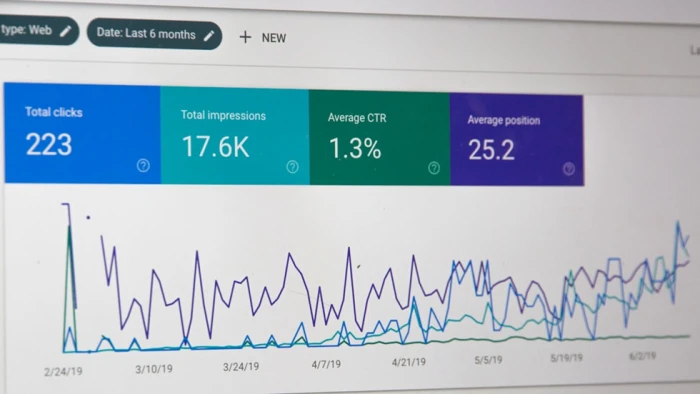
Search Console's familiar performance report. The new generative AI view sits directly beneath it in the left-hand navigation.
Its main limitation is that it does not yet report clicks or the prompts that triggered the impression. It tells you which of your URLs Google's AI features surface and how that changes over time, not what people asked or what they did next.
Alongside the report Google shipped an opt-out control that lets a site withdraw from AI features without affecting classic rankings. Most commercial sites should not take it, but publishers now at least have the option.
31 August 2026 The date Google confirmed its generative AI performance reports had reached every Search Console property worldwide, three months after the initial UK rollout. Impressions only, no clicks, no queries: a start rather than an answer. |
Bing got there first
Bing Webmaster Tools launched an AI performance report in public preview in February 2026 that surfaces specific citations, page-level citation activity and the grounding queries that led to them, which is exactly the prompt-level detail Google's report lacks.
Search Engine Journal's coverage of the worldwide rollout of Google's reports summarises what each platform now provides. Because Bing's index underpins other assistants, its grounding query data is often the best available proxy for the questions those assistants are asking on your behalf.
Your own analytics
Every major assistant sends referral traffic with an identifiable referrer. Create a channel grouping that captures sessions from chatgpt.com, perplexity.ai, claude.ai, gemini.google.com, copilot.microsoft.com and their variants, and report it separately from organic search.
Watch conversion rate as well as volume. The volume will look small next to organic for some time; the conversion rate is where the channel proves itself.
Track branded search as a lagging indicator too. When an assistant recommends you to someone who has never heard of you, the next thing many do is type your name into Google. Neil Patel's walkthrough of the new Search Console data covers combining these sources into a single view.
When to buy a platform
Dedicated AI visibility platforms run thousands of prompts across engines daily and report share of voice, sentiment and citation sources at a scale a spreadsheet cannot. They are worth it once the prompt set is too large to run by hand and budget decisions depend on trend data.
Below that point, manual checks give you most of the signal for none of the cost. Whatever you use, measure against outcomes rather than activity: not how many prompts you appear in, but whether the appearances are accurate, on the prompts that matter, and turning into pipeline.
Mistakes and myths that waste budget
Treating AEO as a project
Between forty and sixty percent of citations change month to month, and a page that is not refreshed quarterly is several times more likely to lose the citations it holds. Any engagement that promises to "get you into ChatGPT" and then wraps up has misunderstood the channel.
Budget for a standing programme with an owner, a prompt set, a refresh calendar and a quarterly review of crawler access, the way you would budget for a paid channel rather than a website launch.
Cutting SEO to fund it
Google's AI features run on Google's index, and the other engines depend on search indexes and search-style crawling. A poorly indexed site is invisible in both channels at once, and the technical fundamentals AEO depends on are the ones the SEO budget already pays for.
Files and markup that do nothing
Publishing an llms.txt does not get you cited, and Google's guidance now lists it among the tactics it does not use. There is no secret schema type that unlocks AI Overviews, and marking up content that is not visible on the page is a policy violation that can cost you rich results.
Chunking content into tiny fragments, producing Markdown mirrors of pages, and rewriting headings as awkward long-tail questions are all things Google has explicitly said are unnecessary. There is no evidence they help elsewhere.
Most technical AEO myths involve a file or a tag that a crawler never reads. Check the logs before you believe the pitch.
Crawler blocks nobody revisited
Sites that blocked every AI user agent in 2023 on principle and never revisited the decision are now discovering that they opted out of the search agents along with the training agents. The CDN rules added at the same time are often still challenging crawlers they now want to admit.
Thin content and ignored accuracy
Producing hundreds of thin, model-generated pages to "cover every question" is the AEO equivalent of the content farms Google spent a decade learning to demote. Retrieval rankers skip thin content for the same reasons.
Ignoring accuracy is a quieter failure. A brand can be highly visible and consistently misdescribed, which has no SEO equivalent, and no amount of extra visibility fixes it. Only correcting the underlying sources does.
Buying confidence instead of evidence
Chasing the biggest engine alone ignores the finding that only about one domain in ten is cited by both ChatGPT and Perplexity. And judging vendors by confidence rather than evidence is the most common procurement error in the category right now.
Much of what is sold as AEO has never been tested, and academic benchmarks of the popular tactics found that most did not help. Ask for the data behind each recommendation.
A 90-day AEO playbook
Everything above condenses into a sequence a small team can run in a quarter without buying anything. Measurement comes first so every later change can be judged against a baseline. Technical access comes before content so the content you rewrite can actually be fetched. Off-site work runs throughout because it is the slowest to compound.
Assign a single owner outside the day-to-day content queue, give them the prompt set and the calendar, and review the numbers monthly with whoever owns pipeline.
Days 1–30
Baseline and access
Write the prompt set and run it across every engine, recording the five states for each prompt plus the competitors and third-party sources that appear instead of you.
Audit robots.txt by user agent and cross-check it against server logs and CDN rules. Verify the site in Search Console and Bing Webmaster Tools, submit sitemaps, and locate the generative AI reports in each.
Read the top twenty third-party sources the engines cite for your category and note where you are absent, out of date or described inaccurately. Agree the canonical one-sentence and one-paragraph descriptions that everything else will be brought into line with.
Days 31–60
Fix and publish
Rewrite the three to five most commercially important pages so every section is self-contained, leads with its answer, carries specific evidence, shows a named author and a real updated date, and links to its sources.
Publish honest comparison pages against your closest competitors, a plain-language definition page if your category is new, and a pricing page with real numbers. Add or repair Organization, Person, Article, Product and FAQPage markup that mirrors visible content, and validate it.
Bring every profile you control into line with the canonical descriptions, from the About page to G2 to LinkedIn to the press boilerplate. Start the quarterly refresh calendar now.
Days 61–90
Amplify and measure
Begin the earned-media work with the gaps the baseline exposed: ask customers for recent reviews on the platforms the engines cite, correct stale listings, pitch one piece of original data to the trade press, and have real people answer real questions where buyers ask them.
Re-run the full prompt set and compare it with the day-one baseline, prompt by prompt, engine by engine. Read the generative AI reports in Search Console and Bing for the first full month, segment AI referrals in analytics, and put branded search on the same chart.
Decide, on the evidence, which prompts to invest in next quarter, whether the manual process needs a platform, and what the standing budget should be.

Baseline, fix, amplify. Three phases, one owner, reviewed monthly against pipeline.
Where this is heading
The measurement gap is closing
Google now reports AI impressions and Bing reports citations and grounding queries. It is reasonable to expect click and query data to follow, at which point AI visibility becomes a line item finance can see rather than a marketing assertion.
Answer engines are becoming agents
When an assistant can compare pricing pages, read documentation, check integration lists and fill in a trial form on the buyer's behalf, the premium on structured, accurate, machine-readable product information rises sharply. The companies whose documentation, pricing and comparison content are clearest will be the ones agents can act on.
The open web is being renegotiated
The engines are actively reshaping their relationship with publishers and communities through licensing deals, which will keep changing which sources they favour and why. None of this changes the fundamentals in this guide. It raises the stakes on getting them right.

The engines will keep changing how they choose. Clear, current, corroborated content is the strategy that survives every change.
The bottom line
AI search is not about to replace search, and anyone who tells you AI referrals are your main channel today is describing a year that has not arrived. But the buyer's first question is increasingly answered by a system that has already decided who to trust, and its description of you is assembled mostly from sources you do not control.
Ranking in Google does not get you cited. Only about one cited page in eight also ranks on page one, most vendor citations come from third parties, and half of all citations turn over every month. Treat AEO as a standing programme with an owner, a prompt set and a refresh calendar, not a project.
The work itself is not exotic. Lead every section with its answer and back it with specific, dated evidence. Let the search and user-triggered crawlers in and decide deliberately about the training ones. Describe yourself the same way on every surface, and earn the reviews, coverage and community mentions the engines already trust.
Roughly half of B2B technology brands have no citations at all, and only a small minority measure them. Twenty-five prompts in a spreadsheet this week puts you ahead of most of your category. That gap will not stay open for long.