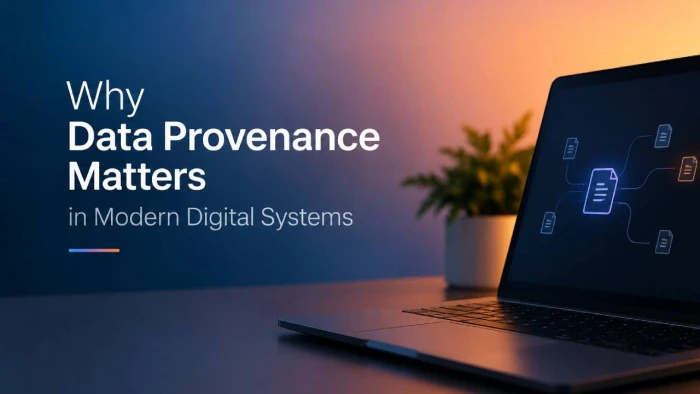
Modern digital systems are exceptionally good at collecting data. They are much less consistent at preserving the story behind it. A number in a dashboard, an AI-generated answer, a fraud alert, or a customer risk score may look precise, but its reliability depends on what happened before the result appeared. Where did the underlying data originate? Was it transformed? Which version was used? Did another system modify it? Can those steps still be reconstructed months later?
That history is data provenance. As software becomes more distributed and automated decisions depend on longer chains of data, provenance is becoming part of the technical foundation of trustworthy systems.
Data Is No Longer Static
The traditional picture of data sitting inside one database is increasingly inaccurate. A single customer action might pass through a web application, analytics SDK, API gateway, event stream, cloud warehouse, transformation job, machine-learning model, and reporting platform.
Each handoff creates another opportunity for context to disappear. A field called revenue, for example, may begin as transaction value before tax. One pipeline may convert currencies, another may exclude refunds, while a reporting layer may aggregate the result by account instead of transaction. Two dashboards can then display different numbers while both appear technically correct.
The issue is not necessarily bad data. It is incomplete history. Modern systems therefore need to know more than where information currently lives. They need to understand how it arrived there.
What Provenance Actually Records
Data provenance describes the history associated with a piece of information. The W3C's PROV work describes provenance around the entities, activities, and people involved in producing data, with the goal of helping assess qualities such as reliability and trustworthiness.
In practical systems, that history can include:
● The original source and collection method, including whether information came from a user, device, external API, imported file, sensor, application event, or another database.
● Changes made after collection, such as normalization, filtering, deduplication, aggregation, enrichment, translation, or format conversion.
● Versions of the data and software involved, so teams can determine which dataset, schema, script, model, or business rule produced a particular result.
● Movement between systems, including which applications consumed the data and which downstream datasets were created from it.
● Timing and ownership information, showing when an event happened, which service produced it, and who or what had responsibility for the relevant process.
Provenance overlaps with several familiar concepts, but they are not identical.
| Concept | Main Question It Answers |
| Data provenance | Where did this information come from, and what happened to it? |
| Data lineage | Through which systems and transformations did the data travel? |
| Metadata | What descriptive information do we know about the data? |
| Audit trail | Who or what performed an action, and when? |
| Data quality | Is the information accurate, complete, consistent, and usable? |
| Observability | What is currently happening inside the system? |
The distinctions matter because an organization can have excellent monitoring while still having poor provenance. A pipeline might report that every job completed successfully without explaining whether the input dataset itself was appropriate.
One Record, Many Systems
Consider something as ordinary as an online purchase. The transaction begins inside an application. An event is sent to an analytics platform. Payment information enters another system. A customer record is updated in the CRM. The transaction may then be copied into a data warehouse, combined with advertising data, processed by an attribution model, and displayed in a revenue dashboard.
The visible result may be a simple figure: £247 in attributed revenue. Behind that number sits a chain of technical decisions.
| Stage | Provenance Worth Keeping |
| Application | Event source, account ID, timestamp, application version |
| API | Endpoint, request time, response, source service |
| Data pipeline | Job ID, transformation logic, input and output datasets |
| Warehouse | Dataset version, schema, ingestion time |
| Analytics | Filters, aggregation rules, attribution method |
| AI or model layer | Model version, feature set, input dataset |
| Final report | Query version, refresh time, reporting rules |
If the figure later looks wrong, a team with strong provenance can work backward through the chain. Without it, troubleshooting often turns into comparing dashboards, reading old code, checking logs, and asking whether anyone remembers when a transformation changed. That difference becomes more important as systems become larger.
How Context Gets Lost
Data rarely becomes unreliable because one dramatic failure destroys it. More often, small changes accumulate.
A developer renames a field. A pipeline begins excluding null values. An API changes its response format. An analyst copies a dataset and applies a filter. A machine-learning team trains against a snapshot that is later replaced. Months afterward, the final data still exists, but the reasoning behind it has disappeared.
Several patterns cause this repeatedly:
● A derived dataset is retained while its exact source version is not.
● Business logic changes without being tied to historical outputs.
● Data is exported into spreadsheets or files outside the main pipeline.
● Multiple teams create slightly different definitions of the same metric.
● Third-party data arrives without enough information about collection or processing.
● Manual edits happen after automated processing but are not recorded consistently.
This is why provenance is closely tied to reproducibility. If a result cannot be reconstructed using the same inputs, transformations, and versions, it becomes harder to explain why that result existed in the first place.
AI Raises the Stakes
Artificial intelligence adds another layer because a model can turn thousands or millions of individual inputs into one apparently simple output.
A recommendation system may combine browsing history, previous purchases, account information, product data, and model-generated features. A retrieval-augmented generation system can pull documents from a knowledge base before producing an answer. A forecasting model may depend on datasets assembled from several internal and external systems.
Knowing the model name is therefore not enough. Meaningful AI provenance may require tracking the dataset used for training, the model version, relevant configuration, preprocessing steps, retrieved documents, feature versions, prompt inputs, and the knowledge available when an output was generated.
This is especially important when data changes frequently. Suppose an internal AI assistant gives an employee an outdated policy answer. Checking the model alone tells us very little. The more useful questions are whether it retrieved an old document, whether the document index had been refreshed, whether two versions existed, and which source was treated as authoritative.
NIST's AI Risk Management Framework reflects the broader need to manage AI risks across organizations rather than treating a model as an isolated technical component. Provenance provides part of the evidence needed to understand those systems after deployment.
From Lineage to Decisions
Traditional lineage tends to answer: Where did this dataset come from? Modern automation introduces another question: Why did the system take this action?
Consider a fraud-detection workflow. A transaction enters a scoring model. The model returns a high-risk probability. A business rule checks the amount. Another service checks account history. The combined result causes the transaction to be held for review. The important object is no longer only the dataset. It is the decision chain.
A useful decision record might preserve:
● which transaction data entered the process;
● which model and feature versions produced the score;
● which rules were evaluated afterward;
● what external services contributed information;
● whether a person reviewed or overrode the automated result;
● and which final action was executed.
This could be thought of as decision provenance. As software moves from storing information to recommending and executing actions, this form of provenance becomes increasingly valuable. Debugging a bad decision requires more than finding the source table. Teams may need to reconstruct an entire path through models, rules, services, and human approvals.
Provenance as Security Signal
Security teams also care about where data came from because malicious information can look perfectly ordinary once it enters a trusted system.
Consider data poisoning. If manipulated records enter a machine-learning pipeline and later become part of a training set, inspecting the final dataset alone may not reveal where the suspicious records originated. Provenance can help connect unusual values with a specific ingestion source, time period, account, or processing job.
Similar logic applies beyond AI. Unexpected configuration changes, modified files, suspicious database records, or altered logs become easier to investigate when systems retain information about creation, modification, and transfer.
Provenance does not replace access controls, cryptographic verification, monitoring, or incident response. It adds context to them. Security systems are stronger when they can distinguish between data that merely exists and data whose path through the system can be accounted for.
Digital Evidence Needs History
The same principle applies to documents, images, video, logs, and other digital records. A screenshot may show what appeared on a screen, but not necessarily when the underlying information was created. A file timestamp may indicate a modification without explaining what changed. A video can be exported repeatedly while losing metadata from earlier versions.
Digital authenticity increasingly depends on preserving context alongside content. This issue has become particularly visible with synthetic media. The Coalition for Content Provenance and Authenticity, or C2PA, develops technical specifications designed to attach information about the source and history of media content. Its Content Credentials work is intended to preserve information about how an asset was created or changed as it moves through compatible systems.
The broader lesson extends beyond media. A digital object becomes easier to evaluate when its history travels with it.
Cloud Architecture Complicates Everything
Provenance becomes harder to maintain when architecture is distributed. A request in a modern application might trigger a microservice, publish an event to a queue, invoke a serverless function, call an external API, write to a transactional database, replicate into a warehouse, and eventually trigger another workflow. No single component necessarily sees the complete sequence.
Third-party services make this harder again. An organization may know that information came from a vendor API without knowing how that vendor generated the original dataset. SaaS integrations can move information across administrative boundaries where different logging, retention, and identity systems apply.
Multi-cloud environments add another problem: identifiers do not always remain consistent across platforms.
Good provenance architecture therefore depends on stable identifiers, timestamps, version information, and machine-readable events that can be connected across systems. Without those links, organizations may have thousands of logs but still lack a coherent history.
OpenLineage takes this kind of approach for data engineering. Its specification models datasets, jobs, and runs so lineage metadata can be collected consistently across different parts of a data ecosystem. That matters because pipeline tooling changes frequently while the need to reconstruct data movement remains.
Governance Gets More Practical
Data governance often sounds abstract when it is expressed only through policies. Provenance makes many of those policies technically actionable.
Suppose an organization discovers that information from a particular provider should no longer be used. Knowing that one source table contains the data is useful, but incomplete. The organization also needs to understand which downstream tables inherited it, which dashboards depend on those tables, whether the data became part of model training, and whether derived copies remain elsewhere. A lineage graph can turn a vague governance problem into a concrete dependency problem.
Provenance can similarly support:
● Retention work, by showing where copies and derivatives of older information remain.
● Access reviews, by providing context around which systems or processes interacted with sensitive datasets.
● Model governance, by connecting models with training datasets, features, and deployed versions.
● Change management, by identifying reports and applications that depend on a dataset before its schema changes.
● Incident investigation, by narrowing the scope of affected downstream systems after a problematic data source is discovered.
This is where provenance stops being documentation for data teams and starts functioning as operational infrastructure.
What Good Provenance Looks Like
A common mistake is trying to document everything manually. That rarely survives real production systems. People forget to update diagrams, scripts change rapidly, pipelines are redeployed, and undocumented data copies appear. Provenance works better when it is captured as part of normal execution.
Useful systems tend to share several characteristics.
1. First, important objects receive persistent identifiers. Datasets, model versions, pipeline jobs, documents, transformations, and other assets need names that remain meaningful across systems.
2. Second, transformations are captured close to where they happen. A pipeline already knows which inputs it read and which outputs it produced, so that is usually the best point to record the relationship.
3. Third, provenance should be queryable. A collection of logs scattered across storage buckets technically contains history, but reconstructing it manually may take days. Useful provenance allows teams to ask questions such as, “What depends on this table?” or “Which model used this dataset?”
Finally, the record itself needs protection. A provenance system that can be silently rewritten by the same process it is supposed to audit offers limited assurance.
Tracking Everything Has a Cost
More provenance is not automatically better provenance. Capturing every query, intermediate dataset, user interaction, model input, file revision, and API call can create enormous metadata volumes. Detailed histories may also contain sensitive information about users, internal systems, or business processes.
Performance matters too. Instrumenting every step of a high-volume pipeline can add processing and storage overhead. Excessive detail may eventually make the provenance system so noisy that important relationships become difficult to find.
The better question is not, “Can we record everything?” It is what information will later be required to reproduce, investigate, govern, or explain a meaningful event.
Critical financial calculations may need precise versioning and transformation histories. Temporary cache data probably does not deserve the same treatment. AI training datasets may need richer provenance than disposable application telemetry. The depth should follow the risk and value of the data.
Provenance Is Becoming Infrastructure
For years, provenance was largely associated with research, scientific computing, data governance, and specialized analytics environments. The architecture of mainstream software is making the concept relevant far beyond those areas.
AI systems need histories for models and datasets. Security teams need trustworthy records of changes. Data platforms need dependency graphs. Cloud systems need context across distributed services. Media platforms increasingly face questions about content authenticity.
These needs are converging. We can already see the technical direction in standards and frameworks. W3C PROV provides a general model for exchanging provenance information across heterogeneous systems. OpenLineage focuses on interoperable lineage metadata for data pipelines. C2PA applies provenance principles to digital media. They solve different problems, but each reflects the same architectural idea: important digital objects become more useful when their history is machine-readable rather than trapped in human memory.
The shift is subtle but significant. Provenance is moving closer to observability, identity, version control, and logging as something systems may need to produce by design.
Can Systems Explain Their History?
A strange gap has emerged in modern computing. Systems can process more data, use more models, call more services, and automate more decisions than before. Yet the final output can sometimes be easier to generate than to explain.
A dashboard can refresh in seconds while determining exactly how one figure was calculated takes hours. An AI assistant can produce an answer immediately while identifying the information that influenced it becomes much harder. An automated workflow may complete thousands of actions before anyone discovers that one upstream dataset was wrong.
This is the deeper value of provenance. It does not guarantee that information is correct. It makes the path to that information visible enough to inspect.
A source can be authentic and still contain errors. A well-documented model can still make a poor prediction. Provenance should therefore not be confused with proof of truth. What it provides is something more practical: evidence about history.
Bottom Line
Modern digital systems increasingly operate through chains rather than isolated applications. Data moves between platforms, changes format, gains new attributes, feeds models, influences decisions, and produces further data along the way.
Without provenance, much of that history disappears while the final output remains. That is manageable when the result is a disposable metric. It becomes much more serious when the same data influences security decisions, AI responses, financial reporting, automated services, digital evidence, or business operations.
The next stage of trustworthy computing will therefore depend on more than protecting databases or improving model accuracy. Systems also need to preserve enough context to answer a basic question after the processing is complete: Where did this result come from, and what happened on the way here? As digital systems become more capable, being able to answer that question may matter almost as much as producing the result itself.