
The two most-read reviews of it reach opposite conclusions. Juliety rates it 4.9 out of 5 and calls it a great investment. Andrew Marketing says most marketers don't need it. Both were written before the tool changed owners, and both still describe a $1 trial that no longer exists.
So I went through it myself: the free version of the site, the pricing page as it reads today, the weekly newsletter, and every user review I could find on Trustpilot, Product Hunt and Reddit. I'll be clear throughout about what I saw directly and what I'm taking from other people's accounts. This is what I observed, including a few things I didn't expect.
What Exploding Topics Is
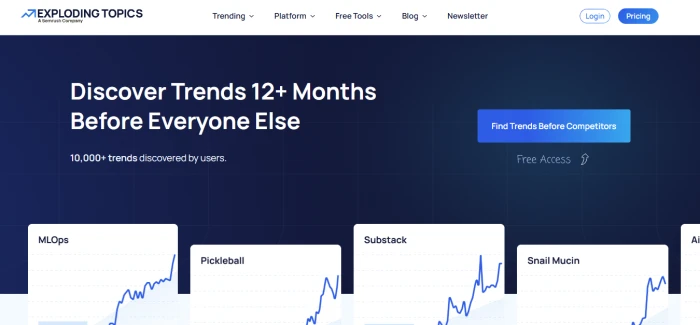
Exploding Topics is a database of topics, products and startups that are growing quickly but haven't become common knowledge yet. You don't type in a keyword. You pick a category, scroll through growth curves, and open the ones that look interesting. That's the whole idea, and it's a simple one.
The history matters more than it usually would, because it changed recently. Josh Howarth started the site in 2019 and launched it on Product Hunt. Brian Dean, the person behind Backlinko, bought it and relaunched it; he has said on YouTube that it reached $3.2M in annual recurring revenue with no employees. Then in August 2024 Semrush acquired it (Dean posted the announcement on X), and Semrush has since been acquired by Adobe. The footer of the pricing page now says Exploding Topics is a trademark of Semrush Inc.
I mention this because neither of the two big reviews does, and it explains a lot of what I found later. Checkout now runs through Semrush, the trial changed, and the tone of the user reviews changed too.
The pricing page lists Google, McKinsey, Goldman Sachs, Unilever, Shopify, Deloitte and Penguin Random House as customers, and the site says 1,200+ teams pay for the Pro version. I can't verify either figure, so I'm noting them as the company's claims rather than mine.
How It Says It Finds Trends
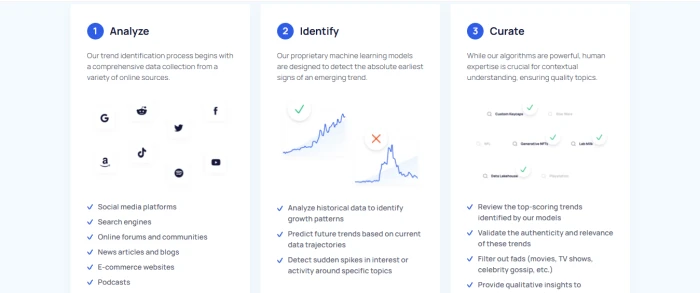
The company's own description is three steps: analyze behaviour signals across "dozens of platforms," let a model pick out topics with compounding growth, then have people check and curate the results before they're published. Data refreshes daily. The sources named on the site are search engines, forums like Reddit, social platforms and shopping data.
In the database every topic carries one of three labels:
1. Exploding – compounding growth
2. Regular – steady interest
3. Peaked – it spiked and is now declining
The chart for any topic can be set from 3 months out to 15 years, and on the two higher plans a dotted forecast line extends it 12 months forward.
What I couldn't find anywhere is which sources feed which number, or how the growth percentage is calculated. Andrew Marketing noted the same lack of transparency two years ago and it hasn't changed. A few reviewers also point out that a "+9,900%" figure on a topic with a few hundred searches looks dramatic but means very little. I ended up treating the growth numbers as a reason to go and look, not as a prediction.
What's Actually In It
The database is the product; everything else is a layer on top of it. Here's what each feature does and which plan it sits on, taken from the pricing page.
| Feature | What it does | Plan |
|---|---|---|
| Trends Database | Browse 1.1M+ topics by category, time range (3 months to 15 years) and status (Exploding / Regular / Peaked). There's a filter to hide brand names so you're left with generic topics. | All Pro plans |
| Trend Analysis | A detail page for one topic: monthly search volume, growth %, related trends, and a channel breakdown showing whether interest is coming from TikTok, Pinterest, LinkedIn or YouTube. | 10 per month on Entrepreneur, 100 on Investor, 500 on Business |
| Trend Tracking | Save topics into project folders (one per client or niche) and get alerted when a tracked trend speeds up. | 100 / 500 / 2,000 tracked trends by tier |
| Meta Trends | Umbrella topics (e.g. "premium snacks") drawn as rings of smaller trends, so a whole market is visible on one screen. | All Pro plans |
| Trending Products | Physical products with Amazon Best Sellers Rank, estimated monthly sales and revenue, average price, review score and TikTok views. | All Pro plans |
| Trending Startups | Companies gaining mentions quickly, with funding, headcount and whether they're bootstrapped. | Investor and Business |
| Trend Forecasting | Model projection of the next 12 months, drawn as a dotted line on the chart. | Investor and Business |
| CSV Export + Trend Reports | Export data to a spreadsheet; weekly analyst-written reports kept in a library. | Investor (CSV) / Business (reports) |
The weekly newsletter is free and, from the issues I've read, it's the part I'd keep regardless of the rest. Each Tuesday it covers four to nine topics with a short note on why each one is moving. Andrew Marketing calls subscribing a no-brainer, and I don't disagree.
What you can see without paying: category browsing and 2-year and 5-year trend lines, no account needed. What's blurred: the search bar, the 3- and 6-month breakouts, most Trend Analysis pages, products, startups and forecasts. Juliety described the free tier as being teased and never let in, and that matches what I saw.
Pricing as of October 2026
The pricing page shows $39, $99 and $249 per month. What it doesn't say in large type is that those are billed annually, so the smallest plan is $468 up front. This is the table as it read on explodingtopics.com/pricing on October 19, 2026.
| Plan | Advertised | Billed per year | Tracked trends | Trend analyses | Exclusive extras |
|---|---|---|---|---|---|
| Entrepreneur | $39/mo | $468 | 100 | 10 | Database, products, Meta Trends, channel breakdown |
| Investor ("Best Value") | $99/mo | $1,188 | 500 | 100 | + Trending Startups, Forecasting, CSV export |
| Business | $249/mo | $2,988 | 2,000 | 500 | + Trend Reports library |
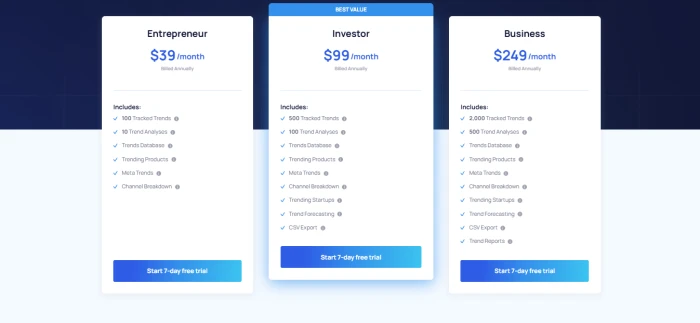
Three things I noticed that differ from the older reviews:
1. The $1 trial is gone. Juliety and Andrew Marketing both describe it (7 days, later 14). The page now offers a 7-day free trial, and checkout runs through Semrush's billing system.
2. There's still no monthly option advertised. Juliety's main complaint in 2025 was the annual-only structure, and nothing has changed.
3. The refund window is 7 days. Several Trustpilot reviewers describe being charged the full annual amount after the trial and being refused a refund once that window had passed.
On plan fit: Entrepreneur covers browsing and tracking but caps Trend Analyses at 10 a month, which is the limit Andrew Marketing ran into when he tried to search the database rather than browse it. Investor is where the full feature set starts. Business adds volume and the reports library, which I'd only expect an agency to need.
If I were trialing it, I'd set a reminder for day 5 and cancel from the billing section of account settings if it wasn't a fit, rather than waiting for a reminder email. Going by the reviews, one doesn't arrive.
What the Review Sites Show
The product reviews and the billing reviews might as well be about two different companies. Here is every rating I could verify in October 2026.
| Platform | Rating | Volume | What reviewers talk about |
|---|---|---|---|
| Product Hunt | 5.0 / 5 (product page), 4.9 / 5 (launch) | 2 product reviews, 12 launch ratings | Clean interface, clear pricing, a newsletter people enjoy reading |
| Trustpilot | 2.1 / 5 ("Poor") | 10 reviews, 80% one-star | Annual charges after the trial, refused refunds, a hard-to-find cancel button |
| MakerStack | 7.6 / 10 | Editorial review | Curated data beats raw Google Trends; some "exploding" topics are already well known |
| Reddit threads | Mixed | Scattered | One commenter called Pro a waste of money; others say it works for specific use cases |
The positive reviews agree with each other. The Product Hunt reviewer who went on to build a competing trend site said Exploding Topics had the cleanest interface of every trend tool he looked at. The one five-star Trustpilot review, from someone who dropships, calls it extremely useful for checking product research. Juliety credits it with surfacing topics nobody had covered yet. The words that keep coming up are "clean," "easy" and "interesting."

The negative reviews agree with each other even more, and nearly all of them are about money rather than the product. Nine of the ten Trustpilot reviews, most posted after the Semrush acquisition, tell a version of the same story: sign up for the trial, miss the cancellation, get charged $450 to $564 for a year (one person reports two separate $468 charges), ask for a refund, get told the 7-day window has closed. A June 2026 reviewer says the trial never made clear which plan would activate or what it would cost. Another couldn't log in to cancel during the trial and was charged anyway.
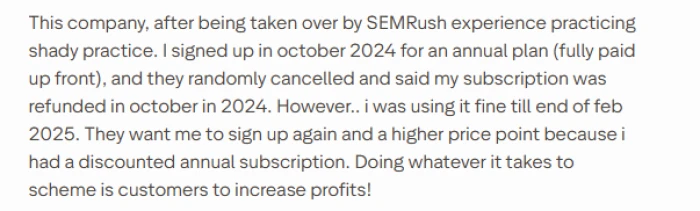
An affiliate also left a two-star review saying commissions had gone unpaid for months.
My read: ten Trustpilot reviews is a small sample, the profile is unclaimed, and unhappy customers review more often than happy ones. But the complaint is specific, repeated, and consistent with annual-only billing. I weighted it accordingly.
Where It Held Up and Where It Didn't
Summed up: strong for finding things, thin for researching them, and a checkout I'd handle carefully.
| What held up | What didn't |
|---|---|
| It surfaces niches I wouldn't have thought to search for; the database is the point | Annual billing only; the lowest plan is $468 up front |
| 1.1M+ trends, refreshed daily, with a human pass so junk is rare | Entrepreneur allows 10 Trend Analyses a month, so free-form searching is throttled |
| The interface takes minutes to learn, no analyst skills needed | Trustpilot is dominated by trial-to-annual billing complaints and refused refunds |
| Trending Products with Amazon sales, revenue and TikTok views has no free equivalent | Data sources and growth maths aren't disclosed; some growth percentages look inflated |
| Channel breakdown shows where interest is coming from, not just that it exists | Loose categorisation; topics sometimes land in the wrong category |
| Forecasting and Meta Trends give a 12-month view free tools don't | Not a keyword tool: no difficulty scores, SERP data or backlinks |
| The free newsletter and no-login browsing are useful on their own | Beta features have shipped with bugs |
Is It Just a Paid Google Trends?
No, and this was the question I most wanted answered. Google Trends answers "is X growing?" Exploding Topics answers "what's growing that I haven't heard of?" Andrew Marketing described the difference as digging for the data versus having it served, and after going through both I'd put it the same way.
| Exploding Topics | Google Trends | |
|---|---|---|
| Price | From $39/mo (annual) | Free |
| Discovery | Browse 1.1M+ curated trends by category, no keyword needed | You have to know the keyword already |
| Data | Search + social + forums + e-commerce, blended and curated | Google Search only, but it's Google's actual data |
| Scale | Monthly search volume and growth % | Relative 0–100 index; brand-new topics read as flat |
| Forecast | 12-month model projection (Investor and up) | None |
| Compare terms | Related-trend list per topic | Up to 5 terms side by side, by region and timeframe |
| Products and startups | Dedicated databases with sales and funding data | None |
| Transparency | Sources undisclosed | One source, fully transparent |
How I ended up using the two together: Exploding Topics (or its newsletter) to find candidate topics, then each one pasted into Google Trends to check the curve against real search data, look at regional interest and compare it with a couple of neighbouring terms. When the Exploding Topics line looked like a hockey stick and Google Trends showed a flat line, the growth was usually coming from TikTok or Reddit chatter rather than search demand, which changes what you'd do with it.
Who It Seems Built For, and Who It Isn't
The pattern I noticed is that the people who like it make money from being early, and the people who don't were hoping for a keyword tool.
Where it made sense to me:
• People selling physical products. Trending Products, with sales estimates, Best Sellers Rank and TikTok views, is the feature I couldn't find a free substitute for.
• Niche-site builders and content marketers who want topics before the big publishers get to them. That was Juliety's original reason for trying it: a colleague ranking quickly on trends nobody had covered.
• Investors and product managers. Trending Startups and Meta Trends give a market-wide view that would otherwise take an analyst days. The customer logos on the pricing page (Goldman Sachs, McKinsey, Norwest) suggest that's who the Investor tier is aimed at.
• Agencies, because the Business tier's 2,000 tracked trends and project folders map onto a client list.
Where it didn't:
• Marketers who need keyword difficulty, SERP or backlink data. Andrew Marketing's verdict still holds: it won't replace Ahrefs or Semrush, and for most marketers it's optional.
• Anyone who'd only open it a few times a year. With no monthly plan, occasional use means $468 for a handful of afternoons.
• Narrow B2B niches. The category list is wide but not infinite; I'd check the free category list before paying.
• Anyone who's uncomfortable with a 7-day refund window and no renewal reminder. Judging by Trustpilot, that discomfort is reasonable.
Alternatives I'd Look At First
If the annual commitment is the sticking point, these are the tools I'd compare before deciding. Prices marked ~ are approximate and should be checked on the vendor's site before you rely on them.
| Alternative | Price | Fits | How it differs from Exploding Topics |
|---|---|---|---|
| Google Trends | Free | Everyone | Google's own search data, regional breakdowns, 5-term comparison. I used it to sanity-check every Exploding Topics find. |
| Pinterest Trends | Free | DTC, home, food, fashion, weddings | Pinterest interest tends to lead retail demand by months; very few people seem to use it |
| TikTok Creative Center | Free | Short-form creators, consumer products | Trending hashtags, sounds and products by region, straight from TikTok |
| Glimpse | Free Chrome extension; paid tiers quoted on request | SEOs and marketers | Overlays real search volume, growth %, seasonality and 12-month forecasts onto Google Trends. Predates Exploding Topics. |
| Treendly | ~$99/yr | Bootstrapped founders | Very similar concept (emerging / peaking / declining curves) at a fraction of the price |
| TrendHunter | Free site; paid reports | Innovation and product teams | A human "trend hunter" network rather than an algorithm; stronger on consumer culture than on search data |
| Thieve | Free + paid | Dropshippers | Only does trending products, with supplier links |
Two more worth knowing about. Semrush's own Topic Research and .Trends tools now sit under the same roof as Exploding Topics, so anyone already paying for Semrush should check what they're entitled to before buying a second subscription. And Ahrefs isn't a trend tool, but its keyword explorer answers the question Exploding Topics never does: whether an "exploding" topic is actually rankable.
Where I landed on alternatives: if I only wanted to confirm search trends, Glimpse on top of Google Trends covers most of it for free. If I sold physical products, I'd struggle to replace the Trending Products data with anything else.
Where I Landed
The database is better than anything else I looked at for finding topics early, the interface is pleasant, and the Trending Products section does something no free tool does. The billing side is the weakest part of the whole experience, and I don't think the reviews exaggerate it.
So my answer to "is it worth it" depends on one thing: whether your work profits from being first.
• If it does (you sell products, build niche sites, or invest), the data is worth looking at, and $468 is small against one early win.
• If it doesn't, and you mainly wanted a nicer Google Trends for occasional checks, the free newsletter and the no-login site already cover that.
• Either way, I'd treat the trial as a commitment with a 7-day exit: set the reminder, cancel from the billing section, keep the confirmation.
The two most-read reviews of this tool disagree, and after going through it I think they're both right. Juliety is describing what it does for someone building authority in a niche; Andrew Marketing is describing what it doesn't do for a general marketer. Which of those you are matters more than anything in the feature list.
Verdict
3.5 / 5 - the best discovery database I found, wrapped in the worst billing experience.
| Rating | 3.5 / 5 |
| Best for | People selling physical products, niche-site builders, investors, agencies |
| Skip if | You want keyword difficulty, SERP or backlink data, or you’d open it a few times a year |
| Price | $39 / $99 / $249 a month, billed annually ($468 / $1,188 / $2,988). No monthly plan. |
| Trial | 7 days free, 7-day refund window, no renewal reminder reported |
| Strongest feature | Trending Products: Amazon Best Sellers Rank, sales and revenue estimates, TikTok views. No free equivalent. |
| Weakest point | Trustpilot sits at 2.1 / 5 and nine of ten reviews are about trial-to-annual charges and refused refunds |
| Free alternative | Google Trends + Glimpse covers search verification; it won’t replace product discovery |
If your work profits from being early, $468 is small against one topic you catch before anyone else, and the database earns it. If you mainly wanted a nicer Google Trends for the occasional check, the free newsletter and the no-login site already give you most of what you’d pay for. Either way, treat the trial as a 7-day commitment: set a reminder for day 5, cancel from the billing section of account settings, and keep the confirmation email.