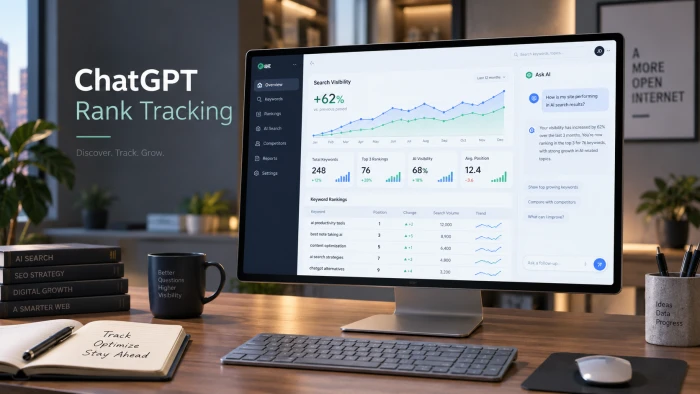

The front door to software discovery has moved. Not long ago, a buyer looking for a new tool started with a search engine and a few vendor websites. In 2026, they are far more likely to open an AI chatbot, ask a question in a peer community, or act on a recommendation from someone they already trust. This guide covers how buyers actually find new tools now, backed by current data, and what it means if you want to be on the shortlist.

The moment of discovery has shifted from a search bar to a single prompt.
AI Chatbots as the Starting Point for Research
The single biggest change is where research begins. It is no longer a search engine and a vendor website. It is a prompt.
In G2's 2026 Buyer Behavior Report, based on a survey of more than 1,000 B2B software buyers, 51 percent said they now start software research with an AI chatbot more often than with Google, up from 29 percent in April 2025. Seventy-one percent rely on AI chatbots for research in some form, and eight in ten have sourced software recommendations from tools like ChatGPT or Google AI Mode in the past two years. Only 3 percent say AI has not changed how they research at all.
The influence runs deep. Sixty-nine percent chose a different vendor than they had planned based on AI guidance, and roughly one in three bought from a vendor they had never heard of before. The wider trend is just as steep. AI search engines now handle an estimated 12 to 18 percent of English-language informational queries, up from under 2 percent a year earlier, and Gartner expects traditional search volume to fall by around 25 percent by 2026.
A typical session ends with the assistant naming three to five vendors, and that set becomes the starting shortlist.
Which AI Tools Buyers Use
Being present in the AI answer means being present in several answers, because buyers do not rely on one assistant. A March 2026 analysis of 680 million citations by Averi found that 73 percent of B2B buyers now use AI tools somewhere in their research. ChatGPT still leads by a wide margin, but the market is fragmenting quickly, and the share using each tool specifically for product research looks like this.
| AI ASSISTANT | SHARE USING IT FOR PRODUCT RESEARCH |
|---|---|
| ChatGPT | 71% |
| Google Gemini | 61% |
| Microsoft Copilot | 45% |
| Meta AI | 24% |
| Perplexity | 18% |
| Claude | 14% |
| Grok | 13% |
Share of B2B buyers using each assistant for product research. Source: Semrush 2026 survey of more than 600 US professionals.
Together, ChatGPT, Gemini, and Claude reach roughly 84 percent of assistant users, which makes those three the baseline to cover. But visibility does not transfer between them. Studies of AI citations find that only around 11 to 12 percent of cited sources overlap across ChatGPT, Perplexity, and Google AI, and the engines pull from different places. Reddit accounts for nearly half of the top Perplexity citations but under 10 percent on ChatGPT. Perplexity attributes every claim to a source, which makes a citation there especially meaningful in categories like security, infrastructure, and compliance, while Gemini rides Google Workspace and surfaces as buyers work inside Docs and Gmail. The practical point is to measure and earn visibility on each engine separately, since being named in one does not mean being named in the rest, and only about 22 percent of marketers track AI visibility at all today.
How AI Builds the Shortlist
Here is the nuance that matters most. AI is not making the final call. It builds the consideration set, and humans validate it. Forrester's research describes a two-step process, in which buyers use AI to define the problem and surface options, then turn to peers and experts to confirm what the AI told them.
The tasks buyers hand to AI are substantive rather than superficial. A survey of more than 600 US business professionals by Semrush found that 72 percent use AI during early research when they are scoping the category, and the vendor-specific work is just as deep.
| TASK | SHARE OF BUYERS |
|---|---|
| Explore possible solutions | 66% |
| Compare vendors directly | 61% |
| Understand a problem or category | 59% |
| Summarize the options | 55% |
This is why the idea of a Day One List has become so important. Bain's buyer research found that a large share of purchase decisions go to a vendor that was already on the buyer's shortlist before any salesperson entered the conversation, and that list is increasingly assembled inside AI chats. If your product is not named in that answer, you are invisible at the exact moment consideration forms.
The Role of Peer Communities
Private communities have become the de facto buyer guides for B2B software.
For all the attention on AI, the most powerful discovery channel is still other people, and it has become more organized than ever. Research by Wynter found that 65 percent of chief marketing officers start their vendor searches in peer communities, and 42 percent rank word of mouth as their single most important influence. Private communities, the report notes, have become the de facto buyer guides for B2B software.
These are the Slack groups, Discord servers, subreddits, and invite-only communities where practitioners compare notes candidly, alongside the niche newsletters and trusted creators who shape opinion in a category. The share of buyers who describe themselves as very familiar with a category before they ever engage a vendor has more than doubled in a year. Buyers now arrive pre-educated, having already formed a view from their peers and their AI research.
Discovery Channels Ranked
Put the pieces together and a clear order emerges. Peer communities and word of mouth sit at the top, the trusted layer that validates everything else. AI-assisted discovery sits right beside them, with recommendations from large language models now ranking fourth among consideration factors, ahead of Google research, vendor content, and vendor ads. Review sites and marketplaces remain durable, and have become among the most-cited sources inside AI answers, which gives them a double role. The clearest loser is cold outreach.
| CHANNEL | WHERE IT RANKS |
|---|---|
| Peer communities and word of mouth | Top, the trusted validation layer |
| AI assistant recommendations | Rising, ranked fourth among consideration factors |
| Review sites and marketplaces | Durable, and the most-cited sources inside AI answers |
| Social platforms | Supporting, for demonstration and discussion |
| Traditional search | Shrinking as a starting point |
| Cold outreach | Last, the least trusted channel |
Three figures underline how high the stakes have become. Independent research by 6sense found that AI now appears somewhere in 89 percent of B2B purchases. The Washington Post reported that visitors arriving through AI search convert to paid subscriptions at four to five times the rate of traditional search visitors. And Adobe agreed to acquire Semrush for around 1.9 billion dollars in late 2025, an explicit bet on brand visibility inside AI answers.
The Gap Between Discovery and Approval

Finding software has never been faster. Getting it approved has never been more complex.
There is a catch worth naming, because it shapes what buyers need from you. Finding software has never been faster, but getting final approval has never been more complex. G2's framing is blunt: the discovery phase has compressed to a single prompt, yet buyers then face an uphill climb to purchase, partly because AI itself is often categorized internally as risky, expensive, and opaque. Buying committees keep growing, and the confidence a buyer gains from AI research can curdle into confusion when a skeptical committee starts asking hard questions. The trust gap in AI-assisted research is the defining tension for buyers and vendors alike this year.
Who Sits on the Buying Committee
The reason approval is so hard is that the buyer is rarely one person. B2B buying committees have roughly doubled in a decade, from about 5.4 stakeholders in 2014 to eleven or more in 2026, according to Gartner. Forrester's 2026 research puts the typical decision at 22 people, 13 internal stakeholders plus 9 external advisors, while 6sense counts a tighter average near ten. The precise number depends most on deal size.
| DEAL SIZE | TYPICAL COMMITTEE |
|---|---|
| Self-serve, under $5K | 1 to 2 people |
| SMB, $5K to $25K | 3 to 5 people |
| Mid-market, $25K to $100K | 5 to 8 people |
| Enterprise, $100K to $250K | 7 to 10 people |
| Enterprise, $250K to $1M | 10 to 15 people |
| Strategic, over $1M | 15 to 25 people |
A modern committee also splits into roles. There is a champion who advocates for you, a decision-maker who signs off, influencers such as IT, security, and operations, and blockers such as procurement, legal, and finance. Procurement now acts as a decision-maker in 53 percent of cycles, and the C-suite in 68 percent, and both get involved earlier than they used to.
This is why so many deals stall. Around 86 percent of B2B purchases stall during the buying process, the most common outcome being no decision at all, which quietly kills a large share of qualified pipeline. Your champion has to sell your tool internally, to a group you will most likely never meet, so the discovery advantage that AI gives you counts for little if you cannot help that champion clear the room. It is worth noting that younger buyers, the Millennial and Gen Z cohorts, now make up more than 70 percent of B2B buyers, and they lean harder on self-service research and AI, which is part of why discovery has drifted so far from the sales conversation.
How to Get Discovered
The through-line is simple. Discovery has moved from a channel you could purchase to a reputation you have to earn, distributed across AI answers, communities, and peers. A few priorities follow directly from the data.
1. Get into the AI answer. Structure content so assistants can extract and cite it, with clear summaries, specific claims backed by evidence, question-and-answer sections, comparison tables, and visible author and date information. Earn mentions on the third-party publications and review sites that assistants trust, cover ChatGPT, Gemini, and Claude as your baseline, and audit which buyer questions your competitors are cited for on each engine separately.
2. Show up in communities honestly. Be a genuine participant in the communities your buyers live in, since that is where searches now start. Helpful presence compounds, while drive-by promotion gets tuned out.
3. Manufacture peer proof. Invest in reviews, referenceable customers, and testimonials, because human validation decides the final selection. Being easy to find is not enough if the people a buyer asks cannot vouch for you.
4. Own a clear category narrative. Define the problem you solve clearly enough that a language model and a practitioner describe you the same way, since consistency is what lets both repeat your story.
5. Help buyers win internal approval. Arm your champion with return-on-investment evidence, security and compliance documentation, and honest answers to the risk questions that AI has taught buyers to ask, because that champion is selling to a committee you will never be in the room for.
Conclusion
Buyers now discover new tools by asking an AI assistant, checking with their peers, and reading what trusted third parties say, often before a vendor knows they exist. AI builds the shortlist, communities and word of mouth decide the winner, and cold outreach has been left behind. The tools that get discovered in 2026 are the ones already being recommended, in AI answers and among peers, long before the buyer ever lands on their website.