
The short answer Gemini finds web sources through a feature Google calls grounding with Google Search. For each prompt the model decides whether a search would improve the answer; if so, it writes one or more queries, runs them against Google's ordinary search index, reads the results, writes its response and attaches the pages it leaned on as citations. There is no separate Gemini crawler and no separate Gemini index. That has three practical consequences. If Googlebot cannot index a page, Gemini cannot cite it. The Google-Extended robots.txt token controls whether Gemini may train on or ground with your content, but it does not touch Google Search, AI Overviews or AI Mode. And because Gemini often answers from memory without searching at all, how the web described you during training matters as much as how your pages read today. |
What "Gemini" means in this article
Google uses the name Gemini for several related but different things: the model family built by Google DeepMind, the consumer Gemini app, Gemini features inside Google products, and the Gemini API available to developers.
This article is mainly about the Gemini app and the Gemini API, where Gemini can decide whether a prompt needs information from the web and, when it does, use Google Search grounding to retrieve sources.
That is different from AI Overviews and AI Mode in Google Search. Those are Search products with their own retrieval behaviour and guidance, even though they use Gemini models underneath.
The distinction matters because visibility does not transfer perfectly between these surfaces. A site that appears frequently in AI Overviews may not be cited nearly as often by the Gemini app, and vice versa. So throughout this article, “Gemini” refers primarily to the Gemini app and Gemini API unless stated otherwise.
The Gemini app, Gemini in Chrome and Workspace, the Gemini API and the Gemini models behind Search are related but not identical surfaces.
Two kinds of knowledge: memory and grounding
What the model already knows
Every large language model carries a compressed impression of the web as it existed up to its training cutoff. When you ask Gemini what a product category is, how a well-known tool works or who the main players in a market are, it can usually answer from that impression without looking anything up, and in the consumer app it frequently does.
Analysts who study Google's three answer surfaces describe the Gemini app as generative by default, meaning it answers from training data with search grounding as an optional step, whereas AI Overviews are grounded by design; a useful side-by-side comparison of the three is published by Wislr.
For a brand, the implication is uncomfortable but important: the description of you that lives inside the model was formed by everything written about you across the web during the training window, and no page you publish today can change it until the next model is trained.
That is why the training corpus is not a side issue for AI visibility. If reviewers, forum threads, press coverage and your own site described you consistently and accurately while the data was being collected, the model's memory of you is stable and it can name you confidently.
If they described you inconsistently, or barely at all, the model is uncertain about you, and uncertain entities get hedged, omitted or confused with something else. This is also the mechanism by which the Google-Extended token, discussed below, affects Gemini: it governs whether your content is allowed into that memory in the first place.
When Gemini decides to look things up
Memory has a cutoff and a blur, so for anything recent, specific, numerical, local or commercial the model is far better off retrieving. Google's own description of the grounding workflow says the model analyses the prompt and determines whether a Google Search can improve the answer, and only then generates queries and runs them.
In the developer version of the product this decision is explicit enough that Google now bills grounded requests per search query the model chooses to execute. In the consumer app the same judgement happens invisibly, which is why the Sources button appears under some answers and not others.
Questions that mention a date, a price, a version number, a named product, a comparison or anything that has plausibly changed since training are the ones most likely to trigger a search, and therefore the ones where your current pages have a chance of being read.

Training memory is a compressed impression of the whole web, frozen at the cutoff. It answers first unless the question gives the model a reason to search.
How grounding with Google Search works, step by step
From prompt to grounded answer
Google documents the grounding pipeline plainly in its developer materials, and the consumer app follows the same shape. First, the prompt is analysed to decide whether search would help. Second, the model writes one or more search queries; a single question about, say, the best observability platform for a Kubernetes team might become separate queries about observability tools, Kubernetes monitoring, pricing and recent comparisons.
Third, those queries are executed against Google Search and the results are processed: the model reads the returned pages or passages, weighs them against each other and against what it already knows, and synthesises a response. Fourth, the API returns that response along with grounding metadata that links specific sentences of the answer to the specific web sources that supported them.
The full mechanics are set out in the Gemini API grounding documentation, which is the single most useful primary source on how Gemini uses the web.
The metadata is worth understanding even if you never write a line of code, because it reveals what Gemini is actually doing.
It contains the list of search queries the model generated, which shows how your original question was decomposed; a set of grounding chunks, each a web source with a title and a URL; and a set of grounding supports, each of which maps a segment of the answer text, defined by its start and end position, to one or more of those chunks.
That last structure is what powers the inline citations you see in the app. It also tells you something about how to write: the model attaches a source to a segment of its own answer, so the pages that get cited are the ones that contain a passage which cleanly supports a specific claim, not the ones that are merely on-topic.
Reading specific pages on request
Grounding is not the only way Gemini touches the web. Developers can also use a URL context tool that fetches the content of specific pages they supply, and Google's documentation notes that grounding and URL context can be combined so that an answer draws on both the open index and a handful of nominated URLs.
The consumer equivalent is what happens when you paste a link into the app, ask Gemini in Chrome about the page you are reading, or run a Deep Research task, which browses many pages over several minutes and produces a report with a sources list. The URL context documentation explains the developer side.
For site owners the point is simply that Gemini can arrive at your page by two routes, through search retrieval or through a direct fetch that a person or an application requested, and both depend on the page being fetchable and legible.

One prompt becomes several queries, each query returns candidates, and each sentence of the answer is tied back to the sources that supported it.
Where the sources come from: one index, no separate crawler
The most consequential fact about Gemini's sourcing is also the simplest. Gemini does not maintain its own crawl of the web. When it grounds, it searches the same Google index that powers the ten blue links, built by the same Googlebot that has been visiting your site for years. There is no bot called Gemini in your server logs, no separate index to be admitted to and no registration process.
Google's guidance on AI features and your website makes the same point for AI Overviews and AI Mode, stating that there are no additional requirements and no special optimisations needed beyond being indexed and eligible to appear in Search.
Everything that makes a page findable and rankable in Google, from crawlability and rendering to page quality, freshness and the site's topical authority, feeds directly into whether Gemini can find and trust it.
This cuts both ways. A site that ranks well and is cleanly indexed has a head start in Gemini that it does not have in ChatGPT or Perplexity, which run their own crawlers and their own retrieval ranking with different preferences.
But it also means that the failures are identical: a page blocked by robots.txt, hidden behind client-side rendering, marked noindex, stuck in a crawl budget problem or suppressed by a snippet control is invisible to Gemini in exactly the way it is invisible to Search.
And because Google's ranking systems decide which candidates the model reads, a page that is technically indexed but ranks on page four for every relevant query is unlikely to be retrieved at all. Google's separate guide to optimising for its generative AI features is candid that its AI features reward the same fundamentals as classic search, and that advice transfers to Gemini's grounding almost unchanged.
When Gemini searches, it searches Google. If Googlebot cannot index a page, Gemini cannot cite it. Image:
Google-Extended: the control most people misunderstand
What it is and what it is not
Google-Extended is the one Gemini-specific control that site owners have, and it is routinely misdescribed as a crawler. It is not.
Google's crawler documentation is explicit that Google-Extended has no HTTP user agent of its own and never fetches a page; crawling is done by the ordinary Google user agents, and the Google-Extended name is a product token that you address in robots.txt to control how that already-crawled content may be used downstream.
Specifically, it governs whether your content may be used to train future Gemini models and whether it may be used for grounding, which Google defines as providing content from the Search index to the model at prompt time, in the Gemini app and in Grounding with Google Search on Vertex AI.
The definition is in the list of Google's common crawlers, and it is worth reading the exact wording rather than a summary, because the scope is narrow and precise.
Two things are outside that scope, and both trip people up. Google-Extended does not affect a site's inclusion or ranking in Google Search; Google says so directly. And it does not affect AI Overviews or AI Mode, which are Search features governed by Googlebot and by the ordinary snippet controls such as nosnippet, data-nosnippet, max-snippet and noindex.
A publisher who blocks Google-Extended to keep their content out of AI Overviews has achieved nothing on that front, while quietly opting out of being cited in the Gemini app. Conversely, a site that wants to be found by Gemini gains nothing from any special allow rule, because Google-Extended is allowed by default; the only way it matters is if someone, or a plugin, has previously disallowed it.
Google also documents a distinct agent, Google-CloudVertexBot, which crawls only when a site owner explicitly asks for it while building Vertex AI agents, and which has no effect on Search or on the consumer app.
What blocking it actually costs you
Because the token covers grounding as well as training, disallowing it has an immediate effect and a delayed one. The immediate effect is that the Gemini app and Vertex-grounded applications are told not to feed your pages to the model at prompt time, so your current content stops being a candidate for citation there even though it remains fully visible in Search, AI Overviews and AI Mode.
The delayed effect is that future Gemini models are trained without your content, so the model's memory of you, the thing that answers when Gemini does not search, is built entirely from what other people wrote. For a news publisher with a licensing strategy that trade-off may be deliberate.
For a software company that wants to be recommended, it is close to self-harm, and it is worth checking now whether a robots.txt file written in 2023 contains a line that nobody has revisited since.
# Google-Extended is a control token, not a crawler. # Allowing it keeps your pages eligible for Gemini grounding and training. User-agent: Google-Extended Allow: /
# Googlebot builds the index that Search, AI Overviews, AI Mode AND Gemini grounding all use. User-agent: Googlebot Allow: /
Sitemap: https://www.example.com/sitemap.xml |

No bot called Google-Extended will ever appear in your logs. It is a line in robots.txt that governs what Google may do with pages Googlebot already fetched. Image: Unsplash.
How Gemini shows sources to the person asking
The Sources button and inline links
When a grounded answer has sources, the Gemini app shows them in two ways: as a Sources button at the bottom of the response, which opens a side panel listing the relevant links, and as inline links attached to particular sentences or phrases within the answer.
Google's help documentation on related sources and double-checking responses is explicit that not every response includes links, and that if the Sources button is absent the app simply did not provide any for that answer.
The links can include public websites, but also files the person uploaded and, for Workspace users who have connected it, their own documents and emails, which is a reminder that in many conversations the "sources" Gemini cites are not the open web at all.
If a response includes an image from the web, the app shows where it came from and links to it. Sources are not shown for responses generated with connected apps, and the feature skips code blocks and tables.
For anyone trying to understand their own visibility, the important discipline is to distinguish between the three kinds of links Gemini can surface. Sources are the pages that supported the generated answer. Related links are pages the app offers for further reading that were not necessarily used. And double-check links, described next, are something different again.
Treating all three as "citations" inflates a visibility count and hides the real question, which is whether Gemini leaned on your page when it wrote the answer. A practical walkthrough of separating these categories in an audit is published by Trakkr, and the underlying rule is simple: only the Sources panel and the inline source links count as citations.
The double-check feature is not a citation
The Gemini app also offers a double-check feature, triggered by the Google icon under a response, that runs statements from the answer through Google Search and highlights which ones Search found supporting content for and which ones it found content that disagrees with.
It is a useful verification tool, but Google's own help text is careful to say that a double-check link shows content Search found to be similar to or different from a statement, and is not necessarily what Gemini used to generate the response. In other words, a page that appears under a double-check highlight is one that Google's index would rank for that claim, not one the model read.
That distinction is easy to miss when you are pleased to see your domain, and it matters for measurement: double-check results tell you about your Search visibility for a claim, while the Sources panel tells you about your Gemini visibility.
Sources, related links and double-check results are three different things. Only the first is evidence that Gemini used your page.
Deep Research and agentic browsing
Gemini's Deep Research mode behaves differently from a single grounded answer. Given a research question it plans a multi-step investigation, browses dozens or hundreds of pages over several minutes, reasons across them and returns a structured report with a full list of the sources it drew on.
Because it reads far more pages than a normal answer and is explicitly looking for corroboration and disagreement between them, it tends to surface a much longer tail of sources, including specialist and lower-authority pages that a one-shot answer would never reach.
As Gemini gains more agentic abilities, browsing sites, comparing options and completing tasks on a person's behalf, this pattern becomes the norm rather than the exception: the pages that are clear, current, machine-readable and easy to compare are the ones an agent can act on, and the ones that are vague or gated are the ones it works around.
What Gemini actually cites
The 2026 picture
Independent trackers now publish monthly rankings of the domains Gemini cites, and the pattern is consistent enough to plan around.
Ahrefs' Brand Radar dataset, which its team turns into a monthly list of the most-cited websites in Gemini, put Reddit at the top through mid-2026 with a mention share above a quarter of all citations among the top sources, with YouTube and Wikipedia next at roughly 13 and 12 percent respectively, followed by Forbes and, unusually, retail domains such as Walmart and eBay.
Gemini is the only major engine in which shopping sites earn a meaningful slice of top-fifty citation share, and it draws on Google-owned surfaces, including YouTube, Maps, Play Store listings and Knowledge Graph entities, more heavily than any other assistant. Community content, video, reference material and commerce, in roughly that order, are what Gemini reaches for.
The YouTube finding deserves particular attention because it is so different from the other engines. Profound's analysis of citation patterns by platform found that Gemini over-indexes on long-tail YouTube videos with fewer than a thousand views, whereas ChatGPT is far more likely to cite high-view videos.
The sensible reading is that Gemini treats a video transcript as first-class citable text and matches on what is said rather than on popularity, so a ten-minute product walkthrough from a small channel can be cited by Gemini for a specific question even when nobody would call the channel authoritative. For a B2B company that has never bothered with video, that is a cheap and underused route into Gemini's source pool.
38.5% The share of the Gemini app's top two hundred cited domains that also appear among the top domains for AI Overviews, according to a mid-2026 citation dataset. AI Overviews and AI Mode, by contrast, overlap by 87 percent. Gemini is a separate channel even inside Google. |
Why Gemini's list looks the way it does
Three forces shape the list. The first is the index: Gemini can only cite what Google has crawled and ranked, so sites that do well in Search are structurally over-represented, and Google-owned properties that are deeply integrated with Search are over-represented further. The second is the model's preference for corroboration, which favours sources where many independent people have said similar things, hence Reddit, Quora and review sites.
The third is the model's memory, which for a Google model was formed on a corpus in which YouTube transcripts, Maps data and Knowledge Graph facts are unusually well represented.
The tracker that measured the 38.5 percent overlap between the Gemini app and AI Overviews, Omnia, draws the practical conclusion that a strategy built for AI Overviews transfers reliably to AI Mode but only partially to Gemini, and that the gap is where Gemini-specific work lives.
Video is a text source to Gemini
It follows from all of the above that YouTube should be treated as a publishing channel for Gemini visibility rather than a brand-awareness afterthought. Transcripts are indexed, spoken answers are extractable, and Gemini demonstrably cites small channels when the words match the question.
A short, plainly titled video that answers one specific buyer question, with the answer spoken clearly in the first minute and a written description that restates it, is doing for Gemini what an answer-first page section does for the text engines. Podcasts that are published to YouTube with accurate transcripts count as well. None of this requires production values; it requires that someone from the company say something specific and checkable on camera.

To Gemini a transcript is text. A spoken, specific answer on a small channel can be cited where a polished page is not.
How Gemini differs from ChatGPT and Perplexity
The engines look similar from the outside, each producing a paragraph with a handful of links, but their plumbing is different in ways that decide who gets cited. ChatGPT search runs OpenAI's own crawler alongside a third-party index and is famously volatile in its source mix, with the leading domains swapping places from month to month.
Perplexity is retrieval-first, searches on almost every prompt, cites almost every time and leans heavily on recency and on Reddit.
Gemini sits at the other end of that spectrum: it searches selectively, it searches Google, and when it does not search it answers from a memory that was formed on a Google-flavoured corpus.
That makes it the most Search-dependent of the assistants and the one where classic SEO work carries over most directly, while also being the one where a purely on-page strategy is least sufficient, because so many answers are never grounded at all.
The mechanics of every engine, the citation data behind them and a 90-day plan for earning citations across all of them are covered in our complete guide to Answer Engine Optimization; this article is the Gemini chapter of that larger picture.
| Question | Gemini app | ChatGPT search | Perplexity |
|---|---|---|---|
| Where do sources come from? | Google's Search index via grounding; no separate crawler | OpenAI's own crawler (OAI-SearchBot) plus a third-party index | Perplexity's own crawler and index (PerplexityBot) |
| Does it search every time? | No. The model decides per prompt; many answers come from memory | Often, but falls back on memory for familiar questions | Almost always; retrieval-first by design |
| How often are citations shown? | Only when grounded; Sources button appears for some answers | Most searched answers show inline links | Nearly every answer carries numbered citations |
| Top cited domains (2026) | Reddit, YouTube, Wikipedia, Forbes, retail sites | Reddit, Wikipedia, YouTube, news and finance publishers | Reddit, then a broad recency-weighted mix |
| Site-owner control | Googlebot for indexing; Google-Extended for grounding and training | OAI-SearchBot for search; GPTBot for training | PerplexityBot for indexing; Perplexity-User for fetches |
| Fastest lever | Rank in Google, publish video, keep entity data consistent | Reference-grade coverage, fresh dates, Wikipedia eligibility | Frequent refreshes, genuine community presence |

Same-looking answers, different plumbing. Gemini is the most Search-dependent assistant and the one that most often answers without searching.
What this means for your website
Be indexed, be ranked, be legible
Because Gemini grounds against Google's index, the first job is the unglamorous one: make sure every page you would want cited returns a clean 200, is server-rendered so that its main content is present without JavaScript, is not blocked or noindexed, sits in an accurate sitemap and is reachable through internal links from pages that already rank.
Then make sure it actually ranks for the questions that matter, because Google's ranking systems decide which candidates the model reads and a page that cannot make the first page for any relevant query is unlikely to be retrieved for grounding either.
Once a page is a candidate, legibility takes over: the model attaches citations to passages that cleanly support specific claims, so each section should state its claim in the first sentence, back it with a concrete number, date or named source, and stand on its own if read in isolation.
Google's introduction to structured data is the right reference for the markup side; it will not force a citation, but Organization, Person, Article and Product markup that mirrors the visible page removes ambiguity about who wrote what, when, and about which entity.
Feed the memory, not just the index
Since a large share of Gemini's answers are never grounded, the second job is to shape the model's memory of you, and that is done off your own site.
Consistent, accurate descriptions of the company and product across review platforms, community threads, trade coverage, partner documentation and your own profiles are what the training corpus absorbs, and they are also what the grounding step retrieves when it does run, because those are the domains at the top of Gemini's citation list.
Reddit and Quora presence should be real people answering real questions transparently, never astroturfing, which the communities detect and which then gets cited against you for years. Video, as discussed above, is a text source to Gemini and a cheap one to produce.
And for any company with a physical footprint or a local element to its business, a complete and active listing in Google Business Profile is a direct feed into the Maps and Knowledge Graph data that Gemini draws on more than any other assistant.
Keep the entity clean across Google's surfaces
Gemini leans on Google's Knowledge Graph to understand who and what an entity is, so the same name, description, logo, founding details, address and category should appear on your site's Organization markup, your Business Profile if you have one, your YouTube channel's About section, your Play Store listing if you ship an app, and your Wikipedia and Wikidata entries if you qualify for them.
Discrepancies between those surfaces are exactly the kind of uncertainty that causes a model to hedge or to confuse you with a similarly named company. This is the piece of Gemini-specific work that most teams have never done, and it is also the piece with the longest tail, because a clean entity is inherited by every future Gemini model and by every Google surface at once.
How to check whether Gemini uses your site
Run the prompts by hand first
The simplest audit is the one nobody skips once they have done it. Write down twenty to fifty questions a buyer would ask before choosing between you and your closest competitors, run each through the Gemini app on a fixed schedule, and record whether you were absent, mentioned, cited or recommended, which competitors and third-party sources appeared instead, and whether the description of you was accurate.
Note separately whether the answer was grounded at all, because an ungrounded answer is telling you about the model's memory while a grounded one is telling you about your index presence, and the fix for each is different. Keep the prompt wording and the date for every run, since Gemini's answers vary between sessions and a single result proves little on its own.
Where you appear only in double-check highlights and never in the Sources panel, treat that as a Search signal rather than a Gemini citation.
Use the API to see the queries and sources directly
The Gemini API offers something no other assistant does as cleanly: a way to see exactly which searches the model ran and which pages it used.
In Google AI Studio you can turn on the Google Search tool, send one of your buyer prompts and inspect the grounding metadata in the response, which lists the generated search queries, the grounding chunks with their titles and URLs, and the supports that map each sentence of the answer to its sources.
The URLs come back wrapped in a Google redirect that resolves to the real page when opened, so the domain is easy to identify.
Running a prompt set this way on a schedule turns "does Gemini cite us" from a guess into a dataset, shows you the sub-queries your question is decomposed into so you can write for them, and reveals which competitor pages are winning each one.
It is the same model and the same grounding that the app uses, so the results are a fair proxy even though the consumer app adds its own presentation layer and personalisation.
3 fields webSearchQueries, groundingChunks and groundingSupports. Together they show what Gemini searched for, which pages it read and which sentence each page supported. No other major assistant exposes its retrieval this transparently. |
What Search Console does and does not tell you
Google's generative AI performance report in Search Console, rolled out worldwide at the end of August 2026, reports impressions from AI Overviews, AI Mode and the generative features in Discover, as its help page describes.
It does not include the Gemini app, which is a separate product rather than a Search feature, so a healthy AI impressions line in Search Console tells you about Google Search's AI surfaces and nothing directly about Gemini. Analytics helps a little more: the Gemini app sends referral traffic with gemini.google.com as the referrer, so a segment for that source shows how many people clicked through from a cited link.
The volume will be small; the conversion rate is the number to watch. Between manual prompt runs, API grounding data, Search Console for the Search surfaces and a referral segment for the app, you have a complete enough picture to manage against without buying anything.
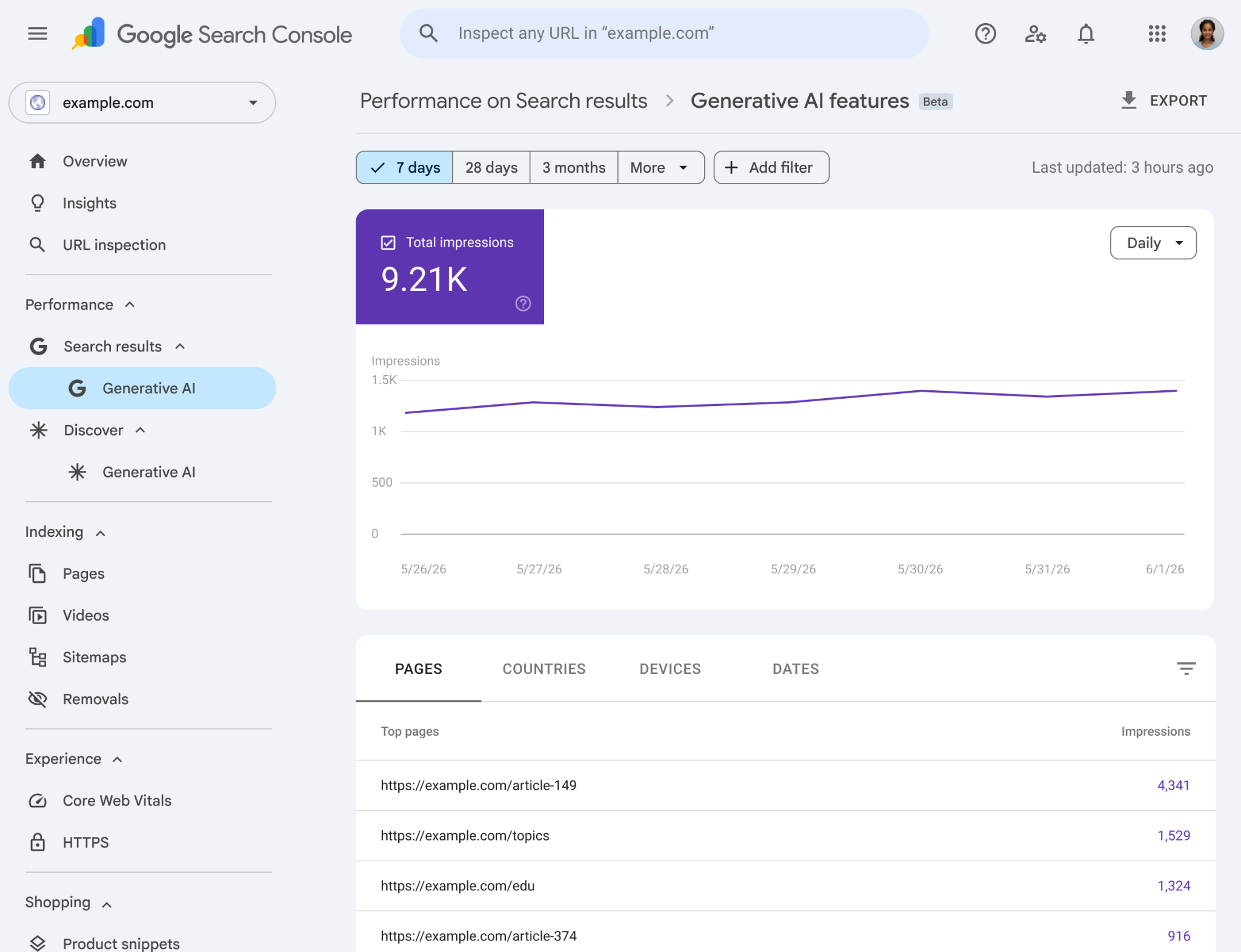
Search Console's generative AI report covers AI Overviews, AI Mode and Discover. The Gemini app is measured separately, through prompts, the API and referrals.
Five misconceptions worth clearing up
"Gemini has its own crawler"
It does not. Gemini grounds against the Google Search index built by Googlebot, and the only Gemini-specific robots.txt control, Google-Extended, is a usage token that never fetches anything. If you are looking for a Gemini bot in your logs you will not find one, and if a vendor tells you to "allow the Gemini crawler" they are describing Googlebot.
"Blocking Google-Extended removes me from AI Overviews"
It does not. AI Overviews and AI Mode are Search features that draw on the index Googlebot builds and are governed by the ordinary snippet and index controls. Google-Extended affects Gemini training and grounding in the Gemini app and on Vertex AI, and nothing else. Publishers who blocked it to escape AI Overviews are still in AI Overviews and have opted out of the Gemini app instead.
"Gemini always searches before answering"
It does not. The model decides per prompt whether a search would improve the answer, and for familiar, general or conceptual questions it frequently answers from training memory with no sources at all. Perplexity searches nearly every time; Gemini is closer to the opposite. That is why the training corpus, and therefore your off-site footprint, matters so much for Gemini specifically.
"If my domain appears anywhere in the response, that is a citation"
Only the Sources panel and inline source links are citations. Related links are suggestions for further reading, and double-check highlights are Search results for a claim, which Google says are not necessarily what the model used. Counting all three as citations inflates the numbers and hides the real gaps.
"Ranking well in Google means Gemini will cite me"
Ranking is necessary but not sufficient. Ranking makes a page a candidate for grounding; being cited requires that the page contain a passage which cleanly supports a specific claim in the answer, and it requires that the model chose to search in the first place.
Gemini also shares only around 38 percent of its top cited domains with AI Overviews, so a good result in Google's Search AI features is evidence of eligibility, not of Gemini visibility.
Most Gemini myths come from confusing a crawler with a control token, or a Search feature with the Gemini app.
The bottom line
Gemini finds web sources by searching Google, and only when the model decides a search is worth running. There is no Gemini crawler to allow, no Gemini index to join and no special file that changes the outcome.
If your pages are indexed, ranked and written so that each section supports a specific claim, they are eligible to be read and cited whenever Gemini grounds; if they are not, nothing else in this article can help, because grounding can only retrieve what Google already holds.

One index, two kinds of knowledge, three kinds of link. Understand those and Gemini's sourcing stops being a mystery.
The part that is different about Gemini is how often it does not search. A large share of its answers come from a memory formed on the web as it was during training, and that memory is shaped by review sites, community threads, video transcripts, Maps and Knowledge Graph data and press coverage far more than by your own pages.
Google-Extended is the switch that decides whether your content is allowed into that memory and into live grounding, and it should be left open by any company that wants to be recommended.
Beyond that, the work is to describe yourself consistently across every surface Google reads, to put specific, checkable answers on video as well as on the page, and to measure Gemini on its own terms rather than through Search Console, using a fixed prompt set and the grounding metadata the API is unusually willing to show you.