
Why follow a single page Internal linking guidance is usually organised by tactic, which is why it reads as a list of things to do rather than a system. Organised around one URL, the dependencies become obvious. A page that fails at stage two never reaches stage five, so effort spent on placement while the page is orphaned produces nothing at all. The running example is a new integration page on an AI SaaS site, because that is the page type most likely to fail at several stages at once. Everything applies equally to a glossary entry, a use case page or a documentation node. |
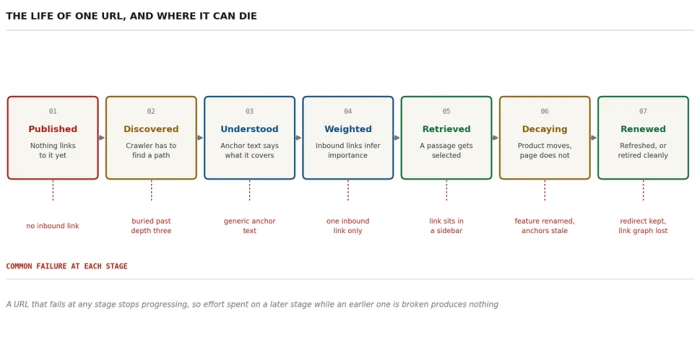
The seven stages, and the failure that most commonly stops a page at each one
STAGE 01 OF 07 PublishedThe page exists and nothing points at it |
The integration page ships with the template that generated it. It has a URL, it returns a valid response, and it appears in the sitemap. On most AI SaaS sites this is where a substantial share of pages stop permanently.
WHAT MUST BE TRUE At least one inbound internal link from another indexable page. Internal links are how pages are discovered and how importance is inferred, and a page reachable only through sitemap submission carries a much weaker signal than a linked one. |
HOW IT FAILS ON AN AI SAAS SITE Programmatic families are generated in bulk and linked from a single index page, which is itself often buried. That produces one fragile path to hundreds or thousands of URLs, and any change to the index page severs all of them simultaneously. |
WHAT TO DO, AND HOW TO CHECK Compare a full crawl against your sitemap and CMS export. Anything present in the latter and absent from the former is an orphan. Start with orphans already showing impressions in search console, since those are pages earning attention that your own site is not supporting. |
The highest return query in this whole guide Pages with impressions in search console and zero inbound internal links. They are already ranking for something despite receiving no support from your own graph, which makes them the cheapest available improvement and the easiest to justify to whoever holds the budget. |
STAGE 02 OF 07 DiscoveredA crawler has to be able to reach it, and to parse the link that leads there |
A link exists now, but existing is not the same as being followable. Two separate things can break here, and the first is syntactic rather than structural.
Google states that it can generally only crawl a link that is an anchor element with an href attribute, and that most links in other formats will not be parsed or extracted. Links inserted by JavaScript are crawlable provided they render as that same markup. An anchor element without an href creates a target rather than a link.
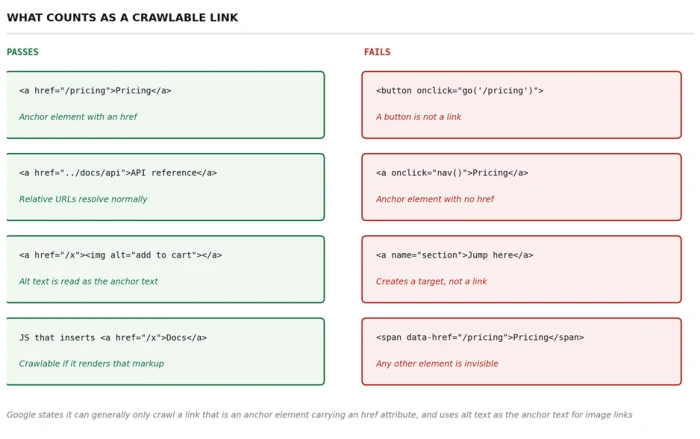
The distinction Google documents, with the four patterns that fail most often on JavaScript heavy sites
WHAT MUST BE TRUE The link is an anchor element with an href pointing at a resolvable URL, it is present in the rendered HTML, and it appears in the mobile rendering as well as the desktop one. |
HOW IT FAILS ON AN AI SAAS SITE Component libraries produce navigation as buttons with click handlers, and client rendered applications create anchors only after hydration. Separately, collapsed mobile menus and trimmed mobile footers drop links that exist on desktop, which matters because indexing is based primarily on the mobile rendering. |
WHAT TO DO, AND HOW TO CHECK View source on your highest value templates rather than trusting the browser, and use the URL Inspection tool to check the rendered HTML. Crawl the site twice, once with a smartphone user agent and once with a desktop agent, then compare the discovered URL sets. |
Two documented points worth stating plainly Google instructs site owners to keep mobile content equivalent to desktop, and warns that differing robots meta tags on the mobile version may cause it to fail to index or follow links on the page. It also states that it will not load content requiring user interactions such as swiping, clicking or typing, which means links inside an interaction gated accordion or tab are never seen. Breadcrumb structured data does not substitute for either. It helps render breadcrumbs in results, and Google has been explicit that it does not treat those URLs the same way as ordinary internal links in the page body. |
The structural half of this stage is depth. Click distance from the homepage influences how often a page is crawled, and audit tools flag pages beyond three clicks as a specific issue. On an AI SaaS site the pages that cross that line are predictable: individual integration pages, older glossary entries and deep documentation nodes. Depth is a property of the link graph rather than the URL path, so a short URL can still sit deep.
STAGE 03 OF 07 UnderstoodSomething has to say what the page is about |
The page is now reachable. Nothing yet tells a search engine or a model what it covers, beyond the page itself. Anchor text is the mechanism that transfers meaning rather than merely equity, and it is the cheapest thing in this guide to fix.
Google documentation states that anchor text tells both people and Google something about the page being linked to. It also states that for images used as links it uses the alt attribute of the image element as the anchor text, which means an image link with empty alt is an anchor carrying no anchor text at all.
WHAT MUST BE TRUE Anchor text describes the destination rather than the action, one canonical phrase dominates the links pointing at each important page, and no single phrase points at two different destinations. |
HOW IT FAILS ON AN AI SAAS SITE Templates generate the same generic anchor across thousands of programmatic pages, so the phrase carries no information and repeats identically everywhere. Separately, a glossary term and a product page routinely compete for the same wording, which splits the association and leaves both ambiguous. |
WHAT TO DO, AND HOW TO CHECK Export every internal anchor and sort by frequency. Generic phrases in the top twenty indicate a template problem rather than a writing problem, which is the cheaper thing to fix. Then group by phrase and flag any pointing at more than one URL. |
On link volume, since it always comes up No documented correct number exists. What is documented is that high counts dilute what each link carries, and Google representatives have noted that too many links make it harder to identify which pages actually matter. The workable test is whether each link answers a question the reader plausibly holds at that sentence. |
STAGE 04 OF 07 WeightedImportance is inferred from how the rest of the site treats it |
The page is reachable and described. Now the graph decides how much it matters, because internal links are also how a search engine infers which pages you consider important. Link equity, historically called PageRank and now more often described as importance scoring, flows along them.
This is the stage where the structural break specific to AI SaaS does the most damage.
WHAT MUST BE TRUE The page carries several inbound links from genuinely related pages, it links upward to a parent, and the marketing and documentation estates link to each other in both directions. |
HOW IT FAILS ON AN AI SAAS SITE Marketing pages and product documentation sit on separate stacks, are owned by different teams, and often live on different paths or subdomains. The link between them belongs to nobody, so it is usually missing entirely, which severs the graph at its most valuable seam. |
WHAT TO DO, AND HOW TO CHECK Filter internal links by source and destination path prefix and count crossings in each direction. Track that number as a standing metric, because it starts near zero on most sites and regresses after every documentation migration. |
The single largest available gain on most AI SaaS sites Building the marketing to documentation join in both directions. Product and integration pages link into the relevant documentation, and documentation links back to product, integration and glossary pages. It requires agreement between two teams rather than any technical work, which is precisely why it does not happen by default. |
STAGE 05 OF 07 RetrievedA passage from the page gets selected and cited |
This stage did not exist in this form two years ago, and it changes what a link placement decision is worth.
Answer engines assemble responses from passages rather than whole pages. A prompt is expanded into sub queries, candidate pages are broken into chunks, those chunks are compared to the query semantically, and the highest scoring passages are passed to the model with citation markers attached. Your site is read at the section level.
In May 2026 Google published its first official guidance on optimising for generative AI features and dismissed several popular tactics, including content chunking, llms.txt files and AI specific rewriting. It did not dismiss internal linking, and the mechanism above explains why placement now carries weight it previously did not.
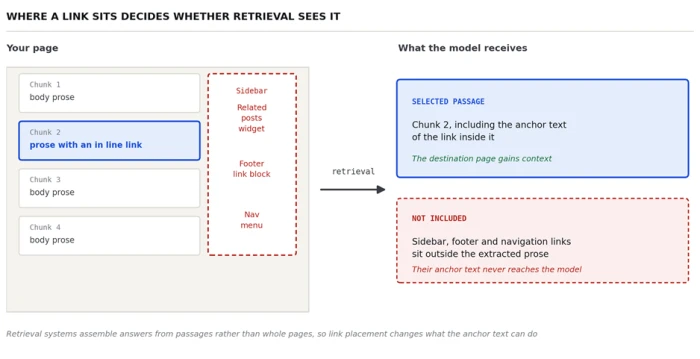
The same page, and the two different fates of a link depending on where it sits
WHAT MUST BE TRUE Links to pages you want understood and cited sit inside body prose, and the paragraph around each one makes sense read in isolation. |
HOW IT FAILS ON AN AI SAAS SITE Related content modules, sidebars and footer link blocks are the default place SaaS templates put internal links, and all three sit outside the prose a retrieval system extracts. Their anchor text therefore never reaches the model, however well written it is. |
WHAT TO DO, AND HOW TO CHECK Sample twenty pages and classify each internal link by placement, then compute the share of links to priority pages sitting in body text. Read any paragraph containing a priority link with the rest of the page covered, and rewrite the opening sentence if the subject is only established elsewhere. |
This is about placement, not removal Sidebar and navigational links still pass equity and still aid discovery, so they are not wasted and should not be stripped out. What they do not do is contribute anchor text to an extracted passage. Keep them, and move the links that carry meaning into sentences. One further caution. Figures circulating about which portion of a page gets cited come largely from tool vendors rather than platform operators and move quickly, so treat them as directional rather than as targets. |
STAGE 06 OF 07 DecayingThe product moves and the page does not |
Every site accumulates stale links. An AI SaaS site does it faster, because the product changes underneath the content on a weekly cycle, and the decay here is quieter than a broken link because nothing about the page fails.

Product velocity is what makes maintenance a stage of its own rather than an afterthought
WHAT MUST BE TRUE Anchors describing a capability are updated when that capability is renamed or deprecated, and documentation migrations are treated as linking work rather than solely as engineering work. |
HOW IT FAILS ON AN AI SAAS SITE A renamed feature leaves dozens of anchors across the site describing it by a name nobody searches. A docs restructure moves URLs in bulk and can break every cross estate link in one deployment, while redirects keep the pages reachable and disguise the loss. Comparison pages describe a competitor at a moment in time and age silently. |
WHAT TO DO, AND HOW TO CHECK Add a linking step to the release checklist, and search the anchor export for the old term after any rename to confirm zero remaining instances. Capture the cross estate link count before and after any documentation migration, and treat any drop as remediation rather than an accepted cost. |
STAGE 07 OF 07 RenewedRefreshed deliberately, or retired cleanly |
Most guides stop at stage six. The final stage matters because an AI SaaS site produces obsolete pages continuously, and how you retire them determines whether the equity they accumulated is preserved or discarded.
WHAT MUST BE TRUE Every page has an owner and a review date, and retiring a page includes redirecting it to the closest live equivalent and updating the anchors that pointed at it. |
HOW IT FAILS ON AN AI SAAS SITE Deprecated feature pages are usually deleted or left in place untouched. Deleting discards whatever the page accumulated, while leaving it produces a page describing behaviour that no longer exists, which is worse than a broken link because nothing signals it. |
WHAT TO DO, AND HOW TO CHECK Maintain a review date and owner on comparison pages and on anything describing product behaviour. When retiring, redirect to the nearest live page rather than to the homepage, then rewrite the anchors that pointed at the old URL so they describe the new destination. |
Redirect chains are the quiet cost here A retired page redirected to a page that is later itself retired produces a chain, and chains accumulate across years of product change. Keep links pointing at final destinations rather than relying on the redirect layer to resolve them, since the redirect preserves reachability while the link graph slowly degrades behind it. |
INSTRUMENTATION
Five numbers, one per failure point
Each metric detects regression at a specific stage, so a change tells you where to look rather than only that something moved.
| Metric | Stage it protects | Where to get it | Target condition |
|---|---|---|---|
| Orphan count | Stage 01 | Crawl compared with sitemap and CMS export | Zero among pages intended to rank |
| Pages beyond depth three | Stage 02 | Crawl depth report | No revenue attributed page in the set |
| Generic anchors in the top twenty | Stage 03 | Anchor export sorted by frequency | None, since this indicates a template fault |
| Cross estate link count | Stage 04 and 06 | Internal links filtered by path prefix | Rising, and never falling after a migration |
| In prose share of priority links | Stage 05 | Sampled pages classified by placement | Majority sitting inside body text |
Run the audit in stage order The stages are dependent, so the audit is too. Fix crawlability before depth, depth before anchors, anchors before placement. Teams almost invariably start by adding contextual links inside individual articles, which is the most enjoyable part of the work and the least consequential while an earlier stage is broken. |
EXPLICITLY OUT OF SCOPE
Things commonly asserted that are not required
A guide is often more useful for what it excludes, because exclusions end recurring internal arguments. Each of these is either undocumented, contested, or dismissed by the platform whose behaviour it claims to influence.
| Commonly asserted | Status | What to do instead |
|---|---|---|
| An llms file is needed at the site root | Google stated in May 2026 that it receives no special treatment | Add one if you wish, but do not let it displace graph work |
| Content must be chunked for AI systems | Explicitly dismissed in the same guidance | Write self contained paragraphs, which helps for other reasons |
| Pages should cover a single topic only | The same guidance stated multi topic pages are fine | Structure for readers and let the sections do the work |
| Nofollow steers crawl budget usefully | Described by Google representatives as not making much sense internally | Control crawl through structure and robots rules instead |
| Breadcrumb markup replaces internal links | Google has stated those URLs are not treated the same way | Ship real anchor elements in the page body |
| There is a correct number of links per page | Undocumented, though dilution at high counts is acknowledged | Link where a reader has a question, and stop |
| AI citation percentages are stable enough to target | Vendor reported, volatile, and inconsistent between platforms | Treat as directional and avoid building targets on them |
Platform guidance changes, so re-verify any status here before citing it in an internal argument.
Verdict
Internal linking on an AI SaaS site is not a hard technique badly executed. It is a straightforward technique that fails structurally, and following one URL through its life shows exactly where.
Two stages account for most of the loss. Stage 01, because programmatic page families are generated in bulk and hang from a single fragile index page, so large numbers of URLs never enter the graph at all. And stage 04, because the marketing and documentation estates sit on different stacks with different owners, which leaves the most valuable seam on the site belonging to nobody.
Neither is a technical problem. The first is a template decision and the second is an agreement between two teams, which is why both persist on sites with capable engineers and competent content people.
The genuinely new stage is 05, and it is worth being precise about what changed. Answers are now assembled from passages rather than pages, so a link inside a sentence contributes its anchor text to what the model reads while a link in a sidebar does not. That does not make navigational links worthless, and it does not justify restructuring a site that works. It means the links carrying meaning belong in prose, at no cost beyond where you place a sentence.
What has not changed is more reassuring than most coverage of AI search suggests. Internal links remain how pages are discovered, related and prioritised. Google published guidance in May 2026 dismissing several tactics built around AI search while leaving those fundamentals untouched, which makes this one of the few areas where the durable advice and the current advice are the same advice.
If you do only two things Build the marketing to documentation join in both directions, and move your priority links into prose. The first repairs the structural break this category of site has by default and requires agreement rather than engineering. The second aligns the graph with how answers are now assembled and costs nothing but placement. Everything else in this guide exists to keep those two from eroding once the team grows and the product keeps shipping. |