

Your site can compete against the whole internet and still lose to itself. When several of your pages target the same keyword, search engines struggle to tell which one to rank, so they spread the signal across all of them. The result is a handful of pages that each rank a little, and none that rank well.
That is keyword cannibalization, and it is one of the most common self-inflicted SEO problems. It rarely announces itself. Your pages keep getting indexed, some traffic still trickles in, and nothing throws an error, which is exactly why it can go unnoticed for months.
The good news is that it is also one of the most fixable problems in SEO. Once you learn to spot the overlap, most cases come down to a single decision per cluster of pages. This guide walks through what cannibalization is, why it costs more than it looks, how to find it, and how to keep it from coming back.
What keyword cannibalization actually is
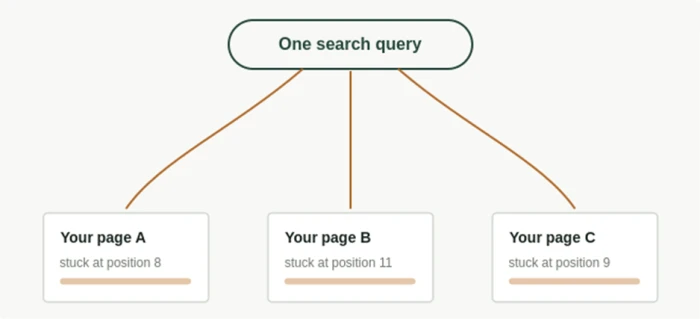
One query, three of your own pages. The ranking signal splits three ways, so each page earns a little and none of them reaches the top.
Keyword cannibalization happens when two or more pages on the same site target the same keyword or the same search intent. Instead of reinforcing one another, they compete for one position in the results, and your own pages end up as each other's rivals.
Search engines pick a single URL to represent a piece of content for any given query. When your pages overlap, you hand that decision to the search engine rather than making it yourself. Google describes how it clusters similar pages and selects one representative URL in its documentation on canonicalization.
The trap is that cannibalization is rarely about text that matches word for word. It is about overlapping purpose. Two articles can read completely differently and still answer the same question for the same searcher, which is all it takes for them to compete.
A quick example
Imagine a software company publishes three posts over two years: one called “email marketing tips”, one called “how to improve email marketing”, and one called “email marketing best practices”. Each was written by a different person at a different time.
To a reader, they feel like separate articles. To a search engine, they answer one intent, so all three line up for the same query and split the signal between them. None of the three ranks as well as a single, complete page would have.
The main types of overlap
Not every clash looks the same, and naming the type makes it easier to choose the right fix later.
Four kinds of overlap
| Type | What it looks like |
|---|---|
| Exact overlap | Two pages target the identical keyword and cover almost the same ground |
| Intent overlap | Different keywords, yet both pages answer the same underlying question |
| Partial overlap | One page's whole topic is buried as a single section inside another page |
| Format overlap | A category page and a blog post compete for the same commercial term |
It is not the same as having related pages
Covering a topic from several angles is healthy, and it is how strong topic clusters are built. A pillar page and its supporting articles are meant to sit together, each answering a different question and pointing back to the hub.
Cannibalization is the opposite. It is when those pages blur into the same question, so neither a reader nor a search engine can tell why both exist. A simple test: if two pages could swap titles and nobody would notice, they are competing rather than complementing.
Why it quietly hurts your rankings
The damage is easy to miss, because nothing looks broken. Each page still exists, still pulls a little traffic, and still appears somewhere in the results. There is no penalty and no warning message.
Underneath, though, your ranking strength is being divided. The links, relevance, and authority that should stack up on one page get spread thin across several, so no single page is strong enough to break into the top few results.
What cannibalization costs you
| What suffers | What actually happens |
|---|---|
| Ranking position | Two mid-page results instead of one strong result near the top |
| Click-through rate | Searchers see competing snippets from your site and trust none of them |
| Link equity | Backlinks land on different URLs and dilute one another |
| Internal links | Your own links point at several rivals, splitting the value you meant to pass |
| Crawl focus | Search engines waste effort deciding between near-identical pages |
| Conversions | Traffic scatters across pages that were never your strongest one |
There is also a slower, quieter cost. When two pages keep trading places for one query, your rankings look unstable and your analytics turn noisy. That noise makes every other decision harder, because you can no longer tell whether a change helped or the pages simply swapped again.
The effect compounds as a site grows. A handful of overlapping posts is a nuisance. A few hundred, built up across years of publishing, can quietly cap how well the whole site performs.
Warning signs to watch for
You do not need a tool to suspect cannibalization. A few patterns tend to surface first, and any one of them is worth a closer look.
Common early signals
| Sign | What it usually means |
|---|---|
| Rankings bounce between two of your URLs for one query | The search engine keeps switching which page it trusts |
| An older page outranks the one you optimised | Your intended page is losing ground to legacy content |
| Traffic dipped soon after you published a similar post | The new page pulled signals away from the old one |
| Several pages sit on page two for the same term | Your strength is split just below the top results |
| Multiple titles look almost identical in search | The pages overlap far more than you realised |
| A strong page slipped after you refreshed another one | The edit pulled relevance toward the wrong URL |
Treat these as clues, not proof. Any single sign can have another cause, so the goal is to collect suspects first, then confirm them with the checks below before you change anything.
How to find keyword cannibalization

Finding cannibalization is detective work, and most of the tools you need are free.
Work through these steps in order, because each one narrows the field before you commit to a change.
1. Run a site search
In Google, type site:yourdomain.com followed by your target keyword, then skim the results. If several of your own pages appear for the same phrase, you have a first list of suspects. Repeat for each keyword that matters to you.
2. Check Search Console by query
Open the Performance report, filter to one keyword, then switch to the Pages view. If a single query sends impressions to several of your URLs, the overlap is in plain sight. Google's guide to the Search Console Performance report covers how to move between the queries and pages views. Watch for any query where clicks are split fairly evenly across two pages.
3. Build a keyword-to-URL map
List your important keywords in a spreadsheet and note the one page that should own each. When you find a keyword sitting next to two or more URLs, you have caught a clash on paper before it costs you anything in the results.
4. Group your pages by intent, not by folder
Sort your URLs by the question each one answers rather than by where they live in your menu. Competing pages often sit in different sections, so folder structure hides them. This is the same grouping step at the heart of a content audit, which is the fastest way to surface overlap across an entire site.
5. Compare intent side by side
Open the suspect pages next to each other and ask whether a searcher would be equally happy landing on either. If the answer is yes, they are too similar to keep as they are.
6. Confirm the value of each page
Record the traffic, backlinks, rankings, and conversions for every page in the cluster before you touch anything. This is how you decide which page to keep and which to fold in. Never merge or delete on a hunch, because the wrong call can retire your best performer.
A quick test If you cannot say in one sentence why two pages both deserve to exist, they probably do not. That single sentence is the line between a healthy topic cluster and a cannibalization problem. |
How to fix keyword cannibalization

Every cluster of competing pages needs one decision: keep, merge, redirect, or set apart.
Once you know which pages compete, choose one fix per cluster. The right move depends on how much value each page holds and whether both need to stay live for readers.
First, pick the winner
Most fixes start by deciding which page should own the keyword. Compare the candidates on a few practical measures and let the strongest one win.
How to choose the page to keep
| Signal | Why it matters |
|---|---|
| Backlinks | The page with more quality links holds authority that is hard to rebuild elsewhere |
| Rankings and traffic | A page already near the top is usually the safest one to back |
| Conversions | The page that turns visitors into customers has earned its place |
| Relevance to intent | The page that answers the query most directly is the natural keeper |
| URL and title quality | A clean, descriptive URL is easier to keep than to replace |
Then choose the fix
With a winner chosen, match the situation to one of these five moves.
Five ways to resolve a clash
| Fix | Use it when | What you do |
|---|---|---|
| Merge | Two thin pages cover the same ground | Combine them into one stronger page, then redirect the weaker URL |
| Redirect | One page clearly wins and the other adds little | Point the weaker page at the winner with a permanent redirect |
| Canonical | Both pages need to stay live for users | Set a canonical tag so search engines know the primary version |
| Differentiate | Each page has a real, separate purpose | Rewrite them to target distinct intents and distinct keywords |
| De-optimise | A page competes only by accident | Shift its title, headings, and internal links toward a different term |
For merges and redirects, the mechanics matter. A 301 redirect passes most of a page's earned signals to its new home, and it is your default when a page is being retired for good. A canonical tag is different: it keeps both pages live for readers but tells search engines which version to rank. Google lays out both methods, and when to reach for each, in its guide to consolidating duplicate URLs.
When you merge, do it properly. Move the useful sections from the weaker page into the stronger one, keep the best examples and data, then redirect the old URL to the survivor. A merge that simply deletes the loser throws away the very content that made it worth keeping.
Whatever you choose, update your internal links afterward. If your own menus and articles keep pointing at a retired page, you send the same mixed signals all over again and slow the recovery. Point every internal link at the page you kept.
Once in a while a page needs to stay live for users but should not compete in search at all, such as a thin landing page or a printer-friendly version. In those cases you can keep it out of the running without deleting it, but reach for that only when merging, redirecting, and differentiating do not fit the situation.
How to prevent it coming back
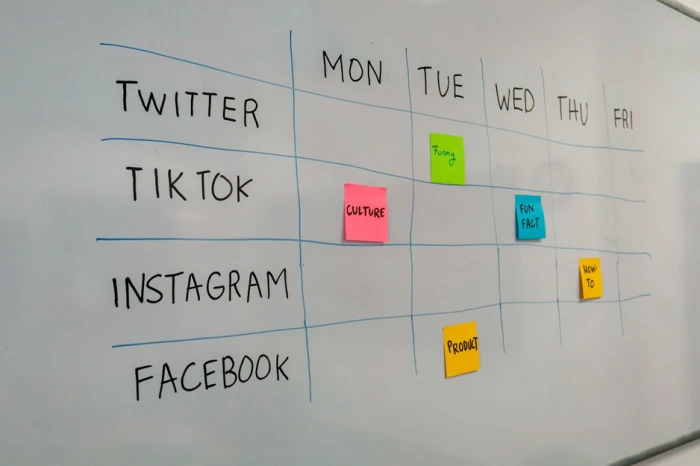
A living keyword map turns prevention into a habit, so overlap is caught before the second page exists.
Fixing cannibalization once feels good. Keeping it away is what protects your rankings over the long run, and it takes far less effort than the cleanup.
Map keywords before you write
Assign one primary keyword and one clear intent to every planned page, then check it against what you already publish. If a page already owns that intent, improve it instead of launching a rival. The cheapest time to prevent a clash is before the second page exists.
Keep a living keyword map
A simple record of which page targets which term makes overlap obvious the moment it appears, rather than months later when rankings start to wobble. Update it whenever you publish, and it doubles as a briefing document for your writers.
Give each page a single job
Before anything goes live, ask which one search this page is meant to win. If you cannot answer in a sentence, the page is not focused enough yet, and it is a cannibalization risk waiting to happen.
Audit on a rhythm
Overlap creeps in as your library grows, so a light and regular review catches it early. Group pages by topic each time, since that is exactly where competing pages hide. A short quarterly pass beats a painful rescue mission every few years.
The one habit that prevents most of it One intent, one page. Before you publish anything, ask which single search this page is meant to win. If another page already wins it, you have your answer. |
A quick checklist
1. Search your own site
Use site:yourdomain.com plus your keyword to spot obvious overlap.
2. Read Search Console
See which pages share a single query in the Performance report.
3. Group by intent
Sort pages by the question they answer, not by folder.
4. Pick the winner
Compare backlinks, traffic, and conversions to choose the page to keep.
5. Apply one fix per cluster
Merge, redirect, canonical, differentiate, or de-optimise.
6. Redirect anything you retire
Send old URLs somewhere sensible so links and equity survive.
7. Update internal links
Point your own navigation and articles at the page you kept.
8. Map keywords before writing
Give every new page one intent it is built to win.
The bottom line
Keyword cannibalization is your site competing with itself, and it costs you rankings without ever looking like a problem. There is no penalty to flag it and no error to chase, which is why so many sites carry it for years without ever knowing it is there.
The fix is rarely complicated once you can see the overlap. Group your pages around the intent they serve, choose one clear owner for each intent, then merge, redirect, or set apart everything else. Most clusters come down to a single, honest decision about which page deserves to win.
The deeper change is in how you plan. When every page is built to win one specific search, your authority concentrates instead of scattering, and each new article makes the ones around it stronger rather than fighting them for the same spot.
Treat it as a habit, not a one-time cleanup. A living keyword map and a light quarterly review keep overlap from ever piling up again, and they cost a fraction of the effort that a full rescue takes later. The sites that stay ahead are simply the ones that never let the problem accumulate.
One intent, one page, done consistently. That is the whole discipline, and it is what turns a library of competing posts into a site that ranks.