

Every site becomes a library over time. The job of an audit is not to admire the shelves, but to decide which books still deserve them.
Thin content is the quiet majority on most established websites. It rarely announces itself. It is not a broken page or a red error in a dashboard. It is the stub published to fill a gap and then forgotten, the near-duplicate written for a keyword variant, the category page with two lines of copy above a grid.
Individually these pages look harmless. Together they shape how search engines, and the answer engines built on top of them, judge whether your site is worth trusting. Finding that content and making a firm decision about each page is one of the highest-leverage things a content team can do.
The usual trap is treating this as a chore with only two outcomes: keep the page or delete it. That framing produces bad calls, because most struggling pages are not dead. They are neglected.
Lumping the neglected in with the hopeless means you bin things you should have rescued and keep things you should have merged. The fix is to get precise about what thin content is, separate finding suspects from judging them, and end with a small, fixed set of decisions.
What counts as thin, and what does not
Thin content is any page that fails to add real value for the query it targets. That definition matters more than any single symptom, because the symptoms vary.
It shows up as surface-level coverage that repeats what the top results already say. It shows up as near-duplicate pages where only a variable has changed, as auto-generated text published without review, and as affiliate pages that add nothing beyond the merchant's own description. Google names several of these patterns in its web search spam policies, including thin affiliation, doorway pages, and scraped content.
The most stubborn myth is that thin means short. It does not. Google weighs a page against the intent behind its query, not against a word count, and no minimum length makes a page safe.
A tight two-hundred-word answer that fully resolves a narrow question is not thin. A padded two-thousand-word article that says nothing you could not find faster elsewhere is. The real test is whether the page contributes something the ranking results lack: expertise, original data, first-hand experience, or a clearer explanation.
The one-line test If everything on the page could be found just as easily in the top two results for its query, the page adds no value, no matter how many words it runs to. |
Why one thin page taxes the whole site
The cost of thin content is not contained to the page itself. Google's Panda update in 2011 first targeted low-value pages at scale, and its logic has long since been folded into the core ranking system rather than run as an occasional pass.
When the helpful-content assessment joined that core system, a page-level problem became a site-level one. A high share of unhelpful pages can weigh on how the whole domain is judged, not just the weak pages on their own. A few dozen forgotten stubs can quietly cap the ceiling for your best work. As the team at Yoast puts it, content has to be meaningful and original to rank, not simply present.
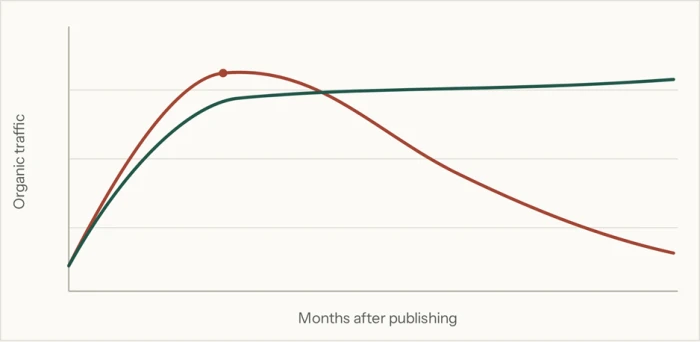
● Left to decay ● Actively tended
Traffic to a page tends to peak, then slide, unless someone tends it. Maintenance is the difference between the two lines.
There is a reader-facing cost too. A visitor who lands on an outdated page, or clicks through three near-identical ones, loses trust in seconds and rarely comes back.
Every one of those pages is also something to host, secure, keep accurate, and account for at every redesign. A good lens for all of it is the set of self-assessment questions Google publishes on creating helpful, people-first content. Running your weakest pages against them turns a vague worry into a concrete list.
A page that answers no one is not neutral. It is a small tax you pay every day it stays published.
How to find it: start with the data
Finding thin content works best as two passes, kept separate. The first pass is mechanical. Let the data surface a shortlist so you are not judging thousands of pages by hand.
1. Export the data. Open Google Search Console, set the Performance report to the last twelve months, and export every indexed page.
2. Read the signals. Flag pages near zero clicks and impressions. Then flag pages with many impressions but almost no clicks, which tend to rank on the edge of relevance.
3. Widen the net. Check the Indexing report for pages marked crawled or discovered but not indexed. Run a crawler for short or duplicate pages, and try a plain site: search.
None of this needs paid software. A spreadsheet, Search Console, GA4, and a free crawler such as Screaming Frog cover it. The practical walkthrough from Semrush is a good reference for wiring these sources into one working sheet.

The data pass only nominates candidates. A page ranking for nothing after a year is a suspect, not yet a verdict.
The judgment call: thin, or just neglected?
Numbers flag a suspect. They do not deliver the verdict. The second pass is human, and skipping it is where most audits go wrong.
Open a sample of the flagged pages and read them. Ask two questions. Is there real search intent behind the query this page targets? And does the page have the bones to satisfy that intent if it were given the care it never got?
Many low-traffic pages aim at real demand and fail only because they were published thin and then abandoned. That is the group worth rescuing.
This pass also exposes pages competing with each other. When several of your pages chase the same intent, they split the signal and none wins. Group pages by topic, not by folder, and the overlap becomes obvious. Google's long-standing advice, captured in Lumar's summary of John Mueller's answers, is to prefer fewer, stronger pages over many thin ones.

The verdict step is stubbornly manual. Read a real sample; a metric never fully judges whether a page is worth keeping.
Deciding what to do: the five moves
Once you have separated the neglected from the hopeless, every flagged page should leave with exactly one decision. This is really one row of a broader content audit, where the discipline is to attach a single verdict to every URL.
For thin content, five moves cover almost everything you will find. The framework below follows the consolidation-and-recovery approach in Indexed's guide to fixing thin pages, framed around the decision rather than the diagnosis.

Think of it as one sticky note per page. The point of the exercise is that none is left blank.
Improve Use when the intent is real and the page has potential.
The largest bucket for most sites. The page targets a query people genuinely search, but it was published shallow. Deepen it until it fully answers the intent, adding the expertise, examples, or original data the ranking results lack. This is usually the highest return, since a page already near the top needs less work than something written from scratch.
Consolidate Use when several pages chase one intent.
When two or three thin pages compete for one query, combine the useful parts into a single authoritative page and point the weaker URLs at it. Consolidation concentrates the link equity that was scattered and removes the cannibalisation. It often delivers the biggest single win in an audit.
Noindex and keep Use when a page must exist but adds no search value.
Some pages are thin by design, not neglect: filtered views, paginated archives, internal search results, thank-you pages. They serve visitors but offer nothing unique to a searcher. Add a noindex directive so they stay usable for people while leaving the index.
Redirect Use when the page has no standalone value but a close relative exists.
If a page cannot justify itself yet sits near a stronger, relevant page, send it there with a 301 rather than deleting it outright. A permanent redirect passes readers and search engines to the better destination and preserves its earned links. As SearchAtlas notes, this is what keeps a cleanup from throwing away equity you spent years earning.
Remove Use when there is no traffic, no intent, and no path to value.
The smallest bucket, and smaller than most people fear. Reserve deletion for pages with no traffic, no purpose, and no realistic route to value: the event page from three years ago, the abandoned microsite, the duplicate nothing links to. Still point the old address at the closest relevant page so you never strand a visitor or a link.
One rule to hold Every flagged page leaves the review with exactly one of these five moves. If a page has no decision, the audit is not finished. Ambiguity is where good intentions quietly die. |
Turn it into a routine, not a rescue
A once-in-three-years purge works, but it hurts. Years of quiet decay all land at once, and the project becomes a thousand-row spreadsheet that stalls before anything ships.
The teams that stay ahead treat this as light, ongoing governance. Give it an owner and a rhythm: a full sweep once or twice a year, plus a quick monthly look at your top twenty or thirty pages.
Work in small, finished batches. Audit one section or topic cluster, assign the moves, ship the changes, and log the date you touched each page.
Record a simple baseline before you edit: traffic, conversions, and rankings in the weeks prior. Compare a similar window afterward so you can tell a real recovery from a seasonal swing, and prove the work paid off.

Governance beats heroics. A recurring monthly review of your top pages keeps thin content from ever piling up.
A one-screen field checklist
1. Pull the suspects from data first. Export twelve months of Search Console performance and flag pages near zero clicks and impressions, plus high-impression, no-click pages.
2. Check the Indexing report. Treat pages marked crawled or discovered but not indexed as a sign a page is likely thin.
3. Group by topic, not by folder. This is where duplicates and self-competition surface.
4. Read a real sample by hand. Ask whether the intent is genuine and whether the page can satisfy it.
5. Assign exactly one move. Improve, consolidate, noindex, redirect, or remove. No page leaves without a verdict.
6. Redirect anything you retire. Preserve links and equity with a 301 to the closest relevant page.
7. Log dates and measure before and after. Baseline the pages you touch so you can prove the recovery.
The bottom line
Finding thin content is not a hunt for pages to delete, and it is not a report that gets filed and forgotten. It is an honest review that separates the pages worth rescuing from the ones worth retiring.
Give every weak page a single decision: improve what has potential, consolidate what competes, noindex what only serves a function, redirect what has a better home, and remove what truly has none.
A few reference points are worth holding as you work. Google has judged low-value pages at scale since the Panda update in 2011, and since the helpful-content assessment became part of the core ranking system in 2024, that judgment runs continuously rather than in occasional batches. There is no fixed word count that makes a page safe, because value is measured against intent, not length. In most audits the pattern repeats: improve is the largest bucket, remove is smaller than teams expect, and consolidate delivers the biggest single win by turning several competing pages into one that ranks.
Set a rhythm you can keep. One or two full sweeps a year, plus a monthly look at your top twenty or thirty pages, stops decay from ever compounding. Work in small, finished batches, record a baseline before you edit, and compare a similar window afterward so a recovery is provable rather than assumed. Leaving a handful of untouched pages as a rough control helps you separate a real lift from a seasonal swing.
The gains compound. Every weak page you fix or retire lifts the average quality of everything around it, and a leaner library is cheaper to host, faster to crawl, and likelier to be quoted by the answer engines now sitting on top of search. That is the quiet return on the work: not a single ranking, but a site that is easier to trust.
Do it in small passes on a fixed rhythm, attach one move to every page, and measure the before and after. Sites do not climb on how much they publish. They climb on how well they tend what is already there.