✦ The short answer To rank in Google AI Overviews, a page must be indexed, eligible to show a snippet, and good enough to rank in normal Search. AI Overviews are built from the same index and the same ranking systems. Beyond that baseline, citations go to pages that state a complete answer in one self-contained passage, cover the sub-questions Google generates through query fan-out, show verifiable expertise, and stay current. Page-one rankings still help, but most citations now come from outside the top 10 for the exact query. |
What Google AI Overviews are, and why 2026 is different
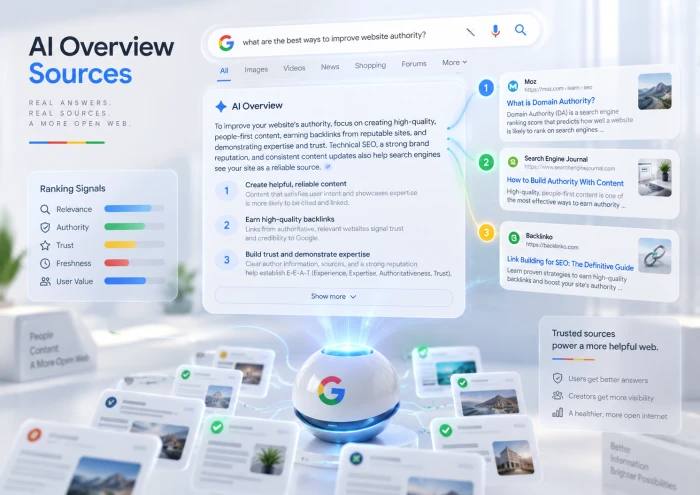
Google AI Overviews are AI-generated answer panels that appear above the traditional results. They are written from pages in Google's index and link back to those pages as sources.
When a search needs synthesis rather than a single fact, Google's Gemini models read a set of retrieved pages, compose a summary, and attach the source links beside or beneath the text. Comparisons, how-to questions, and "what should I know before" queries are typical triggers.
The panel is not a separate product with its own crawler and its own rules. It is a presentation layer on top of ordinary Search. That single fact shapes every recommendation in this guide, because the pages Google is willing to cite come from the same pool it is already willing to rank.

AI Overviews and AI Mode are now a single, continuous experience in Google Search, powered by the same retrieval machinery.
The scale in 2026
At Google I/O in May 2026, Sundar Pichai said that AI Overviews had passed 2.5 billion monthly active users. AI Mode, the conversational full-page version of the same technology, crossed one billion monthly users in its first year.
The two surfaces are no longer separate destinations. A searcher can read an AI Overview, ask a follow-up, and slide into AI Mode without leaving the flow. Classic results are still there, but the AI layer is now the front door for a large share of informational queries.
A new model behind the panel
Google also announced that it was upgrading AI Mode to Gemini 3.5 Flash as the default model globally, and it merged AI Overviews and AI Mode into one seamless experience.
Model changes matter to anyone trying to get cited. A new model reads pages differently and often prefers different passages to quote. Much of the tactical advice written in 2025 stopped working for exactly this reason. The principles in this guide are the ones that survive model upgrades: clear answers, real expertise, and content that maps to how the system retrieves information.
Why it matters even if you already rank
The AI panel changes what people do next. Pew Research Center tracked the real browsing activity of 900 U.S. adults and found that people clicked a traditional result on only 8% of visits when an AI summary appeared, compared with 15% when it did not.
Clicks on links inside the summary happened on roughly 1% of visits, and searchers were more likely to end their session after seeing one. Those numbers cut both ways. The panel takes clicks from every page that is not inside it, and the few links that do appear inside it become disproportionately valuable.
How often the panel appears depends on who is measuring. Trackers such as Semrush, BrightEdge, and Conductor have reported AI Overview presence ranging from the mid-teens to around half of tracked queries over the past eighteen months. Research-stage searches in healthcare, education, and B2B technology sit near the top, and transactional queries near the bottom.
How Google chooses which pages to cite
Google's official position is that there are no special requirements for AI Overviews. A page must be indexed, eligible to appear with a snippet, and genuinely helpful, which is the same bar as regular Search.
The documentation on AI features and your website says this plainly. It adds that generative features are rooted in the core ranking and quality systems that power everything else.
That statement is reassuring but incomplete, because eligible is not the same as chosen. Two pages can both rank on page one for the same query and only one will be quoted. Understanding why means looking at the two steps that happen after ranking: retrieval through query fan-out, and passage selection.

Query fan-out turns one search into many. The system researches the sub-questions behind a query and pools the best sources for each.
Step one: query fan-out
Fan-out is the retrieval step, and it is the part most guides get wrong. Instead of running the searcher's exact words as one query, the model interprets the intent, breaks it into several related sub-queries, runs each through Google's normal search infrastructure, and pools the results.
Google's VP of Product for Search, Robby Stein, has described the system as using Google Search as a backend tool that issues multiple queries and combines them into one response. He noted that the generated queries can include topics the searcher never mentioned.
A search for "how to rank in Google AI Overviews" may quietly become searches for how sources are selected, whether schema helps, whether rank matters, and how to track citations. Each sub-query has its own top results. A page that is not competitive for the head term can still be pulled in because it is the best answer to one of the pieces.
Step two: passage selection
Once the retrieval pool is assembled, the model is choosing passages, not pages. It looks for a span of text that answers a sub-question cleanly, agrees with the other retrieved sources, and can be attributed to a page Google already trusts. That span might be a paragraph, a list, a table row, or a definition.
Pages that bury the answer or spread one idea across several sections give the model nothing to lift. Pages that state the answer in a self-contained paragraph give it exactly what it needs. This is why a page ranking fourth can be cited while the page ranking first is skipped. The unit of optimization is the citable passage, not the page and not the keyword.
The corroboration filter
Because the model synthesizes several sources into one answer, it favors claims that are consistent across the pool. An unusual claim without evidence is unlikely to be quoted even if the page ranks well. A widely supported fact stated precisely, with a number, a date, or a named source, is easy to quote with confidence.
This does not mean you should avoid original findings. It means you should present them with enough context that a model reading three other pages can see how your finding fits, rather than treating it as an outlier.
Do you still need to rank on page one?
Ranking on page one helps a great deal, but in 2026 it is neither a requirement for being cited nor a guarantee of it.
The most useful evidence comes from Ahrefs, which ran the same analysis twice with a year between them. Its first study of 1.9 million citations found that about 76% of cited URLs also ranked in the top 10, with a median organic position of 2 for the most-cited pages. That reinforced the intuition that AI Overviews mostly reshuffle the existing winners.

The share of AI Overview citations coming from top-10 pages fell sharply between Ahrefs' 2025 and 2026 studies.
The 2026 update told a different story. Across 863,000 keywords and roughly four million cited URLs, Ahrefs found that only about 38% of cited pages appeared in the first ten results, with the remainder split almost evenly between positions 11 to 100 and pages outside the top 100.
Ahrefs was careful to note that the two studies are not directly comparable, because its citation detection improved in between. Even with that caveat, the direction is what fan-out predicts. The panel is assembled from many sub-queries, not just the one you track. The same study saw YouTube videos cited frequently even when they never appeared in the blue links.
How to read the data
Think of it as two parallel tracks. On the first, organic strength on the core query still produces the best odds of citation, and those odds fall as you move down the page. If you sit at position 12 for a term you care about, earning a top-five spot is still the most effective move.
On the second track, the map of queries you need to be good at has grown. Every important head term now carries a cluster of sub-questions Google runs on the searcher's behalf. Being the clearest answer to two or three of them can put you in the panel even when the head term is out of reach. Treat ranked results as your floor and the fan-out cluster as your opportunity.
The eight-step playbook for earning AI Overview citations
Everything below follows from how the system works. The steps are ordered by leverage. If you only do the first three, you will still see most of the benefit, but they compound, and the sites that win consistently tend to do all eight.
1 - Lead with the answer, then explain
Put a complete, self-contained answer in the first sentence or two under every heading. Only then explain, qualify, and support it.
This is the highest-leverage change most sites can make, because it directly addresses passage selection. A model looking for something to quote wants a span it can lift without losing meaning. A paragraph that opens with "There are several factors to consider" gives it nothing.
Write each answer so it still makes sense if a reader saw only that paragraph. Name the subject instead of relying on "it" or "this." Put the number, verdict, or definition first. Keep the answer to roughly forty to sixty words before you expand.
Before There are a lot of opinions about whether schema helps with AI search, and the truth is that it depends on a number of things. In this section we will look at what the evidence says and how you might think about it for your own site. | After Schema markup does not guarantee a citation in Google AI Overviews, but it helps Google identify what a page is about, who wrote it, and which organization published it. Treat it as a supporting signal that makes a clearly written page easier to trust, not as a substitute for the writing itself. |
This discipline is the core of answer engine optimization, and it applies beyond Google. The passage that gets quoted in an AI Overview is the same passage most likely to be cited by ChatGPT, Perplexity, or Gemini, because all of them run some version of retrieve-then-extract.
For the full method, including how entity clarity, citation-worthy formatting, and off-site signals fit together across every major answer engine, see our complete guide to answer engine optimization. This article is the Google-specific application of those principles.

Answer-first writing is the single change that most improves a page's chance of being quoted, because it gives the model a passage it can lift intact.
2 - Structure the page so a machine can find the right piece
Use headings that state the question each section answers. Keep one idea per paragraph. Reach for lists and tables only where the content is a real sequence or comparison.
Structure is information, and the model uses it to work out where one answer stops and the next begins. A heading such as "Do you still need to rank on page one?" tells the system that the paragraph beneath it answers that exact sub-question. Vague headings such as "Rankings" or "Our thoughts" do not.
Within each section, resist weaving three related points into one paragraph. A model that wants to cite one of them must either quote the whole tangle or skip it. Give each point its own paragraph with its own opening sentence.
Two cautions keep this from tipping into over-formatting. First, do not turn everything into bullet points. Long-form explanation is what demonstrates expertise, and a page of fragments reads as thin to both people and models.
Second, define your terms the first time you use them, in a sentence that could stand alone. Definitions are among the most frequently quoted passage types in AI Overviews. A crisp one-sentence definition is often worth more than a thousand words of surrounding commentary.

Clear structure tells the model where each answer starts and stops. It does not mean reducing everything to bullet points.
3 - Cover the fan-out without spamming it
Map the sub-questions Google is likely to generate for your topic, and answer them on the same page as distinct, well-labeled sections.
The sources for that map are already in front of you. The People Also Ask box and the related searches at the bottom of the page show the facets Google associates with a query. Running your target query in AI Mode and noting which angles the answer covers, and which pages it cites, shows fan-out in action.
Semrush has published a useful walkthrough of how to find and optimize for fan-out sub-queries, including how the number of sub-queries scales with prompt complexity. Group the results into the four to eight questions that matter most, give each a heading and an answer-first paragraph, and you have a page that can be retrieved for many queries at once.
What you should not do is manufacture a separate page for every variation. Google's guide to optimizing for generative AI features warns that creating content for every possible query variation, including fan-out queries, mainly to manipulate results falls under its scaled content abuse policy.
The distinction is depth versus duplication. One thorough page that answers the whole cluster is what readers and the retrieval system both want. When a sub-question is large enough to deserve its own article, write it properly and link the two pages to each other.
4 - Show first-hand experience and make trust easy to verify
Pages that demonstrate real experience, name a credible author, and make their sourcing transparent are cited more often, because the model looks for claims it can attribute with confidence.
Google's guidance on creating helpful, reliable, people-first content is framed as questions to ask about your own pages. Does the content provide original information or analysis? Does it show first-hand depth? Is it presented in a way that makes you trust the author? Each of those maps to something a synthesis model cares about.
In practice, experience shows up as specifics. Include the screenshot of the report you describe, the numbers from the test you ran, the configuration that worked and the one that did not, and the date you did it.
Put a named author on the page with a short bio explaining why they are qualified. Give that author a consistent presence elsewhere on the web so the name can be verified. Cite sources inline rather than writing "studies show." Keep your about page and contact details current.
For topics that touch health, money, legal matters, or safety, all of this matters twice as much. Those are the areas where Google's quality systems are most demanding about who is speaking and why they should be believed.

Specifics are what experience looks like on the page: the test you ran, the number you measured, the date you measured it.
5 - Get technical eligibility right, then add structured data
A page cannot be cited if Google cannot index it, render it, or show a snippet from it. The technical foundation comes before any markup.
That means a clean 200 status, no robots.txt block or noindex directive, main content that renders without fragile JavaScript, and load times that allow regular recrawling. It also means checking your snippet controls, because they now govern the AI panel too.
Google's robots meta tag documentation confirms that nosnippet prevents content from being used in AI Overviews and AI Mode, and that max-snippet and data-nosnippet limit what can be shown. Publishers sometimes add these to protect content without realizing they have opted out of the AI panel entirely. Audit them first.
Once the foundation is solid, structured data helps Google understand what it is looking at. Google's introduction to structured data explains that markup is used to understand page content and to gather information about the people, organizations, and things a page describes. That is exactly the entity understanding a synthesis model relies on.
Use JSON-LD, which is Google's recommended format. Add Article markup with a real author and publisher, Organization markup on your home page with consistent name and profiles, Person markup for authors, and FAQPage markup only where the page truly has a question-and-answer section.
Keep markup honest and consistent with what is visible on the page. No schema type is a key that unlocks citations. Accurate markup simply removes ambiguity about who you are and what the page covers, and ambiguity is what costs you when a model is choosing between two similar sources.

Structured data removes ambiguity about who published a page and what it covers. It supports good content; it does not replace it.
6 - Keep the page current, and make the currency visible
Fan-out queries often include a time-sensitive facet such as "in 2026" or "latest." A page with stale figures loses those sub-queries to fresher competitors.
This is more than adding a new year to the title. A model reading your page alongside three others will notice when your statistics are two years old and theirs are two months old. It will prefer the source whose claims are less likely to be out of date.
Review your most important pages at least quarterly. Replace numbers that have moved, remove advice that no longer applies, and add a short note on what changed. Show a visible last-updated date near the top, reflect it in your Article markup, and request re-indexing in Search Console after any substantive change.
Freshness is also where model upgrades bite. When Google changes the model behind AI Overviews, the preferred passages shift. Pages that are actively maintained adapt within a review cycle. Pages written once and left alone drift out of the citation set slowly, then all at once.

A quarterly review of your most important pages keeps them in the citation set as models and facts change.
7- Build presence beyond your own site
AI Overviews draw heavily on video, community discussion, and third-party coverage. A brand that exists only on its own domain is competing with one hand tied.
Search Engine Journal's coverage of the Ahrefs data highlighted that YouTube shows up frequently among cited sources that never surface in traditional results. Other trackers consistently find YouTube, Reddit, and Wikipedia among the most-cited domains in Google's AI features.
The reason is structural. A video with a transcript that walks through a process is a highly extractable answer to a how-to sub-query. A well-upvoted forum thread is a corroborated answer to an experience-based one. Neither competes with your written guide. They let you be cited on facets where a page is not the natural format.
Practically, publish short videos that answer the specific questions your pages answer, with clear titles and accurate descriptions, and embed them on the relevant pages. Participate honestly in the communities where your customers ask questions. Be useful rather than dropping links.
Make sure your organization's name, description, and category are identical across your site, LinkedIn, review platforms, and directories, so every mention reinforces one clear entity. Earn mentions from publications Google already trusts. None of this replaces the on-page work. It multiplies it.

Video with a good transcript is one of the most frequently cited formats for how-to sub-queries, and it rarely competes with your written page.
8 - Measure citations, not just rankings
You cannot manage what you are not tracking, and rank trackers alone will not tell you whether you are in the panel.
A page that ranks third and is cited is a success to protect. A page that ranks first and is not cited is a problem to diagnose, and the diagnosis usually points back to one of the first four steps.
Build a short list of the queries that matter most to your business. Check each in Search regularly, record whether an AI Overview appears and which pages it cites, and use that record to decide where to spend your next writing hour. The next section covers the tools.
How to measure AI Overview visibility
The best starting point is Google Search Console, which now reports generative AI performance separately from ordinary web results.
In June 2026, Google introduced Search generative AI performance reports in Search Console. They show which of your URLs appeared within AI features, broken down by page, country, and date, with the same granularity as the standard performance report.
This is the first time site owners have had first-party data on AI visibility rather than inferring it from click-through-rate changes. Look here before spending money on third-party tooling.

Search Console's generative AI reports give first-party data on which URLs appear in AI features. Pair it with a manual query list.
Start by exporting the pages that appear most often and compare them with your top-ranking pages. Pay close attention to the two groups that do not overlap. Pages cited without ranking well tell you what the model values. Pages ranking well without being cited tell you where your writing falls short of the passage-selection bar.
Third-party trackers
Trackers fill the competitive gap. Credible options include Ahrefs Brand Radar, Semrush's AI visibility tooling, SE Ranking's AI Overview tracker, and BrightEdge's Generative Parser. They show who is cited for your queries when it is not you, which passages are quoted, and how that changes week to week.
Choose one, set up a fixed list of fifty to two hundred queries that reflect real customer questions rather than vanity keywords, and review the results monthly. The metrics worth tracking are simple and listed below.
| What to track | Where to get it | What it tells you |
|---|---|---|
| AI feature impressions by page | Search Console generative AI report | Which URLs Google is already willing to surface in AI features |
| Citation share on priority queries | Manual checks or a third-party tracker | How often you are in the panel versus a competitor |
| Cited passage text | Manual checks or a tracker with passage capture | Which sentences the model prefers, so you can write more like them |
| CTR on cited vs uncited pages | Search Console, segmented by page | Whether citations are translating into visits |
| Ranked-but-not-cited pages | Search Console compared with rank tracking | Where structure or answer clarity is the bottleneck |
Over time, the CTR comparison will tell you whether being in the panel is producing traffic and conversions. That is the only measure that matters in the end.
Mistakes that quietly cost citations
Most lost citations trace back to a handful of avoidable habits. The most common is chasing AI-specific tricks that have no evidence behind them.
There is no special AI crawler to feed, no secret markup that guarantees a citation, and no credible data showing that an llms.txt file influences Google's AI features. Time spent on these is time taken from the writing and structure work that moves the needle.
A close second is over-correcting on structure. Converting every page into bullet points and two-sentence sections assumes models want fragments. They do not. They want a clear answer followed by real depth, and a page stripped of explanation reads as thin to Google's quality systems.
The third mistake is generating pages at scale to cover every fan-out variation. Google's guidance on generative AI content is clear that producing many pages without adding value violates its scaled content abuse policy, regardless of which tool produced them.
Using AI to research, outline, or tighten a piece you have real expertise in is fine. Using it to produce fifty near-identical articles is the fastest way to lose visibility across the whole site.
The fourth mistake is technical: accidentally opting out through nosnippet or an aggressive max-snippet, or leaving important pages behind a rendering barrier Googlebot cannot pass. No amount of writing quality can rescue a page Google cannot quote.
And finally, treating rank as the only metric. A page that holds position two while a competitor's page is quoted above it is losing, and you will not see that loss in a rank report.
Where to start
If you take one thing from this guide, take the reframing. AI Overviews do not reward pages. They reward passages that answer a specific question completely, in a place the model can find, from a source it has reason to trust.
Ranking well is the entry ticket, and it still matters. But the pages that win citations in 2026 are written for the way the system actually retrieves information: by breaking a question into pieces and looking for the best answer to each.
Start with your five most valuable informational pages. Rewrite the opening of every section so it answers the heading outright. Add the two or three sub-questions you are missing. Put a real author on the page with real evidence of experience. Check your snippet controls. Then look at Search Console in a month and see what changed. That loop, repeated, is the whole strategy.