Every page you publish starts to age the moment it goes live. Rankings slip, click-through rates soften, and newer articles slowly push yours down the results. The instinct, when you notice the decline, is to delete the old post and write a fresh one. That instinct is almost always wrong.
Starting over throws away years of accumulated trust. The backlinks, the indexed history, and the ranking signals Google has built up around that exact URL all disappear the moment you scrap the page. A content refresh is the safer and far cheaper path, but only when it is done with a steady hand. Done badly, a refresh strips out the very things that made the page rank and leaves you worse off than before.
This guide walks through how to refresh aging pages the safe way. First we cover why pages fall, then which ones are worth saving, and finally the exact steps to update one without losing the equity it already holds.
Why old content loses rankings
Content decay is rarely a dramatic event. It is a slow bleed. A page that once pulled two thousand visits a month drifts to fourteen hundred, then nine hundred, then five hundred. It never looks alarming on any single day, but it compounds into a real problem across a few quarters.
A handful of forces drive this decline, and most struggling pages suffer from more than one at once:
• The facts drift. Prices change, tools get redesigned, and old statistics get quietly replaced by newer numbers.
• The structure ages. A layout that felt modern a few years ago now reads as a wall of text that mobile readers refuse to scan.
• The search shifts. The query the page was built to answer now rewards a different kind of result.
There is also a newer force that did not exist a few years ago. Answer engines and AI summaries now sit on top of traditional search, and they apply their own freshness requirements. A page can hold its Google ranking and still disappear from the answers that ChatGPT, Perplexity, and Google AI Overviews generate, because those systems lean toward recent, clearly sourced information.
So decay now happens on two curves at once. There is the familiar slide down the organic results, and a second, faster erosion in whether machines will quote you at all. According to research summarized by Animalz, organic content decays at roughly 1.2% per week once a decline sets in, and quarterly refreshes outperform annual ones by a wide margin.
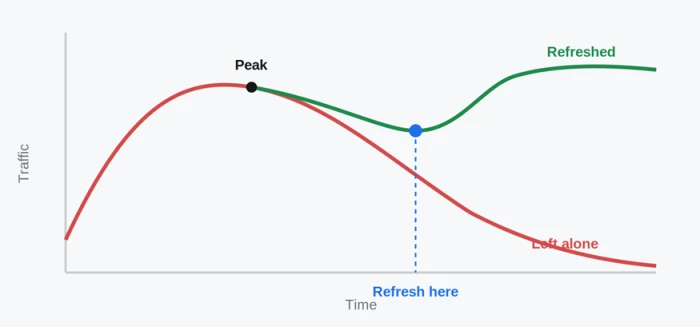
Traffic peaks, then slides. A refresh at the right moment recovers the curve instead of letting it bleed out.
One clarification matters here. Decay is not simply age. A well-tended page from five years ago can outrank something written last month, because search engines reward relevance and usefulness, not the calendar. The goal of a refresh is never to look newer. It is to be genuinely better, and to let freshness follow from real improvement.
Not every page deserves a refresh
Refreshing content is an investment of real time, and the return depends on where you start. Spreading effort evenly across a whole library is one of the fastest ways to burn hours for no measurable gain. The pages that reward a refresh are the ones that already proved they can compete and have since slipped.
This kind of triage is a smaller cousin of a full content audit, which reviews everything you have published and attaches a clear decision to each page. If you have run one recently, your refresh shortlist is already sitting in the update bucket.
The highest-value candidates share a few recognizable traits:
• Former page-one pages that dropped. Decay, not irrelevance, is the problem, and the page has already shown it can hold a top spot.
• Pages in positions four to fifteen. Bottom of page one, top of page two. Close enough that a focused update pushes them into clickable territory.
• Backlink magnets with thin traffic. Inbound links mean the wider web trusts the page. A refresh finally converts that trust into visits.
Google Search Console is the best free tool for building this shortlist. Compare two date ranges in the Performance report and it surfaces exactly which pages have slipping clicks, falling positions, or queries you nearly rank for.
Knowing when a refresh is the wrong tool matters just as much. If you have no coverage of a topic at all, write something new. If one page is trying to rank for five subtopics and doing none well, split it. If a page serves an audience you no longer target, bending it toward new intent often confuses more than it helps.
The golden rule: protect what already ranks
One principle governs every safe refresh. You are protecting SEO equity, not resetting it. An existing page carries assets a brand-new URL does not have: accumulated backlinks, a crawl and index history, and years of ranking signals that give Google reasons to trust it.
Almost every serious refresh mistake is a version of throwing that inheritance away, and the most damaging one is changing the URL. Keep the original URL whenever it is possible. It is where your backlinks live, where paid campaigns point, and where Google’s indexed history is attached. Change it casually and you sever all of those at once.
There is one common exception. A URL with a year baked into the slug, such as one ending in -2022, will become permanently stale. In that case, set up a 301 redirect to the new address immediately, then update every internal link that pointed at the old slug. The biggest mistake refresh teams make is treating a URL as disposable, and the cost is lost backlinks and reset history that take months to rebuild.
The same instinct applies to sections other pages depend on. If part of your article is the target of internal links or backlinks, do not silently delete it during a refresh. Preserve it, or add an anchor so the incoming link still lands somewhere useful. Check your canonical tags after publishing too, since a broken canonical confuses search engines about which version to index.
How to refresh a page, step by step
With the safety rules in place, here is the working sequence. The order matters, so resist the urge to jump straight to rewriting before you know what is actually wrong.
1. Map every keyword the page already ranks for
Before editing, list every query the page wins, not just your target term. It is easy to improve a page for one keyword while quietly weakening it for three others you forgot it was ranking for.
2. Re-check the search intent
Look at what actually ranks for your target term today. If the results now reward a different format or angle, realign the page to match before touching anything else.
3. Fix accuracy first
Hunt for any year, statistic, or tool reference. Replace old figures with current ones traced to a primary source, and confirm every tool you mention still exists and works as described.
4. Tighten the structure
Break real walls of text with descriptive subheadings, shorten run-on sentences, and make the shape of the argument clear at a glance. Do not shred everything into fragments; just make it scannable.
5. Close the gaps
Study the subheadings competitors now cover, find the questions they answer that you skipped, and add those sections. An FAQ block is efficient here because it helps readers and gives AI systems clean passages to quote.
6. Add something hard to copy
An original diagram, a short video, a data table from your own numbers, or an expert quote with a named, dated source. According to Search Engine Land, unique media strengthens the page and opens extra traffic channels a rival cannot easily recreate.
7. Refresh the title and meta description
A sharper, more current title can lift click-through even when the ranking position has not moved, and better click-through feeds back into how the page performs.
8. Repair internal links in both directions
Point the refreshed page at your most current related content, and link back to it from newer articles on the same topic. Fix any broken links you find along the way.
9. Update the date, only if you earned it
Change the visible date and the dateModified schema field only after making substantial changes. Then request a recrawl in Search Console and redistribute the page so it earns fresh engagement signals.
| A refresh sits on a spectrum. On the light end, a 90-minute update that swaps in current stats, rewrites the title, and adds a few internal links. On the heavy end, a full-day rewrite with new structure, fresh sections, and expert quotes. Both count, as long as the change is real. |
The empty-refresh trap
One failure mode is common enough to earn its own warning. The empty refresh changes the appearance of freshness without changing the substance. Swapping “2023” for “2026”, bumping the date, and tweaking a few sentences feels like work, but search engines are built to see through it.
They evaluate whether the actual content delta justifies a new timestamp. When the examples, data, and structure are still visibly outdated, rankings do not move. Padding a page from 1,200 words to 1,800 while leaving stale assumptions in place is the same mistake in a different shape. Length has never been a quality signal.
THE DATE QUESTION Update the visible date and schema field only when you have made genuinely substantial changes. A date bump with nothing behind it is one of the clearest empty-refresh signals, and search engines increasingly treat it as noise. Change the content first, then let the date follow. |
This is also where teams leaning on fully autonomous AI writers get into trouble. Spinning text into slightly different words adds no value, and both search engines and answer engines are increasingly good at discounting it. A true refresh needs depth: updated relevance, sharper clarity, and broader coverage. If you cannot point to specific improvements a skeptical editor would notice, you have not refreshed the page. You have only disturbed it.
Optimize the result for AI search
The most modern part of a refresh, and one of the biggest opportunities in 2026, is structuring the updated page for AI systems rather than for Google alone. Answer engines read and cite pages differently from a ranking algorithm.
Structure for passage-level retrieval. State each point plainly, put the direct answer near the top of each section, and back claims with named, dated sources a machine can verify. Article schema with accurate published and modified dates helps these systems confirm your freshness, and clean headings make it easy for an LLM to lift a self-contained passage into an answer.
The upside is large. According to a 2026 analysis of B2B SaaS brands, even the best-performing brand studied was absent from more than seventy percent of relevant AI-generated answers. That gap is room for any page willing to structure itself for citation. Content built to be quoted by a machine tends to be clearer for humans too.
Measure whether it worked
Measurement separates a refresh you can defend from one you are only hoping worked. Set the baseline before you touch anything, then compare the same window afterward.
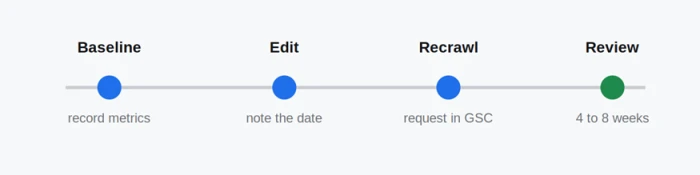
The measurement loop: record a baseline, log the edit date, request a recrawl, then review the same metrics over four to eight weeks.
Record impressions, average position, clicks, and conversions for the weeks before you edit, and note the exact change date. Most refreshed pages show ranking movement within two to four weeks as the page is recrawled. If six weeks pass with no movement, that is a strong sign the refresh did not address the real cause of the decline, and it is worth revisiting your analysis.
Turn refreshes into a rhythm
The teams that never run a painful rescue mission are the ones that treat refreshing as a light, recurring habit. A page left untended for three years accumulates three years of decay that all lands at once. A page checked every few months rarely drifts far enough to lose real ground.
The right cadence depends on your topic:
| Content type | Suggested refresh cadence |
|---|---|
| Technology, marketing, SaaS | Every 3 to 6 months |
| Finance and healthcare | Every 6 months |
| Local business content | Once or twice a year |
The exact interval matters less than having one. Give the work an owner and a rhythm, and the rest follows. A monthly pass over your twenty most important pages keeps the pages that matter most in far better shape than an annual marathon, and it costs a fraction of the effort because you catch decay while it is still cheap to reverse.
The bottom line
Refreshing old content is one of the highest-return moves in SEO, and the reason is simple economics. A new article starts from zero and has to earn its backlinks, its indexed history, and its trust from scratch, a process that usually takes months. A refreshed page inherits all of that on day one. You are not buying a new asset, you are getting more out of one you already paid for. That is why a two-hour update to a page sitting on the second results page will often beat a week spent writing something brand new.
The catch is that the entire advantage depends on restraint. Every safe refresh comes back to protecting what the page has already earned while giving it a genuine reason to climb. If you remember nothing else, remember these six moves:
• Keep the URL. It is the address your backlinks and indexed history live at. Redirect with a 301 only when a year-stamped slug forces your hand.
• Protect the signals you earned. Do not delete sections other pages link to, and confirm canonical tags still point where they should after you publish.
• Make changes a skeptic would notice. Update facts, structure, and coverage. A date bump with nothing behind it is worse than leaving the page alone.
• Repair links in both directions. Link out to your newest related content and back from it, so authority flows through the refreshed page.
• Structure for AI, not just Google. Plain statements, clear headings, and dated sources are what get you quoted by answer engines.
• Measure against a baseline. Record the numbers before you edit and review them over four to eight weeks, so you can prove the refresh paid off.
Do all of this on a rhythm rather than in a panic, and the compounding works in your favour instead of against you. A library that is tended a little every month rarely produces the kind of emergency that forces a rescue. Sites do not rise on how much you publish. They rise on how well you tend what is already there, and a disciplined refresh habit is the single clearest way to turn that principle into rankings and traffic you keep.
If you want a place to start, run a quick content audit this week, pull the ten pages with the steepest traffic decline, and refresh the top three using the nine steps above. That single afternoon is usually enough to see movement, and it builds the habit that keeps the rest of your library healthy.