

17.3% More citations from changing structure alone, with the words, claims and sources left completely unchanged. |
THE EXPERIMENT THIS IS BASED ON In March 2026 a team from the University of Tokyo, Tsukuba, Hiroshima and Japan’s National Institute of Informatics ran an unusually clean test. They took content, kept every word, claim and source identical, and altered only how it was organised. Then they measured how often six AI engines cited it.1 Citations rose 17.3 percent from formatting alone. | WHAT THIS GUIDE IS Seven paragraphs shown before and after, each demonstrating one change. Reading about structure is much less useful than seeing the same text in both states. Every example is written for this guide rather than taken from a real page, so treat them as demonstrations of a principle. The principles come from the papers listed at the end. |
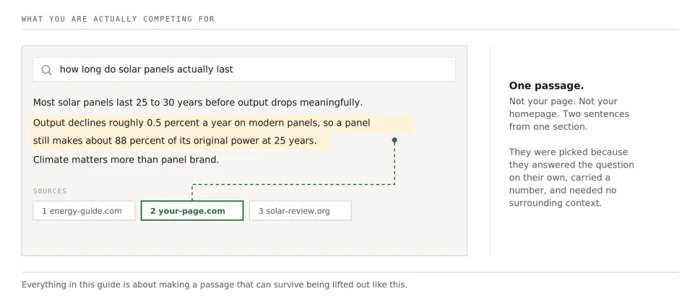
Figure 1. An illustration of an AI answer with its sources, drawn for this guide. Not a screenshot of any product.
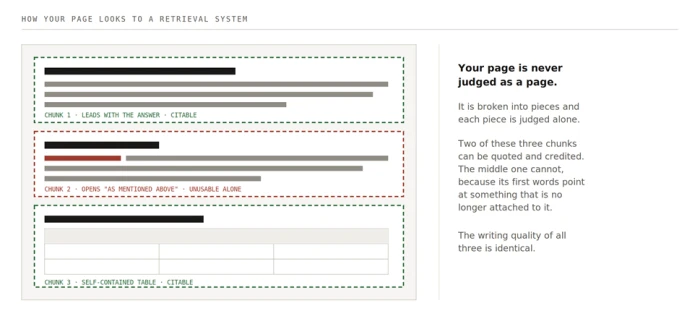
Figure 2. Chunk boundaries are approximate. Real systems split on their own rules, which is a reason to keep sections short.
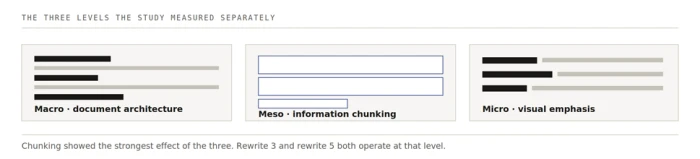
Figure 3. The three levels as defined in the source paper.
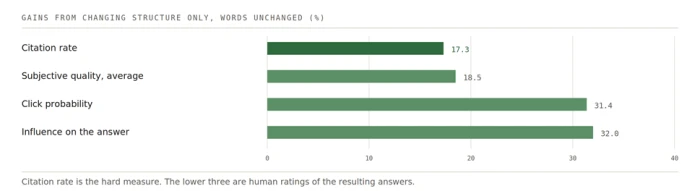
Figure 4. Reported gains across six generative engines.
REWRITE 1 | Put the answer in the first sentence |
The most common failure, and the easiest to fix. Most writing warms up before it answers, because that is how we are taught to write for people. A system pulling out a passage takes what is there, and if the passage opens with context it lifts context.

BEFORE · 76 WORDS Solar technology has advanced enormously over the past two decades, and homeowners considering an installation naturally have questions about the long term. One of the most frequent concerns we hear relates to durability and how the investment holds up over time. There are a number of factors involved, including climate, panel quality and installation standards. Generally speaking, most modern panels will continue producing electricity for around twenty five to thirty years, though output does decline gradually. | AFTER · 58 WORDS Most solar panels last twenty five to thirty years. They do not stop working at that point. Output declines slowly, and twenty five years is roughly when a typical panel drops to around eighty percent of its original production. Three things shape where you land in that range: climate, panel quality and installation standard. Each is covered below. |
WHAT CHANGED The answer moved from sentence four to sentence one and the throat clearing came out. The passage now survives extraction, because the first line is a complete answer to the question someone typed. Nothing was added and eighteen words were removed.
REWRITE 2 | Make every section readable on its own |
Retrieval works on chunks, not pages. A section that refers backwards is fine for someone reading top to bottom and useless once pulled out, because the reference points at something the engine no longer has.

This is chunk 2 in figure 2.
BEFORE · 48 WORDS Climate As mentioned above, this is one of the three factors. It has a larger effect than the others, particularly in the conditions described earlier. Panels in these regions tend to sit at the lower end of the range we gave, while those in milder conditions do better. | AFTER · 49 WORDS How climate affects solar panel lifespan Climate has a larger effect on solar panel lifespan than either panel quality or installation standard. Panels in hot desert conditions or areas with frequent hail typically last twenty to twenty five years. Panels in temperate climates commonly reach thirty years or more. |
WHAT CHANGED Every backward reference is gone. No "as mentioned above", no "the range we gave", no "these regions". The subject is named in full in the first sentence and the vague comparisons became specific conditions. The section now means the same thing in place or alone.
REWRITE 3 | Turn the comparison into a table |
Of the three levels in figure 3, chunking showed the strongest effect, and structured elements such as tables and lists outperformed prose carrying exactly the same information. A comparison in flowing sentences makes the engine reconstruct the comparison. A table hands it over ready made.
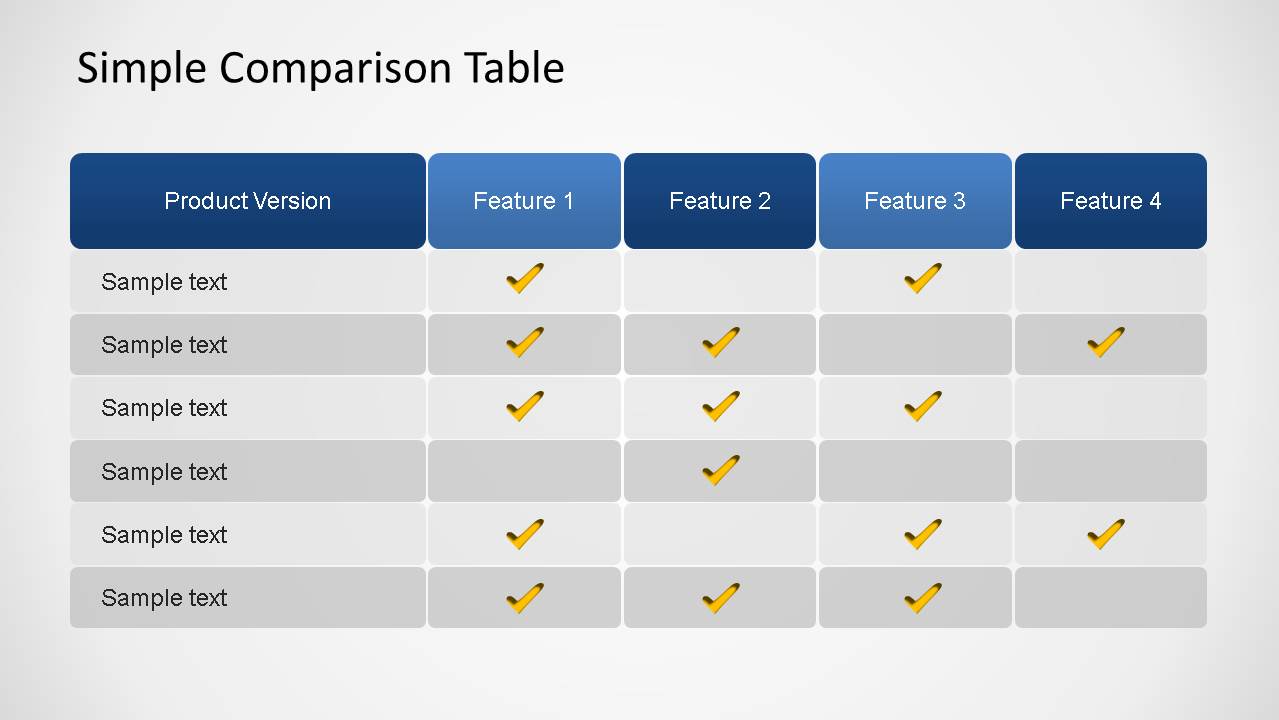
BEFORE · 65 WORDS Monocrystalline panels are the most durable option and usually carry warranties of twenty five to thirty years, though they cost more. Polycrystalline panels are somewhat cheaper and typically warranted for twenty five years, with slightly faster degradation. Thin film panels are the least expensive but also the shortest lived, generally warranted for ten to twenty years and degrading noticeably faster than the other two types. | AFTER · 25 WORDS
|
WHAT CHANGED The information is identical and the word count more than halved. Each comparison is now directly readable rather than inferred across three sentences. A table is also easy to reproduce inside an answer, so an engine can use it and credit you rather than paraphrasing and crediting nobody.
REWRITE 4 | Attach a number, a source and a date |
The founding study in this field tested nine content changes and found that adding statistics, quotations and cited sources produced the largest gains, worth up to forty percent. Each gives the engine something specific it can attribute to you.
BEFORE · 24 WORDS Panel efficiency declines over time, and industry experts agree that the rate of decline has improved considerably in recent years compared to older technology. | AFTER · 62 WORDS Panel output declines by roughly 0.5 percent a year on modern panels, against closer to 1 percent on panels made before 2010. At 0.5 percent, a panel still produces about 88 percent of its original output after twenty five years. Manufacturer warranties typically guarantee a floor of 80 to 85 percent at that point, which tells you what the industry itself expects. |
WHAT CHANGED "Industry experts agree" became a number, carried through to what it means in practice. This rewrite is longer, and that is the point: the extra length is specifics rather than padding. The claim is now checkable, which is the same property that makes an engine willing to attribute it.
REWRITE 5 | Split the wall into one claim per paragraph |
A long paragraph holding four ideas is one chunk with four topics. Whichever topic the question is about, the retrieved passage arrives padded with three irrelevant ones, which weakens the match. Four short paragraphs are four candidates, each matching cleanly.
BEFORE · 91 WORDS, ONE SENTENCE Maintenance requirements are fairly low but not zero, and most owners find that an annual clean is sufficient in temperate climates although dustier regions may need more frequent attention, while inverters generally need replacing once during the panel’s lifetime at somewhere between ten and fifteen years which is a cost many people forget to budget for, and it is also worth checking mounting hardware periodically since fixings can loosen over time particularly in high wind areas, and monitoring output monthly will usually reveal a developing fault long before it becomes serious. | AFTER · 74 WORDS, FOUR PARAGRAPHS Cleaning. An annual clean is enough in temperate climates. Dusty or arid regions need it more often. Inverter replacement. Inverters usually need replacing once in the panels’ lifetime, at ten to fifteen years. This is the cost most owners forget to budget for. Mounting hardware. Check fixings periodically, especially in high wind areas, since they can loosen over time. Output monitoring. Checking output monthly usually reveals a developing fault long before it becomes serious. |
WHAT CHANGED One sentence became four short paragraphs, each with a bold label naming its subject. Someone asking about inverter replacement now matches a passage entirely about inverter replacement. The bold labels are the micro level from figure 3, and they make the page scannable for people too.
REWRITE 6 | Write headings as the question being asked |
Headings sit at the macro level in figure 3 and do double duty. They tell a retrieval system what the section beneath is about, and they can match a question directly when phrased the way someone would ask it.

BEFORE · FOUR HEADINGS
| AFTER · FOUR HEADINGS
|
WHAT CHANGED Four headings describing the document’s own filing system became four headings stating what the reader wanted to know. "Considerations" tells a retrieval system nothing about what sits beneath it. "What makes panels wear out faster" tells it everything, and matches a real question.
REWRITE 7 | Define the thing before you discuss it |
Pages written for existing customers assume shared vocabulary. Pages reached through an AI answer are meeting the reader cold, and a passage full of undefined terms is harder to match to a question and riskier to quote.

BEFORE · 41 WORDS LID and PID both contribute to early losses, and while LID stabilises after the first few hundred hours, PID can worsen over years if the system is not properly earthed. Most quality manufacturers now include PID resistant cell treatments as standard. | AFTER · 74 WORDS Light induced degradation (LID) is a small drop in output during the first few hundred hours of sunlight exposure. It typically costs one to three percent of output and then stops. Potential induced degradation (PID) is a gradual loss caused by voltage leaking through the panel to its frame. Unlike LID it can worsen over years if the system is not properly earthed. Most quality manufacturers now include PID resistant cell treatments as standard. |
WHAT CHANGED Each acronym is expanded and defined before use. Definitions are among the passage types most reliably lifted into answers, because a definition is self-contained by nature. The page can now also be cited for two questions it previously could not answer at all.
What does not work
A benchmark presented at NeurIPS in 2025 tested popular content tactics systematically and found most were ineffective, with several actively harmful once more than one party applied them. What kept working was straightforward relevance to the question.4
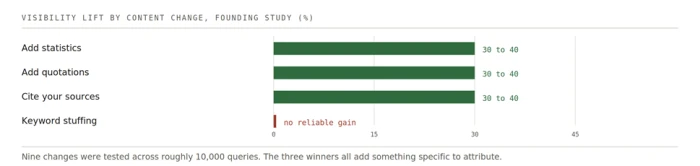
Figure 5. Nine changes tested across roughly 10,000 queries. Source [2].
• Keyword stuffing. Tested in the founding study and among the changes that produced no reliable gain.
• Writing longer. Length is not the lever. A longer page gives retrieval more irrelevant material to wade through, not more to cite.
• Authoritative sounding language. Research on how models judge competing documents found stylistic credibility markers had minimal effect, while plainly matching the question’s wording changed outcomes substantially.
• A question and answer block with thin answers. The format is not what earns the citation. A question with a one line non-answer beneath it is still a non-answer.
• Treating this as a one off project. Work published in 2026 found engines change their citation behaviour over time, so fixed rules degrade.
THE HONEST LIMIT OF ALL THIS Structure decides whether your content can be cited. It does not decide whether you are found at all. Separate research consistently shows AI engines reaching for independent coverage over anything a company publishes about itself, so a perfectly structured page on a site nobody references still loses. Structure is necessary and it is not sufficient. |
VERDICT
You do not need new content. You need what you have, rearranged.
The finding worth taking seriously is that the Tokyo team got a measurable lift without changing a single claim, source or fact. The chart below measures the seven rewrites in this guide. Three got shorter, one stayed level, three grew, and the total moved by under five percent. Where a rewrite grew, it grew because a vague sentence was replaced with a specific one, never because anything was padded.
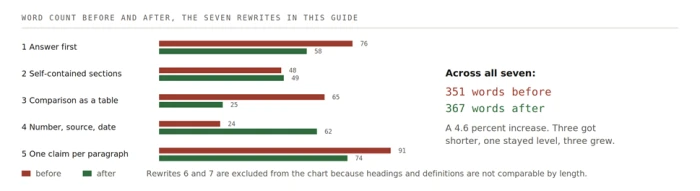
Figure 6. Measured from the examples in this guide. Restructuring is close to word-count neutral.
01 Answer first The first sentence of every section is a complete answer. Explanation follows. | 02 No backward references Every section must make sense pulled out and read alone. |
03 Comparisons in tables Never across three sentences of prose. | 04 Numbers with sources Replace every vague claim with a figure, an origin and a date. |
05 One idea per paragraph Bold label naming the subject at the front. | 06 Headings as questions What the reader asked, not how you filed it. |
07 Define before you use Expand every acronym and term on first appearance. | 08 Re-check quarterly Engines change what they reward, so fixed rules decay. |
| Where to start. Take your single most commercially important page and apply rewrites 1 and 2 only. Answer in the first sentence of every section, and delete every backward reference. Those two account for most of the benefit and take about twenty minutes a page. None of this is difficult. It is fiddly, it applies to every page you own, and it is boring, which is the actual barrier rather than knowledge. |