There is no mention log, no citation report and no rank tracker. Every method available to you is a workaround. This document builds the three that are worth the effort, in the order you should build them.
| NO NATIVE REPORTS | PROMPTS PER DAY | ATTRIBUTION LOSS |
|---|---|---|
| 0 | 2.5B | 60 to 70% |
| brand reports published by OpenAI | conversations you cannot see | of AI referral traffic misfiled by analytics defaults |
The Constraint You Cannot Design Around
ChatGPT exposes no public interface that tells you what it says about your brand. There is no dashboard, no mention log, no citation export, and no equivalent of a rank position. This is not a gap that a clever tool has quietly solved.
Try OpenAI - https://openai.com
Every product in this category, including the expensive ones, works the same way underneath. It asks ChatGPT a list of questions on a schedule and records what comes back. You are paying for scale, storage and reporting, not for privileged access. Understanding that changes what you should expect from the numbers.
THE DISTINCTION THAT DECIDES YOUR WHOLE SETUP
A mention means your brand name appears in an answer. A citation means a specific URL of yours was surfaced as a source. These come from different mechanisms. A mention can come from training data alone, with no link to your site. A citation means ChatGPT retrieved your page live. Tools that report a single blended visibility score hide this difference, and the fix for each problem is completely different.
That distinction gives you the shape of the whole programme. There are three separate things you can observe, they use different plumbing, and they answer different questions.
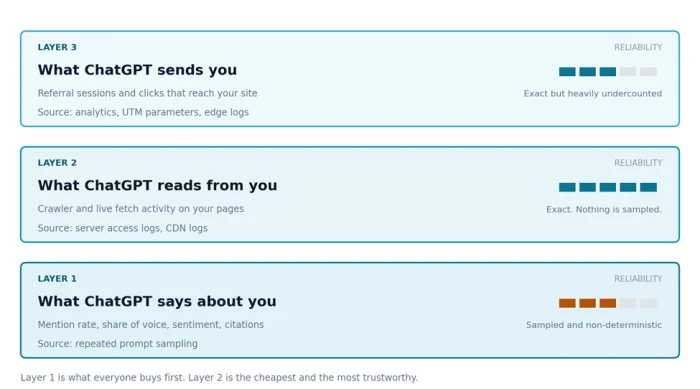
Figure 1. The measurement stack. Build upward. Reliability ratings are this guide's judgement, based on whether the underlying signal is sampled or logged directly.
Layer 1: What ChatGPT Says About You
This is the layer everyone means when they ask the question, and it is the least reliable of the three. You cannot read ChatGPT's mind, so you interrogate it. Ask a fixed set of questions repeatedly, record the answers, and count.
| L1 Prompt sampling | |
| ANSWERS | Do we appear at all, how often, alongside whom, described how, and citing which URLs |
| BUILD | Define 30 to 50 prompts, run each on a schedule, log mention, position, competitors and cited URLs |
| EFFORT | High if manual, low if bought |
| RELIABILITY | 3 of 5. Sampled, and answers vary between runs. |
| BLIND SPOT | Your prompt set is a guess about what real users ask. Everything downstream inherits that guess. |
The Four Metrics Worth Recording
| METRIC | DEFINITION | WHAT A BAD NUMBER MEANS |
|---|---|---|
| Mention rate | Share of prompts where your brand name appears | You are absent from the consideration set |
| Share of voice | Your mentions as a share of all brand mentions | You appear, but rivals appear more |
| Citation rate | Share of prompts where one of your URLs is cited | ChatGPT knows the name but does not retrieve your pages |
| Sentiment and accuracy | Whether the description is positive, neutral or wrong | A visibility win that is actively costing you deals |
Track mention rate and citation rate separately, always. A brand with a high mention rate and a low citation rate is being recalled from training data. A brand with the reverse is being retrieved live but not remembered. Those need opposite fixes.
SAMPLING, NOT MEASURING
ChatGPT answers are non-deterministic. The same prompt can return different brands on consecutive runs, and model updates can move your visibility overnight. A single run is an anecdote. Run each prompt several times per cycle and report a rate with a range, not a single number. If a tool reports your visibility to one decimal place without showing variance, treat that precision as decorative.
Designing the Prompt Set
Every number in Layer 1 is downstream of the questions you chose. Most programmes fail here, by testing prompts that flatter the brand rather than prompts that customers actually type. Four categories cover the buying journey.
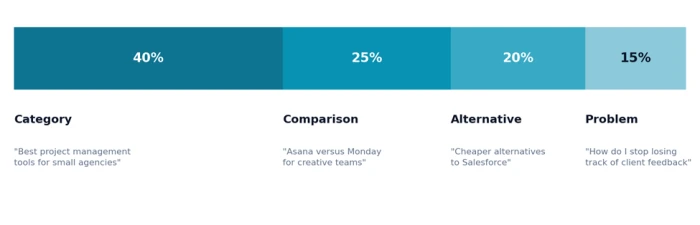
Figure 2. A recommended starting distribution rather than a measured finding. Prompt categories follow the taxonomy used across 2026 practitioner guides.
• Write them as a customer would type them. Not as your marketing team would phrase them. No brand name in the prompt, except in comparison prompts. If your brand appears in the question, the answer proves nothing.
• Cover the money queries first. The prompts that precede a purchase decision matter more than the ones that precede idle reading. Start with 30 to 50 and resist the urge to track 500.
• Include the prompts you are afraid of. Problems with your category, and whether your brand is any good, both belong in the set. Those are the answers that cost you revenue when they are wrong.
• Freeze the set between cycles. If you change prompts every month, you are measuring your prompt edits rather than your visibility. Version the list and change it deliberately.
Layer 2: What ChatGPT Reads From You
This is the cheapest layer to build, the most trustworthy, and the one most teams skip. Your server already records it. OpenAI operates three named crawlers, and they mean three completely different things.
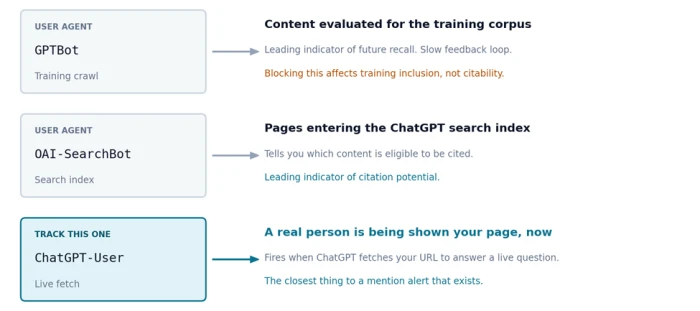
Figure 3. The three OpenAI user agents. Only one of them indicates a real person is reading about you right now. Sources: OpenAI published crawler documentation and 2026 practitioner analyses from Attrifast, Foundry and AuthorityTech.
| L2 Server log analysis | |
| ANSWERS | Which of your pages ChatGPT retrieves, how often, and whether it is retrieving them at all |
| BUILD | Filter access or CDN logs by user agent, then chart hits per URL per week |
| EFFORT | Low. One command to start, a log pipeline to sustain. |
| RELIABILITY | 5 of 5. Logged directly. Nothing estimated. |
| BLIND SPOT | Tells you what was read, never what was said about you afterwards |
The one line that gets you started, run against your access log:
grep -c "GPTBot\|OAI-SearchBot\|ChatGPT-User" /var/log/nginx/access.log
Two checks are worth doing on day one. First, confirm the bots are not blocked in your robots.txt file, because a surprising number of sites block them by accident. Second, note that blocking GPTBot stops training inclusion but does not stop ChatGPT-User from fetching your pages when a user asks. Those are separate decisions and they are often conflated.
Layer 3: What ChatGPT Sends You
Mentions matter because they produce visits. This layer counts the visits, and it is where most analytics setups quietly lie to you.
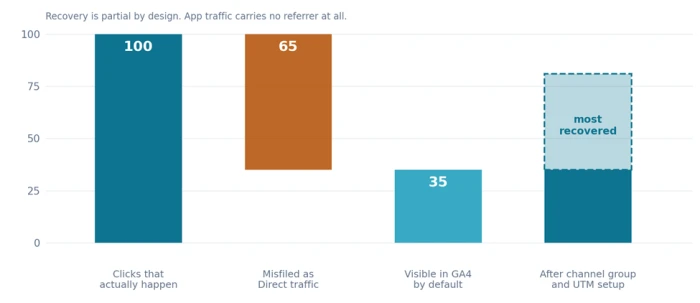
Figure 4. Where ChatGPT clicks disappear. The loss figure is the midpoint of published 2026 estimates, which range from 35 to 70 percent depending on device mix and measurement method. Sources: Devimus, AuthorityTech, Conversios and Attrifast, 2026.
| L3 Referral attribution | |
| ANSWERS | How many people arrive from ChatGPT, on which pages, and whether they convert |
| BUILD | Custom channel group, UTM capture, and a landing page report filtered to AI sources |
| EFFORT | Low. Under an hour of configuration. |
| RELIABILITY | 3 of 5. Exact for what it catches, blind to the rest. |
| BLIND SPOT | Mobile app traffic carries no referrer, so a slice is permanently invisible |
| SIGNAL | WHAT IT CATCHES | STATUS |
|---|---|---|
| chatgpt.com referrer | Desktop web clicks that pass an origin header | Partial |
| utm_source=chatgpt.com | Citation links, independent of the referrer header | Reliable |
| GA4 AI Assistant channel | ChatGPT, Gemini, Copilot, Grok and DeepSeek automatically | Excludes Perplexity |
| Unreferred deep landing pages | App traffic, inferred rather than measured | Inference only |
Build one report that matches on any of the first three, rather than picking a favourite. Each catches sessions the others miss. The fourth is a diagnostic rather than a metric. If unbranded deep pages are collecting direct traffic that nobody could plausibly have typed or bookmarked, you are looking at stripped-referrer AI clicks.
Operating Cadence
A monitoring programme that runs continuously produces noise. One that runs on a cadence produces decisions. Model updates can move your numbers overnight, so weekly is the right resolution for the top layer and far too often for the rest.
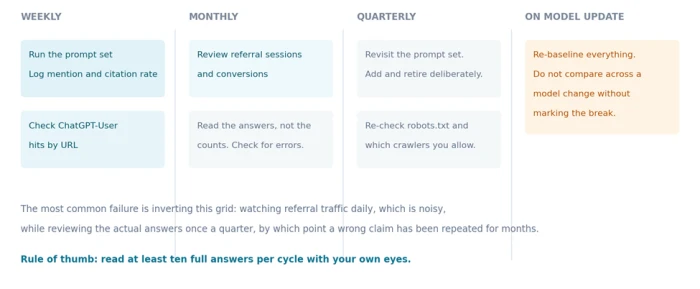
Figure 5. The operating cadence. This is the guide's recommendation. Weekly prompt sampling reflects the consensus in 2026 practitioner guides that model updates can shift visibility within days.
Buying Versus Building
The category is crowded and young. Entry pricing starts around 29 dollars a month, and every vendor claims a proprietary advantage that mostly amounts to a bigger prompt scheduler. Some price additional AI engines as separate add-ons, which is worth checking before you commit.
| YOUR SITUATION | APPROACH | WHY |
|---|---|---|
| Fewer than 20 prompts, one market | Do it manually | A spreadsheet and one focused hour a week beats a subscription you will not read |
| 50 or more prompts, or several markets | Buy a tool | Manual sampling stops being feasible and stops being consistent |
| Already paying for an SEO suite | Check the add-on first | Most major suites now bundle AI visibility, which avoids a second workflow |
| You need attribution, not just counts | Build Layer 3 yourself | No external tool can see your analytics or your revenue |
• Ask how many samples per prompt. A tool that runs each prompt once per day is reporting noise as trend. Ask for the sample count and whether it reports variance.
• Ask whether mentions and citations are separated. A blended visibility score is the single most common way these products flatter themselves.
• Check which engines are included. Several vendors price ChatGPT in the base plan and charge separately per additional engine.
• Ignore proprietary index claims. Nobody has privileged access. Everyone is prompting the same public product.
Failure Modes
• Treating a sample as a measurement. Your mention rate is an estimate from a handful of runs of a guessed prompt list. Report it as a range, and never celebrate a two point move.
• Comparing across a model update. A new model version resets the baseline. A visibility drop the week of a release is usually the model changing, not your content failing.
• Optimising for prompts nobody types. It is easy to reach a high mention rate on a set of prompts you invented. It proves nothing about revenue.
• Confusing being read with being recommended. Heavy crawler activity is a leading indicator, not an outcome. Layer 2 rising while Layer 1 stays flat means your content is being retrieved and then not used.
• Counting mentions without reading them. Being named in an answer that describes your product incorrectly is worse than being absent. Sentiment and accuracy need human eyes, at least monthly.
Verdict
This section stands on its own. If you read nothing else in this document, read the table below before approving a budget.
What You Can and Cannot Answer
| QUESTION | CAN YOU ANSWER IT | WHICH LAYER |
|---|---|---|
| Does ChatGPT mention us for buying questions | Yes, approximately | Layer 1 |
| Are we gaining or losing against a named rival | Yes, as a trend | Layer 1 |
| Is ChatGPT describing us accurately | Yes, by reading answers | Layer 1 |
| Which of our pages does ChatGPT retrieve | Yes, exactly | Layer 2 |
| How much traffic and revenue does it send | Partially, undercounted | Layer 3 |
| How many real users saw us mentioned | No | Not observable |
| What share of all ChatGPT answers include us | No | Not observable |
Reliability and Effort by Layer
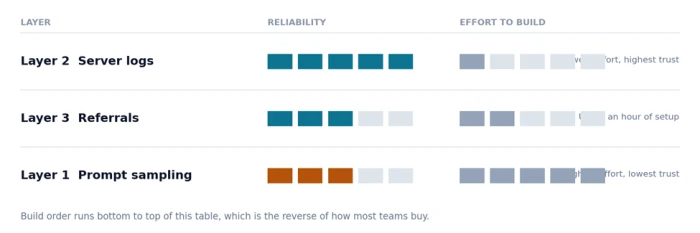
Figure 6. Reliability and effort by layer. Build order runs bottom to top of this table, which is the reverse of how most teams buy.
Verdict on Each Layer
Layer 2. Build this first. It takes an hour, it costs nothing, and it is the only layer that never lies to you. Every team that skips it is paying for a worse version of the same signal.
Layer 3. Build this second. Under an hour of configuration recovers most of the traffic your analytics is currently misfiling as direct. Treat the resulting number as a floor rather than a total, and say so whenever you report it.
Layer 1. Build this last, and buy it rather than building it if your prompt set passes about 50. It is the layer executives ask for and the layer that deserves the least confidence. Useful as a trend, misleading as a measurement.
Overall Summary
Verdict: you can build a reliable trend line and an exact retrieval log. You cannot build a true mention count, and any vendor implying otherwise is selling you a modelled number as a measured one.
That is a real limitation, and it is also enough. A directional trend you trust, paired with a retrieval log you can verify and a traffic figure you know is a floor, supports every decision you actually need to make: what to publish, what to correct, and where you are losing to a competitor.
The failure mode to avoid is buying a dashboard that converts an unmeasurable thing into a confident number. Measure what is logged, estimate the rest, and label which is which. A set of numbers you can defend is worth more than a precise one you cannot.
Build Checklist: The First Week
Day 1. Search your access logs for the three OpenAI user agents. Record the baseline count per URL.
Day 1. Check robots.txt and confirm you are not blocking crawlers by accident.
Day 2. Create the custom channel group and a landing page report filtered to AI sources.
Day 2. Add UTM parameters to every link you place off-site, since those survive a stripped referrer.
Day 3. Write 30 prompts across the four categories. Do not use your brand name except in comparison prompts.
Day 4. Run each prompt three times. Record mention, position, competitors named, and URLs cited.
Day 5. Read ten full answers properly. Note every factual error about your product.
Day 5. Decide buy or build, now that you know what a single cycle actually costs you in time.