0.664 Correlation between branded web mentions and AI visibility. Backlinks: 0.218. (Ahrefs, 75,000 brands) | 88% Of Google AI Mode citations come from outside the organic top 10. ( 40,000 queries) | $750 Average cost per link reported by digital PR teams. ( 2026) | 58% Of SEO teams increased link building budgets in 2026. (Reporter Outreach, 500 SEOs) |
Why links changed jobs
Three things a link does for an AI company, and the one that grew.
Rankings in classic search
Links remain a ranking signal in Google Search. Ahrefs' Patrick Stox describes the current state as links matter less but still matter: their weight has fallen over time, but pages with more referring domains still tend to rank higher.
Classic search is also still the largest traffic source by a wide margin. Ahrefs' May 2026 report, drawing on 76,000 websites, found Google sends about 190 times more traffic to websites than ChatGPT does.
Referral visits that already trust you
A link from a publication your buyers read sends people who arrive with a reason to be there. That is why referral traffic from editorial coverage tends to engage better than cold traffic.
Links bring visitors to the door. What happens next is a conversion problem, which we cover in our SaaS conversion rate optimization guide for AI products. The two compound: better links send better traffic, and better conversion makes every link worth more.
Brand mentions that AI answers rely on
This is the job that grew. Ahrefs analyzed 75,000 brands to find what correlates with appearing in Google AI Overviews. Branded web mentions correlated at 0.664. Backlinks correlated at 0.218. The three strongest factors were all off-site brand signals rather than link signals.
A December 2025 follow-up extended the work to ChatGPT and Google AI Mode. YouTube mentions came out as the strongest single signal on all three surfaces, at about 0.737.
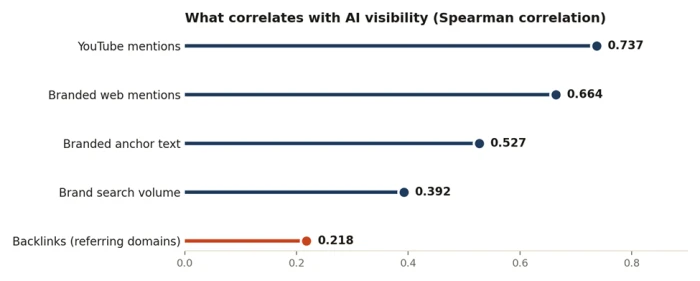
Spearman correlation with brand visibility in AI answers. Source: Ahrefs, 75,000-brand studies, May and December 2025.

Ahrefs is explicit that correlation is not causation. Brands that get mentioned widely are usually brands that invested in PR, product, and community for years. The practical reading holds anyway: the work that earns editorial links is the same work that earns mentions, so the two goals belong in one program.
Why ranking first does not get you cited
Moz analyzed nearly 40,000 queries in February 2026 and found 88% of Google AI Mode citations were not in the organic top 10 for the same query. Only 12% matched a top-10 URL, and about one in five came from a top-10 domain.
Semrush's earlier AI Mode study saw the same pattern from a different angle: the sidebar links shown with 92% of AI Mode responses overlapped with Google's top 10 at the domain level 51% of the time and at the URL level 32% of the time.
The cause is structural. AI Mode splits a question into several background searches and assembles the answer from all of them, so the page that ranks first for the typed query is one input among many.
Context for the shift: Ahrefs found AI Overviews on 21% of keywords across 146 million search result pages, and clicks to top-ranking content fell 58% between December 2023 and December 2025 across 300,000 keywords. Earning mentions is how a brand stays visible when fewer clicks reach the results page.
The rulebook
What Google's spam policies allow, what must be marked, and what is off the table.

Google publishes its spam policies for web search. Every play in this guide is checked against them. Four policies matter most for link building.
• Link spam. Links intended to manipulate rankings. Google's examples include buying or selling links that pass ranking credit, excessive link exchanges, large-scale guest posting built for links, and automated link programs.
• Qualified links. Paid placements are allowed when marked with rel="sponsored" or rel="nofollow". Google introduced the sponsored and ugc attributes in September 2019 and treats all three as hints rather than directives.
• Site reputation abuse. Added in March 2024. Third-party content published on a host site mainly to benefit from the host's ranking signals. Sponsored posts on high-authority publishers that exist only to carry your link fall here.
• Manipulating AI answers. On May 15, 2026, Google updated the definition at the top of its spam policies. Spam now explicitly includes attempts to manipulate generative AI responses in Google Search, which covers AI Overviews and AI Mode. Search Engine Land reported the change the same day.
| PRACTICE | STATUS | WHAT THE POLICY SAYS |
|---|---|---|
| Earning coverage with data, tools, or expert comment | Allowed | Editorial links given because the content is useful are the links Google's systems are built to reward. |
| Partner and integration pages that link to each other | Allowed | Relevant links between real business relationships are fine. Excessive exchange schemes are not. |
| Sponsored articles and paid placements | Marked only | Permitted with rel="sponsored" or nofollow. Marked links do not pass ranking credit. |
| Directory listings your buyers actually use | In moderation | A handful of relevant directories is fine. Volume submissions to low-quality directories are link spam. |
| Private blog networks, bought followed links, mass guest posts | Violation | Named in the link spam policy. Can lead to ranking demotions or manual actions. |
| Seeding "best AI tools" lists or instructions to influence AI answers | Violation | Explicitly spam since May 15, 2026 under the generative AI clause. |
What links cost
Three 2026 surveys, what each number measures, and a budget worked example.
The surveys below measure different things, so the table lists what each figure means and where it comes from.
Two things stand out for an AI company setting a budget. Most digital PR practitioners earn links without paying publishers, so the $750 figure mostly reflects staff time and content cost rather than fees. And three quarters of buyers expect costs to keep rising, which favors building assets you own over renting placements.
Budget worked example
A $5,000 monthly program at the reported $750 average cost per link would produce six to seven links a month if it performed at the industry average.
The same program aimed at a data-led campaign with a strong finding can produce more, because one study is pitched to many outlets. That is why the roadmap in Chapter 09 concentrates spend on one campaign per quarter.
| FIGURE | VALUE | SOURCE |
|---|---|---|
| Average cost per link, digital PR teams | $750 | BuzzStream, State of Digital PR 2026 |
| Digital PR teams that never pay for placements | 81.1% | BuzzStream, State of Digital PR 2026 |
| Teams that cannot state their cost per link | 39.2% | BuzzStream, State of Digital PR 2026 |
| Average guest post cost | $295 direct, $461 through a vendor | BuzzStream, State of Digital PR 2026 |
| Acceptable price for one quality link | $508.95 | Editorial.link, 518 SEO professionals |
| Buyers willing to pay $300 or more per link | 76%, with 31% in the $500 to $1,000 range | Reporter Outreach, 500 SEOs, 2026 |
| Best-performing tactic | Digital PR 34%, journalist requests 21%, guest posts 18% | Reporter Outreach, 2026 |
| Budget change in 2026 | 58% increased, 14% cut | Reporter Outreach, 2026 |
| Expect costs to rise over two years | 75% | Reporter Outreach, 2026 |
Your linkable inventory
Six assets AI companies produce as a byproduct of building the product.

Most content earns nothing. Backlinko and BuzzSumo's analysis of 912 million blog posts found 94% had zero external links, and Ahrefs' study of a billion pages found about 66% had no backlinks at all.
AI companies have an advantage most SaaS businesses lack. They generate reference material while building the product. Each card below names one asset, why it earns links, and how to prepare it.
Asset 1: Benchmarks and evals
Why it earns links: journalists, analysts, and competitors cite numbers with a method behind them.
Prepare it: stable URL, dated versions, summary table in the first screen, raw results downloadable.
Asset 2: Original usage data
Why it earns links: nobody else can publish what your aggregated, anonymized usage shows. Research by Aggarwal and colleagues (KDD 2024) found adding statistics, quotes, and citations improved content visibility in generative engines by up to 40%.
Prepare it: one surprising finding up top, method in plain language, charts you allow others to embed.
Asset 3: Model cards, docs, and changelogs
Why it earns links: developers writing tutorials and reporters covering releases need a canonical reference.
Prepare it: public, clean URLs, visible version history so old citations still resolve.
Asset 4: Open-source repos and SDKs
Why it earns links: useful libraries get named in READMEs, tutorials, and forum answers. Links in user content on platforms like GitHub carry nofollow, so treat them as mention and referral sources.
Prepare it: canonical documentation on your own domain, linked from the repository.
Asset 5: Free tools and calculators
Why it earns links: a token counter, cost estimator, or benchmark comparison gets bookmarked because it does a job. Tools earn links steadily for years.
Prepare it: fast, no signup wall, a one-line "cite this" with the canonical link.
Asset 6: Transparency and safety pages
Why it earns links: data handling, safety evaluations, and incident reports are cited in coverage of the industry. They also answer the trust questions AI buyers ask before signing up.
Prepare it: plain language, dated, one page per topic.
A 30-minute audit: list every page with a number nobody else has published, a tool, a dataset, a benchmark, or a versioned technical reference. Check each for a stable URL, a visible headline finding, and a "cite this" line. Most teams find five to ten assets that exist but were never promoted.
Four plays
Each play lists effort, time to first result, what it yields, and the steps to run it.
Play 1: Data-led digital PR
Effort: High First result: 4 to 8 weeks Yields: Links and mentions Best for: Companies with usage data

Digital PR means creating something newsworthy and pitching it to the journalists who cover your space. In the Reporter Outreach survey it was the tactic most often named as best-performing, and BuzzStream's practitioner survey found more than nine in ten digital PR teams run data-led campaigns.
For AI companies the raw material is close at hand: usage patterns, model behavior, cost trends, and adoption data are all subjects reporters cover.
1. Pick a question reporters are already asking. Read the last month of coverage in your category and note questions answered with opinion rather than data. Your dataset should answer one of them.
2. Pull the data and write the method. Aggregate and anonymize. State sample size, dates, and exclusions in plain language. Reporters ask, and the answer decides whether they trust the rest.
3. Find the one finding that surprises. A campaign with twelve charts gets ignored. Lead with the single number that contradicts what people assume.
4. Build the page before the pitch. Publish on your own domain with the headline finding, a summary table, downloadable charts, and a stable URL. This is where links will point.
5. Pitch narrowly and offer a quote plus a chart. Email the specific reporters who covered the topic, finding in the first line, with a named source and a visual so the piece can be written without a follow-up.
Play 2: Expert commentary and journalist requests
Effort: Low to medium, daily First result: 1 to 3 weeks Yields: Mentions, some links Best for: Teams with a credible named expert

Journalists post requests for expert sources on dedicated platforms. Answering well earns quotes, links, and brand mentions in publications you could not otherwise pitch. In the Reporter Outreach survey, 21% of respondents named journalist requests as their best-performing tactic.
The platform landscape changed. Help a Reporter Out (HARO) was the standard for over a decade. Cision rebranded it as Connectively in 2024, added a paid tier, and shut it down on December 9, 2024. Featured.com bought the HARO brand in April 2025 and relaunched a free digest. Most active teams now watch more than one service.
• Qwoted. Vets both journalists and sources. BuzzStream's analysis of seven journalist request platforms found 70.3% of Qwoted requests came from publications with a Domain Rating of 70 to 100.
• Source of Sources. Free, started by HARO founder Peter Shankman. Highest share of followed links in the same BuzzStream analysis.
• Featured, SourceBottle, Help a B2B Writer, ProfNet. Smaller or specialized services that cover beats the larger ones miss.
1. Nominate two or three real experts. A founder, a research lead, and a product lead with distinct specialties. Reporters want a named person with a title.
2. Set up beat alerts. AI regulation, model costs, automation in a specific industry, data privacy. Most requests close within hours, so speed matters.
3. Answer the question in the first two sentences. Quotable answer first, one supporting fact, then a short bio line.
4. Include something only you can say. A number from your own data, a pattern across customers, or a concrete prediction with reasoning.
5. Track placements yourself. Most reporters do not notify sources. Set alerts for your experts' names and your brand.
Play 3: Partner and ecosystem links
Effort: Low First result: 2 to 6 weeks Yields: Relevant followed links Best for: Products with integrations

AI products live inside ecosystems: model providers, cloud platforms, integration marketplaces, and the tools they connect to. Each relationship can produce a legitimate, relevant link when both sides have a reason to publish.
• Integration listings. Marketplaces and partner directories run by the platforms you build on. Complete every field and link to a dedicated integration page.
• Partner pages on both sides. Providers whose models or infrastructure you use often publish customer and partner stories, and they link.
• Joint case studies, co-authored research, and webinars. Two audiences, two links.
• Customer sites. Engineering blogs and "tools we use" pages often link when asked.
1. List every partner, integration, and customer with a website. Note who already links and who does not.
2. Create a page worth linking to for each relationship. An integration page that explains setup, or a case study with real results, gives the partner a reason beyond goodwill.
3. Ask at natural moments. Launch day, a joint announcement, a new version, or a renewal.
4. Avoid formal swaps. Google's link spam policy names excessive exchanges. Link where it helps your users and let partners do the same.
Play 4: Developer communities, open source, and video
Effort: Medium, ongoing First result: 2 to 4 months Yields: Mentions at scale Best for: Developer-facing products

Developer communities produce mentions at scale. Most are nofollow links or no link at all, which makes them weak for classic rankings and strong for AI visibility, where Ahrefs found branded mentions correlate three times more strongly than backlinks.
Video counts too. YouTube mentions were the strongest single correlate of AI visibility in Ahrefs' December 2025 study, at about 0.737. That does not require your own channel: appearing on shows your buyers watch, and being covered in video reviews, both produce mentions.
1. Pick one community your users are already in. A forum, a Discord, a subreddit, or a Q&A site. Answer under real names, and link only when the link answers the question.
2. Ship one useful open-source project per year. Small and maintained beats large and abandoned. Link the README to documentation on your domain.
3. Publish one technical deep dive per quarter. Architecture, numbers, tradeoffs, and what did not work. Engineers cite reproducible detail.
4. Book podcasts and video appearances. List shows that covered your category, pitch two specific topics, and send a bio and headshot up front.
5. Track mentions, not only links. Brand monitoring makes unlinked mentions count in your reporting.
Choosing plays by company stage
Most teams should run two plays at once, not four. The table matches plays to the situation they fit best.
| SITUATION | START WITH | ADD NEXT | WHY |
|---|---|---|---|
| Pre-launch or under 12 months old | Play 2 (journalist requests) | Play 3 (partners) | Both need a person and a page, not a dataset or an audience. |
| Product in market with usage data | Play 1 (data-led PR) | Play 2 | One study per quarter produces the editorial links; requests keep mentions flowing between campaigns. |
| Developer-facing product | Play 4 (community and open source) | Play 1 | Mentions at scale from the audience that already uses you, then data campaigns for broader coverage. |
| Enterprise AI with few public users | Play 1 | Play 3 | Research and partner pages carry the program when there is no community to draw on. |
Outreach that gets replies
Every play ends with an email to someone who does not know you.
Backlinko's analysis of 12 million outreach emails found an average reply rate of 8.5%, and a single follow-up increased replies by 65.8%. Those two numbers set the rules.
• One reader, one reason. Name the piece of theirs you are responding to and say why your asset fits it. Templates get deleted.
• Lead with the finding. The first line is the number or the claim. Who you are comes last.
• Make the ask small and specific. "Would this data be useful for your piece on AI support costs?" is easier to answer than "Would you consider linking to us?"
• Send one follow-up, then stop. The data supports one. Repeated chasing costs the relationship.
• Reply fast. A reporter on deadline who hears back in ten minutes remembers you next time.
An email that follows the rules
Subject: Refund requests are 3x more common after AI-drafted replies (data)
Hi Maya, your piece on AI in customer support last week asked whether automated replies change customer behavior. We measured it across 40,000 anonymized conversations: refund requests were three times more common after AI-drafted replies than after human ones. Method and charts here: [link]. Happy to share the raw table if useful. Sam Ortiz, head of research at [company].
Red lines
Tactics sold to AI startups as growth hacks that violate policy or no longer work.

• Private blog networks. Sites that exist only to pass link value. Named in the link spam policy and detectable at scale.
• Undisclosed paid links. Buying a placement without rel="sponsored" or nofollow. Allowed only when marked, and marked links do not pass ranking credit.
• Exchange schemes. Reciprocal linking at scale, including "partner page" swaps that exist only for links.
• Mass AI-generated guest posts. Generic articles on unrelated sites for a link. Covered by the link spam and scaled content abuse policies.
• Sponsored content that borrows a host's authority. Site reputation abuse when the content exists only to carry your link.
• Manufactured "best AI tools" lists and recommendation seeding. Explicitly spam since May 2026.
• Directory blasts. Hundreds of low-quality submissions. A handful your buyers use is fine.
Scoreboard
What to measure, and why most programs do not.
The Reporter Outreach survey found 74% of SEOs believe backlinks affect AI visibility, but only 24% track it. Measurement is where most link programs fall short.
| METRIC | DEFINITION | WHY IT MATTERS |
|---|---|---|
| Referring domains | Unique sites linking to you | The classic ranking input. Count domains, not total links. |
| Links per asset | Referring domains to each asset page | Shows which assets earn and which need promotion. |
| Branded web mentions | Third-party pages naming your brand, linked or not | Strongest measured correlate of AI visibility. |
| AI citations | How often your domain is cited for a fixed prompt set | The outcome the mention program is trying to move. |
| Referral traffic and conversion | Sessions from linking sites and the share that signs up | Connects links to revenue, not rankings alone. |
| Cost per link and per mention | Program cost divided by results | The number 39.2% of digital PR teams cannot report. |
SETUP IN FOUR MOVES
1. Baseline in week one. Referring domains, mentions, AI citations for 20 to 50 prompts, and referral conversion rate, before anything starts.
2. Tag every asset and campaign. Track at the page level so you can see what works.
3. Check the same prompts monthly. AI answers change often. A fixed prompt set on a schedule is the only way to see a trend.
4. Report cost per link and per mention. Even a rough number changes the budget conversation.
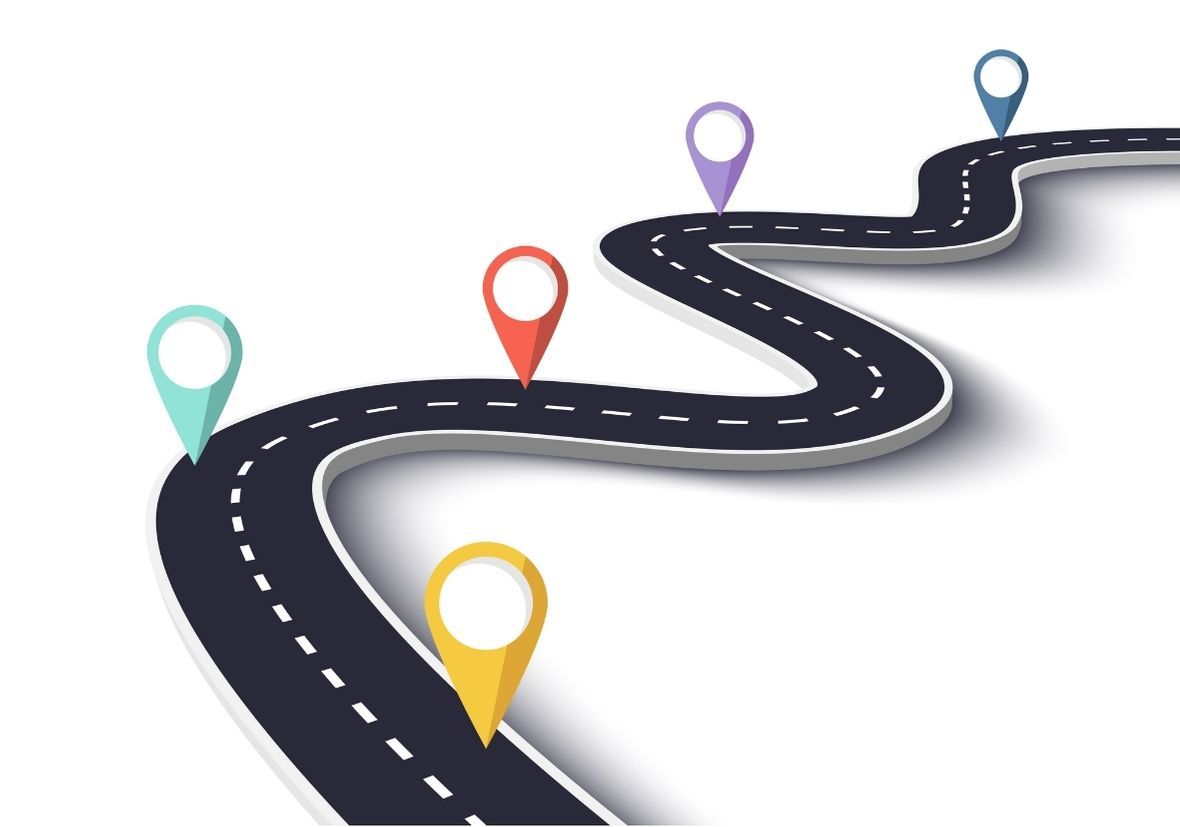
The 90-day roadmap
Measurement first, existing assets second, the fastest plays third, compounding programs last.
Weeks 1 to 2: Baseline and audit
DO
• Record referring domains, mentions, and AI citations for a fixed prompt set.
• Run the linkable inventory audit from Chapter 04.
• List partners, integrations, and customers, with link status.
• Review your link profile against Google's policies.
WHY FIRST
Every later step is judged against this baseline, and most teams find assets that only need promotion.
DONE WHEN
One document holds the baseline, the inventory with stable URLs, and the partner list.
Weeks 3 to 4: Fix and promote what exists
DO
• Give every asset a stable URL, a visible finding, and a "cite this" line.
• Ask partners and customers who do not yet link, with a specific page.
• Register experts on two journalist request platforms with beat alerts.
WHY SECOND
No new content needed, and links start within weeks, which builds support for the longer programs.
DONE WHEN
All assets pass the three-point check, partner asks are sent, experts answer daily.
Weeks 5 to 8: First data-led campaign
DO
• Answer one question reporters keep asking, with your data.
• Publish the study page with method, summary table, and charts.
• Pitch a short reporter list, with one follow-up.
• Book two podcast or video appearances.
WHY THIRD
Digital PR is the tactic most practitioners rate best-performing, and the page is reusable next quarter.
DONE WHEN
Study live, pitch list contacted, coverage tracked at the page level.
Weeks 9 to 12: Start the compounding programs
DO
• Ship or refresh one open-source project with docs on your domain.
• Publish one technical deep dive with numbers.
• Release one free tool tied to a real task.
• Review baseline versus current and plan next quarter.
WHY LAST
These take longest to pay off, so they start once faster plays are producing and measurement can show the difference.
DONE WHEN
Each program has an owner, a cadence, and a line in the monthly report.
Questions AI teams ask
Short answers to the objections that come up in every planning meeting.
Do we still need links if AI answers care about mentions?
Yes. Google still sends far more traffic than any AI assistant, referring domains remain a ranking input, and the coverage that earns a mention usually carries a link anyway. Build one program for both rather than choosing.
Is buying links ever acceptable?
Paid placements are permitted when marked with rel="sponsored" or nofollow, and marked links do not pass ranking credit. Buying followed links to influence rankings is link spam under Google's policies.
Do nofollow links from GitHub, Reddit, or forums help at all?
Google treats nofollow as a hint, so do not count on ranking value. They do count as brand mentions and as referral sources, and mentions are the stronger correlate of AI visibility in Ahrefs' data.
How many links per month is a realistic target?
At the reported $750 average cost per link, a $5,000 monthly program running at the industry average produces six to seven links. A strong data-led campaign can beat that because one study is pitched to many outlets. Set targets per asset, not per month.
Can we optimize directly for AI Overviews and AI Mode?
You can earn citations by publishing content worth citing and being mentioned by sources AI systems draw on. Attempts to manipulate generative AI responses have been explicitly spam under Google's policies since May 15, 2026.
Quarterly scorecard
Eleven checks to run before each planning cycle.
- Referring domains, mentions, and AI citations are baselined and tracked monthly.
- Every linkable asset has a stable URL, a visible finding, and a "cite this" line.
- Benchmarks, model cards, and changelogs are public and versioned.
- Two or three named experts answer journalist requests on at least two platforms.
- One data-led campaign runs per quarter, published on your own domain.
- Every partner, integration, and customer relationship has a page worth linking to.
- Open-source documentation lives on your domain and is linked from the repository.
- Outreach leads with the finding, asks for something specific, and gets one follow-up.
- No paid placement goes out without rel="sponsored" or nofollow.
- Nothing in the program is designed to manipulate AI answers rather than earn coverage.
- Cost per link and per mention is reported.
Bottom line
Link building for an AI company in 2026 is a mentions program that also earns links. The work is what it has always been at the top of the market: publish something worth citing, put it in front of the people who cite things, and make the ask small.
1. Mentions outweigh links for AI visibility. Ahrefs measured branded web mentions at 0.664 and backlinks at 0.218. Build for coverage and links follow.
2. Classic rankings still matter. Google sends about 190 times more traffic than ChatGPT, and referring domains remain a ranking input.
3. Use what you already have. Benchmarks, data, docs, open source, and tools are linkable by nature and rarely promoted.
4. Run two plays, not four. Data-led PR and journalist requests produce the fastest editorial results; partner and community programs compound.
5. Stay inside the rulebook. Mark paid links, avoid exchange schemes, and do not try to game AI answers. Since May 2026 that last one is spam by definition.
6. Measure mentions and referral conversion. Three quarters of SEOs believe links affect AI visibility. A quarter track it.