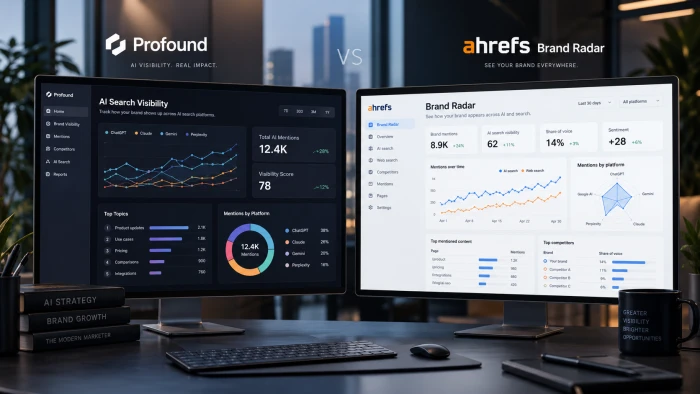
What this comparison covers
AI visibility tools answer a question that rank trackers cannot: when a buyer asks an AI assistant for a recommendation, does your brand show up, and who shows up instead of you? Profound and Ahrefs Brand Radar are two of the most discussed products in this category.
This guide is written for marketing leads, SEO managers and agency owners who need to pick one. It compares what each tool measures, where the data comes from, what the plans cost once you add the extras, what verified users say about each, and how to test both before you commit.
Everything about plans and limits below comes from the vendors' own pricing and product pages as of early September 2026. Where third-party reviews report numbers the vendors do not publish, that is flagged in the text.
Quick verdict
If you only read one section, read this one. The short version is that Profound is an operations platform built around prompts you configure and content you ship, while Brand Radar is a research database built around prompts Ahrefs already ran.
Choose Profound when Your team owns a content program and wants monitoring, fact correction and content creation in one workflow. You need daily tracking of your own prompt set with browser-captured answers, and you can commit to annual billing. You need engines beyond the Google and OpenAI pair, such as Claude, Grok or DeepSeek, and you can move to an Enterprise contract to get them. | Choose Brand Radar when You already pay for Ahrefs and want AI visibility next to your backlink, keyword and traffic data. You want to look up any brand or category instantly, with history back to 2025, without configuring anything first. Your priority is Google AI Overviews and AI Mode, plus off-site signals like YouTube, TikTok and Reddit results in Google. |
Neither tool is cheap once you configure it for real work. Profound's practical entry point for multi-engine tracking is the $399 per month Growth plan on annual billing. Brand Radar starts at $199 per month, but most teams add custom prompt checks and a base Ahrefs plan on top.
What is Profound
Maker: Profound, a New York company founded in 2024 by James Cadwallader and Dylan Babbs. It raised a $96 million Series C at a $1 billion valuation on February 24, 2026, bringing total funding past $155 million, and reported more than 500 customers at the time.
Category: Answer engine optimization (AEO) platform. Profound positions itself as a "read and write" system: it reads how AI describes your brand, then helps you write content that changes the answer.
Core modules: Answer Engine Insights for monitoring, Prompt Volumes for demand data, Agent Analytics for AI-referred traffic and crawler activity, Shopping for ChatGPT Shopping, Agents for content creation, and Aim for orchestrating projects.
Scale claims: The company states it analyzes more than 1 billion citations, 10 million prompts and 30 billion crawler visits every day.
Answer Engine Insights, the monitoring layer
Answer Engine Insights is where most users spend their time. You define a brand, its competitors and the topics you care about, and Profound runs a prompt set against the chosen engines every day. The dashboard reports a visibility score, share of voice, a rank against competitors, sentiment, and the citations behind each answer.
Prompts come from three places: an auto-generated set built from your brand and topic configuration, a manual upload, or the Prompt Volumes dataset of questions real users have typed into AI platforms. Full details are on the Answer Engine Insights page.
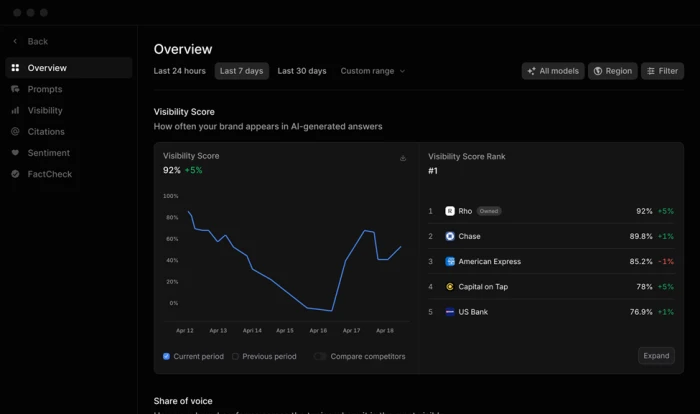
Profound's Overview screen: a daily visibility score on the left and a competitor rank on the right, filterable by model, region and date range.
Citations and FactCheck
The Citations report groups every source an AI answer relied on into categories such as owned, earned, competition and social, then ranks the domains that appear most often. That tells you which third-party sites shape the answer and whether your own pages are being read at all.
FactCheck goes one step further. It lists claims AI has made about your brand, marks the ones that are wrong, shows the "ground truth" you supply, and points to the source that introduced the error. See the FactCheck page for how correction workflows are built on top of it.
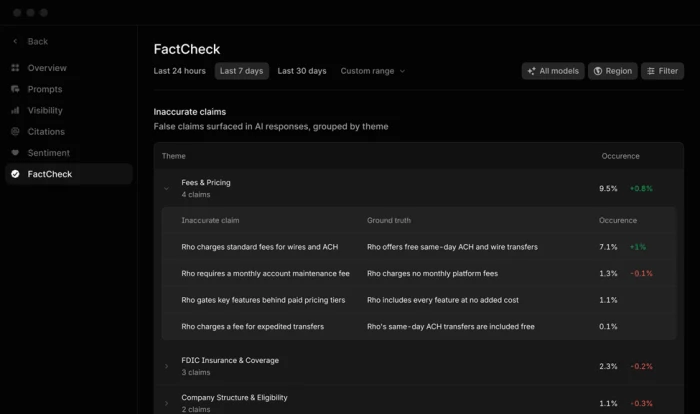
FactCheck pairs each inaccurate claim (for example, that a company charges wire fees) with the correct statement and how often the error occurs.
Agents, Prompt Volumes and Agent Analytics
Profound Agents launched on February 24, 2026, the same day as the Series C. They are automated workers that research gaps, draft and optimize content, and publish through integrations. Usage is metered in credits: 100 per month on Starter, 400 on Growth, and custom on Enterprise. The Agents page lists the templates available.
Prompt Volumes is panel data from opted-in consumers that shows what people actually ask AI assistants, with cuts by region and demographic. Self-serve plans only see related keywords; full search of the dataset is an Enterprise feature.
Agent Analytics tracks AI crawler visits and AI-referred traffic across unlimited domains, using integrations with Cloudflare, Akamai, Fastly, AWS, Vercel, Netlify, WordPress and Google Analytics.
What is Ahrefs Brand Radar
Maker: Ahrefs, the Singapore-based SEO suite known for its backlink index and keyword database. Brand Radar is its AI visibility product, and the product page states it is used by more than 3,000 companies.
Category: AI visibility research and tracking inside an SEO platform. It can be bought on its own (you receive an Ahrefs Free account with it) or added to a paid Ahrefs plan.
Two ways to track: The AI Visibility Index, a pre-built database of more than 460 million monthly prompts already run through six AI platforms, and Custom Prompts, where you define buyer questions and choose how often each is checked.
Bonus data: Search demand, web mentions, and visibility on YouTube, TikTok and Reddit results inside Google, which are free while in beta. Full overview on the Brand Radar page.
The AI Visibility Index
The Index is what makes Brand Radar different from every prompt tracker. Ahrefs takes real queries from its keyword database, expands them into natural questions using People Also Ask and semantic fan-out, runs the results through AI Overviews, AI Mode, ChatGPT, Perplexity, Gemini and Copilot, and stores every response.
Because the data already exists, you can type any brand, product or category and see mentions, citations, estimated impressions and AI share of voice immediately, with history back to 2025 and no cap on the number of domains you look up. The prompt pool is heavily weighted toward Google: of roughly 462 million monthly prompts, about 308 million are AI Overviews, with the other five platforms at around 30 million each.
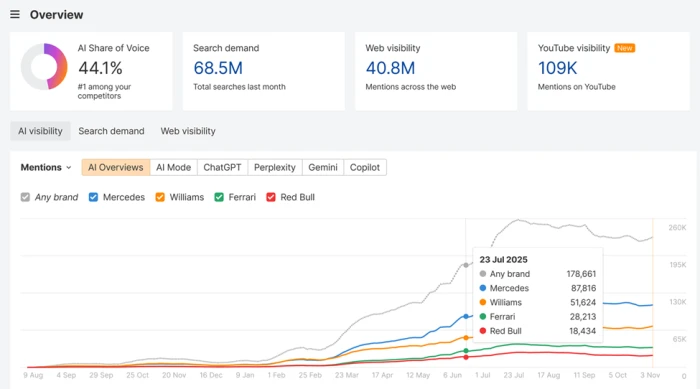
Brand Radar's Overview: AI share of voice, search demand, web visibility and YouTube mentions, with a per-platform mentions chart for a set of competing brands.
Custom Prompts
Custom Prompts cover the case the Index cannot: a brand nobody searches for yet, or a niche question that never appears in a keyword database. You add the exact questions your buyers ask, pick platforms, locations and a cadence from daily to monthly, and Brand Radar runs them from that point forward.
Every paid Ahrefs plan includes a small daily quota (5 prompts on Lite, 10 on Standard, 20 on Advanced) and larger check packages can be bought separately. Custom Prompts also support Claude, which the Index does not. The Custom Prompts page explains fan-out discovery, where the tool shows the hidden sub-queries an AI generates while answering your prompt.
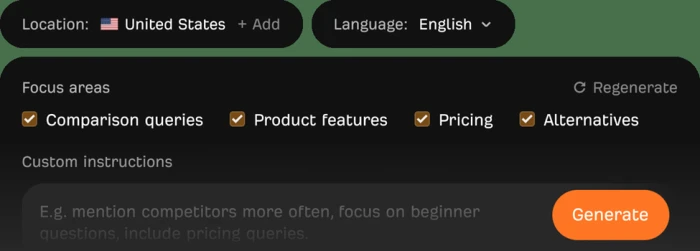
Custom Prompts can be generated from signals Ahrefs already holds, such as competitor comparisons and pricing data, then filtered by location and language.
AI analytics and off-site sources
Brand Radar connects to two free Ahrefs tools. Web Analytics adds an AI traffic column so you can see which pages already receive visits from AI assistants, and Bot Analytics shows AI crawlers reading your site in real time. Both are described on the Web Analytics and Bot Analytics pages.
The off-site module scans YouTube titles, descriptions and transcripts, TikTok trends, and Reddit threads that rank inside Google. Ahrefs' argument is that these conversations become the sources AI models retrieve from, so watching them gives you an early signal.
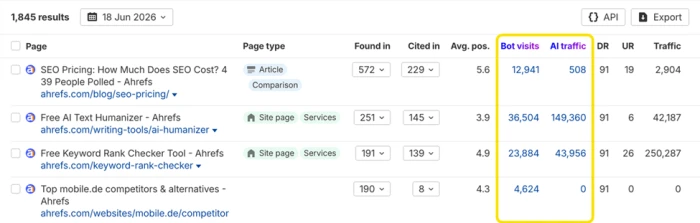
The top pages table in Ahrefs Web Analytics with Bot visits and AI traffic columns alongside the usual organic figures. Source: Ahrefs, Brand Radar.
How each tool collects AI visibility data
The collection method matters more than any single feature, because it decides how fresh the numbers are, how well they match what a customer sees, and how much setup you owe before the first chart appears.
Profound Runs your tracked prompts every day, on every plan. Answers are captured from the browser front end of each engine rather than an API, so the response matches what a person sees on the site. Each prompt is run multiple times because AI rarely gives the same answer twice. On Growth, 100 prompts produce about 9,000 responses a month. Prompts are yours: auto-generated from your setup, uploaded, or pulled from Prompt Volumes panel data. | Ahrefs Brand Radar Maintains a shared index. Question sets are re-tested monthly on a rolling 90-day window, while the search demand layer refreshes every few days and web visibility every few minutes. Prompts are seeded from real Google search demand, then expanded with People Also Ask and fan-out. This grounds visibility in things people search, at the cost of missing questions that never hit Google. Custom Prompts run on your schedule, daily to monthly, and each run consumes checks. The methodology post covers the pipeline. |
A useful way to frame it: Profound is a laboratory where you control the experiment, and Brand Radar is a census that already happened. The lab is more precise for your prompts. The census is far broader and needs no setup.
Feature comparison in five short tables
One long table is hard to hold in your head, so the comparison is split by theme. Every cell is plain text, and plan details reflect the vendors' public pages on September 8, 2026.
Table 1: how the data is collected
This is the root of every other difference, so it comes first.
| Area | Profound | Ahrefs Brand Radar |
|---|---|---|
| Core approach | Prompt tracking you configure, run daily with browser-captured answers | Pre-collected index of 460M+ search-seeded prompts, plus optional custom prompts |
| Prompt source | Auto-generated, uploaded, or Prompt Volumes panel data of real AI queries | Ahrefs keyword database expanded with People Also Ask and semantic fan-out |
| Refresh cadence | Daily on all plans | Index re-tested monthly on a 90-day window; custom prompts daily, weekly or monthly |
| Response capture | Front-end browser sessions on each engine, several runs per prompt | Public web interfaces of each platform, one stored response set per re-test |
| Best suited to | Measuring your own prompt set with fast feedback | Benchmarking any brand against real search demand |
Table 2: engine coverage by plan
Coverage is gated in opposite directions, which is why the entry prices are not comparable on their own.
| Area | Profound | Ahrefs Brand Radar |
|---|---|---|
| Engines on entry plan | ChatGPT only on Starter ($99/mo) | Six platforms in the Index from $199/mo: AI Overviews, AI Mode, ChatGPT, Perplexity, Gemini, Copilot |
| Engines on mid plan | ChatGPT, Perplexity and Google AI Overviews on Growth ($399/mo) | Same six platforms; Custom Prompts add Claude on any paid plan |
| Maximum coverage | Nine on Enterprise, adding AI Mode, Gemini, Copilot, Grok, DeepSeek and Claude | Seven in total: six in the Index plus Claude through Custom Prompts |
| Claude tracking | Enterprise only | Custom Prompts only, at eight checks per update |
| Index weighting | Not applicable, every engine gets the same prompt set | Roughly two thirds of prompts are Google AI Overviews |
Table 3: setup, history and competitor research
These rows decide how quickly you get a first answer and how far back you can look.
| Area | Profound | Ahrefs Brand Radar |
|---|---|---|
| Setup time | Instant configuration, data accumulates from day one | None for the Index, any brand can be searched immediately |
| Historical data | All time for your tracked prompts, from the day you start | Index responses back to 2025 for any brand, even ones you never tracked |
| Competitor research | Competitors you add to your configuration | Any brand or category in the Index, no configuration required |
| Brand entities | One brand per configuration, multiple companies on Enterprise | Merge several domains and brand names into a single entity |
| Regions and languages | One region and one language on self-serve; 150+ regions and 30+ languages on Enterprise | Location is set per check; multi-market handled through entities |
Table 4: metrics and analysis features
What each dashboard reports and which checks run automatically.
| Area | Profound | Ahrefs Brand Radar |
|---|---|---|
| Primary metrics | Visibility score, share of voice, rank, citation share, sentiment | Mentions, citations, AI share of voice, estimated impressions |
| Accuracy monitoring | FactCheck flags false claims with their sources | No dedicated feature, responses are read manually |
| Sentiment analysis | Built in, with keyword and theme breakdowns | Not a core Brand Radar metric |
| Citation analysis | Citations grouped by owned, earned, competition and social, ranked by domain | Cited pages and domains linked to Ahrefs backlink and keyword data |
| Off-site sources | Citation authority by category and domain | YouTube, TikTok, Reddit-in-Google visibility, web mentions and search demand |
| Traffic and crawler data | Agent Analytics with CDN and hosting integrations, unlimited domains | Web Analytics AI traffic column and Bot Analytics, both free |
Table 5: execution, reporting, billing and security
The practical rows: what you can do with the data, how you export it, and how you pay.
| Area | Profound | Ahrefs Brand Radar |
|---|---|---|
| Content execution | Profound Agents create and optimize content, metered by credits | Reporting only; content help lives in the separate AI Content Helper add-on |
| Exports and API | CSV and JSON on Growth; API on Enterprise | API and MCP server on paid plans; Looker Studio on Advanced and above |
| Reporting | AEO dashboards inside the platform | Ahrefs Dashboard and Report Builder alongside SEO reports |
| Billing | Annual billing on Starter and Growth; custom contract on Enterprise | Monthly, cancel anytime; annual saves up to 17 percent |
| Free trial | Free trial on Growth | No trial; free AI Visibility Checker and Ahrefs Free account |
| Seats | 1 on Starter, 3 on Growth, custom on Enterprise | 1 user included on the base plan, extra users $40 to $100/mo by tier |
| Security | SOC 2 Type II; SSO/SAML on Enterprise | SSO, access management and audit log on Ahrefs Enterprise |
Eight differences that change the decision
The five tables above hold 28 rows. These eight are the ones that most often decide a purchase.
Difference 1: your prompts versus everyone's prompts
Profound tracks a prompt set that you own. If you sell warehouse robotics, you write or generate fifty questions a warehouse manager would ask and Profound checks them daily. The result is precise for your niche and blind to everything outside it.
Brand Radar starts from Google demand. If your buyers ask questions that produce search volume, the Index probably already has them and you can see two years of history. If your category is new or your brand is small, Ahrefs itself says the Index may have limited coverage and points you to Custom Prompts.
Difference 2: daily runs versus monthly re-tests
Profound runs every tracked prompt every day. When you publish a new page or a competitor launches a product, the visibility line moves within days.
The Brand Radar Index is re-tested monthly on a rolling 90-day window. That is fine for benchmarking and quarterly reporting, but too slow to measure a specific campaign. Custom Prompts close the gap, and daily checks on several platforms consume the 2,500-check allowance quickly.
Difference 3: engine coverage is gated in opposite directions
Profound's Starter plan covers ChatGPT only, Growth adds Perplexity and Google AI Overviews, and the remaining six engines including Claude, Grok and DeepSeek require an Enterprise contract.
Brand Radar's Index covers six platforms at the entry price, and Custom Prompts add Claude at a cost of eight checks per update. The trade-off is that the Index is dominated by Google AI Overviews, so a team focused on ChatGPT gets a thinner slice.
Difference 4: monitoring only versus monitoring plus execution
Brand Radar tells you what happened. Turning that into content is a separate job done in other Ahrefs tools such as AI Content Helper, or outside Ahrefs entirely.
Profound bundles execution. Agents draft and optimize pages against the prompts where competitors are cited and you are not, then the monitoring layer shows whether the visibility moved. Credits limit how much of this you can do on self-serve plans.
Difference 5: correcting what AI gets wrong
FactCheck is unique to Profound in this pairing. It surfaces claims such as incorrect pricing or discontinued features, ties each one to the source that introduced it, and gives PR and brand teams a list to work.
Brand Radar stores the raw responses and lets you read and export them, so you can find errors, but nobody flags them for you.
Difference 6: competitor lookups without setup
Because the Index already contains answers for millions of prompts, Brand Radar can profile a competitor you have never added, or an entire category, in seconds. Agencies pitching new clients and analysts sizing a market get a lot from this.
Profound benchmarks you against the competitors in your configuration. Adding a new one starts a new data series from that day forward.
Difference 7: where the tool lives
Brand Radar sits beside Site Explorer, Keywords Explorer, Rank Tracker and Web Analytics. Cited pages link into backlink data, prompts map to keyword topics, and the reporting tools you already use work with it.
Profound is a standalone platform with its own integrations into CDNs, analytics and publishing systems. That is a strength if AEO is a dedicated function, and extra overhead if it is one line in an SEO manager's job description.
Difference 8: how you pay
Profound's self-serve plans are billed yearly, so a Growth subscription is a $4,788 commitment before you know whether the team will use it. Enterprise is a negotiated contract.
Brand Radar is monthly with no contract, and Ahrefs states it can be cancelled at any time. The bill is modular though: the Index, check packages, a base plan and extra seats stack up separately.
Pricing compared
Both vendors publish prices, which is unusual in this category, but both also have costs that only appear once you configure the tool properly. This section lays out the published numbers first, then the realistic totals.
Profound plans
Figures are from the Profound pricing page. Starter and Growth are billed yearly with two months free; Enterprise is a custom quote.
| Plan detail | Starter, $99/mo | Growth, $399/mo | Enterprise, custom |
|---|---|---|---|
| Engines | ChatGPT only | ChatGPT, Perplexity, Google AI Overviews | Up to nine engines |
| Prompts and responses | 50 prompts, 1,500 responses per month | 100 prompts, 9,000 responses per month | Tailored prompt plan |
| Frequency | Daily | Daily | Daily |
| Regions and languages | 1 and 1 | 1 and 1 | Custom, up to 150+ regions and 30+ languages |
| Agent credits | 100 per month | 400 per month | Custom package |
| Prompt Volumes | Not included | Related keywords only | Full search |
| Exports and API | None | CSV and JSON, no API | CSV, JSON and API |
| Seats and support | 1 seat, email | 3 seats, email | Custom seats, dedicated Slack and specialist |
| Security | No SSO | No SSO | SSO/SAML and SOC 2 |
Profound also sells agency plans with per-client workspaces. Third-party reviews published in 2026 estimate Enterprise deals at roughly $2,000 to $5,000 per month depending on engines, seats and credits, but Profound does not publish those figures, so treat them as a range to sanity-check a quote.
Ahrefs Brand Radar plans
Figures are from the Ahrefs pricing page and the Brand Radar page. One check equals one prompt on one platform in one location, and Claude costs eight checks per update.
| Component | What you get | Price |
|---|---|---|
| AI Visibility Index | Instant lookups across 460M+ prompts on six platforms, 83 prompts per day, 2,500 checks per month, YouTube, TikTok and Reddit free while in beta | From $199 per month, available standalone with an Ahrefs Free account |
| Custom prompt package, Basic | 2,500 checks per month, roughly 80 prompts daily on one platform | $50 per month, overage $0.020 per check |
| Custom prompt package, Growth | 7,000 checks per month, roughly 100 prompts daily on two platforms | $100 per month, overage $0.015 per check |
| Custom prompt package, Scale | 25,000 checks per month | $250 per month, overage $0.010 per check |
| Included prompts on base plans | Lite 5 prompts and 150 checks, Standard 10 and 300, Advanced 20 and 600, Enterprise from 83 and 2,500 | Included in Lite $129, Standard $249, Advanced $449, Enterprise $1,499 per month |
| Additional users | Extra seats on the base plan | $40 to $100 per user per month depending on tier |
Independent reviews from mid-2026, including AEO Labs, describe a per-platform index price of $199 with a $699 all-platform bundle, and put a typical all-in configuration between about $830 and $1,150 per month once a base plan and check packages are added. Ahrefs has changed the packaging more than once this year, so confirm the current structure before you budget.
What a realistic month costs
Consider a mid-size B2B software company that wants three engines, 100 tracked prompts checked daily, and three people with access.
Profound Growth covers exactly this: three engines, 100 prompts, daily runs, three seats. Cost is $399 per month, paid as $4,788 up front for the year. Adding Claude or Gemini means moving to Enterprise, and heavy Agent usage beyond 400 credits also pushes you there. | Ahrefs Brand Radar 100 prompts on three platforms every day is 9,000 checks a month, so the Index's 2,500 checks plus a Growth package of 7,000 gets close. Cost is roughly $199 plus $100, or about $299 per month. Three seats and the full SEO toolset mean a Standard plan at $249 plus two users at $60, bringing the total to around $668 per month, cancellable monthly. |
The difference is not the sticker price. It is that Profound charges once for a bundle and Brand Radar charges separately for breadth, freshness and people, so the cheaper option depends on which of those three you need most.
What real users say
Vendor pages describe the best case. Verified reviews describe the Tuesday afternoon case. The tables below summarize reviews from G2, in our own words, with the reviewer's role, company size and review date so you can judge how close their situation is to yours.
Two things to know before reading. Profound has its own G2 listing with 1,128 reviews and a 4.5 out of 5 rating as of September 2026, and G2 labels most of them as seller-invited, often with a small incentive. Brand Radar has no separate listing, so its rows come from the main Ahrefs listing (713 reviews, also 4.5 out of 5), filtered to reviewers who talk about Brand Radar or the AI visibility features.
Profound reviews on G2
| Reviewer | Rating | What they liked | What they disliked |
|---|---|---|---|
| Georgie K., SEO and AI Search Lead, mid-market, May 2026 | 4.5 | Topical tracking with daily updates, because AI rankings move fast and you need to know when you moved. Fast product iteration. | Limited to a select set of LLMs. Wants broader engine coverage and clearer differences by model and by country. |
| Haley T., SEO Manager, enterprise, May 2026 | 4.0 | Tracks visibility, citations and sentiment, and stores every AI answer per prompt for deeper review. | Rank tracking fills up with generic non-brand entities. A Canadian business sees US-sourced answers with no way to filter brands by country. |
| Marie B., SEO and GEO consultant, mid-market, May 2026 | 4.0 | Clear dashboards, bulk prompt upload, prompt tagging by theme, and custom reports that work well for client presentations. | Could only use it for one month because the client would not absorb the annual commitment. Wants a project-based option for audits. |
| Dharam J., Principal Search Marketing Strategist, mid-market, May 2026 | 3.5 | Shows how content, technical and authority work move visibility and share of voice. Agents cut time spent on reports. Responsive support. | No transparency into the underlying prompt universe, which limits client trust in the numbers. Prompt and platform limits feel tight for enterprise use. |
| Matthew N., Senior Channel Manager for Organic Search, enterprise, May 2026 | 5.0 | One agent cut content briefing from more than six hours to under a minute. Sheets run agents across many pages at once. Citation data feeds PR outreach to correct outdated information. | Occasional lag in dashboard page loads when a lot of data is being pulled. |
| Kimberly P., Senior Manager of Content Strategy, mid-market, May 2026 | 5.0 | Daily feedback on content performance, AI bot activity and AI referral visits. Reports a visibility score up 6 percent and AI referral traffic up 147 percent. | Occasional bugs that require logging out and back in. The Opportunities feature had not produced relevant suggestions yet. |
| Parinaaz S., Digital Marketing Lead for UK and Ireland, enterprise, May 2026 | 3.5 | Diagnoses prompt by prompt why a brand does or does not appear, which surfaced fixes that unlock several prompts at once. | Needs real expertise to turn insights into action. Citation data can be inconsistent, so the team relies on manual review. The content creator needs brand and claims oversight. |
| Kathleen F., Director of Content Marketing, mid-market, February 2026, organic review | 5.0 | Prompt tracking shows the direct impact of content work. Profound University unlocked features the team had not been using. Reports AEO citations and traffic up more than 250 percent. | Felt overwhelmed by the platform's depth before completing the training course. |
Ahrefs Brand Radar reviews on G2
| Reviewer | Rating | What they liked | What they disliked |
|---|---|---|---|
| Verified user in IT services, enterprise, May 2026, organic review | 4.0 | Brand Radar covers multiple LLMs, countries and languages, and shows which sources AI prioritizes in non-English markets. | Every index update changes past metrics, so the historical view is not consistent. Seen across several brands over eight months. Only workaround is tracked prompts. |
| Ivan F., Fractional CMO, small business, April 2026, organic review | 5.0 | Brand Radar shows the brand's AI visibility, its main competitors, which topics are most visible, and which websites feed the AI answers. | Prices are on the high side, and the number of sub-tools can feel overwhelming. |
| Mark G., Website Editor, software company, May 2026 | 5.0 | Keyword research across many tabs and filters, plus AI visibility measured through the built-in Brand Radar. | Overloaded with secondary functions that are not clearly explained. |
| Zubair P., SEO Team Lead, agency, July 2026 | 4.0 | Backlink data and AI Overview data are both very good. | Pricing is too high, especially because the AI Overview data is priced separately. |
| Aditee K., IT Security Manager, mid-market, May 2026, organic review | 5.0 | Six years of accurate keyword data, and the new AI visibility tracking is useful for AI Overviews and ChatGPT. | Cost is a little higher than it should be, even if the features justify most of it. |
| Bas S., Freelance Marketer, small business, January 2026 | 4.0 | The dashboard overview shows everything in one place and drives weekly priorities. | Not happy with the AI citations report or with guidance on how to optimize for AI search. Wants clearer direction on what to improve. |
| Khushal R., SEO Specialist, mid-market, April 2026 | 4.5 | AI Overview data makes it easy to find trending AI queries and act on them. | The AI Overview queries feature was in beta and the data could be slightly inaccurate. |
| Ashley A., Marketing Communications Specialist, small business, May 2026 | 5.0 | Makes SEO understandable without juggling many tools; strong keyword and competitor research. | Newer AI analysis features feel locked behind higher tiers. Wants AI trend visibility without upgrading. |
Review themes side by side
Reading across both tables, the praise and complaints cluster in predictable places.
| Theme | Profound | Ahrefs Brand Radar |
|---|---|---|
| Rating and volume | 4.5 out of 5 from 1,128 reviews on a dedicated listing | No dedicated listing; Ahrefs suite at 4.5 out of 5 from 713 reviews |
| How reviews were collected | Mostly seller-invited, many with a nominal incentive, per G2's labels | Mix of organic and G2-invited reviews of the whole suite |
| Most praised | Daily prompt tracking, citation detail, agents that save hours, responsive support and onboarding | Multi-platform and multi-country coverage, AI Overview data, sitting next to keyword and backlink data |
| Most criticized | Price and annual commitment, learning curve, engine limits on lower plans | Separate add-on pricing, retroactive changes to history, little guidance on what to fix |
| Accuracy complaints | Inconsistent citation data at times, generic entities in rank lists, US answers shown for a Canadian brand | Beta AI Overview data described as slightly inaccurate, index updates rewrite past metrics |
| Outcomes reviewers reported | Visibility up 6 percent with AI referrals up 147 percent; citations and traffic up over 250 percent; briefing time cut from hours to under a minute | Faster competitor and source research; no reviewer in this sample reported a measured visibility lift |
| Who sounds happiest | Content and SEO teams at mid-market and enterprise companies with someone to act on the data | Long-time Ahrefs users who wanted AI data inside the tool they already use |
One caution on reading review sites for this category. Both products change monthly, so a complaint from January may already be fixed, and a five-star review written during onboarding says little about month six. Weight the reviews that mention how long the person has used the tool.
How to evaluate both tools in 14 days
Demos show the best case. A structured two-week trial shows your case. Each step below explains what to do, why it matters, and what a good result looks like.
1. Write the one question the tool must answer
What to do: Before opening either product, write a single sentence such as "Are we recommended when a CFO asks ChatGPT for expense software?" or "How does our AI share of voice compare to the top three competitors across our five markets?"
Why it matters: The first question is a prompt-tracking problem that favors Profound. The second is a benchmarking problem that favors Brand Radar. Most teams who regret a purchase never wrote this sentence down.
Good outcome: Everyone on the buying committee agrees on the sentence, and it names a decision the answer will change.
2. Find out which engines your buyers use
What to do: Open your analytics and filter referrals from chatgpt.com, perplexity.ai, gemini.google.com, copilot.microsoft.com and claude.ai. Ahrefs Web Analytics and Profound Agent Analytics both do this for free during evaluation.
Why it matters: Engine coverage is gated differently on each tool. If Claude or Gemini sends real traffic, Profound's self-serve plans will not track it and you should price Enterprise, while Brand Radar covers Gemini in the Index and Claude through Custom Prompts.
Good outcome: A ranked list of engines by referral volume, with a note on which plan of each tool covers the top three.
3. Build a 30 to 50 prompt test set from real buyer language
What to do: Pull questions from sales call notes, support tickets, Google Search Console question queries and community threads. Write them the way a person types into a chat box, including comparisons and "best for" phrasing.
Why it matters: Both tools can generate prompts for you, but a generated set cannot be compared across vendors. Using one fixed set lets you judge the two tools on identical inputs.
Good outcome: A spreadsheet with prompt, intent, target engine and the competitor you expect to see, ready to upload to Profound and to add as Custom Prompts in Brand Radar.
4. Run the free checks before paying for anything
What to do: Use the Ahrefs AI Visibility Checker to preview your brand's Index data, and start Profound's free trial on the Growth plan from the pricing page.
Why it matters: The checker tells you whether the Index has meaningful coverage of your brand. If your mentions are near zero, the Index adds little and Custom Prompts become the real product. The Profound trial reveals whether the daily prompt volume on Growth is enough.
Good outcome: You know whether your brand exists in the Ahrefs Index and whether 100 prompts on Profound cover your test set.
5. Track the same prompts in both tools for seven days
What to do: Upload the test set to Profound and add the same prompts as daily Custom Prompts in Brand Radar on the same platforms. Record mentions and citations per prompt each day in your spreadsheet.
Why it matters: AI answers vary between runs. Seven days of data shows how stable each tool's numbers are and how closely they agree. Large gaps usually mean one tool is sampling differently, which you need to understand before reporting to leadership.
Good outcome: A short table showing per-prompt agreement between the two tools and the day-to-day variance of each, plus a note on which one caught a change first.
6. Price the full stack you would actually buy
What to do: For Profound, choose the tier that covers your engines, count seats, and estimate Agent credits by running two or three content agents during the trial. For Brand Radar, multiply prompts by platforms by days to get monthly checks, then add the Index, a check package, a base plan if you need the SEO tools, and extra users.
Why it matters: Both vendors' headline prices understate real cost. Profound's is annual and gated by engine; Brand Radar's is modular and metered by checks.
Good outcome: Two twelve-month totals side by side, with the assumptions written next to each.
7. Decide who owns the loop after the data arrives
What to do: Name the person who will act on a visibility gap each week. Ask whether they will write content, brief an agency, or send a correction request to a publisher.
Why it matters: If nobody acts, both tools become a dashboard. Profound's Agents help a small team execute; Brand Radar assumes execution happens elsewhere.
Good outcome: A named owner, a weekly slot on their calendar, and a first action taken during the trial so you can see whether the tool measured it.
Setup steps for each tool
Both products advertise instant setup. In practice the first hour decides whether the data is useful, so here is what to do in that hour with each one.
Setting up Profound
1. Configure the brand, competitors and topics
Enter your brand, the four or five competitors that appear in your sales deals, and the topics you want to own. Profound uses this configuration to generate a recommended prompt set for your industry, so be specific: "accounts payable automation" produces better prompts than "finance software".
2. Review and replace generated prompts
Open the prmpt list, delete anything a real buyer would not ask, and upload your own test set from the evaluation above. Keep the count under your plan's limit (50 on Starter, 100 on Growth) so every prompt runs daily rather than being queued.
3. Connect Agent Analytics
Add the Cloudflare, Vercel, Akamai or Google Analytics integration so crawler visits and AI-referred sessions appear next to visibility. This is what lets you connect a visibility gain to actual traffic later.
4. Load ground truth into FactCheck
Enter the facts AI most often gets wrong about you, such as pricing, free tiers, integrations and headquarters. FactCheck compares claims in answers against these statements and flags mismatches with their source.
5. Set a weekly review and one Agent experiment
After the first week of data, pick a single prompt where a competitor is cited and you are not, run a content Agent against it, publish, and watch that prompt's citations for two weeks. One clean experiment teaches more than ten dashboards.
Setting up Ahrefs Brand Radar
1. Search your brand in the Index first
Type the brand name and domain into Brand Radar before adding anything. You will see mentions, citations, estimated impressions and share of voice per platform right away. If the numbers are tiny, your category has little search demand and Custom Prompts will be your main tool.
2. Build entities for your brand and competitors
Combine every domain and brand variant into one entity: country sites, product names, and any legacy brand from an acquisition. Accept or edit the competitor suggestions and build entities for them too, so share of voice compares like with like.
3. Open the Topics and Cited pages reports
Topics shows which clustered subjects trigger AI answers and where you are absent. Cited pages shows the exact URLs engines rely on for those topics. Together they give you a first content list without adding a single custom prompt.
4. Add Custom Prompts with a check budget in mind
Add your test set, choose platforms and locations, and set cadence per platform. Do the arithmetic: 30 prompts on three platforms daily is 2,700 checks a month, which already exceeds the 2,500 included with the Index. Put daily cadence only on the prompts that matter and run the rest weekly.
5. Install Web Analytics and Bot Analytics
Both are free and take one script. The AI traffic column tells you which pages assistants already send visitors to, and Bot Analytics shows which pages AI crawlers read most, so you can prioritize updating pages the models are actually fetching.
Which one should you choose
The right answer depends on the shape of your team more than on the feature lists. Here are the common situations and what tends to work.
A content team that ships weekly
Choose Profound. Daily prompt runs plus Agents create a tight feedback loop, and FactCheck gives PR something concrete to fix. Budget for Growth at minimum and expect an Enterprise conversation if Claude or Gemini matters.
An SEO team already on Ahrefs Standard or Advanced
Choose Brand Radar. You already have the included Custom Prompts quota, the Index adds broad benchmarking for $199 per month, and the data sits next to the backlink and keyword reports you use every day.
An agency pitching new clients
Brand Radar's instant lookups make prospecting easy, because you can profile a prospect and its competitors before the first call. For managing client work after the win, Profound's agency plans with per-client workspaces are built for that job, so many agencies end up with both.
A multi-market brand with legacy names
Brand Radar's entities handle this well, since several domains and legacy brand names can be merged into one comparable unit per market. Profound can do it on Enterprise with multiple companies and 150+ regions, but the self-serve plans are single region and single language.
A small brand in a new category
Neither tool's index data will help much because there is little search demand to seed it. Profound's Starter at $99 on ChatGPT, or a Brand Radar Basic check package on top of an Ahrefs Lite plan, both give you a daily prompt tracker. Pick based on whether you want Agents or the SEO suite alongside it.
A team that mainly cares about Google AI Overviews
Choose Brand Radar. Roughly two thirds of its Index is AI Overviews, and it is the only one of the two that also tracks the search queries that trigger an AI answer inside Google results.
Bottom line
Profound and Ahrefs Brand Radar are not two versions of the same product. Profound is a daily prompt tracker with content execution attached, sold as an annual bundle. Brand Radar is a research index with optional custom prompts, sold monthly in modules inside an SEO suite.
Profound is the better buy if Your first question each week is "what should we publish or fix next", you want daily runs on prompts you own, and someone on the team will act on the gaps. Plan on the $399 per month Growth tier as the real starting point, and on an Enterprise contract if Claude, Gemini or multiple regions are required. | Brand Radar is the better buy if Your first question is "where do we stand in the market and why", you want to profile any brand without setup, and you already live in Ahrefs. Plan on the $199 per month Index plus a check package, and add a base plan and seats only if the team needs the wider SEO toolset. |
Three things to remember. First, the collection method is the product: daily lab runs versus a monthly census. Second, entry prices hide the real stack, so price the configuration you would actually use. Third, both tools are dashboards until a named person owns the follow-up.
If you are still undecided, run the free checks and the seven-day parallel test from the evaluation section before you sign anything. The numbers from your own prompts will settle it faster than any review, including this one.