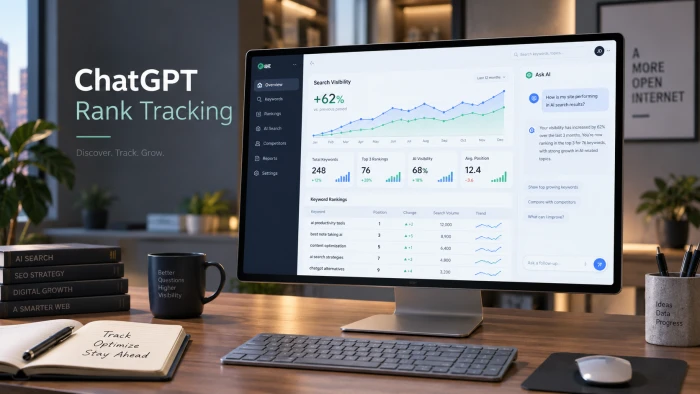
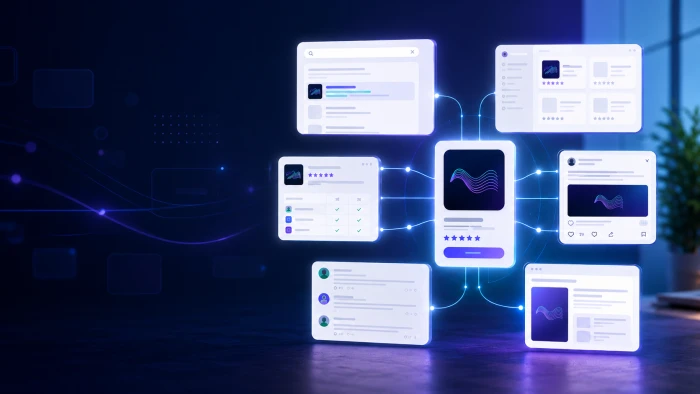
THE SHORT VERSION • Buyer behaviour has already moved. Attribution has not, and mostly never will, because answers given inside a chat window produce no click to count. • Six surfaces now decide your fate: search, assistants, marketplaces, review sites, communities, and developer registries. A gap in one is invisible from the others. • Start where the data is counted rather than modelled: developer surfaces first, search second, marketplaces third. |
Two numbers that contradict each other
51% of B2B software buyers now start research with an AI chatbot more often than with Google, up from 36% seven months earlier. G2 AI SEARCH INSIGHT REPORT, 2026 | 1.08% of website visits arrive with a visible AI referrer attached, across 13,770 enterprise domains. CONDUCTOR BENCHMARKS, 3.3BN SESSIONS, 2026 |
Both are credible. They describe the same shift from opposite ends. Behaviour moved first, and measurement never caught up, because an answer composed inside a chat window has no click to attribute.
That gap is why teams keep concluding this is hype. They are reading a traffic report that structurally cannot see the thing they are trying to measure. For scale, Cloudflare data cited by its chief executive in June 2026 put automated requests at 57.5% of HTML web traffic against 42.5% from humans, the first machine majority recorded on the open web.
A word on the numbers below. Most research in this field is published by companies that sell visibility tools, and studies disagree wildly. One analysis put Reddit in 40.1% of AI answers, while a later tracker gave YouTube the top spot at 26.47% with Reddit second at 17.39%. Every figure here carries its source, sample size and date. Where studies conflict, the range is shown. Treat any single percentage as directional and recheck it quarterly. |
Search and the answer layer
Google and Bing, plus the AI summaries that now sit above the results.
8% vs 15% How often people click a normal search result when an AI summary is present, against when it is not. Sessions also ended more often, 26% against 16%. PEW RESEARCH CENTER, 900 US ADULTS, 68,879 SEARCHES, JULY 2025. GOOGLE PUBLICLY DISPUTED THE METHODOLOGY. |
The mechanics did not change: crawl, index, rank. What changed is the last step, where a summary gets built from a handful of retrieved passages and sits above everything else.
The important consequence is that ranking and being quoted are coming apart. Pages now get cited without being the top result, and top results get ignored. Long, question-shaped queries are where this happens most, which is exactly how someone researches a category.
| 58% | lower click-through for the top-ranking page on AI Overview keywords, up from a 34.5% drop measured ten months earlier. AHREFS, FEBRUARY 2026 |
| 37.9% | of URLs cited in AI Overviews also rank in the top 10, down from roughly 76% seven months before. AHREFS, 4 MILLION AI OVERVIEW URLS |
| 1% | of visits involved clicking a source link inside the summary itself. PEW RESEARCH CENTER, JULY 2025 |
Two things sit underneath all of it. Your content has to be reachable by crawlers, and it has to exist in the initial HTML rather than appearing after scripts run. Structured data in JSON-LD then labels what is a product, a price, a rating or a question, so machines can parse rather than guess.
VERDICT KEEP INVESTING CONFIDENCE: HIGH This is the only surface where several independent studies, one from a non-commercial research centre, agree on direction and rough size. Clicks per impression are falling. Impressions are not. Do not cut search spend because click counts dropped. Change what you count. First move: rewrite your five highest-intent pages so each answers one specific question in the first 150 words, then check the answer is still there with JavaScript off. |

Assistants and chat
ChatGPT, Gemini, Claude, Copilot, Perplexity, and assistants built into other products.
900 million Weekly ChatGPT users announced by OpenAI in February 2026, up from 400 million a year earlier. Reports in late July 2026 put the figure near a billion. OPENAI, 27 FEBRUARY 2026; THE INFORMATION, JULY 2026 |
An answer here is assembled from two pools: what the model learned in training, which you cannot edit and which lags reality, and what it retrieves live, which depends on what is publicly readable right now. No provider publishes the criteria, and the same prompt gives different answers on different runs.
So this is an influence problem, not a ranking problem. Keep one canonical page saying plainly what the tool does, who it is for, what it costs and where it does not fit. Then make sure that description is identical everywhere else, because contradictory descriptions produce hedged answers.
| 76% to 53% | ChatGPT's share of worldwide AI web traffic between June 2025 and May 2026, with Gemini at roughly a quarter and Claude near a tenth. SIMILARWEB, MAY 2026 |
| 51.8% | of AI crawler requests are for training, which returns no traffic by design. Only 9.3% is search-related. CLOUDFLARE RADAR, MAY 2026 |
| 5:1 vs 1,255:1 | Pages crawled per referral sent, Googlebot against GPTBot. Cloudflare notes app traffic sends no referrer, which inflates these ratios. CLOUDFLARE RADAR, 2026 |
Check your robots.txt deliberately, since GPTBot, OAI-SearchBot, ClaudeBot, PerplexityBot and Google-Extended are all governed by it. One caution: the proposed llms.txt convention is widely recommended but still has no confirmed support from any major provider. Treat it as a cheap experiment, not a replacement for accessible HTML.
VERDICT INVEST, MEASURE DIFFERENTLY CONFIDENCE: MEDIUM Behavioural data here is strong and traffic data is weak, and both will stay that way. Judging this surface on referral sessions will make you underinvest in it. Platform concentration is also falling fast, so a plan built only around ChatGPT now reaches a shrinking share of the audience. First move: read your robots.txt this week and decide on each named AI crawler, then start logging a fixed prompt set across three assistants. |

Marketplaces and directories
Hyperscaler marketplaces, platform app stores, and the connector directories inside AI products.
$45 billion Estimated software transacted annually through the AWS, Azure and Google Cloud marketplaces, growing 35% to 40% a year. TACKLE BUYER RESEARCH, 2026 |
A marketplace is a closed catalogue with its own search box. The ranking inputs are unusually visible: category, keywords in your listing, installs, ratings, review recency and editorial curation.
But the real advantage is procurement, not discovery. A purchase that draws down an existing committed cloud spend agreement skips several approval steps, which is why marketplace deals close larger. That is a finance mechanic, and it is the reason this surface converts so well for enterprise software.
| $470bn | estimated upfront cloud commitments sitting across AWS, Azure and Google Cloud, which marketplace purchases can draw down. OMDIA, 2025 |
| 140% | larger deals through AWS Marketplace than other channels, according to CrowdStrike. Snowflake passed $7bn lifetime marketplace sales by May 2026. COMPANY DISCLOSURES, 2026 |
| 18,500 | live listings in the Shopify App Store alone in May 2026, which is what your listing hygiene is competing against. PUBLIC APP STORE TRACKER, MAY 2026 |
BEST RETURN FOR ENTERPRISE SELLERS CONFIDENCE: MEDIUM The growth forecasts come from analysts and vendors with an interest in the channel, so hold those loosely. The committed-spend mechanic underneath is not a forecast, and it is what actually moves deals. For self-serve products the maths differs: the catalogue is crowded and the listing is your entire storefront. First move: check whether your target accounts hold committed spend with a hyperscaler. If they do, this is a pricing and procurement project, not a marketing one. |

Review and comparison sites
G2, Capterra, TrustRadius, Gartner Peer Insights, and the comparison pages that rank for versus queries.
No. 1 Review sites now rank as the single biggest influence on vendor shortlists, slightly ahead of AI chatbots themselves. G2 2026 BUYER BEHAVIOR REPORT, 1,038 BUYERS, JUNE 2026 |
These platforms impose a taxonomy on your market. A buyer picks a category, applies filters, reads a grid. If you are not in the category they picked, you were never a candidate.
Their second job now matters more than their traffic. These are dense, structured, frequently updated pages about software, which makes them favourite retrieval targets for both search summaries and assistants. A stale profile is not a neutral absence, it is an outdated description being read aloud by other systems.
| 45% | of buyers say a review-site citation is the most confidence-inspiring signal inside an AI answer. G2 AI SEARCH INSIGHT REPORT, 2026 |
| 69% and 33% | chose a different vendor than planned after chatbot guidance, and bought from a vendor they had never heard of. G2, 1,076 BUYERS, MARCH 2026 |
| 39% / 50% | name IT security review as the biggest bottleneck after selection, overall and among enterprises. G2 2026 BUYER BEHAVIOR REPORT |
That last figure is the strategic one. Shortlists now form in a single prompt, so the friction moved downstream into security review and internal approval. The documents that clear those gates belong in your discovery strategy, not in a late-stage sales folder.
TABLE STAKES, CHEAP TO FIX CONFIDENCE: MEDIUM, SINGLE SOURCE Nearly all this buyer data comes from G2, a company with a direct interest in the finding that review platforms matter. Independent citation research supports the direction, but treat the exact percentages more cautiously than the Pew or Cloudflare numbers. Even discounted, the mechanism holds. Absence is expensive and takes an afternoon to fix. First move: claim every profile, correct the category, and publish your SOC 2 or ISO 27001 status where a buyer can find it without asking. |

Community and creators
Reddit, YouTube, LinkedIn, Hacker News, Discord and Slack groups, newsletters, Product Hunt.
0.737 Correlation between YouTube mentions and AI brand visibility, the strongest single factor tested across roughly 75,000 brands. Branded web mentions followed at 0.66 to 0.71. AHREFS, CHATGPT, AI MODE AND AI OVERVIEWS, DECEMBER 2025 |
This is where categories get argued about before they are formally defined, and where practitioners say what actually happened when they used something. It is the least controllable surface and often the most decisive, because a specific account from a named person beats any vendor claim.
It also feeds the machine surfaces directly. Forum threads and video transcripts are indexable text, and they get retrieved heavily whenever an assistant is asked about real experience with a product.
| 40.1% | of AI answers cited Reddit in one 2025 study, against 26.3% for Wikipedia. A 2026 tracker instead put YouTube first at 26.47%. SEMRUSH, JUNE 2025; LLM PULSE, MAY 2026 |
| 60% to 10% | collapse in ChatGPT's Reddit citation rate over roughly six weeks in 2025, with no announcement. SEMRUSH, 230,000 PROMPTS, 2025 |
| 19.9% | Reddit's mention share among top cited domains in Google AI Mode, still the leading domain there. AHREFS BRAND RADAR, JULY 2026 |
Plan around that volatility. Anything built on a single source of third-party mentions is exposed to a retuning you will not see coming. The only approach that compounds is participation under your own name, with specifics rather than positioning. Astroturfing is the reliable failure mode, and the penalty is a permanent searchable record of the attempt.
HIGH VALUE, LOW CONTROL CONFIDENCE: LOW ON NUMBERS These citation percentages are the least reliable data in this guide. Studies disagree by a factor of two, and platforms retune faster than anyone can measure. The direction is consistent everywhere though: third-party and user-generated platforms dominate what gets cited, and brand-owned media does not. First move: pick the three communities where your category is genuinely debated and participate under your own name for a quarter before judging results. |

Developer and agent surfaces
GitHub, npm, PyPI, Docker Hub, plus your docs, API description, SDKs and any MCP server you publish.
97 million Monthly downloads of the Model Context Protocol SDKs by March 2026, from roughly 100,000 in the first month after its November 2024 launch. ANTHROPIC, MARCH 2026 |
Developers often find tools without opening a search engine. They search a registry by name, scan a README, check the last release date and try the quickstart. Adoption is decided in minutes: either the sample runs from copy and paste, or the tab closes.
Agents are now a second audience with a narrower question. Can the model find a description of what this does, understand the parameters, and call it correctly without a human writing glue code. That turns ordinary engineering hygiene into discovery work.
| 10,000+ | active public MCP servers by mid-2026, with client support across ChatGPT, Claude, Cursor, Gemini, Copilot and VS Code. PRACTICAL DEVSECOPS, MID-2026 |
| 20% | of monthly interactive queries at Honeycomb are now made by agents rather than humans. HONEYCOMB, QUOTED IN THE MCP 2026-07-28 RELEASE |
| 84% vs 29% | developers using AI tools against those who trust the output. Only 3% highly trust it, and 66% name almost-right answers as their top frustration. STACK OVERFLOW DEVELOPER SURVEY, 49,009 RESPONDENTS, 2025 |
That trust gap is the design brief. Tools that fail loudly and legibly are worth more than tools that fail plausibly. Precise tool names, a machine-readable API description, honest errors, stable versions.
MOST UNDER-SERVED, ACT NOW - CONFIDENCE: HIGH ON ADOPTION The adoption numbers here are the cleanest in this guide, because downloads and survey responses are counted rather than inferred. What nobody has credibly measured is conversion: how often agent-reachable tools actually win over ones that are not. That gap is the opportunity. The work is cheap, it is ordinary engineering, and most competitors have not done it. First move: run your own quickstart on a clean machine and time it. Then publish a machine-readable API description and rewrite your tool descriptions. |
Scorecard
All six, side by side
| SURFACE | WHO DECIDES | DATA QUALITY | VERDICT |
|---|---|---|---|
| 01 Search | Ranking systems, then an answer generator | High | Keep investing, change the metric |
| 02 Assistants | A model, from training plus retrieval | Medium | Invest, measure differently |
| 03 Marketplaces | Platform search plus procurement | Medium | Best return for enterprise sellers |
| 04 Reviews | A taxonomy plus verified reviewers | Medium-low | Table stakes, cheap to fix |
| 05 Community | Practitioners and their audiences | Low | High value, no shortcuts |
| 06 Developer | Engineers, and models calling tools | High | Most under-served, act now |
Data quality reflects how independent and reproducible the underlying studies are, not how favourable their findings are.
Checklist
Eight things to do this month
- Write one sentence describing your product and replace every variant of it in public.
- Read your robots.txt and decide, deliberately, which AI crawlers you allow.
- Confirm your key pages render their content without JavaScript.
- Add JSON-LD structured data to product, pricing and question pages.
- Claim every review profile and fix the category you are filed under.
- Audit marketplace listings for stale screenshots and over-broad permissions.
- Time your quickstart on a clean machine, then fix whatever slowed it down.
- Put your security and compliance documents somewhere findable without a sales call.
Final VerdictBehaviour moved first. Spend where the evidence is strongest. One conclusion holds firmly: the click is no longer a reliable proxy for discovery, and any team budgeting on sessions alone is optimising a shrinking measurement rather than a shrinking channel. Everything else is provisional, because most specific percentages here come from vendors with something to sell and will be stale within two quarters. If you act on three things, make them the three where the data is counted rather than modelled. DO FIRST Developer and agent surfaces Counted adoption data, almost no competition, ordinary engineering you can start today. DO SECOND Search, rebuilt around answers The only surface with independent converging research. Keep the spend, change the metric. DO THIRD Marketplaces, for enterprise sellers Committed spend is a procurement fact, not a forecast, and it is why these deals close larger. Reviews are table stakes, so fix them and stop thinking about it. Community cannot be bought, so give it a year of real participation rather than a campaign. Assistants deserve investment but not a dashboard, because the numbers you would put on it do not yet mean what you want them to mean. The work underneath all six is less exotic than the phrase AI discovery suggests. Say clearly what your product does. Make that statement identical everywhere. Keep it reachable by the things that read the web. Then check, surface by surface, whether you are actually there. |