

The Short Answer
Thinking about Valant.io for your therapy or psychiatry practice? Before you book that sales demo, read this. Valant hides its pricing behind a "talk to sales" wall and promises to run your entire practice from one dashboard. So is it the real deal for behavioral health providers, or overkill you will regret paying for?
If you run a growing behavioral health practice (a therapy group, a psychiatry clinic, or an IOP/PHP program), Valant.io is genuinely built for you, not retrofitted from generic medical software. But if you are a solo therapist who just needs notes, a calendar, and simple billing, Valant is probably more machine than you need.
Bottom line: Valant is worth it for scaling mental health practices that feel the pain of disconnected tools. Smaller providers should price-check the easier alternatives first.
What Valant.io Actually Is
Valant is a cloud-based EHR and practice-management platform built specifically for behavioral and mental health. That is the key word: specifically. The entire product speaks the language of this field, including IOP/PHP programs, measurement-based care, treatment-plan templates, and evidence-based note types. You will not find generic hospital terminology bolted on.

It is a B2B SaaS tool aimed at U.S.-based outpatient, intensive outpatient, and partial hospitalization providers of every size, from solo prescribers to multi-site groups. The core pitch is consolidation: clinical documentation, scheduling, billing, and outcome tracking living in one system instead of five.
The Quick Verdict
| Question | Answer |
|---|---|
| Who is it best for? | Therapy groups, psychiatry clinics, growing mental health teams, IOP/PHP programs |
| Who should skip it? | Solo providers who only need simple notes, scheduling, and basic billing |
| Biggest strength | A true behavioral-health-native EHR with billing, scheduling, portal, and practice management in one |
| Biggest drawback | Quote-only pricing, so you cannot compare costs without a sales call |
| Top alternatives | SimplePractice, TherapyNotes, TheraNest, ICANotes, Tebra, Carepatron, Sessions Health |
| Overall take | Worth it for practices whose complexity justifies a specialized, scalable platform |
How I Judged It (So You Know This Is Not a Puff Piece)
I did not review Valant like a generic hospital EHR, because it is not one. A counselor, psychiatrist, or practice owner needs more than patient records. They need fast documentation, clean insurance billing, flexible scheduling, treatment planning, patient communication, and reporting that actually makes sense.
So I evaluated it against real behavioral health workflows: recurring appointments, detailed clinical notes, insurance claims, patient intake, and day-to-day operations. Here is the lens I used.
| What I Examined | The Question Behind It |
|---|---|
| Clinical workflow | Does it truly support BH documentation, notes, and treatment plans? |
| Practice management | How well does it handle scheduling, billing, reporting, and admin? |
| Provider fit | Solo, small group, psychiatry, or large clinic: who wins? |
| Ease of use | Simple enough daily, or too heavy for small teams? |
| Pricing clarity | Public and transparent, or quote-gated? |
| Patient experience | Can clients handle forms, payments, and the portal easily? |
| Billing support | Does it genuinely ease claims and revenue management? |
| Alternatives | How does it stack up against the obvious competitors? |
The point: Valant's value is entirely conditional. For a scaling therapy group, uniting clinical and admin work in one place is a real advantage. For a one-person practice, it can be more software than the problem requires.
Inside the Platform: The 4 Pillars
At its core, Valant bundles four jobs into one system: clinical documentation, scheduling and operations, billing and revenue, and patient engagement with telehealth. The whole value proposition rests on killing context-switching. Here is how each piece actually performs.
1. Clinical Documentation and the EHR Experience
Valant's EHR is designed around long-term behavioral health relationships, not one-off medical visits.
What stands out:
• Customizable note templates built for therapy, psychiatry, and medication management
• Intake forms, assessments, and treatment plans baked in
• Notes accessible straight from the appointment view, cutting friction
Real talk: Clinicians managing ongoing patients benefit from having history, assessments, and plans tightly linked. The trade-off is a learning curve, especially if you are migrating from something simpler.
| Aspect | Valant's Approach | What It Means For You |
|---|---|---|
| Note structure | Behavioral-specific templates | Less customization work |
| Historical data | Longitudinal patient records | Great for ongoing care |
| Assessment tools | Built in | Fewer external forms |
| Learning curve | Moderate to high | Expect training time |
2. Scheduling and Daily Operations
Scheduling here is more than a calendar. Each appointment is a springboard. From a single slot you can trigger linked clinical notes and billing, manage prospective patients and waitlists, and see provider availability across the whole practice.
The catch: This connected approach is a gift for mid-sized and growing clinics, but solo practitioners may find it heavier than basic scheduling demands.
3. Billing and Revenue Management
Billing is one of the most painful areas in behavioral health, and Valant leans on automation to ease it: automated claim creation and submission, ERA processing and payment posting, plus dashboards tracking billing status and outstanding balances.
Balanced view: Automation cuts manual errors, but practices with unusual billing setups or frequent exceptions will still need hands-on oversight. More than a few users say mastering the billing tools takes real time.
4. Telehealth and Patient Engagement
Valant ships with built-in telehealth and a patient portal: secure video sessions, online appointment management, digital intake, and bill payment.
Worth noting: The built-in telehealth removes your dependence on third-party video tools. But if you already run a specialized telehealth platform, Valant's version may be sufficient rather than superior.
Integrations and API Access
Valant offers API access to connect with analytics tools, data warehouses, and specialized third-party services. This matters most for larger organizations, multi-location practices, and groups with custom reporting needs. Smaller practices will likely never touch this.
Valant.io Pricing: The Part Everyone Wants (and It Is Frustrating)
Here is the catch that trips people up: Valant does not publish pricing. No monthly tiers on the site, no instant comparison. Instead, you get a custom quote-based model, where cost depends on practice size, number and type of provider licenses, optional features, add-ons, and your growth plans.
| Pricing Factor | The Reality |
|---|---|
| Public pricing | Not listed on the official site |
| Pricing model | Custom quote-based |
| Plan structure | Flexible, built around practice needs |
| Cost depends on | Size, licenses, features, add-ons, growth |
| Demo or quote required | Yes, expect a sales conversation |
| Free plan | None publicly offered |
| Free trial | Not promoted as a standard self-serve trial |
| Main frustration | Hard to compare quickly against transparent competitors |
Treat Valant as a demo-first EHR. You will need to contact them, explain your size and requirements, and wait for a tailored quote.
So What Does It Actually Cost?
Valant's site will not confirm a starting price. But third-party software directories and EHR comparison sites estimate roughly $100 to $300 per provider, per month, depending on package, add-ons, and requirements.
Treat that as a ballpark, not gospel. The only accurate number comes from a direct quote.
| Pricing Item | Expected Cost |
|---|---|
| Official fixed price | Not publicly listed |
| Third-party estimate | About $100 to $300 per provider/month |
| Possible add-ons | E-prescribing, faxing, implementation, integrations, API usage, advanced features |
| Implementation cost | Varies by practice size and setup |
| Final cost | Whatever your custom quote says |
Is Valant.io Expensive? It Depends.
For a solo provider needing basic notes, scheduling, and billing, yes, it can feel pricey. For a larger practice, the monthly figure matters less than whether Valant cuts admin time, smooths billing, and keeps operations tight.
If disconnected tools, billing delays, manual intake, messy notes, or weak reporting are bleeding your hours, the custom price gets easier to justify. If you just need an EHR for one clinician, you are probably overpaying.
Trust and Transparency: Read the Site With Clear Eyes
Trust signals exist, but they are subtle. Company identity, longevity, and behavioral health specialization check out across LinkedIn and software directories, and third-party sites report solid aggregate ratings. Valant also highlights unlimited access to a live, local support team with behavioral health expertise, a sign it is positioning itself as an ongoing service relationship rather than a set-and-forget tool.
That said, go in with your eyes open:
• Treat the company blog as vendor-aligned education. It is genuinely useful, but it is written from an EHR seller's point of view.
• Prepare pointed questions on pricing, integrations, data migration, and implementation support, because the surface pages do not spell these out.
• Cross-check with independent reviews and directories, especially on usability at scale and long-term support responsiveness.
What Real Users Say
The Praise
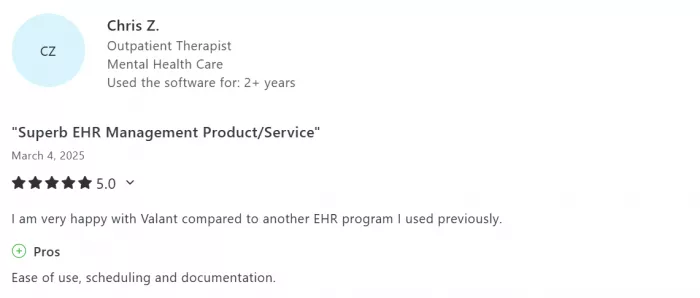
It is genuinely behavioral-health-native. Users repeatedly note it feels designed for psychotherapy, psychiatry, group work, and outcome tracking, not generic medicine.
Fast documentation. Reviewers say templates and narrative-style notes let them finish charting quickly, with some describing it as intuitive and a real time-saver.
True all-in-one. Clinicians and admin staff like charting, billing, and record management living in one place. One reviewer praised being able to "chart and bill at ease."
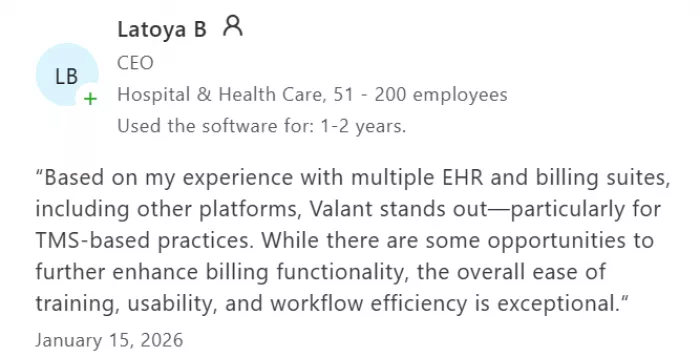
Strong onboarding (when it clicks). Some practices report smooth setup, great IT support, and helpful training resources.
The Complaints
Billing can frustrate. A vocal minority find the billing system confusing or rigid. One accountant bluntly called it "beyond stupid" for complex scenarios.

Inconsistent support. While some love it, others report slow responses, escalation headaches, and over-reliance on email instead of quick phone fixes.
Dated interface quirks. Some say parts feel clunky, and certain clinical forms lack logical flow or miss things like simple discharge notes or phone-call documentation.
Contract rigidity. A few could not easily reduce licensed users mid-contract, and ended up paying months for inactive providers.
Who Should Actually Buy Valant.io
It is a strong fit if you are:
1. A medium-to-large behavioral health practice
2. A clinic running in-house billing
3. An organization planning to scale or add providers
Look elsewhere if you are:
1. A solo practitioner wanting minimal setup
2. A practice prioritizing low cost over integrated depth
Valant.io vs. The Alternatives
| EHR | Best For | Pricing | Standout Strength |
|---|---|---|---|
| Valant | Mid to large BH groups, IOP/PHP | Custom quotes | BH-specific workflows, outcomes, complex ops |
| TherapyNotes | Solo to mid therapy/psych groups | Transparent per user | Solid all-in-one, easy to learn |
| SimplePractice | Solo and small private practices | Public plan tiers | Very user-friendly, strong client portal |
| Ensora (TheraNest) | Solo to group BH practices | Flat/simple pricing | Flexible forms, treatment planning |
| Sessions Health | Solo to small groups | Transparent tiers | Clean, simple, lightweight |
The Scorecard
| Category | Rating | Notes |
|---|---|---|
| Behavioral health fit | 9/10 | Strong niche focus for mental health workflows |
| Ease of use | 7/10 | Capable, but heavier for smaller providers |
| Feature depth | 8.5/10 | Strong EHR, practice management, billing, portal, reporting |
| Pricing transparency | 5.5/10 | Quote-based model makes comparison harder |
| Best for solo providers | 6.5/10 | Often more than needed |
| Best for group practices | 8.5/10 | Clear fit for growing teams |
| Best for psychiatry | 8.5/10 | Clinical workflows add real value |
| Overall value | 8/10 | Worth it when complexity justifies it |
Final Takeaway: Should You Book the Demo?
If you are a behavioral or mental health provider, especially running an outpatient clinic, group practice, or IOP/PHP program, think of Valant.io as a specialized, long-standing EHR built around your workflows, not general medicine. The site gives you a clear read on its focus and features, but deliberately leaves the big operational details (pricing, integrations, quantified ROI) for direct conversations and your own research.
Use it for three things: understanding how a behavioral-health-native EHR could reshape your clinical and admin processes, exploring its educational content, and shortlisting it as one of several vendors to compare through demos and independent reviews. Approached that way, as a serious starting point rather than a complete decision hub, Valant can play a real role in shaping your EHR strategy.
The move: Shortlist Valant, line it up against two transparent-pricing competitors, and book demos for all three before you commit to anything.