

Every brand that posts online faces the same question sooner or later: what should we actually talk about? Some days there are too many ideas, and other days there are none at all. Content pillars solve this problem. They give your team a clear set of topics to work from, so you always know what to create next and why it matters. Before we get into strategy and examples, let's start with the basics.
HOW TO USE THIS GUIDE If you are a social media manager, read Route A, the scorecard, and the governance section. If you are doing SEO, read Route B, the build spec and measurement. If you are a solo founder or creator, read Route C and the unified model, because you will be doing all three jobs with one set of hours. |
What is a content pillar?
A content pillar is a main topic that your brand decides to focus on and build all of its content around. Instead of posting about random things every week, you pick a few core subjects (usually three to five) and make sure everything you publish fits under one of them.
Think of it like the foundation of a house. The pillars hold everything up, and every blog post, social media update, or video you create rests on one of them.
The confusing part is that different people use the term to mean different things:
- A theme. For social media teams, a pillar is a subject the brand keeps coming back to, like "customer stories" or "how-to tips."
- A page. For SEO teams, a pillar is a long guide on your website that links out to many smaller, related articles.
- An asset. For agencies and marketing teams, a pillar is one big piece of work, like a research report, that gets broken down into dozens of smaller posts and clips.
All three versions share one simple idea. It is better to go deep on a few topics than to spread yourself thin across many. When you focus, your audience learns what you stand for, and search engines learn what your site is about. This guide explains all three meanings and shows you how to use them together.
Search "what is a content pillar" and you get answers from social media tools, SEO platforms and content agencies. They are describing three different objects. Pick your route.
ROUTE A · THEME A recurring topic your brand keeps returning to A planning constraint. You pick 3 to 5 themes, and every post has to belong to one. Nothing gets published just to fill a slot. | ROUTE B · PAGE A long-form hub page at the centre of a topic cluster A URL. It covers a broad topic end to end and links out to 8 to 30 deeper articles, each of which links back. | ROUTE C · ASSET One big piece of production you cut into many small ones A workflow. Run a research report, webinar or podcast once, then atomise it into 40 posts, clips and emails. |
The eleven things almost nobody covers
Reading across the whole result set, these are the genuine holes. Each one gets a full treatment further down.
1. The disambiguation itself. No page-one result states plainly that the term has three meanings. That single omission causes most of the confusion.
2. A test for whether a topic qualifies. Guidance stops at "pick things you are passionate about". There is no threshold, no scoring, no rejection criteria.
3. The pillar page traffic paradox. Hub pages often earn very little direct organic traffic themselves. If you measure them like a blog post, you will kill a working system.
4. Cluster sizing. How many supporting articles per pillar before it works? There is a real answer and it is not "as many as possible".
5. Keyword cannibalisation. The most common way pillar builds destroy existing rankings. Barely mentioned anywhere.
6. Timeline expectations. What should you see at 30, 90, 180 and 365 days? Nobody sets the curve, so teams abandon at month three.
7. Retirement and merging. Every guide tells you to create pillars. None tell you when to kill one.
8. Evidence quality. The same handful of vendor-reported percentages get recycled without anyone flagging how they were produced.
9. AI search implications. A few 2026 pages touch this. Almost none connect it back to the pillar decision itself.
10. B2B vs B2C vs creator differences. Pillar strategy diverges sharply by model. Most guides write as if there is one playbook.
11. Actual templates. Descriptions of what to do, without the artefact you would fill in.
Theme pillars: constraints, not categories
A theme pillar is a recurring subject your brand commits to owning. Three to five of them, and every piece of content you publish must belong to one.
The framing most guides use, "buckets for your posts", undersells it. A bucket is a filing system applied after the fact. A pillar is a constraint applied before the fact. The value is not in the sorting; it is in what the constraint forces you to reject.
When a team without pillars asks "what should we post this week", the answer comes from whatever is nearby: a trending audio, a competitor’s post, an internal announcement. When a team with pillars asks the same question, the answer is bounded before the brainstorm starts. That bound is the entire mechanism.
Why three to five
Social and most practitioner sources converge on three to five, and the reasoning holds up under scrutiny in both directions:
● Under three and your content becomes monotonous. There is not enough range to sustain a feed without repeating yourself within weeks, and you have no way to reach adjacent audience segments.
● Over five and the constraint stops constraining. If a pillar only receives content every six weeks, the audience never forms the association, and the algorithm never gets a consistent signal about what you are about.
The mechanism underneath is repetition. Both human memory and recommendation systems build associations through repeated exposure within a bounded space. Six pillars publishing at the same total volume means each pillar gets 40% less reinforcement than four would. You have not added range. You have diluted every signal you had.
The pillar types that actually recur
Across the sources reviewed, roughly the same five categories appear under different names. Here they are with the job each one does, because the job matters more than the label:
| TYPE | WHAT IT LOOKS LIKE | THE JOB IT DOES |
|---|---|---|
| Educational | How-tos, frameworks, myth-busting, teardowns, industry explainers | Earns saves and shares. Builds the authority that makes every other pillar credible. Usually the volume leader. |
| Proof | Case studies, customer results, reviews, user-generated content | Converts consideration into action. The only pillar that answers "does this actually work for someone like me?" |
| Culture | Behind-the-scenes, team, process, founder POV, values | Makes the brand a "who" rather than a "what". Disproportionately effective for recruitment and for early-stage brands with no case studies yet. |
| Product | Features, launches, demos, offers, use cases | Direct revenue. Also the pillar that degrades fastest if over-weighted, because it borrows trust the other pillars deposited. |
| Entertainment | Trends, humour, memes, community in-jokes | Reach and top-of-funnel discovery. The highest-variance pillar: biggest upside, most likely to feel off-brand. |
On the famous ratios
You will run into the 80/20 rule (80% value, 20% promotional), the 5:3:2 rule (five curated, three original, two personal per ten posts), and the 50/30/20 split. Here is the honest position on all of them.
TREAT RATIOS AS A STARTING HYPOTHESIS, NOT A LAW None of these ratios traces back to a published study with a stated methodology. They are practitioner heuristics that hardened into rules through repetition. They are useful as a default when you have no data. 80/20 in particular is a reasonable guard against over-promoting. But the moment you have four weeks of your own performance data, that data outranks any ratio. A B2B brand in a considered-purchase category and a DTC brand running weekly drops should not have the same mix, and no universal number can know which one you are. |
A better practice, and one that many flags well: treat your first two to four weeks as a pilot. Publish two or three pieces under each candidate pillar, then keep what earns engagement and cut what does not. Pillars chosen in a workshop are guesses. Pillars confirmed by four weeks of data are decisions.
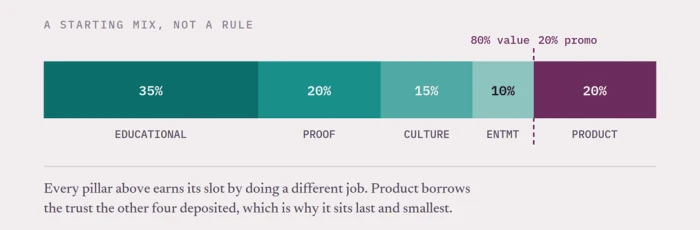 Figure 1. An illustrative mix, not a prescription. The 80/20 boundary is a practitioner heuristic with no published study behind it. Replace these proportions with your own four-week pilot data as soon as you have it. |
Pillar pages and topic clusters
This is the SEO meaning, and it is a completely different object: a single long URL that covers a broad topic comprehensively and sits at the centre of a linked web of deeper articles.
The model was formalised by HubSpot in 2017, in research led by Mimi An. The problem it solved was structural. Most blogs were flat archives: hundreds of posts, chronologically ordered, with no relationship between them that a crawler could read. Every post competed alone.
The topic cluster rearranges that. One pillar page defines a broad subject at a high level. Around it sit cluster pages, each drilling into a single subtopic in depth. Every cluster page links back to the pillar. The pillar links out to every cluster page. HubSpot’s own finding was direct: the more interlinking they did, the better the placement in search results, with impressions rising alongside link count.
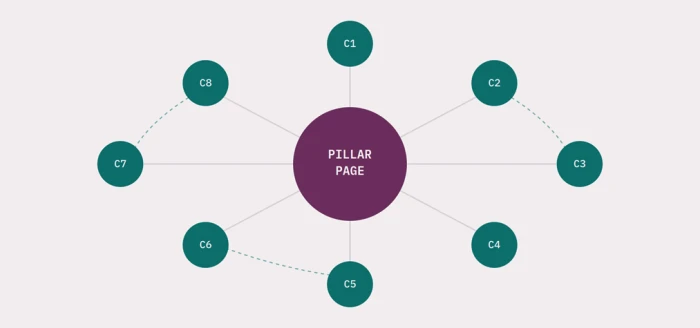 Figure 2. Solid lines: two-way links between pillar and every cluster page. Dashed lines: cluster-to-cluster links where the topics genuinely continue from one another, the layer most teams skip. |
The three mechanisms that make it work
It is worth being precise here, because "it signals authority" is hand-waving. There are three separate mechanisms, and they fail independently.
Crawl and discovery
Internal links are how crawlers find and re-fetch pages. A properly built cluster eliminates orphan pages by construction: every cluster page has at least one inbound internal link from the pillar, and the pillar has inbound links from every cluster page. Google’s own developer documentation is specific that a crawlable link needs to be a standard HTML anchor with an href attribute. A JavaScript-driven card that navigates on click is not reliably a link.
Authority distribution
Link equity flows along internal links. In a flat blog, equity from your strongest post goes nowhere useful. In a cluster, it flows to the pillar and redistributes across every related page. This is why a cluster’s rankings tend to move together rather than one page at a time.
Semantic relationship
Anchor text and link topology together tell a search engine how pages relate. Descriptive anchor text, such as "the complete guide to sourdough hydration" rather than "read more", carries meaning. The cluster consolidates what was a scattered set of posts into a single readable topical unit.
THE PILLAR SELECTION TEST HubSpot’s Leslie Ye proposed a test that remains the cleanest one available. Ask of a candidate pillar page: would this page answer every question a reader searching this term had, and is the topic broad enough to serve as an umbrella for 20 to 30 supporting posts? If the answer to either half is no, you have picked the wrong scope. Too narrow and you have a cluster page. Too broad and you have a category, not a pillar. |
Pillar assets: build once, cut many
The third meaning is a production model. You invest heavily in one substantial piece, such as a research report, a webinar series or a long interview, then break it into dozens of derivatives that feed every channel.
Many sites gives the cleanest description of this: a substantive piece on a specific topic that can be broken into many derivative sections and materials. The economics are the point. Producing forty pieces of content independently means forty rounds of ideation, research, drafting and review. Producing one pillar asset and cutting forty pieces from it means one round of research and forty rounds of packaging, which is a fundamentally cheaper operation.
What actually works as a pillar asset
The requirement is proprietary substance. If the source material is something anyone could have written, the derivatives will be too, and you have just industrialised the production of forgettable content. Assets with real derivative yield:
● Original research. A survey of your customers or industry. Every finding is a post, every cross-tab is a chart, the methodology is a credibility asset, and it earns links because there is no other source for the number.
● Recorded expert conversation. A 60-minute interview with a genuine practitioner yields quotes, clips, a transcript-derived article, a newsletter, and audio. The expertise is the moat.
● A worked teardown. Taking one real case apart in public, whether a campaign, a codebase or a P&L, with permission and specifics.
● A definitive resource. A benchmark set, a template library, a calculator. These keep producing derivatives for years because they get updated rather than replaced.
An atomisation map
From one original research report, a realistic yield across a quarter:
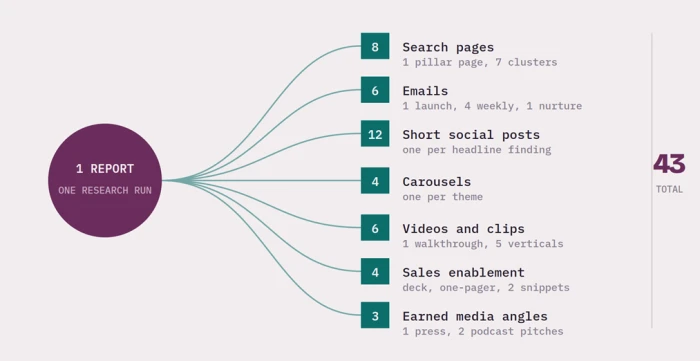 Figure 3. One round of research, seven rounds of packaging. The economics only work if the source contains something proprietary, because every derivative inherits whatever the original had, including emptiness. |
| ONE REPORT BECOMES 43 ASSETS | |
| Search | 1 pillar page (the report hub) plus 6 to 8 cluster articles, one per major finding |
| 1 announcement, 4 finding-of-the-week sends, 1 nurture sequence | |
| Short social | 12 to 15 single-stat posts, each with the chart |
| Long social | 4 carousels or LinkedIn breakdowns, one per theme |
| Video | 1 findings walkthrough plus 5 to 6 vertical clips |
| Sales enablement | 1 slide deck, 1 one-pager, 3 objection-handling snippets |
| Earned | 1 press angle, 2 to 3 podcast pitches built on the exclusive data |
THE FAILURE MODE Atomisation without substance produces slop at scale. If your pillar asset is a summary of things already published elsewhere, the derivatives inherit that emptiness and multiply it across every channel you own. The test before you build: after this exists, will there be a fact in the world that only we can supply? If not, it is a content project, not a pillar asset. |
The three are not rivals. They are layers.
Here is the piece missing from every result on the current SERP: the three definitions describe the same strategy at three different altitudes.
Read them as a single stack and the confusion resolves:
| LAYER | OBJECT | TIME HORIZON | THE QUESTION IT ANSWERS |
|---|---|---|---|
| Theme | A subject commitment | Quarters to years | What is this brand about? Sets the boundary for everything below. |
| Page | A URL and its cluster | Months to years | How does search find us for this theme? The theme’s expression in site architecture. |
| Asset | A production run | Weeks to a quarter | How do we produce enough at acceptable cost? The theme’s expression in the calendar. |
A team running all three coherently looks like this. Their theme pillar is restaurant labour management. Their pillar page is a 4,000-word guide to restaurant staff scheduling, linked to fourteen cluster articles on overtime law, shift-swapping, turnover benchmarks, and so on. Their pillar asset for Q3 is a survey of 400 restaurant operators on staffing costs, which becomes the newest cluster page, six weeks of social posts, and the data that gets them cited.
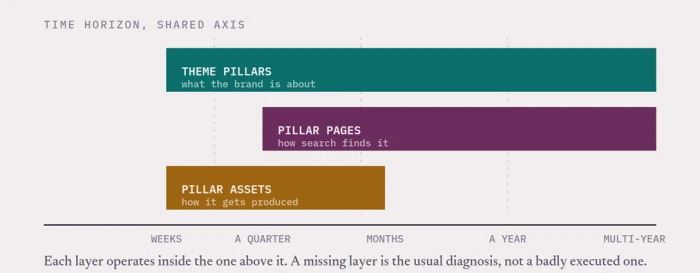 Figure 4. Read left to right: assets turn over fastest, themes change slowest. Themes with no page means social presence and no search footprint. Pages with no theme means guides that never add up to a position. |
Every layer reinforces the others. The theme decides what the page is about. The page gives the asset a permanent home and an internal link target. The asset gives the page something no competitor’s page has.
THE DIAGNOSTIC Most struggling content programmes are missing a layer, not doing a layer badly. Themes with no pages: consistent social presence, no organic search footprint. Pages with no themes: a scattering of guides that do not add up to a position. Assets with no themes or pages: expensive one-off campaigns that spike and vanish. Identify the missing layer before you try harder at the ones you have. |
The numbers, honestly graded
A handful of statistics circulate through every article on this topic. Most are quoted without any indication of where they came from. Here they are with a grade attached, because knowing a number’s provenance changes how much weight it should carry in your decision.
43% Average organic traffic increase attributed to topic cluster implementation VENDOR-REPORTED · GRADE C | 8.2M Estimated monthly organic visits to HubSpot’s blog, per an independent Ahrefs audit THIRD-PARTY ESTIMATE · GRADE B | r=0.41 Correlation between topical authority and AI citation frequency PUBLISHED METHODOLOGY · GRADE B |
| CLAIM | SOURCE | GRADE | HOW TO READ IT |
|---|---|---|---|
| Organisations implementing topic clusters see an average 43% increase in organic traffic | HubSpot research, widely re-quoted | C | Directionally plausible, but self-reported by the vendor that sells the tooling, with no published control group. Selection bias is likely: teams that build clusters are teams already investing in content. |
| More interlinking correlated with better SERP placement and higher impressions | HubSpot internal experiment, 2017 | B | The most useful of HubSpot’s claims because it is a within-site dose-response observation, not a cross-site comparison. Still correlational and still vendor-run. |
| HubSpot’s five content hubs receive links from roughly 36,000 locations across their own properties, yet the hub pages themselves generate very little direct organic traffic | Ahrefs independent audit, June 2024 | B | The most important finding in this guide. Independent, and it contradicts the vendor narrative. See section 11, because it should change how you evaluate your own pillar page. |
| Sites with correctly implemented clusters see about 40% more organic traffic; transitions from keyword-first to cluster-first report 50% to 300% gains in 6 to 12 months | Agency-published analyses, 2026 | D | A range that wide is a signal of no controlled methodology. The 300% figure almost certainly comes from a low base. Use as motivation, never as a forecast. |
| AI citation rates rose from 12% to 41% for content organised into pillar-and-cluster structures versus standalone pages on the same topics | Backlinko study, cited 2026 | B minus | A same-topic comparison, which is the right design. Worth weight, but AI citation behaviour is unstable month to month, so treat the magnitude as provisional. |
| Bidirectional internal linking within clusters increased AI citation probability by 2.7 times | Yext AI Citation Study | C plus | Consistent with the Backlinko finding, which raises confidence. Isolates a specific mechanism, which is unusual and useful. |
| Most 2026 analysis converges on 8 to 12 cluster pages per pillar as the range producing measurable citation gains | Aggregated industry analysis | C | Convergence across independent practitioners is weak evidence, but it is the only sizing guidance available. Treat 8 as a floor rather than 12 as a target. |
| Sites with full topical coverage are about 6.5 times more likely to be cited by AI tools than sites with fragmented coverage | Wellows AI Visibility Audit, 2026 | C | Large effect, unpublished methodology, vendor-produced. Points the same direction as better-graded findings, which is why it is included at all. |
What AI search changed about pillars
This is the single biggest gap in the older guides ranking today, several of which predate AI Overviews entirely. The strategic case for pillars in 2026 is different from the case in 2017, and in some ways stronger.
The traffic environment
The numbers describing the shift are consistent across sources. Per BrightEdge, AI Overviews grew 58% between February 2025 and February 2026 and now trigger on roughly 48% of Google searches. A Seer Interactive study covering 3,119 informational queries across 42 organisations and 25.1 million organic impressions found organic click-through rate on AI-Overview queries fell from 1.76% to 0.61%, a 61% drop.
That is the bad news, and it is genuinely bad for anyone whose model depends on informational clicks. But the second-order finding is what matters for pillar strategy.
The ranking-citation divergence
Citation and ranking have come apart. Per ALM Corp analysis, the share of AI Overview citations coming from top-ten organic pages fell from 76% to 38% between late 2024 and early 2026. For chat interfaces the gap is wider still: roughly 80% of citations from ChatGPT and Perplexity go to pages that do not rank in Google’s top 100 for the original query.
This means the signals that earn AI citations are substantially different from the signals that earn rankings. And the ZipTie analysis is direct about which signal dominates: topical authority, defined as measurable depth and breadth of coverage on a subject, correlates with AI citation at r=0.41. Domain Authority explains under 4% of citation variance. Topical authority explains around 17%.
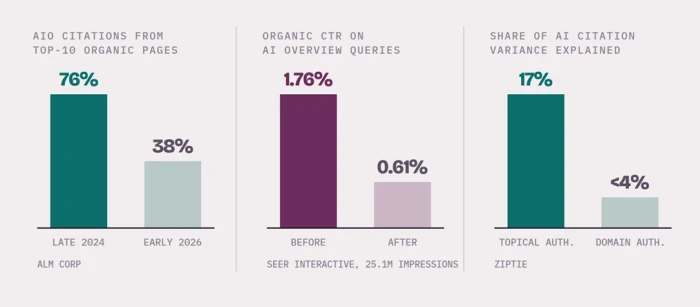 Figure 5. Each panel has its own baseline, so compare within a panel and not across them. The first two show the traffic environment getting harder. The third shows which signal now decides who gets cited, and it is the one a topic cluster is built to produce. |
WHY THIS FAVOURS PILLARS SPECIFICALLY Google’s AI systems use query fan-out: a single search is decomposed into multiple related sub-queries, and sources are assembled from across them. A site with one excellent article on a topic can answer one sub-query. A site with a pillar and twelve well-differentiated cluster pages can answer eight. Fan-out mechanically rewards coverage breadth over single-page quality, which is precisely the shape a topic cluster produces. |
Three practical adjustments
1. Answer-first structure inside every page. Extraction favours content where a clear, self-contained answer sits immediately under a question-shaped heading. Lead each section with the conclusion, then support it. This costs you nothing with human readers, who also prefer it.
2. Coverage over polish, up to a point. If you are choosing between a twelfth cluster article and a third revision of your pillar page, current evidence favours the twelfth article. Breadth is the scarcer signal.
3. Your own site is not the whole surface. Semrush’s AI Overviews study found reviews and social proof account for 57% of citations across the major AI engines, and community platforms are heavily represented. A pillar strategy that only produces pages on your domain is optimising for a shrinking share of the citation surface. The theme should govern where you show up off-site too.
A CAVEAT WORTH HOLDING AI citation research is roughly eighteen months old, methodologies vary wildly, and the systems being measured change monthly. The directional finding, that depth of topical coverage beats domain-level authority signals, is corroborated across several independent sources, so it is reasonably safe. The specific coefficients are not. Do not build a business case on r=0.41. |
Is your topic actually a pillar?
Every guide tells you to choose three to five pillars. None tell you how to know whether a candidate qualifies. This is the test I would apply: five criteria, scored zero to two, with a threshold you have to clear.
Score one candidate topic. Answer honestly. The failure mode is scoring the topic you want to be true rather than the one you have.
| CRITERION | 0 | 1 | 2 | SCORE |
|---|---|---|---|---|
Is there real, recurring demand? Search volume, repeated support tickets, sales objections, or visible community activity. Your own enthusiasm is not demand. | No evidence | Some signals | Clear, documented demand | |
Can it support at least 8 distinct subtopics? Each must target a different query. If two subtopics answer the same intent, they count as one. | Fewer than 4 | Around 5 to 7 | 8 or more, all distinct | |
Does it connect to what you sell? Trace the path from someone reading this to someone buying. If the path needs three unlikely leaps, it is not there. | No clear path | Indirect path | Direct, obvious path | |
Can you prove something others cannot? First-hand experience, proprietary data, customer results, or practitioner credentials. | Nothing proprietary | Some experience | Real data or deep expertise | |
Can you realistically beat what ranks? Look at the current top five. Name your angle in one sentence: narrower segment, better data, or different position. | No angle | Possible angle | Clear, statable angle |
| TOTAL | VERDICT | WHAT TO DO |
|---|---|---|
| 9 to 10 | Core pillar. Build it. | This clears every bar. Commit properly: map the full cluster, write the supporting pages first, and finish it before you open another. Topics that score this well are rare, so treat this as one of your three to five. |
| 7 to 8 | Viable, with one weak leg. | Worth building, but fix the lowest-scoring criterion before you start. A weak proof score means finding first-hand data. A weak defensibility score means narrowing the angle. Building on a known weakness rarely resolves it later. |
| 5 to 6 | Not a pillar. It is a cluster page. | There is something real here, but it cannot carry a full cluster on its own. Fold it into an adjacent pillar as one of its supporting pages. That is a promotion for the topic, not a demotion: it gets published, and it strengthens something that can compound. |
| 0 to 4 | Park it. | Too little of what a pillar needs. If demand scored low, this is a topic you find interesting and your audience does not. If defensibility scored low, you would be entering a fight you have already lost. Either way, spend the quarter somewhere better. |
Why these five and not others
Demand and breadth are the SEO criteria: without them the cluster has nothing to rank for and nothing to be built from. Proximity is the business criterion, and it is the one most creators fail: a pillar that draws an audience with no path to revenue is a hobby with analytics. Proof is the E-E-A-T criterion, and it has become the differentiator as generic coverage of every topic approaches infinity. Defensibility is the strategy criterion: in a category with five entrenched incumbents publishing weekly, "we will do it slightly better" is not a plan.
A topic scoring 5 or 6 is not a failure. It is usually a cluster page in someone else’s pillar. Fold it in rather than discarding it.
Build spec: the pillar page
Concrete specifications, with the reasoning attached. Adjust for your context, but know what you are adjusting away from.
| PILLAR PAGE SPECIFICATION | |
| Length | 3,000 to 5,000 words is the working range. Length is an output of covering the topic completely, never a target. A 2,200-word pillar that genuinely answers everything beats a padded 4,500. |
| URL | Short, root-adjacent, no date, no year. /guides/staff-scheduling not /blog/2026/03/ultimate-guide-to-staff-scheduling-2026. This page should live for a decade. |
| Access | Ungated. A form-gated pillar page cannot rank, cannot be crawled and cannot be cited. Gate a downloadable version if you need leads. |
| Navigation | In-page table of contents with anchor links. Improves usability and creates jump-link targets that can surface in search. |
| Headings | One H1 matching the topic. H2s phrased as the questions readers actually ask. Answer immediately beneath each: first sentence, not third paragraph. |
| Outbound cluster links | Every cluster page linked at least once, from the section where that subtopic is introduced, with descriptive anchor text. |
| Inbound cluster links | Every cluster page links back to the pillar. Standard HTML anchors with href. Not buttons, not JS handlers. |
| Cluster-to-cluster | Link where topics genuinely continue. Cap at 2 to 4 per article. Beyond that you dilute focus and give readers too many exits. |
| Site placement | Reachable from primary navigation or a resources hub, not just from blog archives. |
| Update cadence | Quarterly review, substantive refresh at least annually. Change the content, not just a date stamp. |
Cluster sizing
The guidance that converges across 2026 analyses: eight to twelve cluster pages per pillar before you see measurable effect, with five as the point where the structure begins doing anything at all. HubSpot’s own tooling allows up to 100 subtopic keywords per cluster, which tells you the ceiling is high, but the ceiling is not the target.
The practical implication is a sequencing decision most teams get wrong. Publishing your pillar page and three cluster articles, then moving to a different topic, produces nothing. A cluster below critical mass is just four articles. Finish the cluster before you start another one. Depth on one topic beats shallow presence on four.
Build order
Counterintuitively, the pillar page is usually not the first thing you write.
1. Audit what exists. Most teams already have five or six articles that belong to a cluster they have not named. Zapier’s approach of recognising existing content that could slot into a hub beats building from zero.
2. Map subtopics and check for overlap. List every subtopic. For each, write the single query it targets. If two subtopics target the same intent, merge them now, before you have a cannibalisation problem.
3. Write or refresh the cluster pages first. They are what you will link from, and writing them reveals the true shape of the topic. Your pillar outline will be better for having done them.
4. Write the pillar last. Now you know what it needs to cover and what it links to.
5. Wire the links in both directions. Then verify. Crawl the site and confirm every cluster page has an inbound link from the pillar and an outbound link to it. This step gets skipped more than any other, and it is the step that makes the structure real.
What this looks like across eight industries
Generic examples are why pillar advice feels unusable. These are specified at the level you would actually brief.
| BUSINESS | THEME PILLARS | LEAD PILLAR PAGE | PILLAR ASSET |
|---|---|---|---|
B2B SaaS HR software | Compliance changes, people analytics, manager enablement, customer results | "Employee onboarding: the complete guide", supported by 14 clusters on paperwork, 30/60/90 plans, remote onboarding and retention data | Annual survey: 600 HR leaders on first-year attrition |
DTC e-commerce Skincare | Ingredient science, routine building, customer before/after, founder POV | "How to build a skincare routine", supported by 12 clusters by skin type, concern and ingredient conflict | Dermatologist video series, cut into 40 short clips |
Local service Dental practice | Procedure explainers, cost transparency, patient stories, practice culture | "Dental implants: cost, process and recovery", supported by 9 clusters on stages, financing and alternatives | Recorded consultations (with consent) as a "what to expect" library |
Agency Performance marketing | Channel teardowns, client results, contrarian POV, team craft | "Paid social benchmarks by vertical", supported by 11 clusters, one per vertical | Quarterly benchmark report from anonymised client spend |
Fintech SMB lending | Cash-flow literacy, regulation, borrower stories, product mechanics | "Small business financing: every option compared", supported by 13 clusters, one per instrument | Approval-rate and rate data from their own book, published quarterly |
Creator Solo educator | Craft teaching, public work-in-progress, reader Q&A | One deep guide in their niche, supported by 8 clusters. Three pillars, not five, since solo capacity is the binding constraint | Monthly long-form essay, cut into a week of posts and a newsletter |
Non-profit Housing advocacy | Policy explainers, beneficiary stories, data journalism, volunteer culture | "How housing policy works in [region]", supported by 10 clusters on mechanisms and local rules | Annual regional housing index, the citation magnet |
Manufacturer Industrial components | Spec education, application engineering, failure analysis, supply chain | "Selecting the right [component type]", supported by 15 clusters by application, material and standard | Failure-mode database from decades of service records |
How the models genuinely differ
The advice that "everyone needs three to five pillars" flattens real differences:
● B2B weights educational and proof pillars heavily because the buying committee is researching for months. Entertainment pillars rarely earn their slot. The pillar page matters more than in any other model, since it is the asset the committee circulates internally.
● B2C and DTC invert this. Entertainment and community pillars drive the discovery that search cannot, purchase cycles are short, and the pillar page often matters less than the pillar asset.
● Local service businesses should usually run fewer pillars, two or three, and build one very good pillar page. Their search competition is geographically bounded, which makes a single well-built cluster unusually effective.
● Creators face a capacity constraint, not a strategy constraint. Three pillars executed consistently beats five executed sporadically, every time.
Measurement, and the traffic paradox
This section exists because of one finding that contradicts how nearly everyone measures pillar pages, and it comes from an independent source, not a vendor.
The paradox
Ahrefs’ 2024 audit of HubSpot’s SEO found that HubSpot maintains five major content hubs receiving internal links from roughly 36,000 locations across their own properties, and that those hub pages generate very little direct organic traffic themselves.
Read carelessly, that looks like proof the model does not work. It is not. It is evidence about where the value lands. The pillar page’s primary job is structural: to consolidate a topic, receive and redistribute internal link equity, and give a crawler a readable map. The traffic accrues to the cluster pages, which target the specific queries people actually type.
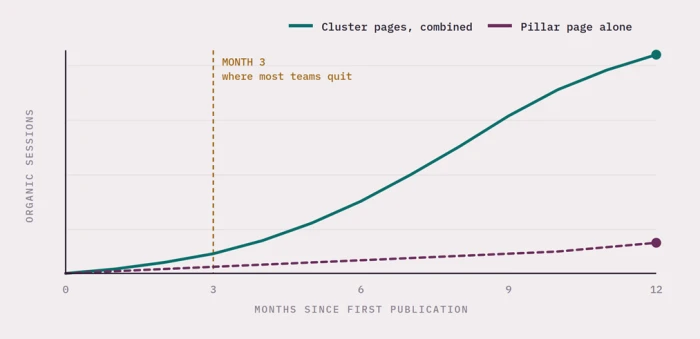 Figure 6. Illustrative shapes, not measured values. The point is the divergence: judging the system by the purple line is the error that gets working clusters dismantled at month four. Report the teal line, which is the topic as a whole. |
THE MEASUREMENT ERROR THIS CAUSES Teams judge the pillar page by its own sessions, find them disappointing at month four, and conclude the strategy failed. They then either delete the pillar page or stop investing in the cluster. Both moves dismantle the thing that was working. Measure the cluster as one unit. The correct question is not "how much traffic does the pillar page get" but "how much traffic does this topic get, and is it growing". |
What to track, at which level
| METRIC HIERARCHY | |
| Topic level (the real KPI) | Combined organic sessions across pillar plus all clusters. Number of keywords in the topic ranking top 10. Combined assisted conversions. This is what you report. |
| Pillar page level | Internal links in and out (completeness check, not performance). Backlinks earned. Scroll depth. Rankings for the broad head term. Not sessions. |
| Cluster page level | Sessions, ranking position for its one target query, conversion rate. This is where traffic is legitimately expected. |
| Theme level | Share of published content per pillar versus plan. Engagement rate by pillar. Which pillar sources your best-performing pieces. |
| AI visibility | Citation appearances across AI Overviews and chat interfaces by topic. Noisy and immature as a metric. Track the trend, do not set targets on it. |
A realistic timeline
Setting this curve matters, because the most common cause of pillar failure is abandonment at month three, when nothing has happened yet and nothing was supposed to have.
| WINDOW | WHAT SHOULD BE TRUE | WHAT SHOULD NOT WORRY YOU YET |
|---|---|---|
| 0 to 30 days | Pillar and first clusters published and indexed. Internal links verified in both directions. Impressions appearing for long-tail cluster queries. | Traffic. Rankings. Anything at all, really. |
| 30 to 90 days | Cluster pages entering positions 20 to 50. Impressions climbing. Long-tail queries you did not target starting to appear. | The pillar page ranking for its head term. That takes longer, always. |
| 90 to 180 days | Cluster count at 8 or more. First cluster pages reaching page one. Topic-level sessions measurably above baseline. | Pillar page sessions. See the paradox above. |
| 180 to 365 days | Pillar climbing for the head term. Cluster pages ranking for queries you never targeted. Compounding: each new cluster page ranks faster than the last. | Individual page volatility. Judge the topic, not the page. |
The compounding effect in the final row is the actual payoff and the reason to persist. In a working cluster, the tenth article ranks faster than the first, because it launches into an established topical footprint rather than from nothing.
Seven ways pillar strategies fail
Ranked by how often they occur, and each with the diagnostic that catches it early.
1. Keyword cannibalisation
The most damaging and least-discussed. Your pillar page targets "email marketing", and so does a cluster page called "what is email marketing". Now two of your own URLs compete for one intent. Search engines split signals between them and often rank neither well, sometimes demoting a page that used to rank fine.
Diagnostic: for every page in the cluster, write down the single query it targets. If any two match, or if one is a plain subset of another, you have a problem. Fix by merging and redirecting, not by rewriting.
2. The abandoned cluster
Pillar page plus three clusters, then the team moves on. Below roughly eight clusters, the structure is not doing structural work. It is four articles with links between them.
Diagnostic: count published clusters per pillar. Anything under five is unfinished, not underperforming. Finish it before starting another.
3. Pillar bloat
Six pillars becomes nine becomes "we cover everything". Each one gets too little content to build an association with either audiences or algorithms.
Diagnostic: divide your monthly output by pillar count. If any pillar gets fewer than two pieces a month, you have too many pillars for your capacity.
4. Themes with no page
Common in social-first teams. Strong, consistent themes; no corresponding site architecture. The brand builds an audience it can only reach by paying a platform for distribution, and captures none of the durable search value.
Diagnostic: for each theme pillar, name its URL. If you cannot, that is the gap.
5. The orphaned pillar page
The page is built beautifully and then linked from nowhere except one blog index. Nothing points to it, so nothing flows to it.
Diagnostic: crawl the site. Count inbound internal links to the pillar. Fewer than the number of cluster pages means the wiring is incomplete.
6. The gated pillar
Someone decides the flagship guide should generate leads and puts a form on it. The page now cannot rank, be crawled, or be cited. You have traded a permanent asset for a temporary list.
Diagnostic: if the pillar requires any interaction before the content is readable, it is gated. Publish it open; gate a PDF version.
7. Pillars chosen from the inside
Pillars derived from the org chart rather than from audience demand. Each department gets a pillar. The result maps your internal structure onto an audience who has no interest in it.
Diagnostic: for each pillar, cite the external evidence that it matters: search volume, support tickets, sales objections, community threads. "Our product team wanted it" is not evidence.
Auditing, merging and retiring pillars
Every guide covers creation. None cover the other half of the lifecycle, which is where mature programmes actually spend their time.
The quarterly review
Four questions per pillar, ninety minutes, once a quarter:
1. Did it earn its share? Compare each pillar’s share of output against its share of results. A pillar taking 30% of production for 8% of outcomes is a candidate for reduction.
2. Is the cluster complete? New subtopics emerge as a field moves. List what is missing and what is now stale.
3. Has it drifted? Pillars widen by accident. If "email marketing" has quietly absorbed SMS and push, either rename it or split it.
4. Is anything cannibalising? Re-run the one-query-per-page check. Clusters accumulate overlap as they grow.
When to merge
Merge two pillars when they consistently produce content that could sit under either, when their clusters are cross-linking heavily, or when neither has enough volume to sustain itself. Merging is usually an upgrade: two half-built clusters become one complete one, which is a materially stronger topical signal than the two were separately.
When to retire
Retire a pillar when the audience demand behind it has structurally declined, when your business has moved away from it, or when you have concluded you cannot win it against incumbents. Retirement is not deletion. Fold the strongest pages into a neighbouring cluster, redirect the rest, and keep the pillar page live if it still earns links, because an old asset with backlinks is worth more redirected into a live cluster than deleted.
THE RULE THAT KEEPS PROGRAMMES HEALTHY Add a pillar only by replacing one. This forces the question every content team avoids: what are we giving up to do this? Teams that add without subtracting arrive at nine pillars and wonder why nothing compounds any more. |
Fill-in templates
Fill these in and you have done the strategy. Keep them somewhere the whole team can see.
| TEMPLATE 1 · PILLAR DEFINITION | |
| Pillar name | Two to four words. If you need a sentence, the scope is wrong. |
| In scope | Five subtopics that clearly belong. |
| Out of scope | Three adjacent subtopics that do not belong. This line prevents drift better than any other. |
| Audience | Who specifically cares, and what they are trying to do. |
| Evidence of demand | Search volume, support-ticket frequency, sales objections, or community activity. External evidence only. |
| Our proof | What we can say here that a competitor cannot. Data, customers, practitioner experience. |
| Business link | Which product or service this leads to, and how. |
| Success measure | One topic-level number and its target at 6 and 12 months. |
| Owner | One named person. Not a team. |
| TEMPLATE 2 · CLUSTER MAP (ONE ROW PER PAGE) | |
| Page title | The working headline. |
| Target query | Exactly one. This column is your cannibalisation check. No two rows may share it. |
| Intent | Informational / commercial / transactional. |
| Status | Exists / needs refresh / to write. |
| Links to pillar | Yes / no. Verified, not assumed. |
| Linked from pillar | Yes / no, plus which section. |
| Sibling links | Which other clusters this genuinely continues from. Max 4. |
| TEMPLATE 3 · ATOMISATION BRIEF | |
| Source asset | What is being produced, and the one proprietary fact it will contain. |
| Home URL | Which pillar cluster it joins. |
| Cut list | Every derivative, with channel, format and owner. |
| Sequence | Publication order across the quarter. Derivatives should not all ship in week one. |
| Reuse trigger | What event brings this back into rotation later: an anniversary, a data refresh, or a news hook. |
The verdict
| If this is you | Verdict | The one move that matters |
|---|---|---|
| You run social for a brand | Route A. Worth doing. | Pick 3 to 5 themes, then name the URL each one maps to. If you cannot name a URL, you are building an audience you rent rather than own. |
| You own organic search | Route B. Worth doing. | Build one complete cluster of 8 or more pages, wired in both directions and verified by a crawl. Do not begin a second until the first is finished. |
| You are a solo founder or creator | Route C, plus 3 themes. | Capacity is your binding constraint, not strategy. Produce one substantial thing a month and atomise it properly instead of posting daily from scratch. |
| You already have pillars and no results | Diagnose before adding. | Work out which layer is missing (section 05), then run the seven failure diagnostics (section 12). Cannibalisation and unfinished clusters explain most of these cases. |
| You are deciding whether to start at all | Score one topic first. | Run a candidate through the scorecard in section 08. If nothing you own clears 7, your problem is topic selection, and more content will not fix it. |
| You want a shortcut | There is not one. | The compounding that makes clusters worth building takes 6 to 12 months to appear. Anyone quoting faster is selling something. |
Where this verdict could be wrong
Stating a position honestly means stating what would overturn it.
- If controlled experiments ever get published and show no cluster effect, the structural case weakens sharply. Right now the absence of such experiments is the single biggest hole in the evidence base, and I have assumed the mechanisms hold because they are individually well-established, not because anyone has tested the whole model.
- If search engines shift weighting away from coverage breadth, the "finish the cluster" advice loses much of its force. The current advantage of clusters under query fan-out is a property of how these systems work today, not a law.
- The AI citation research is roughly eighteen months old and measures systems that change monthly. I would treat the direction as reasonably safe and every coefficient as provisional.
- The ratios are folklore. 80/20, 5:3:2 and the rest have no published methodology behind them. They are reasonable opening defaults and nothing more. Four weeks of your own data should replace them.
The short version
Work out which of the three things you mean. Pick fewer topics than feels comfortable. Finish what you start. Measure the topic rather than the page. Then wait longer than you want to.