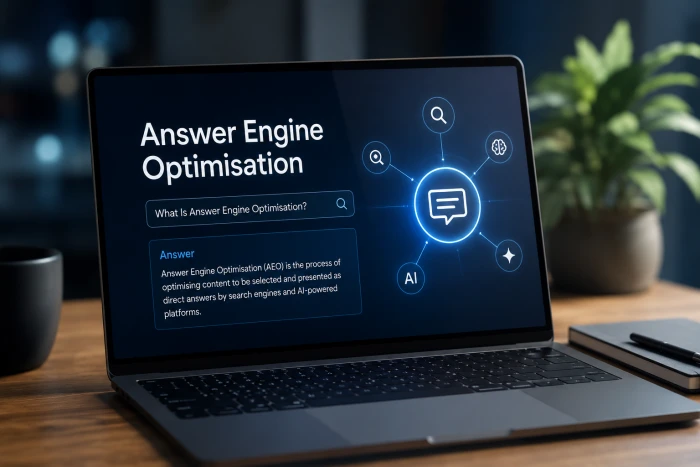
More and more people get their answer from an AI tool instead of clicking a link. Answer engine optimisation is how you make sure that when the AI answers, it quotes you. This guide explains what it is, what the research actually proves, and whether it is worth your time.
THE SHORT VERSION Answer engine optimisation, or AEO, means writing and promoting your content so AI tools like ChatGPT, Google AI Overviews, Perplexity and Gemini pick it as a source when they answer a question. You are no longer competing for a spot on a list of links. You are competing to be quoted inside the answer. Ranking first on Google no longer gets you there on its own. |
Four numbers that explain why people are paying attention
| NUMBER | WHAT IT MEANS | SOURCE |
|---|---|---|
| 84% | Share of AI quotes that come from other people writing about you, not from your own website | Muck Rack, 25 million links, 2026 |
| 8% | How often people click a normal search result when an AI answer is on the page. Without one it is 15% | Pew Research, 68,879 searches |
| 40% | The most visibility you can gain by adding stats, quotes and sources to your content | Princeton led study, KDD 2024 |
| 14% | Share of marketers who check whether AI tools mention them at all | GoodFirms survey, 2026 |
What answer engine optimisation actually is
IN ONE SENTENCE Answer engine optimisation is the work of making your content easy for an AI tool to quote when it answers someone question. |
Think about how search used to work. You typed something, Google showed you ten links, and you picked one. Your job as a website owner was to be one of those ten links, ideally near the top.
Now a lot of searches end differently. The AI reads several sources, writes you a paragraph, and lists its sources underneath in small print. Most people read the paragraph and never click anything. So the question has changed. It is no longer "am I on the list?" It is "am I in the paragraph?"
Here is the part that surprises people. Being good at the old game does not automatically make you good at the new one. In early 2026, the sources AI tools quoted overlapped with Google top ten results only 17% to 38% of the time. A year earlier that overlap had been around 75%.
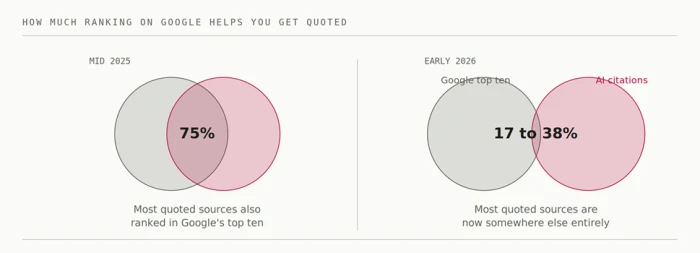
Figure 1. Ranking on Google used to almost guarantee you would be quoted. It no longer does. Sources: [5], [6].
So which tools count as answer engines? In practice: Google AI Overviews and AI Mode, ChatGPT, Perplexity, Gemini, Claude, Copilot and Grok. Each one searches the web its own way, and each one gives you a different set of sources for the same question.
How answer engines decide who to quote
You do not need to know how the models work internally. You do need to know the four steps between someone question and the finished answer, because you can lose at any one of them.
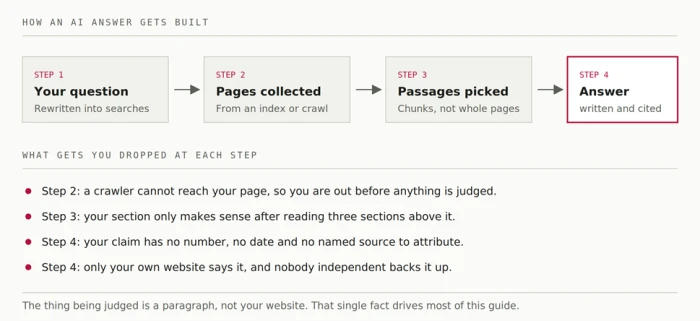
Figure 2. The four stages, and the four ways to get dropped.
The single most useful thing to take from this diagram is that the AI is not judging your website. It is judging one paragraph at a time. Your homepage could be excellent and still supply nothing an AI can lift out cleanly.
WHAT THIS MEANS IN PRACTICE Write so that any single section makes sense on its own, without the sections above it. That is how it will be pulled out and read. |
AEO, GEO and SEO: what the labels mean
You will see three or four different acronyms used for roughly the same work. Here is the honest version: the industry has not agreed on these terms, and most people use them loosely.
| LABEL | WHAT YOU ARE OPTIMISING FOR | HOW YOU KNOW IT WORKED |
|---|---|---|
| SEO | A ranked list of blue links | Your position, and clicks from search |
| AEO | Direct answers of any kind, including featured snippets, voice results and AI answers | You appear in the answer |
| GEO | AI generated answers specifically | How often AI tools quote you, and how often versus rivals |
| LLM SEO | Same thing as GEO | Same thing as GEO |
For everyday purposes, treat AEO as the umbrella term and GEO as the AI specific part of it. And keep doing normal SEO, because several AI tools search the web through a regular search index. Ranking well is still an input, even though it is no longer the finish line.
What happens to your clicks when an AI answers
Every study that has measured this found clicks going down. What they cannot agree on is by how much. The range runs from 15% to 89%, which sounds like chaos until you see why.
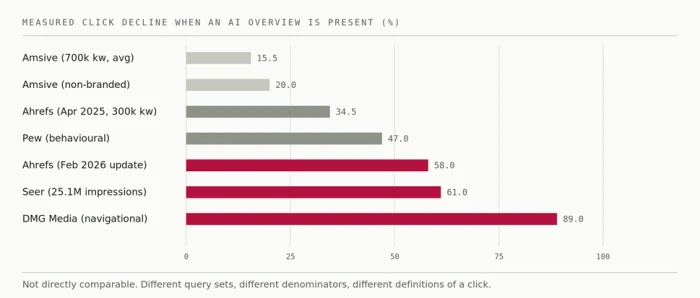
Figure 3. Seven measurements, all pointing the same way, disagreeing by a factor of six. Sources: [2], [7], [8], [9], [10].
The spread is not a contradiction. The studies measured different things. Pew watched what real people actually did in their browsers. Ahrefs measured the click rate of the top ranking page for the kind of keyword that triggers an AI answer. Seer tracked one long time series inside Search Console. Amsive averaged across all query types, which drags the figure down because searches for a brand name are barely affected.
USEFUL QUESTION TO ASK A VENDOR When someone quotes you a single percentage for AI traffic loss, ask what they divided by. The number is close to meaningless without it. |
Two more findings are worth knowing. Pew found that people clicked a source listed inside the AI answer only about 1% of the time. And Seer found that being quoted in an AI Overview earns you roughly 35% more clicks than not being quoted, though both are still well below what you got before AI answers existed.
Being quoted helps. It does not give you your old traffic back. Anyone promising otherwise is selling something.
How often do AI answers even appear? Estimates for early 2026 range from about 25% of searches to more than 60%, depending on which keywords you look at. At the start of 2025 it was around 6% to 7%. Whatever the exact figure, the direction is not in doubt.
Where AI tools get their quotes from
This is the most important section in the guide, and the one most introductory articles skip. AI tools overwhelmingly quote what other people write about you, not what you write about yourself.
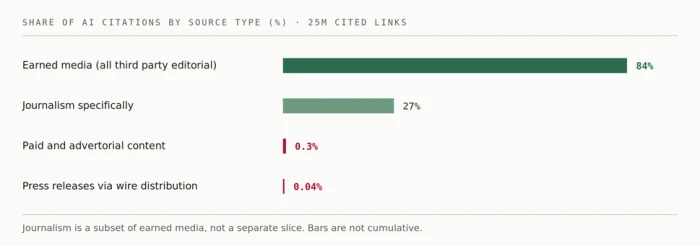
Figure 4. Muck Rack analysed 25 million cited links across ChatGPT, Claude and Gemini in 17 industries. Source: [1].
Look at the bottom two bars. Paid and advertorial content made up 0.3% of quotes. Press releases sent out over a wire service made up 0.04%. If your plan for getting into AI answers is a press release, the data says it will not work.
Three independent studies reached the same conclusion by different routes. A University of Toronto team ran controlled experiments and found AI search strongly favours third party authoritative sources over anything a brand publishes about itself. Ahrefs looked at 75,000 brands and found that being mentioned around the web predicted AI visibility about three times better than backlinks did. Stacker and Scrunch ran a controlled test and measured a median 239% lift in AI visibility from distributing content through third party news outlets.
THE UNCOMFORTABLE IMPLICATION You cannot do all of this inside your own website. Getting written about, publishing data other people want to cite, showing up where your industry actually talks, and having video coverage all matter. That is a public relations job as much as a content job. |
One more thing worth planning around. The tools barely agree with each other. One analysis found only 11% of websites were quoted by both ChatGPT and Perplexity, and that 40% to 60% of citations change from one month to the next. Getting quoted once is not a permanent win.
What actually works, according to testing
The most reliable evidence comes from a 2024 academic paper by researchers at Princeton, Georgia Tech, the Allen Institute and IIT Delhi. They tested nine different changes to content across roughly 10,000 queries and measured what happened to visibility.
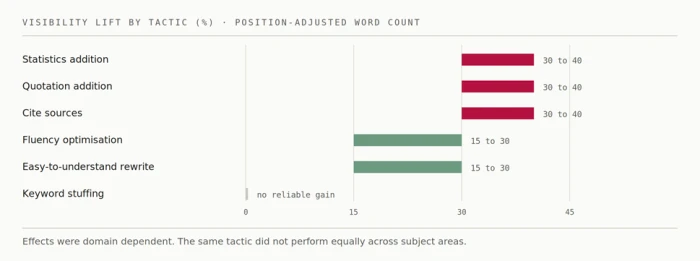
Figure 5. Nine tactics tested. The three winners all do the same thing: they give the AI something specific to attribute. Source: [3].
Notice what the three winning tactics have in common. Every one of them hands the AI something concrete it can lift and credit to you: a number, a quote from a named person, a reference to a source. Vague writing gives it nothing to work with.
Two details are easy to miss. First, simply making writing clearer produced a solid gain without adding any new information at all. Hard to read content is penalised even when the information in it is good. Second, the results varied by subject area, so a tactic that works in one industry may not transfer to yours.
There is also good news if you are not the market leader. The same paper found that a source sitting in fifth place gained far more, proportionally, from adding citations than a source already at the top. AEO is a bigger opportunity for challengers than for incumbents.
What a quotable paragraph looks like
The theory is easier to see than to describe. Both paragraphs below say something about the same subject and are about the same length. Only one of them can be lifted into an AI answer.
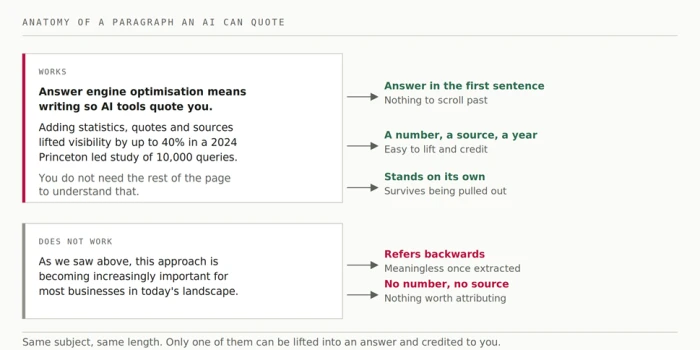
Figure 6. Same subject, same length, completely different odds of being quoted.
Five habits worth building
• Answer first, explain second. Open each section with a direct answer in roughly 40 to 60 words, then elaborate.
• Make every section stand alone. If it only makes sense after the section above it, it will not survive being extracted.
• Put a number and a source on your claims. "Most companies struggle with this" gives an AI nothing. A specific figure with a named source and a year gives it everything.
• Check that AI crawlers can reach you. They use different names from Google. Blocking one does not block the others, and blocking the wrong one removes you from the running entirely.
• Refresh on a schedule. One 2026 analysis found pages not updated quarterly were about three times more likely to lose their AI citations.
How well AI traffic converts
Here is the good news, and it is genuinely good. The trickle of visitors who arrive from AI tools converts far better than visitors from normal search.
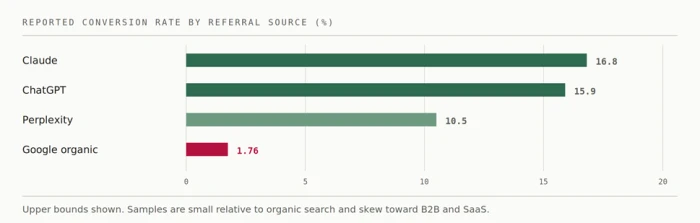
Figure 7. Reported conversion rates by source. Upper bounds shown. Sources: [9], [20].
Semrush studied more than 500 high value topics and found AI search visitors converting at about 4.4 times the rate of normal organic visitors. HubSpot reported roughly three times better lead conversion from the same kind of traffic.
The likely reason is not magic. Someone who arrives after reading an AI answer has already had their options narrowed for them. They have done more of the thinking before they land on your page.
KEEP THIS IN PROPORTION AI referrals were measured at only around 1% of total website traffic in 2026, with ChatGPT accounting for most of it. A brilliant conversion rate on 1% of your visitors is a real but small revenue line today. The case for investing now rests on how fast it is growing, not on what it pays this quarter. |
How to measure whether it is working
Your rank tracker cannot see any of this, because there are no positions to track. Instead you pick a fixed set of questions and check, on a schedule, whether the AI tools mention you when answering them.
| WHAT YOU ARE CHECKING | THE METRIC | HOW TO GET IT |
|---|---|---|
| Are we there at all? | Citation frequency | Share of your test questions where you get mentioned, checked weekly across tools |
| How do we compare? | Share of voice | Your mention rate against named competitors on the same questions |
| How prominent are we? | Citation position | Where you sit in the answer list of sources |
| What are they saying? | Sentiment and accuracy | How you are described, and whether it is actually correct |
| Is anyone arriving? | AI referral sessions | Filter analytics by AI hostnames, split by tool |
| Is it worth anything? | Conversions from AI visits | Normal goal tracking, applied to that segment |
A workable test set is 15 to 30 questions phrased the way your customers would actually phrase them, spread across general research, comparison and buying intent. Run the same set the same way each time so the results are comparable.
One thing to avoid: screenshots are not measurement. AI answers vary between sessions, users and countries. A single screenshot is an anecdote, not evidence.
The competitive picture here is unusual and worth exploiting. A 2026 survey found only 14% of marketers were checking AI citations at all. Basic measurement currently puts you ahead of most of your competitors, which is not something you can normally say about a spreadsheet.
What to do, in order
Each step gives you information the next one needs, so the order matters more than usual.
1. Measure before you change anything. Write your test questions and record where you stand today. Without a baseline you will never know if any of this worked.
2. Check the AI tools can actually reach you. Look at which AI crawlers your robots.txt allows, and whether login walls or heavy JavaScript are hiding your best pages.
3. Read your important pages as an AI would. Take one section at a time and ask whether it makes sense alone. Rewrite the ones that fail.
4. Add the specifics. Swap vague claims for real numbers, name the source and the year, and add quotes from named people. This is the biggest lever you control directly.
5. Start getting written about. Original data, expert commentary, third party coverage. This is where most citations come from and it is the slowest part, so begin it early rather than last.
6. Show up where your industry talks. Community forums and video both feed AI answers. Take part honestly. Fake accounts and coordinated posting get detected, and the damage carries across platforms.
7. Re-measure, and keep content fresh. Quarterly at minimum, given how quickly stale pages lose their citations.
Claims you should be sceptical of
This field has a lot of confident marketing and not much confident evidence. Here are the claims worth pushing back on.
| YOU WILL HEAR THIS | WHAT THE EVIDENCE ACTUALLY SHOWS |
|---|---|
| AEO tactics reliably get you cited | C-SEO Bench, the first systematic test of these tactics, found most did not help and several made things worse. Plain relevance kept working. |
| SEO is dead | Search indexes are still how several AI tools find pages, and normal organic clicks remain far larger in volume than AI referrals. |
| AEO is just featured snippets with a new name | Snippets are one surface with a known ranking input. AI tools run their own separate search and agree with Google top ten only 17% to 38% of the time. |
| Publish more content and you will get cited | Most citations come from other people writing about you. Volume on your own site is rarely the bottleneck. |
| Send a press release to get into AI answers | Wire distributed press releases were 0.04% of citations in the largest published sample. |
| This tool tracks your AI visibility definitively | Answers vary by session, person and country, and 40% to 60% of citations change monthly. Every tool is sampling. |
What this data cannot tell you
If you are about to spend money based on the numbers in this guide, carry these caveats with you.
• Most of it comes from people selling the solution. The Princeton paper and C-SEO Bench are academic. Many of the citation share studies come from companies selling AEO tools.
• It goes out of date fast. Citation patterns shift substantially month to month. Treat anything older than about six months as history.
• Nobody agrees on definitions. Studies count citations, AI Overview appearances and clicks differently. That explains most of the spread in figure 3.
• Correlation is not cause. Well covered brands might get quoted because they are famous, not because the coverage caused it.
• The samples lean B2B. Those impressive conversion figures come mostly from business software, where deal values are high and sample sizes small.
• The tools do not explain themselves. No major AI company publishes how it chooses sources. Everything here is inferred from watching what they do.
Summary
IF YOU READ NOTHING ELSE Answer engine optimisation is about getting quoted by AI tools when they answer a question. It matters because AI answers take clicks away from the sources underneath them, and because ranking on Google no longer predicts getting quoted. Three things are well evidenced: most citations come from other people writing about you, adding specific attributed facts to your content measurably helps, and the traffic that does arrive converts several times better than normal search while staying small in volume. Most other claims in this field are thin. |
• Optimise the paragraph, not the page.
• Getting written about is the biggest lever and the slowest to build, so start it first.
• Statistics, quotes and sources are the best tested content changes, worth roughly 30% to 40%.
• Measure with a fixed set of questions on a schedule. Screenshots are not data.
• Treat every percentage in this field as method dependent and short lived.
Verdict: is it worth your time?
Having weighed the evidence, here is a straight answer rather than a balanced one.
| Worth doing, but not worth reorganising your marketing around yet. The behaviour change is real and the direction is not seriously disputed. The current payoff is small, roughly 1% of traffic, and much of the advice being sold is not supported by evidence. The sensible position is to start now, spend modestly, and concentrate on the things that would be worth doing even if AI search stalled tomorrow. |
| VERDICT BY AREA | RATING | REASONING |
|---|---|---|
| Is the underlying shift real? | Strong evidence | Every independent study finds clicks falling when AI answers appear. The disagreement is about size, not direction. |
| Should you write more quotable content? | Do it now | Cheap, tested, and it improves your content for human readers too. There is no scenario where this is wasted. |
| Should you invest in getting written about? | Do it now | The largest measured driver of citations, and it pays off in reputation and search regardless of AI. |
| Should you buy an AEO tracking tool? | Only if you are large | Useful at scale. A spreadsheet and 20 test questions gets a smaller business most of the way there. |
| Should you hire an AEO specialist agency? | Wait | Much of what is being sold is untested. C-SEO Bench found most tactics did not work. Judge by evidence, not confidence. |
| Should you cut SEO to fund it? | No | Search indexes still feed several AI tools, and organic clicks remain far larger in volume. |
Who should act now
• YSell to businesses, especially software or professional services, where buyers research with AI tools before ever contacting you.
• You are a challenger brand. The evidence suggests lower ranked sources gain proportionally more from these changes than leaders do.
• Publish research, data or expert analysis. You already have the raw material that gets quoted.
Who can reasonably wait
• Customers are local and buy on proximity or price. AI answers matter less than a map listing and reviews.
• You have no working measurement in place. Fix that first, or you will be spending blind.
• Basic SEO and content are not in order. AEO builds on that foundation rather than replacing it.
THE ONE THING TO DO THIS WEEK Write down 20 questions a customer might ask an AI tool before buying from you. Ask ChatGPT, Google AI Mode and Perplexity each one, and note whether you appear and who does instead. That costs an afternoon and tells you more than any report, including this one. |