
For roughly fifteen years, one number quietly ran the SEO industry. Domain Authority told you, on a scale of 1 to 100, how likely your website was to rank on Google. Marketers chased it, benchmarked competitors against it, and sometimes panicked when it dropped a few points.
That number is not dead. But it is no longer the number that decides whether people find you. As search gets filtered through AI assistants like ChatGPT, Perplexity, Gemini, and Google AI Overviews, a different kind of authority has taken its place. It is called Entity Authority, and it measures something Domain Authority never could: whether AI systems actually understand who you are, trust what you represent, and choose to name you when a user asks a question.
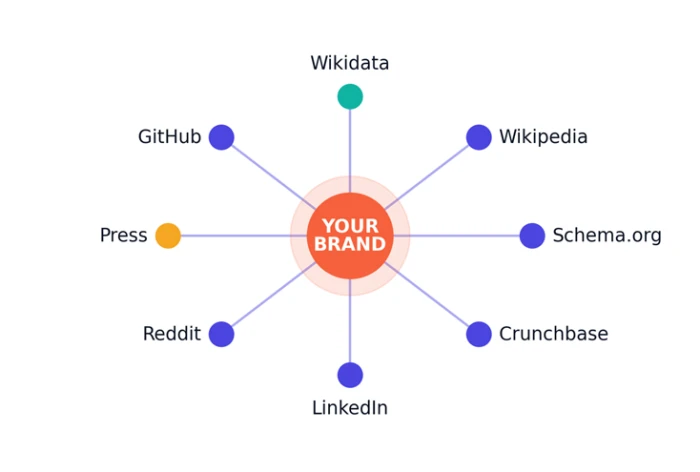
How a brand entity is corroborated across the sources AI systems trust.
What Domain Authority actually measured
Domain Authority is a third-party metric created by Moz. It is not a Google ranking factor, and it never was. Under the hood it is a machine learning model trained on real search results, built to predict the probability that a domain ranks competitively. The output is a single logarithmic score from 1 to 100.
The engine behind that score is links. The most important input is the number of unique linking root domains, because ten links from ten trusted sites carry more weight than a hundred links from one. In plain terms, DA treated links as votes, and more votes from trusted sources meant a higher predicted chance of ranking.
That model fit a decade of search that worked in a straight line. Links created trust, trust created rankings, and rankings created visibility. The blind spot is now obvious: Domain Authority is site wide and link centric. It has no concept of who you are as a brand, and no way to know whether the wider web agrees on what your company even does.
So what is Entity Authority?
In AI search, an entity is any uniquely identifiable thing a machine can recognize and reason about: a brand, a person, a product, a place, or a concept. Google, Apple, and digital marketing are all entities.
Entity Authority is the clarity and credibility of that entity across search and AI systems. Instead of asking how many trusted sites link to a domain, it asks whether the web consistently and verifiably agrees on what a thing is, and whether trusted sources reinforce that understanding. The more clearly your entity is defined, the more a model understands it. The more it understands you, the more it trusts you. The more it trusts you, the more often it names you in an answer.
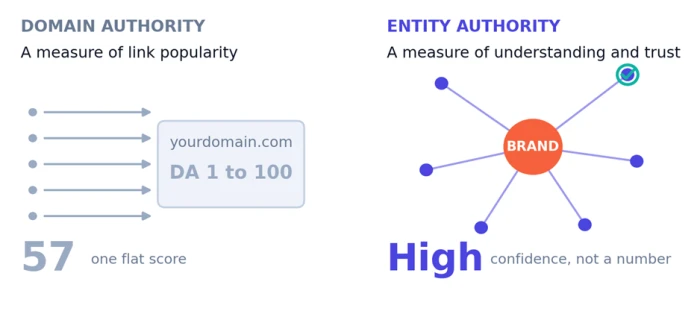
Domain Authority counts links into a site. Entity Authority reflects how well AI understands and trusts the brand itself.
This is why a small site with clean entity signals can surface in an AI answer while a larger competitor outranks it in classic search. AI rewards clarity, not size.
Why the ground shifted
When you ask ChatGPT or Perplexity a question, the model is not sorting ten blue links. It is reasoning over concepts, relationships, and confidence, then deciding which entities are trustworthy enough to name. The signal it leans on has quietly changed from links pointing at a page to a consensus about what a brand is.
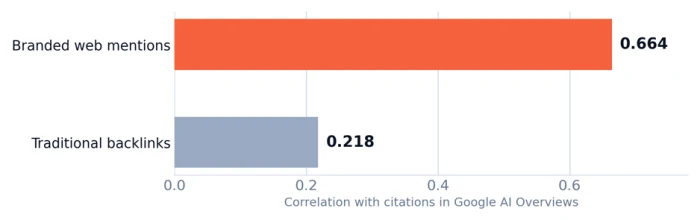
Source: Semrush, 2025. Correlation with citations in Google AI Overviews.
Semrush found in 2025 that branded web mentions correlate 0.664 with citations in Google AI Overviews, while traditional backlinks correlate only 0.218. Being talked about consistently now predicts AI visibility roughly three times better than being linked to.
Ranking and citation are also coming apart. Ahrefs reported in August 2025 that around 80 percent of the URLs cited by AI engines do not rank in Google's top 100 results for the original query. Winning the classic search page and winning the AI answer are becoming two different jobs.
Domain Authority vs Entity Authority
| Dimension | Domain Authority | Entity Authority |
|---|---|---|
| Measures | Link based ranking potential of a whole site | Clarity and trust of a specific brand, person, or product |
| Unit | A single score from 1 to 100 | No single universal score |
| Primary signal | Backlinks and unique linking root domains | Structured data, consistent identity, and corroborating mentions |
| Origin | A Moz proxy for Google ranking behavior | An emergent property of knowledge graphs and language models |
| Predicts | Likelihood of ranking in classic search | Likelihood of being understood and cited by AI |
| Scope | The entire website | The entity, wherever it appears online |
| Main weakness | Blind to brand identity and context | Harder to reduce to one clean number |
| Fastest lever | Earning more high quality links | A clean Wikidata entry and matching schema |
What is actually happening in AI search
This is not a forecast anymore. It is a current operating condition, and the numbers are moving fast.
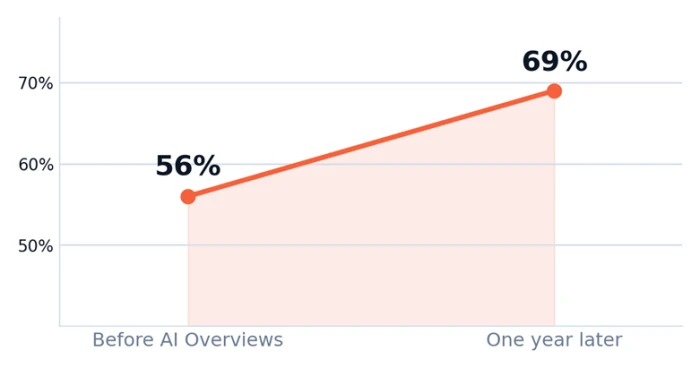
Source: Similarweb, July 2025.
Zero-click behavior has crossed from trend to structure. Similarweb found that zero-click searches on Google rose from 56 percent to 69 percent in the year after AI Overviews launched, and roughly 93 percent of AI search sessions now end without a click to any website. Visibility is moving inside the answer, not onto your page.
Source: Dimension Market Research.
The market is racing to catch up. The generative e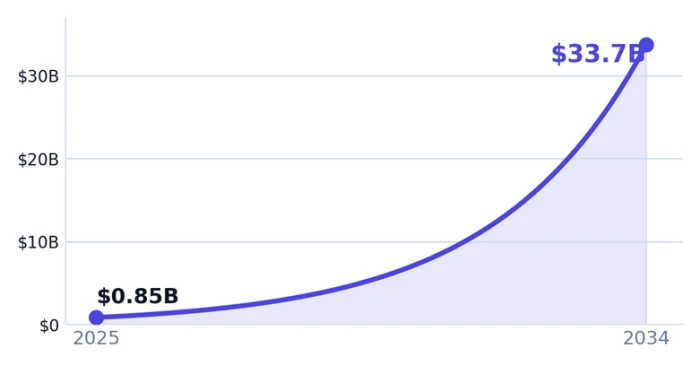 ngine optimization market is projected to grow from about 848 million dollars in 2025 toward 33.7 billion dollars by 2034, a compound annual growth rate near 50 percent. Around 38 percent of business decision makers have already allocated budget to AI search optimization, yet while about 92 percent of marketers say they plan to optimize for AI search, only roughly 41 percent are doing it today. That gap is where early movers win citation share.
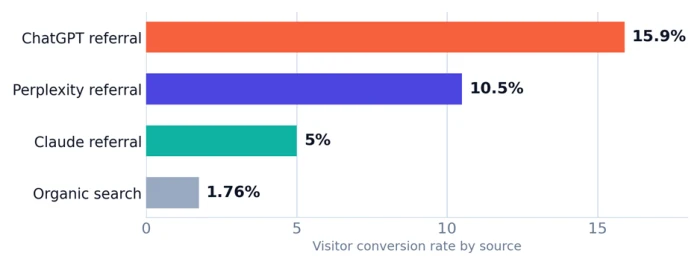
Source: Seer Interactive, June 2025.
The traffic that does arrive is unusually strong. Seer Interactive found that visitors from AI assistants convert far above organic search, with ChatGPT referrals converting near 16 percent against roughly
1.76 percent for organic. Fewer clicks, but much better ones.
Two more facts should shape how you act. AI systems lean on a small set of trusted references rather than the open web at large: as of early 2026, Wikipedia and Reddit were among ChatGPT's most cited sources, at roughly 5 percent and 3 percent of citations, and ChatGPT was processing around 2.5 billion queries per day by mid 2025. Getting your entity represented accurately in the places these systems trust is leverage, not vanity.
The three signals that build Entity Authority
AI systems assemble a profile of your entity from consistent, corroborated evidence. Three signal types do most of the work.
A consistent identity. Use the same name, description, founding details, and reference links everywhere you appear, from your site to Wikidata, LinkedIn, and Crunchbase. Contradictions lower a model's confidence in you.
Structured data. Schema is how you describe yourself to machines directly. Organization schema declares your brand, Person schema declares your authors, and Article schema tells systems which entities your content covers.
Corroborating mentions. Earned references across sources a model already trusts, such as press, Wikipedia, and credible communities, act as third-party validation. Being talked about carries more weight than raw link volume.
A practical playbook
You do not need a large PR budget to start. You need to make yourself legible.
1. Claim your entity home and Knowledge Panel, then publish an Organization schema block that links to your official profiles using sameAs references.
2. Create or clean up a Wikidata entry, since it is structured and machine readable and is often the fastest path into the knowledge graph AI systems draw on.
3. Align every profile you own so the name, description, and key facts are identical across LinkedIn, Crunchbase, GitHub, and your social accounts.
4. Add Person schema for your authors and give the people behind your content real, verifiable footprints.
5. Earn mentions on trusted sources, paying attention to the context of those mentions and not only their count.
6. Structure content for machines and humans with clear headings, direct answers near the top, supporting statistics, and regular updates.
7. Monitor for drift by checking that your Knowledge Panel, Wikidata entry, and site descriptions still match and that AI answers describe you accurately.
How to measure it
Domain Authority gave you one comforting number to track. Entity Authority does not, and that is the real cost of this transition. Instead you watch a small set of indicators.
Entity clarity: is your identity complete and identical across every platform, is your schema thorough, and are your sub-entities such as founders, products, and authors properly connected. Citation share: how often you appear in AI answers for the prompts your customers actually use, tracked across ChatGPT, Perplexity, AI Overviews, and Gemini. Brand mentions: the volume and sentiment of references across trusted sources.
One caution sits over all of it. Citation patterns differ enormously from one AI platform to another, so a single tool checking a single engine will mislead you. Track more than one.
Why this matters most for AI brands
Sell an AI product and your buyers are the very people asking an assistant what to use all day. The assistant answers with the entities it understands and trusts most. A confusingly defined AI startup can be effectively invisible in exactly the surface where its customers are looking, even with a polished website and healthy backlinks.
Because AI referred visitors convert so much higher than average, being the entity a model reaches for compounds over time. The brands that get understood first tend to get recommended repeatedly.
The takeaway
Domain Authority was built to answer a ranking question. It estimated how much link equity a site had accumulated and used that to predict whether the site would win a position on a results page. Entity Authority answers a recommendation question instead. An AI assistant does not hand back a list of links for the user to sort through. It composes an answer and names a few sources it trusts. So the thing being scored is no longer your page's position, it is the model's confidence in who you are.
That is why the line about describing you in one clear sentence matters. A model only recommends what it can summarize with confidence. If it cannot state plainly what your company is, what it does, and why it is credible, it will reach for a competitor it understands better, even one with a weaker website. Clarity is the currency, and ambiguity is the thing that quietly costs you citations.
"Corroborated everywhere it looks" is the second half of that. One clean description on your own site is not enough, because the model cross-checks. It reads your site, then Wikidata, LinkedIn, Crunchbase, press coverage, and community mentions, and it raises its confidence when those agree and lowers it when they contradict. Consistency is what builds trust, and every mismatched name, description, or founding date is a small tax on it. This is also why brand mentions now predict AI citations more strongly than backlinks. A mention is evidence that the wider web agrees on what you are.
Links have not stopped mattering. They were once the entire game, and now they are one signal among several. The change is that entity signals often outweigh them for whether an AI names you at all, which is a different outcome from ranking.
The "right now" at the end is not filler. Ranking and being cited have come apart, so a brand can rank well and still be missing from the answer the user actually reads. At the same time, most competitors are still watching a link-based number and have not defined their entity yet. That leaves a window where the brand that becomes legible first tends to get recommended repeatedly, because the traffic AI sends converts well and the model keeps returning to the entity it already trusts.
So the practical translation is a change of mindset more than a task list. Stop treating authority as a score to inflate, and start treating it as an identity to define and keep consistent. Make yourself easy for a machine to understand, say the same true things about yourself everywhere, and let trusted third parties confirm them. That is what earns a place in the answer.