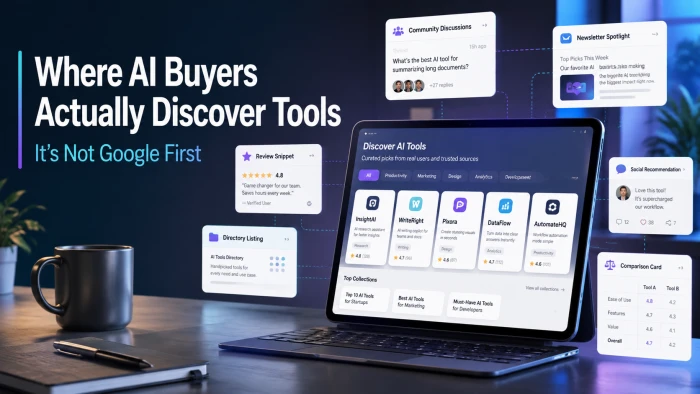
Evidence base: 680 million AI citations analyzed, more than 12 studies synthesized, across a window from late 2025 to 2026. The journey below runs Spark, Prompt, Peers, Reviews, Shortlist, Search, Decide, which is the order buyers actually reach these channels.
The story teams still tell, and what the data shows
Most discovery strategy is still built on assumptions from the keyword era. Here is the balance sheet.
| The story teams still tell | What the 2026 data shows |
|---|---|
| Buyers start on Google | 51% now start research in an AI chatbot rather than a search engine, up from 29% a year earlier |
| AI search means ChatGPT | The surface is wide: Google AI Mode leads it and ChatGPT ranks fourth, with Perplexity, Gemini and Claude all in play |
| A polished site earns trust | 42% rank word of mouth as their top influence, while cold outreach is top for just 2%, the lowest of any channel |
| Buyers find us when they are ready | 96% of companies are invisible in early discovery, and 1 in 3 buyers purchase from a brand they had never heard of |
| Traffic is the scoreboard | 5.1x higher conversion from AI-referred visitors, yet only 22% of marketers track AI visibility at all |
One purchase, moment by moment
A single buying journey, traced from trigger to decision. The channels appear in the order buyers actually reach them, which is not the order most teams plan for.
- THE SPARK
A problem, a budget or a mandate, not a search
The journey never starts with a keyword. It starts with a broken workflow, a new goal or a budget line. By the time a buyer acts, the research that decides the outcome has not begun on your terms.
- THE PROMPT
They open an AI chatbot and ask in plain language
Instead of keywords, the buyer describes the problem and gets back a shortlist, comparisons and reasons in one answer. With ChatGPT alone at 900 million weekly users and Google AI Mode past a billion a month, this is where most journeys now begin.
51% start here rather than a search engine, up from 29% a year earlier, per the G2 2026 Buyer Behavior Report
- THE PEER CHECK
They ask communities where other buyers talk
The AI answer gets pressure-tested against real users. For AI and developer tools that means Reddit above all, in subs like r/ChatGPT and r/LocalLLaMA, plus private Slack and Discord groups. Reddit does double duty, since its threads also train the models from moment one.
65% of SaaS CMOs start vendor searches in peer communities, per Wynter, January 2026
- THE TRUST TEST
They verify the shortlist against reviews
Buyers know AI gets things wrong, so they cross-check. Peer reviews on sites like G2 are the verification layer, and because the models cite those same sources, reviews shape both the human decision and the machine answer.
64% hit AI inaccuracies weekly or more and turn to peer reviews to verify, per the G2 2026 report
- THE SHORTLIST
The consideration set forms, often before you know it exists
By now the buyer has three or four names, and many vendors never made the cut because they were absent from the answer and the communities. This is the moment most discovery strategies miss entirely.
1 in 3 buyers purchase from a company they had never heard of, and 69% switch from their original pick based on what AI told them
- THE DEEP DIVE
Now search finally appears, as verification
Only here does a search engine enter, to confirm details, pricing and specifics, and even then an AI Overview often answers before the links. Aggregator and category pages, once the backbone of discovery, have collapsed to a rounding error.
5.4% of buyers now start on aggregator or directory sites, while 68% begin with Google or AI tools, per the Software Finder study
- THE DECISION
A committee decides, mostly before contacting sales
The final call runs through a buying group, not one champion, and most of the journey is done before any vendor is contacted. Your first real conversation happens after the shortlist is already set.
61% of the buying journey is complete before a vendor is contacted, with a committee that Forrester puts near 22 stakeholders
The channel map: trust versus reach
Every discovery channel positioned by how much trust it carries and how early it reaches buyers. The winners cluster where high trust meets early reach.
| Channel | Trust | Reach | Evidence |
|---|---|---|---|
| AI chatbots | High | Earliest | 51% of buyers start here (G2 2026) |
| Peer communities | Very high | Early | 65% of CMOs start here (Wynter 2026) |
| Word of mouth | Highest | Early to mid | 42% top influence, vs 2% cold outreach (Wynter 2026) |
| Review sites | High | Mid | 64% cross-check AI answers here (G2 2026) |
| Search | Medium | Late | Aggregators just 5.4% of starts (Software Finder) |
| Directories and launches | Medium | Mid | A Product Hunt spike lasts about 3 days (community data) |
| Ads and cold outreach | Lowest | Any | Top influence for only 2% (Wynter 2026) |
The full evidence, in numbers
Every figure in this report, grouped by theme, with its source. Samples and methods vary, so read them as a consistent direction rather than precise constants.
Scale of the shift
| Finding | Figure | Source |
|---|---|---|
| ChatGPT weekly active users, more than double a year earlier | 900M | OpenAI, Feb 2026 |
| Queries ChatGPT processes per day | 2.5B | OpenAI, 2026 |
| Monthly reach of Google AI Overviews across 200+ countries | 2.5B | Google I/O, May 2026 |
| Consumers who now begin searches with AI rather than traditional search | 37% | Industry data, 2026 |
| Predicted drop in traditional search volume by 2026 due to AI | 25% | Gartner, 2024 |
How B2B buyers behave
| Finding | Figure | Source |
|---|---|---|
| Buyers who start research in an AI chatbot rather than search, up from 29% | 51% | G2 2026 Buyer Behavior Report |
| B2B buyers who used a generative AI tool in their most recent purchase | 94% | 6sense, 2025 |
| Mid-market SaaS CMOs who use AI or LLMs for vendor discovery | 84% | Wynter, Jan 2026 |
| CMOs who start vendor searches in peer communities | 65% | Wynter, Jan 2026 |
| Buyers who begin with Google or AI tools, versus aggregators at 5.4% | 68% | Software Finder study |
| Of the buying journey completed before a vendor is contacted | 61% | Forrester, 2025 |
Trust, peers and reviews
| Finding | Figure | Source |
|---|---|---|
| CMOs who rank word of mouth as their top influence | 42% | Wynter, Jan 2026 |
| CMOs who rank cold outreach as their top influence, the lowest measured | 2% | Wynter, Jan 2026 |
| Buyers who hit AI inaccuracies weekly or more and verify via reviews | 64% | G2 2026 report |
| Buyers who switched from their planned vendor based on an AI answer | 69% | March 2026 survey |
| Buyers who bought from a company they had never heard of | 1 in 3 | March 2026 survey |
Visibility and performance
| Finding | Figure | Source |
|---|---|---|
| Of B2B companies invisible in early-stage AI discovery | 96% | 2X AI Index |
| Companies that appear while a buyer is still forming a shortlist | 4.3% | 2X AI Index |
| Higher conversion from AI-referred visitors, at 14.2% versus 2.8% | 5.1x | Exposure Ninja, Mar 2026 |
| More time AI-referred visitors spend on site than organic | 68% | SE Ranking |
| Marketers who currently track AI visibility at all | 22% | 2026 analysis |
Four moves that follow from the data
Move 01 - Get named in the answer
With only 4.3% of companies visible during shortlist formation, structure content for answer engines and earn citations. This is answer engine optimization, and it is where first impressions now form.
Move 02 - Bank peer reviews
Reviews on G2 and Capterra are the trust layer that buyers and models both rely on, so a credible review presence quietly feeds every other channel, including the AI recommendations you cannot see.
Move 03 - Earn community presence
Reddit influences buyers and trains the models, but developer communities reject ad-style promotion, so the return comes from genuine participation, not campaigns.
Move 04 - Measure influence, not clicks
AI-referred visitors convert several times better, yet most teams do not track AI visibility, so start measuring citations and assisted conversions before competitors notice the gap.
The bottom line
The shortlist is built before anyone opens Google. Trace the journey and the conclusion is hard to miss. Buyers open an AI chatbot, ask their peers and check reviews, and by the time a search box appears the decision set is mostly closed. If you build or sell AI tools, being findable now means being present and vouched-for where the model and the community can see you, not just ranking on a results page.