Most writing on this subject cites marketing agencies quoting other marketing agencies. That is a problem, because those firms sell the solution they are describing, and their methods are rarely published. This piece leans almost entirely on one study, supported by three others. The main source is a University of Toronto paper that ran the same 1,000 queries through Perplexity, ChatGPT, Claude, Gemini and Google, then classified every cited domain as brand owned, earned media or social. The methodology, the model versions and the classification rules are all in the paper. |
CASE 01 | The brand that publishes everything about itself |
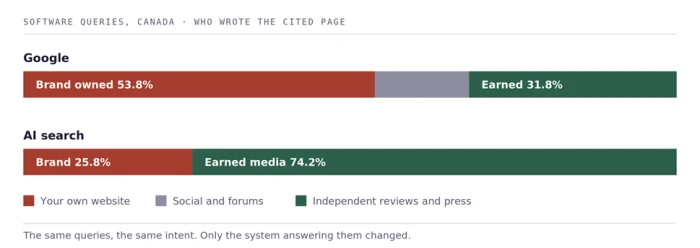
The result that matters most for this article is not about Perplexity specifically. It is about the whole category of AI search, and it is stark. In software queries in Canada, Google’s results were dominated by vendor sites, at just under 54% brand owned. Run the same intent through AI search and the picture inverts: brand owned falls to roughly a quarter, and earned media takes about three quarters.
The same reversal shows up in every vertical they tested and in both countries. This is the single most reliable finding in the literature, and it is worth sitting with, because it contradicts how most companies allocate their marketing budget.
Why this happens
Think about what a retrieval system is trying to do when someone asks which product is best. It needs to justify a recommendation. A page written by the company selling the product is a poor source for that, not because it is dishonest, but because it is structurally unable to say "and here is where we lose to a competitor." An independent review can. So the system reaches for the independent review.
This is why the standard response of publishing more blog posts does so little. You are adding volume to the category the engine has already decided to discount.
WHAT THIS MEANS FOR YOU If your entire plan is publishing on your own domain, you are competing for about a quarter of the available citations while ignoring the other three quarters. The fix is not writing more. It is getting written about. |
CASE 02 | The brand with a YouTube presence |

Here is where Perplexity stops behaving like the other engines. In the automotive vertical, YouTube was Perplexity’s single most frequent source. In consumer electronics, YouTube and BestBuy sat alongside editorial sites like RTINGS and CNET among its top domains.
Claude and ChatGPT, asked the same questions, went almost entirely to editorial outlets. Their top sources were TechRadar, Tom’s Guide, RTINGS, Consumer Reports and Wikipedia. Video barely featured.
Why this happens
Perplexity is closer to a search engine with a conversational front end than to a language model with search bolted on. It retrieves live for every question and it draws on a wider mix of source types than its competitors do. Where ChatGPT filters aggressively toward editorial authority, Perplexity keeps retailer pages, community posts and video in the pool.
That difference is a genuine opportunity, because video is a surface most companies in most categories are not competing on. A well made explainer that answers a specific buying question is competing against far fewer alternatives than the four hundredth blog post on the same topic.
WHAT THIS MEANS FOR YOU If you already have video, or content that could become video, Perplexity is the engine most likely to reward it. This is one of the few tactics where the same effort produces very different results depending on which engine you care about, so it is worth deciding that first. |
CASE 03 | The brand people discuss on forums |
THE EXPERIMENT Ranking and identification queries about well known and niche brands were put to Claude, Gemini, ChatGPT and Perplexity. Every returned link was classified, and the mix was compared across engines. |
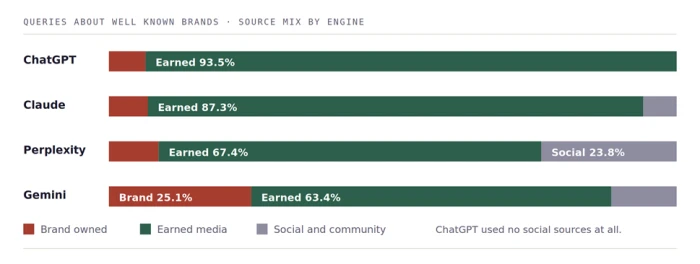
Asked about well known brands, ChatGPT drew on social and community sources not at all. Zero percent. Claude was close to that, at under 6%. Perplexity drew almost a quarter of its citations from social and community sources.
Why this happens
Every engine here is earned media heavy. That part is universal. What separates them is what they do with the remainder, and Perplexity is markedly more willing to treat a forum thread or a video comment section as evidence.
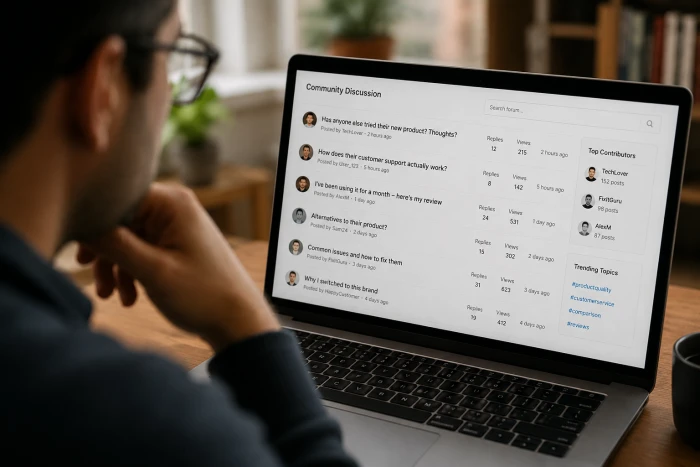
The practical consequence is that a single well regarded discussion thread about your product can earn you a Perplexity citation while doing nothing at all for you on ChatGPT. That is not a reason to go and manufacture discussion. Coordinated posting is detectable and the reputational damage travels further than the benefit. It is a reason to take part properly in the places your category already talks, and to make sure the people discussing you have accurate information to work with.
WHAT THIS MEANS FOR YOU Community presence is the clearest single difference between Perplexity and the other engines. If your customers discuss your category anywhere public, that is a Perplexity channel, and it is invisible on ChatGPT. |
CASE 04 | The niche brand nobody has heard of |

THE EXPERIMENT Two matched query sets were built, one asking about established consumer names and one about specialised or less familiar brands. Both were run through all four engines, and the researchers measured how often two engines gave the same answer. |
On questions about well known brands, the engines agreed with each other between 76% and 81% of the time depending on which pair you compare. On questions about niche brands, agreement fell to between 71% and 76%.
That gap is smaller than you might expect, and it is more interesting than a large gap would be. It says the engines are not wildly guessing about small brands. It says they are reaching a consensus for big names and losing that consensus as the subject gets less familiar. The paper’s authors name this directly as a big brand bias, and one of their four headline recommendations is aimed at helping niche players overcome it.
Why this happens
A retrieval system can only work with what has been written. For a household name there is an enormous, consistent body of independent coverage describing what the brand is and who it suits. For a small company there may be a handful of pages, and those pages may describe it differently from one another. The system has less to go on, so its answer becomes less stable and less confident.
There is a hopeful counterpart to this. The foundational academic work on optimising for generative engines found that its techniques improved visibility by up to 40%, and that the gains were strongest for lower ranked sites rather than the ones already dominating. The authors describe this as a democratising effect. Being small is a disadvantage at the starting line and an advantage in how much you can gain.
WHAT THIS MEANS FOR YOU If you are a small brand, the constraint is consistency rather than volume. A handful of independent sources describing you in the same terms is worth more than a large body of coverage that describes you four different ways. |
CASE 05 | The brand that writes to impress humans |
THE EXPERIMENT A separate research group built a dataset pairing contested questions with real documents arguing opposite answers, then tested which features made a language model find one document more convincing than another. They also made controlled edits to documents to see what changed the outcome. |
This is the finding that changed how I think about the whole subject. The researchers found that language models weight plain textual relevance, meaning how closely the document matches the wording and meaning of the question, far above the features humans associate with credibility. Scientific references, neutral tone and authoritative language had minimal effect. Simple edits that increased relevance, such as putting the question’s own phrasing near the top of the document, substantially increased how often the document won.
Why this happens
We have all been trained to signal credibility in ways that work on people. Measured tone, careful hedging, a long list of references, an authoritative voice. Those signals are doing much less work than you think when the reader is a retrieval system, and matching the question directly is doing much more.
This is not an argument for writing badly or for keyword stuffing, which has been tested and does not work. It is an argument for a specific discipline: state the question you are answering, then answer it, in that order, near the top. Most corporate writing does the reverse, opening with context and reaching the answer somewhere in the middle.
WHAT THIS MEANS FOR YOU Open every section with the question in plain terms and the answer immediately after. The elaborate credibility signalling can stay, but it should follow the answer rather than delay it. |
CASE 06 | The brand in the right category |

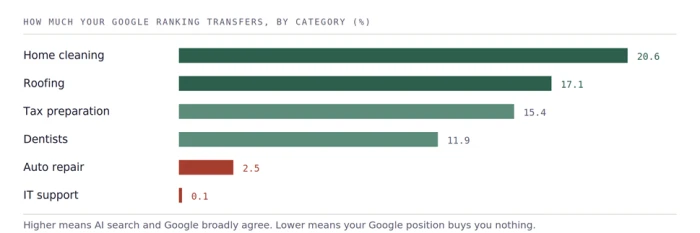
THE EXPERIMENT Queries for local businesses across several service categories were put to both Google and an AI engine, and the researchers measured what fraction of cited domains the two systems had in common. |
Some of your outcome is decided by which industry you happen to be in, and the spread is enormous. For home cleaning queries, about one in five domains was shared between Google and AI search. For IT support, effectively none were.
Why this happens
Where a category has a small number of widely recognised authorities, both systems converge on them. Where a category is fragmented, with no obvious set of trusted evaluators, the two systems wander off in different directions.
The consequence is that the honest answer to "how much does my SEO work carry over" is that it depends heavily on your industry, and you can find out in an afternoon. Run your ten most valuable questions through Perplexity, note who gets cited, and compare that against who ranks on Google for the same thing. If the lists broadly match, your existing work is carrying you. If they barely overlap, you are starting close to zero and should plan accordingly.
WHAT THIS MEANS FOR YOU Do not accept a general claim about how much SEO transfers to AI search. Measure it for your own category, because the honest range runs from almost everything to almost nothing. |
VERDICTPerplexity is not evaluating your writing. It is evaluating what the rest of the web says about you. Five of the six cases above come down to the same thing. The engines are built to justify a recommendation, and a company’s own description of itself is structurally weak evidence for that purpose. So they reach past you, to reviewers, to journalists, to forums and to video, and they assemble their answer out of those. The sixth case, the one about how models judge persuasiveness, is the exception and the most actionable. It says that when your page does get considered, plainly matching the question beats sounding authoritative. That is a change you can make this week and it costs nothing. |
| The honest summary: most of what determines whether Perplexity cites you is not on your website, and the part that is on your website is mostly about answering the question early and directly. Anyone selling you a technical fix for this is selling you the small half of the problem. |