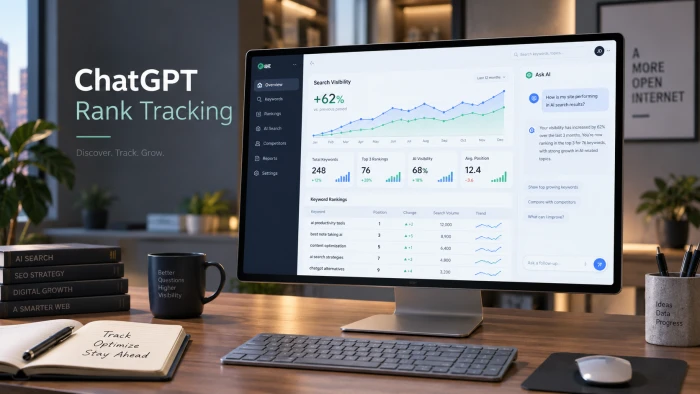
Think about how people used to find products. They typed something into Google, looked at a list of ten links, and clicked around until they found what they wanted. That is changing fast. Today, many people just ask an AI assistant a question and get one clean answer back, with two or three brands named inside it.
Here is the problem. When someone asks an AI tool "what is the best option for a team like mine," the tool picks a small handful of brands to mention. If your brand is not one of them, you do not just lose a click. You never even make it onto the buyer's shortlist. And that shortlist is now being formed before the person ever visits a single website.
This matters because it is not a small or niche channel anymore. About 35% of US shoppers now start looking for products by asking an AI tool instead of using a search box, and 89% of business buyers say they use AI somewhere while deciding what to purchase. AI search still sends less traffic than Google, but the people who arrive through it are usually much closer to buying, and they convert at a far higher rate.
1. How AI Picks Which Brands to Name
Most people assume this is a search-engine problem, so they try to fix it with normal SEO. That usually does not work, because AI tools do not choose brands the way Google chooses pages.
Google ranks one page at a time, based on things like keywords, links, and the reputation of a page. An AI assistant does something different. It reads across many sources at once, then names the brand that those sources describe most consistently. In other words, Google asks "which page best answers this question," while AI asks "which brand do my trusted sources keep agreeing on."
The clearest proof comes from Ahrefs, which studied 1.9 million AI citations. Only about 12% of the web pages that AI tools cite also rank in Google's top 10 for the same question. Flip that around and it means roughly 80% of what AI tools cite does not appear anywhere in Google's top 100. So your competitor may not have a better product or a higher Google ranking. They simply get mentioned in more of the places AI trusts.
To see just how little overlap there is, here is where AI citations actually come from.
This is why a page can dominate Google and still be missing from AI answers. A genuine Reddit thread, a review-site comparison, or an industry roundup can carry more weight with an AI tool than a page that wins the normal search results.
Notice the middle number. ChatGPT used to name six or seven brands per answer and now names only three or four. There are fewer seats at the table, so competition for each one is tougher than it was a year ago.
2. The Three Things Missing Brands Lack
When a brand is absent from AI answers, it is almost always weak in the same three areas at once. Working out which one is weakest for you is the fastest way to start fixing it.
| Signal | What it means in plain terms | Why your competitor wins on it |
|---|---|---|
| Outside mentions | How often you show up on review sites, Reddit, industry blogs, and directories that the AI already trusts | About 90% of AI citations for business topics come from sources the brand does not own. Competitors simply appear in more of them. |
| A clear identity | Consistent, easy-to-read signals across the web about who you are and what you do | Brands with a steady, matching presence across places like LinkedIn and forums get recognized as a real, distinct company and cited more often. |
| Easy-to-lift content | Direct answers placed near the top of your pages, backed by real numbers, on pages that load fast | 44.2% of AI citations come from the first 30% of a page. Answers buried lower down rarely get pulled. |
The evidence here is striking. In one study of 20 companies inside a single UK industry, AI visibility scores on the same five questions ranged all the way from 0 to 100 out of 100. The companies at the top shared one habit: they were cited heavily on trusted sites like Wikipedia, government pages, regulators, and trade publications. The companies at the bottom had similar Google authority but a much thinner presence on those outside sources. In fact, the gap between companies inside one industry was wider than the gap between different industries. That tells you the deciding factor is not your field. It is who mentions you, where, and how recently.
3. Two Fixes You Can Make This Week
Building up outside mentions takes time. But two things are within your control right now, and both make a measurable difference.
Put the answer at the top
Because AI tools pull from the top of a page, a long warm-up introduction actually works against you. Start each important page with a short, direct answer of two or three sentences that clearly states who you are and gives the conclusion, then explain the details below. Research from Princeton found that adding real statistics, quotes, and citations to content raised its AI visibility by as much as 41%. Specific numbers are not decoration here. They are the exact material an AI tool needs in order to quote you with confidence.
Keep your pages fresh
AI tools actively skip over old content. In 2026, 71% of AI citations point to content published in the last two to three years, and the typical cited page is now under a year old. A page you have not touched in three years is quietly falling out of the answer set, while a competitor's recently updated page takes its place.
4. Why Checking Once Tells You Nothing
Here is a trap that catches almost everyone. AI answers are not fixed. Research from SparkToro in early 2026 found there is less than a 1-in-100 chance that ChatGPT gives the exact same list of brands when you ask it the same question 100 times. There is no single ranking to hold and no one screenshot that captures the truth.
This has a real, practical result. Asking a question once and seeing whether you appear tells you almost nothing, because the next answer could be different. The brands that win treat this as a measuring job. They run their most important questions many times, record how often they show up, note which competitors appear next to them, and track which websites get cited. After dozens of runs, a stable picture appears. That bigger picture, not one lucky or unlucky answer, is what you should be improving against.
5. What to Do Next
A simple plan
- Measure the pattern, not one answer. Run your key buying questions many times across ChatGPT, Gemini, Perplexity, and Google AI, and track how often you appear next to competitors.
- Look at who cites you, not where you rank. Find the outside websites that get cited for your topic, then earn a real, honest presence on those specific sites.
- Lead with a clear answer and real numbers. Put a direct, name-first answer and concrete figures in the first third of every important page.
- Update on a schedule. Refresh your most important pages so their content stays recent enough for AI tools to favor them.
- Check the basics. Make sure AI crawlers can read your site, your pages load quickly, and your identity is stated clearly.
The Verdict
Your competitor is not winning AI answers because their product is better. They are winning because, across the sources these tools trust, they are described more clearly, more consistently, and more recently than you are. Every one of those is something you can change.
Related Insights
Does Blaze AI actually work?
5 Best GravityWrite AI Alternatives You Can Try
GravityWrite in 2026: I signed up and hit the paywall
Link Building for AI Companies: A Practical Playbook
SaaS Conversion Rate Optimization: The Complete CRO Guide for AI Products