

Most content plans do not fail during writing. They fail at the pillar stage, weeks earlier, when someone picks three or four broad themes in a meeting because they sound like the sort of thing the company should talk about. The themes are plausible. Nobody argues. Then twelve months and sixty articles later, traffic is flat, sales never cites a single page, and the team quietly starts over.
The fix is unglamorous. Pillars should be chosen from evidence, not from instinct, and the evidence comes from two directions that have to be reconciled: what people search for, and what people actually say when they are trying to solve the problem. Keyword data tells you the size and shape of the demand. Audience research tells you the language, the stakes, and the objections that keyword tools flatten into a single phrase. Use only the first and you build a library that ranks for terms nobody buys from. Use only the second and you write beautifully for an audience that never finds you.
This guide walks through a six step process for choosing pillars from both inputs, scoring the candidates, validating them before you commit budget, and knowing when to retire one.
The process at a glance
Six steps, run in order. Each one produces a specific artefact that the next step needs, so resist the temptation to run them in parallel. The whole sequence takes two to three weeks for most teams, and the majority of that time sits in step two.
01 - Set the boundary
Decide what you can credibly own before you look at any data. Revenue lines, real expertise, publishing capacity, and explicit exclusions.
OUTPUT one paragraph defining scope
02 - Research the audience
Mine calls, tickets, interviews, communities, and your own site search for problems, vocabulary, decisions, and objections. Do this before keywords.
OUTPUT thirty to sixty coded problem statements
03 - Build and cluster keywords
Seed from the problem statements, expand every phrasing, filter hard, then cluster twice: once by intent and once by results page overlap.
OUTPUT cluster count per candidate topic
04 - Reconcile the two lists
Sort every candidate by search demand against audience evidence. Only topics strong on both axes stay in contention as pillars.
OUTPUT a shortlist of four to eight candidates
05 - Score and select
Run the shortlist through a weighted model covering business proximity, depth, evidence, right to rank, durability, and cost to serve.
OUTPUT ranked candidates with visible trade offs
06 - Validate before committing
Read the real results pages, draw the internal linking structure on paper, and publish one supporting piece as a live test.
OUTPUT a confirmed pillar and its first asset
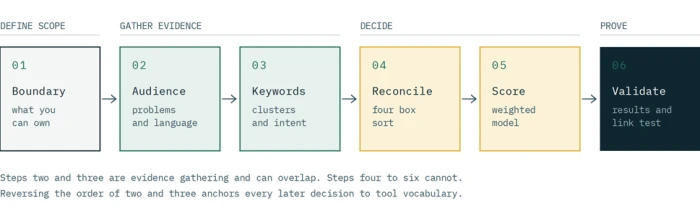
Figure 1 The six step sequence. The first three steps produce evidence, the last three convert it into a commitment. The gate between step three and step four is where most content plans skip straight to a calendar.
A working definition worth agreeing on first
A content pillar is a broad subject area your brand commits to covering with depth, structure, and continuity. It is not a single page and it is not a campaign. It is a container: one substantial hub asset plus a growing set of supporting pieces that answer narrower questions inside the same subject and link back to the centre.
Teams get into trouble because the term gets used for at least three different things: the topic itself, the long hub page, and the internal linking structure. If you are still fuzzy on those distinctions, it is worth reading the complete guide to content pillar strategy, SEO, and implementation before going further, because everything below assumes the pillar and cluster model rather than a flat list of blog posts.
For the purposes of this guide, treat a pillar as valid only if it satisfies four conditions at once. It matters to a buying audience. It has enough distinct search demand to support twenty or more supporting pieces. Your organisation has a real claim to authority on it. And it will still be relevant in three years. A theme that meets three of the four is a campaign, not a pillar.
FIELD NOTE Write the four conditions on the wall before the research starts. Half the arguments later in the process are really arguments about the definition, and they are much cheaper to have now.
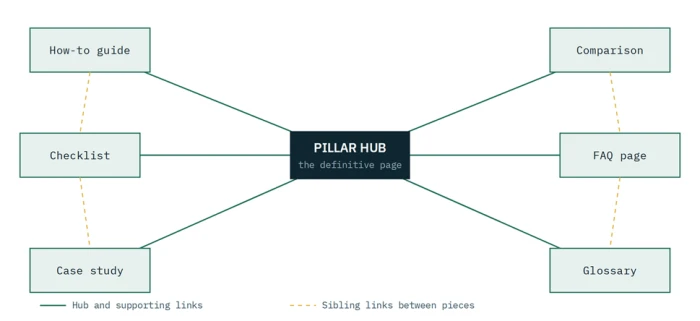
Figure 2 What a pillar looks like once built. One hub page holds the subject together, each supporting piece answers a narrower cluster and links up to the hub, and siblings link sideways to each other. A topic that cannot be drawn this way is a single article, not a pillar.
Step one: set the boundary of what you can credibly own
Research without a boundary produces a list of everything, which is the same as producing nothing. Before you open a single tool, write down the constraints that any pillar has to fit inside.
Start with the commercial edge. Which products or services generate the revenue you are being asked to grow, and who signs off on buying them? A pillar that attracts an audience with no route to those products is a cost centre with good analytics. Then map your credibility. What does your company actually know that a competitor cannot cheaply copy? Proprietary data, operational scars, licensed expertise, and access to practitioners are all defensible. Opinions are not.
Next, be honest about capacity. A pillar needs sustained publishing, not a launch. If you can realistically ship four solid pieces a month, you cannot maintain five pillars simultaneously, and pretending otherwise guarantees that all five stay shallow. Finally, note the exclusions: subjects that are legally sensitive, regulated, seasonal to the point of irrelevance for nine months, or already saturated by your own sales enablement material.
The output of this step is a short paragraph, not a spreadsheet. Something close to: we sell payroll software to finance leads at companies of fifty to five hundred people, our credibility is in multi state compliance and month end close, we can publish five pieces a month, and we will not write about broad HR culture topics.
Step two: run audience research before you touch a keyword tool
Do the audience work first, deliberately. If you start with keywords, every later decision gets anchored to the vocabulary the tool happened to surface, and you will unconsciously discard problems that people describe in words nobody types into a search box. Starting with human language gives you seed terms you would never have guessed, and it gives you the framing that makes a pillar feel like it was written by someone who has met the reader.
You are collecting four things: the problems people are trying to solve, the words they use to describe those problems, the decisions they are trying to make, and the objections that stall them. The classic framing here is to look for the progress someone is trying to achieve rather than their demographic profile, an idea laid out clearly in the jobs to be done literature. A pillar built around a job holds up far longer than one built around a persona.
Where to look, and what each source is good for
Audience research sources and what they reliably reveal
| Source | What it reveals | Effort and caution |
|---|---|---|
| Sales and demo call recordings | The objections that actually block deals, and the exact phrasing buyers use when they push back on price or fit. | Low effort with high yield. Bias toward people already far down the funnel, so pair it with earlier stage input. |
| Support tickets and chat logs | Recurring friction after purchase, which often points to strong retention and mid funnel pillars. | Low effort. Skewed toward existing customers, so treat it as evidence of depth rather than of new demand. |
| Customer interviews, six to ten of them | The decision sequence, who else was involved, and what nearly stopped the purchase. The single richest source. | High effort. Ask what happened rather than what they would want, since recall of events is more reliable than speculation. |
| Community threads and industry forums | Unfiltered vocabulary and the questions people are too embarrassed to ask a vendor. | Medium effort. Loud minorities distort the picture, so look for repetition across separate threads. |
| Surveys to your list | Rough scale for problems you already suspect exist, useful for ranking rather than discovering. | Medium effort. Question wording changes answers substantially, so keep items neutral and specific. |
| Your own site search and internal search logs | Intent from people already on your property, including gaps where they looked for something you never published. | Very low effort and frequently ignored. Worth checking first in any audit. |
If you are writing survey questions rather than interview scripts, it is worth borrowing method from people who do it professionally. The public guidance on writing survey questions covers the traps that quietly ruin marketing surveys, particularly leading phrasing and double barrelled items.
Now code what you collected. Pull every distinct problem statement into a single sheet, tag each one with the job it belongs to, and count how often it appears across independent sources. A problem raised by one talkative customer is a data point. The same problem raised in three interviews, eleven tickets, and two forum threads is a candidate pillar. When you have thirty to sixty tagged statements, group them by hand. Grouping by hand matters, because the groups you form are a first draft of your taxonomy, and the technique is essentially a card sort. If you can persuade a few customers to do the sort instead of you, the resulting structure will match how they think rather than how your org chart is arranged.
FIELD NOTE - Keep a verbatim column. When a pillar eventually gets written, those exact sentences become your headlines, your subheads, and your FAQ questions. Paraphrasing loses the thing that made them useful.
Step three: build and cluster the keyword set
Now bring in search data, using the problem statements from step two as your seeds rather than starting from product names. Product led seeds return a narrow, brand adjacent list. Problem led seeds return the market.
Expand, then filter
Take each coded problem group and expand it into every phrasing you can find: the queries autocomplete offers, the related searches at the foot of the results page, the questions the engine surfaces in expandable panels, the terms in Search Console that already earn you impressions without clicks. Look at relative interest over time in Google Trends to separate a durable subject from a spike you would be arriving late to. Whatever keyword tool your team uses is fine here; the method does not depend on the vendor.
Then filter hard. Drop anything that is clearly navigational for another brand, anything you have no product story for, and anything where the results page is so dominated by a format you cannot produce that ranking is not realistic. What remains is your working universe.
Cluster by intent and by results page overlap
Raw keyword lists are useless for pillar selection because they hide the fact that thirty phrases are often one topic. Cluster them twice. First by intent, then by how much the search results overlap. Two queries whose top ten results share five or more of the same pages are the same topic to the engine, whatever the phrasing looks like to you, and they should sit inside one supporting piece rather than two competing ones.
Intent types and their role inside a pillar
| Intent | Typical query shape | Role in the pillar |
|---|---|---|
| Informational | Queries asking what something is, why it happens, or how it works. | Forms the bulk of supporting pieces and feeds the hub page. Builds the topical footprint that makes commercial pages rank. |
| Instructional | Queries asking how to perform a task, fix an error, or complete a process. | Highest value for demonstrating competence. Often the best performing content in a pillar because the reader has a live problem. |
| Comparative | Queries weighing options, alternatives, or approaches against each other. | Sits between the hub and the product. Converts well but needs genuine even handedness to be believed. |
| Transactional | Queries with buying language such as pricing, cost, or provider selection. | Belongs on product and service pages that the pillar links to, not usually inside the pillar itself. |
Count the clusters per candidate topic. This number is your depth test, and it is the most decision relevant figure in the whole exercise. A candidate with six clusters cannot sustain a pillar no matter how attractive the head term looks. A candidate with twenty five clusters can carry two years of publishing.
Step four: reconcile the two lists
You now have a set of audience problem groups and a set of keyword clusters. Put them side by side and sort every candidate topic into one of four boxes.
1. Strong on both. Real search demand and repeated, evidenced audience pain. These are your pillar candidates, and there are usually fewer than you hoped.
2. Search demand, weak audience evidence. Volume exists but your specific buyers never raised it. Often a different audience entirely. Park these and revisit only if the audience picture changes.
3. Audience pain, little search volume. The problem is real but people do not search for it, either because they lack the vocabulary or because they hear about it from peers. These make excellent sales enablement, email, and community content, and poor pillars.
4. Weak on both. Delete without ceremony.
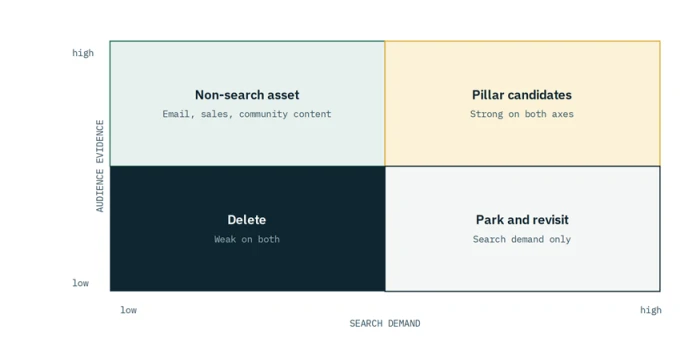
Figure 3 The reconciliation sort. Only the top right box becomes a pillar shortlist. The top left box is real work for other channels, and the trap is publishing it as a pillar and then judging it on organic traffic it was never built to earn.
The third box is where most disagreement happens, and it is worth sitting with. A subject with genuine audience pain and thin search volume is not worthless, it is simply not a search asset. Publishing it as a pillar and then judging it on organic traffic is how good content gets killed for missing a target it was never suited to.
Step five: score and select
Take the candidates from box one and score them. The point of a scoring model is not mathematical precision, it is forcing the trade offs into the open so the final choice is defensible to a finance director six months later.
Pillar scoring model, scored one to five per criterion
| Criterion | What you are measuring | Weight | A score of five looks like |
|---|---|---|---|
| Business proximity | How directly the topic connects to something you sell. | 25% | Every supporting piece has an obvious, non forced path to a product or service page. |
| Cluster depth | Number of distinct keyword clusters the topic supports. | 20% | Twenty five or more clusters with room to expand as the subject develops. |
| Audience evidence | How often the problem appeared across independent research sources. | 20% | Raised repeatedly in interviews, tickets, and calls, in consistent language. |
| Right to rank | Whether you can plausibly outperform what already ranks. | 15% | You hold data, practitioners, or first hand experience the incumbents visibly lack. |
| Durability | Whether the subject survives three years and a platform change. | 10% | Rooted in a stable job or obligation rather than a tool, trend, or feature name. |
| Cost to serve | Research, review, and expertise burden per piece, scored in reverse. | 10% | Producible at cadence without a bottleneck on one unavailable expert or a legal review queue. |
Score every candidate, then look at the spread rather than only the winners. If your top four scores cluster within a few points, the choice is closer to arbitrary than the numbers suggest and you should pick on capacity and conviction. If one candidate is far ahead, resource it properly instead of splitting attention evenly across four.
Step six: validate before you commit
Before the calendar gets built, run three cheap checks on each selected pillar.
First, read the actual results pages for the head term and five representative clusters. Not the metrics, the pages. What format wins, what depth is standard, who is ranking, and is it the kind of page you could produce a materially better version of? If the top ten is entirely tools, forums, or government sources, an article is the wrong instrument and no amount of writing quality will change that. Google’s own guidance on creating helpful, reliable, people first content is a reasonable benchmark to hold your planned pieces against, particularly the questions about experience and original value.
Second, test the linking structure on paper. List the hub page and twelve supporting pieces, then draw where the links go. Every supporting piece should link up to the hub and sideways to at least two siblings, and the hub should link down to all of them. If you cannot draw it without the structure collapsing into a single long page, the pillar is really one article. Make sure the links you plan are ordinary crawlable anchors rather than script driven interactions, which Google’s documentation on crawlable links spells out plainly.
Third, write one supporting piece and publish it before the pillar hub exists. It is the cheapest possible test. If a single narrow piece inside the topic cannot earn impressions, get shared internally, or survive a sales team read, the pillar has a problem that scale will amplify rather than solve.
FIELD NOTE - The paper linking test catches more bad pillars than any keyword metric. Topics that cannot be split into linked parts are almost always too narrow, however impressive their head term volume looks.
How many pillars, and how big
Fewer than you want. For most teams publishing four to six pieces a month, three pillars is the practical ceiling and two is often better in year one. Each pillar needs enough supporting pieces to look like coverage rather than sampling, which in practice means fifteen to twenty five pieces before it starts to compound. Divide your annual output by that number and you have your real pillar count.
Size the pillars asymmetrically. One primary pillar taking roughly half your output, a second taking a third, and a third receiving the remainder works better than an even split, because search authority accrues to concentration rather than to breadth. Even coverage across four pillars produces four thin ones.
Six ways this goes wrong
- Picking pillars from the org chart. Departments are not topics. A pillar per team produces content organised around your internal structure, which is invisible and irrelevant to the reader.
- Choosing head term volume over cluster depth. A term with high volume and eight clusters is a single competitive page, not a pillar. Depth predicts sustainability; volume predicts nothing on its own.
- Skipping audience research because keyword data feels objective. Keyword tools show you demand that already exists in the vocabulary of the tool. They cannot show you the problem your buyers have not yet learned to name, and that problem is often where the least contested pillar sits.
- Overlapping pillars. If two pillars share more than roughly a fifth of their clusters, they will compete for the same queries and dilute each other. Merge them or move the boundary.
- Treating the pillar as a launch. A hub page published alone with three supporting pieces and no follow through is a long article with ambition. The compounding comes from continuity.
- Never retiring anything. Pillars have lifespans. When cluster volume declines for three consecutive quarters, or the product moves away from the subject, consolidate the pillar into its strongest pieces and redirect the rest instead of maintaining a monument.
A worked example
A payroll software company serving mid sized finance teams starts with a boundary: finance leads at companies of fifty to five hundred people, credibility in multi state compliance and month end close, five pieces a month, no general HR culture content.
Audience research across eight customer interviews, four months of support tickets, and twelve recorded sales calls surfaces three repeated problems. Multi state filing rules that change without warning and carry personal liability. Month end close taking four days when it should take one. And the fear of switching providers mid year and breaking something.
Keyword work seeded from those three produces very different depth. Compliance yields thirty one clusters spanning instructional and informational intent. Close and reconciliation yields nineteen clusters, heavily instructional. Provider switching yields nine clusters, almost entirely comparative and largely dominated by review sites.
Scoring puts compliance first on depth, evidence, and durability but marks it down slightly on cost to serve, since every piece needs specialist review. Close and reconciliation scores highest on business proximity because the product’s automation features answer the problem directly. Switching scores poorly on right to rank, since third party review platforms hold the results page.
The decision: two pillars, not three. Compliance takes roughly half of output as the authority play. Close and reconciliation takes the remainder as the conversion play. Switching becomes a small set of sales enablement pages and a comparison page on the product side of the site, judged on assisted conversions rather than on organic traffic. That last reallocation is the part most teams skip, and it is what keeps a perfectly good topic from being written off as a content failure.
Conclusion
Pillars are chosen, not brainstormed. Everything in this guide exists to move that choice off the whiteboard and onto evidence, because the meeting where four plausible themes get nodded through is the exact moment most content programmes are quietly lost. The writing that follows can only ever be as good as the topic it serves.
The discipline that separates a durable pillar from an expensive one is the reconciliation. Search demand tells you a topic can be found. Audience language tells you it is worth finding. A candidate that wins on only one axis is still useful work, but it belongs in another channel, and naming that honestly up front is what stops a sound topic from being judged later against a target it was never built to hit.
The rest is restraint. Choose fewer pillars than you have the appetite for, weight them asymmetrically rather than evenly, measure depth in clusters instead of head term volume, and validate with a single published piece before the calendar swallows a quarter. A pillar is a bet you intend to hold for years, so place it deliberately, resource the winner properly, and retire it without sentiment when the evidence turns. Do that, and twelve months out you have compounding coverage that sales actually cites, rather than sixty articles and a quiet decision to start over.