

When you invent a new category, there is no demand waiting to be captured. Nobody is searching for you, because nobody knows the problem has a name yet. Your job changes from winning a market to building one.
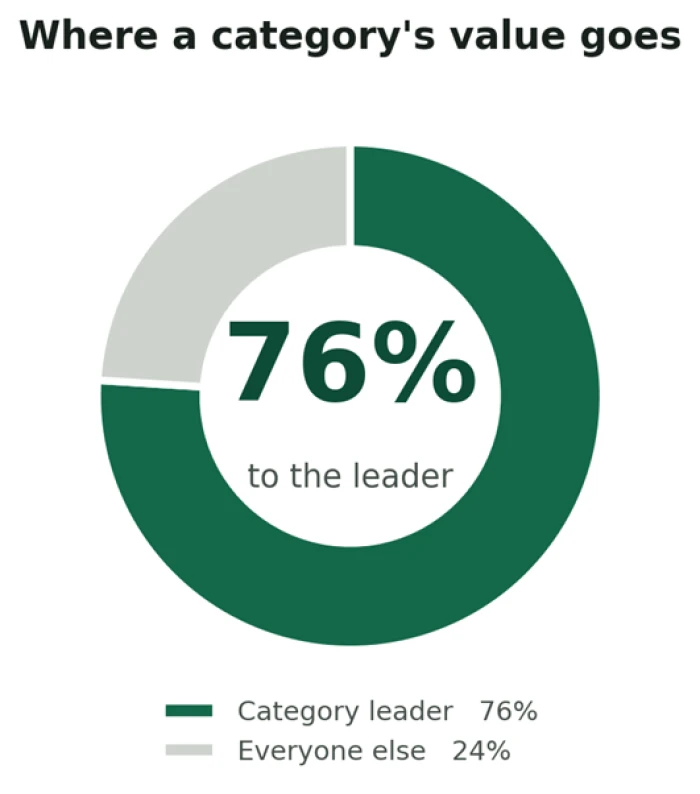
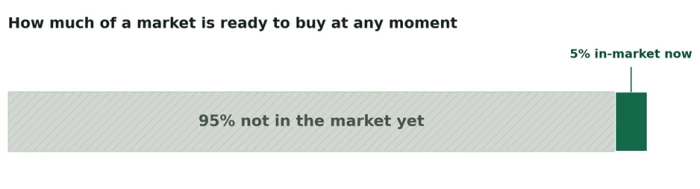
76% of a category's value goes to its leader | 95% of a market is not looking to buy right now | 6 to 10 years it usually takes to build a category | 2 to 3x the education spend a new category demands |
Start here
You Are Not Entering a Market. You Are Making One.
The default marketing playbook assumes demand already exists and your job is to win your share of it. In a brand-new category that assumption is simply false.
There is no line of buyers comparing options, because most of them do not know the option exists, and many do not yet believe the problem is worth solving. So the work flips. Before you can sell the answer, you have to make people feel the question. This is not a harder version of normal marketing. It is a different job with a different budget, a different timeline, and a different definition of progress.
| Companies that win a new category do not shout louder. They explain better. They name the problem clearly, challenge the old way of doing things, and let the product become the obvious escape. |
The stakes
Why the Effort Is Worth It, and Why It Is Brutal
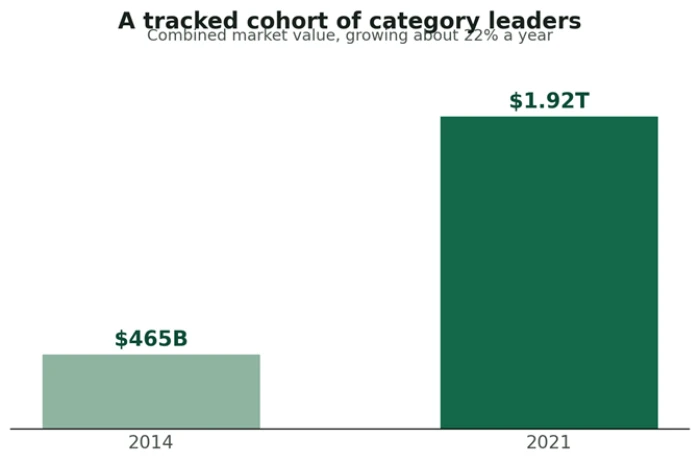
The upside is lopsided in a way few strategies are. Research from Play Bigger found that the company which defines and leads a category tends to capture around 76 percent of that category's total market value, while every other player divides the remaining quarter. The cohort of category leaders it tracked grew their combined value from roughly 465 billion dollars to 1.9 trillion over seven years. Separate Harvard Business Review analysis found that category creators earn about 3.40 dollars in extra market value for every dollar of revenue growth, and that half of the fastest-growing large companies grew by creating a category rather than competing inside one.
That prize is real, and so is the cost. For every category that took off, dozens of companies tried and failed by explaining a problem their buyers never actually felt. Here is the honest balance sheet before you commit.
The prize The leader captures the majority of the category's value, not a thin edge You set the vocabulary, the buying criteria, and the rules everyone competes on The lead is durable, since challengers must play on terms you defined | The price Building the category usually takes six to ten years, not quarters You spend two to three times more on education than on a normal launch The failure rate is high, and most attempts never reach the payoff |
The mental model
Creating Demand Is a Different Job From Capturing It
Most teams run demand capture. They meet buyers who are already searching, comparing, and ready to buy, and they work to be the obvious choice. That is a fine strategy when demand exists. The trouble is that at any given moment only about five percent of a market is actively in the market to buy. The other ninety-five percent are not looking, and in a brand-new category that share is even higher, because the problem itself is still invisible.
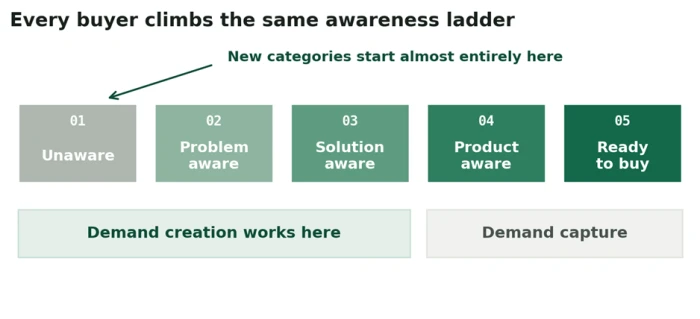
Every buyer moves through the same ladder of awareness, and capture tactics only work near the top of it. In a new category almost everyone sits on the bottom rungs, which is why paid search and comparison pages fall flat at first. There is nothing to search for and nothing to compare against, so the early work is teaching, not converting.
The playbook
Seven Plays for Building Demand From Zero
No single tactic creates a category. There is a sequence of moves that, taken together, teach a market to want what you built. These are the seven that matter most, roughly in the order you run them.
1. Name the problem before you sell the product
People cannot want a solution to a problem they have not named. Your first job is not to describe your product, it is to give language to a frustration your buyer already feels but has never put into words. Make the pain conscious, and cast the old way of coping as the thing holding them back.
In practice HubSpot did not lead with software. It named inbound marketing and framed interruptive advertising as the tired old way, so the product became the obvious way out. |
2. Start with a beachhead, not the whole ocean
A new category is too big and too vague to sell to everyone at once. Pick one narrow segment that feels the pain most sharply and has the least patience for the status quo. Win them completely, then expand outward. A small group of true believers builds more momentum than a large group of the mildly curious.
In practice This is the wedge behind Crossing the Chasm. New categories are carried by a focused set of early adopters long before the mainstream will follow them in. |
3. Sell a point of view, not a feature list
In an established category you compete on being better. In a new one you win by being different, and difference is carried by a story, not a spec sheet. Frame a clear shift in the world: the old way that is breaking, the new way arriving, and the better future on the other side. Your product is the bridge between them.
In practice Salesforce did not pitch a better database. It sold the end of on-premise software with a simple, memorable stance against the old way of buying and installing it. |
4. Create the language and own it
If you name the category and the problem, you set the terms everyone else has to use. Coin a phrase that is simple, repeatable, and points at the problem rather than at your product. Then use it relentlessly until analysts, buyers, and even competitors adopt your words. Whoever owns the vocabulary owns the frame.
In practice Gong popularized revenue intelligence, Drift built conversational marketing, and Gainsight defined customer success. Each one authored the words its market now uses by default. |
5. Recruit lighthouse customers and turn them into proof
In a new category there are no analyst rankings and no peer reviews to lean on, so trust has to be borrowed. Win a handful of respected, visible customers, help them succeed loudly, and let their results become your evidence. One credible believer telling your story is worth more than any claim you make about yourself.
In practice Early category leaders obsess over a small set of reference customers whose visible wins carry the new idea to the skeptics who come next. |
6. Educate relentlessly across every channel
Demand creation is teaching at scale. Publish the point of view everywhere your buyer already learns: long-form writing, talks, podcasts, community, and analyst briefings. The goal at this stage is not leads, it is to become the name people associate with the problem. Expect to invest far more here than a normal launch, and expect it to pay back slowly.
In practice Category leaders routinely spend two to three times more on content, events, and thought leadership than companies entering a category that already exists. |
7. Make the old way feel obsolete
A category is truly won when the new way becomes the default and the old way starts to feel embarrassing. Keep raising the contrast between the world you are building and the one you are replacing, until continuing the old way looks like a choice nobody sensible would make. That is the moment demand stops needing to be created and begins to pull on its own.
In practice Once customer success and inbound became baseline expectations, buyers pressured every vendor to conform, and the category began defending itself without help. |
The operating reality
How to Fund It, Pace It, and Measure It
The most common way category creation dies is quiet. A team funds it like a normal launch, measures it like a normal launch, and shuts it down before it ever had a chance to work. Creating demand runs on a different clock and a different scoreboard than capturing it. This is the contrast worth keeping on the wall.
| Dimension | Demand creation | Demand capture |
|---|---|---|
| Buyer state | Does not know the problem exists | Already searching for a solution |
| Main job | Teach the market and shape beliefs | Convert existing intent |
| Typical channels | Thought leadership, talks, community, analysts | Search ads, comparison pages, retargeting |
| Early budget tilt | The majority of spend | A supporting slice |
| Time to payback | Eighteen months and often years | Weeks to a quarter |
| What to measure | Problem awareness and share of conversation | Leads, pipeline, and cost per acquisition |
| Failure mode | Giving up before belief forms | Running dry once demand is created |
A useful rule of thumb is that the newer your category, the more your early budget should lean toward creation, because there is almost nothing to capture yet. Judge progress with leading indicators, not lead counts, since the lead counts arrive last.
Read the early signals
What Progress Looks Like Before Revenue Does
Demand creation shows up in soft signals months before it shows up in pipeline. These are the ones that move first, and the ones to hold your nerve on when the finance team asks why the funnel is quiet.
Your words spreading Prospects, analysts, and even rivals start using the name you gave the problem | Search starting to appear People begin looking up the term that did not exist before you created it |
Inbound that self-diagnoses Conversations open with buyers describing the problem the way you framed it | Shorter why-this-matters Sales calls spend less time justifying the problem and more on the solution |
A gathering audience Community, subscribers, and waitlists grow around the idea, not just the product | Third parties validating Analysts and press begin covering the category as a real thing, not a curiosity |
Before you commit
When You Should Not Create a Category
Category creation is seductive, and it is the wrong move more often than founders want to hear. If any of these is true, put the ambition down and win a different way.
Do not proceed if
|
The takeaway You cannot capture demand that does not exist yet. In a new category, the market is not something you enter, it is something you build, one clearly named problem at a time. |