

Why this is arranged as evidence Advice about marketing AI products is abundant and largely interchangeable, because most of it is written from intuition. There is now a substantial documented record instead. Regulators have brought cases and published what the claims actually were, courts have entered orders, and buyer researchers have measured how much of any of it is believed. So the format below is an exhibit followed by the rule it produces. Every exhibit is a public record or a published survey. If you disagree with a rule you can go and read what it came from, which is the exact posture this article recommends you adopt toward your own claims. |

Advice in this category is plentiful, and the documented record is a better starting point
PART ONE
The record
Eleven exhibits, roughly in the order a marketer should care about them. The first establishes why the usual playbook stopped working. The next eight establish what is now actionable against you. The last two establish what is left.
EXHIBIT 01 Vendor marketing ranked last among sources buyers consult |
A survey conducted in January 2026 and published that July found trust in online resources falling sharply. Buyers reporting that they trust online sources less than before rose from 39 percent to 47 percent in a single year. The neutral middle collapsed from 50 percent to 42 percent, and those buyers did not become more trusting, they became sceptical. The sources losing most ground are those buyers associate with vendor control. Vendor marketing collateral ranked last among resources buyers actually consult. Analyst reports, once standard in enterprise evaluation, were used by only 13 percent of buyers, a 63 percent decline since 2022. Separately, 94 percent of buyers reported fact checking AI generated research outputs. |
RULE DERIVED Producing more of the channel you control cannot be the strategy. The work shifts to generating evidence you did not author and placing it where you have no editorial control. |
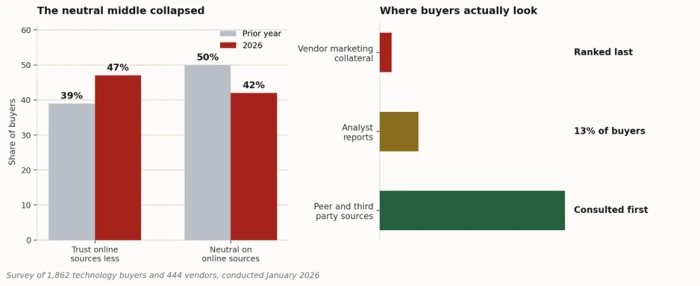
The two measurements behind exhibit 01, from the January 2026 survey
EXHIBIT 02 The first AI washing enforcement actions, and what the claims were |
The Securities and Exchange Commission settled charges against two investment advisers for false and misleading statements about their use of AI, totalling 400,000 dollars in civil penalties. These were the first enforcement actions of their kind. The detail is more instructive than the amount. One firm had advertised that it put collective client data to work to make its AI smarter so it could predict which companies were about to succeed. Under questioning it acknowledged that it had not used any client data and had not built the algorithm it described. It paid 225,000 dollars. The second claimed to be the first regulated AI financial adviser offering expert AI driven forecasts, and according to the order could not substantiate its performance claims when the Commission asked. It paid 175,000 dollars. Both were charged under existing antifraud provisions and the advertising rule for investment advisers, not under any AI specific statute. |
RULE DERIVED The operative test is whether you can substantiate a claim on demand. If a regulator asked tomorrow for the evidence behind a sentence on your homepage, and you would need a week and some interpretation, that sentence is a liability. |
EXHIBIT 03 A category name can itself be the false claim |
A security screening company marketed AI powered scanners it said could detect weapons while ignoring harmless personal items. The FTC alleged the products did not perform as advertised, and that claims comparing their accuracy and cost effectiveness with traditional metal detectors were unsupported. The most instructive part of the complaint concerns naming. The company had insisted publicly and repeatedly that its product was a weapons detection system rather than a metal detector, and the agency characterised that as solely a marketing distinction, on the basis that the scanners detected metallic objects and their alarms could be triggered by metallic objects that were not weapons. The stakes were material. Contracts reportedly ran to tens of thousands of dollars a year, several times the cost of conventional detectors, and one Kentucky district spent 17 million dollars on deployment. The proposed order would restrict claims about detection accuracy, false alarms, labour cost savings and AI enabled superiority unless substantiated, and requires that certain school customers who signed between April 2022 and June 2023 be offered the chance to cancel. |
RULE DERIVED Inventing a category name to escape an unflattering comparison is itself a claim about capability. If the honest description of your product is a better version of an existing thing, the renaming will not survive scrutiny and makes the underlying claim worse. |
EXHIBIT 04 Substitution claims require testing against the thing you claim to substitute |
A legal services company marketed its chatbot as the world’s first robot lawyer. The FTC alleged the product was represented as able to substitute for a human lawyer without the company having tested whether its output met the standard of an actual lawyer, and that the chatbot was neither adequately trained nor adequately tested. The order imposed 193,000 dollars along with ongoing advertising restrictions and notice to past subscribers. The failure was not exaggeration in the ordinary marketing sense. It was making a comparative claim against a professional standard and never running the comparison. |
RULE DERIVED Any claim of the form as good as a human X, or replaces your Y, converts into a testing obligation the moment you publish it. Without that test the claim is unsubstantiated regardless of how well the product performs in practice. |
Every exhibit in this section rests on a filing, an order or a published survey
EXHIBIT 05 Concealing human labour escalated from civil to criminal |
The Department of Justice charged the chief executive of a shopping application with wire fraud in connection with allegedly false and misleading statements to investors about the company’s proprietary AI. According to the indictment the software was represented as able to complete retail transactions autonomously across e commerce sites using AI. Separately, a heavily funded company in an adjacent space was reported to have relied on human engineers for work presented as automated code generation. The distinction that matters is not whether humans are involved. Many credible products keep people in the loop deliberately, and say so. It is whether the marketing conceals it. |
RULE DERIVED If people perform part of what you present as automated, disclose it and frame it as review or quality assurance. Concealment is the specific conduct that has moved this category from advertising complaints to criminal exposure. |
EXHIBIT 06 Enforcement has moved into business to business marketing |
The FTC opened a sweep called Operation AI Comply in September 2024 and has brought at least a dozen AI washing cases through 2025, with a thirteenth filed in May 2026 against marketing companies over an AI powered listening tool. Analysis of the programme notes that of the most recent eight such cases, seven involved marketing claims made to other businesses rather than to consumers. The legal basis has not changed across any of them. The agency is applying the general prohibition on unfair or deceptive practices that has existed since 1914, and evaluating AI claims under the same substantiation standard applied to any other product representation. Published guidance identified three recurring risk areas: vague capability claims lacking technical specificity, comparative performance claims unsupported by empirical testing, and implied endorsements suggesting verification that never occurred. |
RULE DERIVED Business to business positioning is inside the perimeter, and those three risk areas function as a review checklist for your own pages. Most enterprise marketing sites contain all three. |
EXHIBIT 07 The pattern across the rest of the programme |
The individual matters repeat a narrow set of failures, which is what makes them useful as a checklist. A facial recognition vendor drew an order in January 2025 over claims about accuracy and bias characteristics. An AI content detection product was the subject of an action after allegedly claiming to identify machine written text across all content types when the model had been trained on a narrower body of material. Another matter concerned guaranteeing that consumers could make money running online storefronts with AI powered software. Read together, almost every case turns on one of three things: an accuracy figure that was not tested under the conditions implied, a scope claim broader than the evidence, or a guaranteed outcome. None of them turn on the underlying technology being poor. |
RULE DERIVED Scope is as dangerous as magnitude. Claiming a capability works across all content, all customers or all conditions is a stronger assertion than a high accuracy number, and it is harder to substantiate. |
EXHIBIT 08 The counter exhibit, because the posture is not monolithic |
In an unusual step the FTC reopened a settled AI matter involving a writing assistant and set aside the earlier consent order, citing the administration’s AI executive order and action plan and stating that the complaint had failed to satisfy the requirements of the FTC Act. This is included deliberately. An article presenting enforcement as a uniformly expanding threat would be selecting its evidence, which is the behaviour the rest of this piece argues against. Priorities shift with administrations, penalties in several of these matters have been modest, and at least one theory of liability has been withdrawn. |
RULE DERIVED Do not build a marketing posture around predicting enforcement appetite, which moves. Build it around substantiation, which is the one requirement that has survived every shift and which sceptical buyers are independently demanding. |
EXHIBIT 09 Disclosure became a product requirement this month |
The transparency obligations in Article 50 of the EU AI Act took effect on 2 August 2026. Systems that interact with people must disclose that they are AI, and AI generated image, audio, video and text content must be marked. The obligations reach any provider or deployer serving users in the EU, so a company based elsewhere running a chatbot for European customers or publishing machine generated marketing to European audiences can be in scope, including where the underlying tools belong to a third party. Penalties for breach can reach 15 million euros or 3 percent of worldwide annual turnover, whichever is higher. The machine readable marking requirement carries a grace period running to December 2026 for tools already on the market before August, and content produced before that date does not require retroactive labelling. |
RULE DERIVED Disclosure has moved from a positioning choice to a compliance obligation with a live date. If your product talks to users or your marketing is machine generated, labelling is now an operational question rather than a philosophical one. |
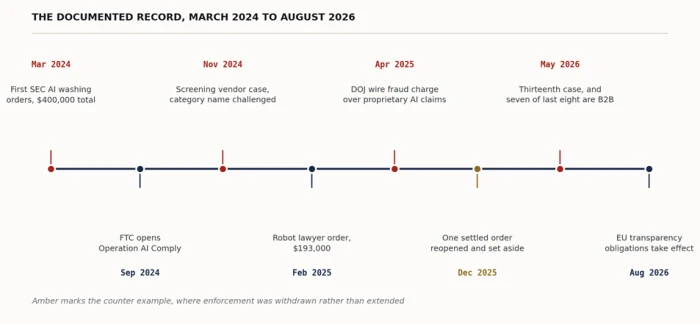
Exhibits 02 to 09 in sequence, from the first SEC order to the EU obligations
EXHIBIT 10 Some categories were absorbed rather than contested |
Market analyses through 2026 identify several categories as functionally closed to new standalone entrants, including AI writing assistants with more than a hundred funded competitors, support chatbots, meeting summarisers, logo generators and resume builders. The stated cause is not competitive intensity between startups. It is that incumbents shipped the capability natively inside suites customers already pay for, which collapsed standalone pricing power. This is a different problem from a crowded market and needs a different response. In a crowded market you differentiate. Against an absorbed feature you relocate, because the buyer is not choosing between you and a rival, they are choosing between you and waiting. |
RULE DERIVED Diagnose whether you are in a crowded category or an absorbed one. If your core function now ships free inside a suite your buyer already owns, no amount of positioning fixes it, and the answer is to move to ground the suite cannot occupy quickly. |
EXHIBIT 11 Half of buyers now start research with an assistant |
Around 51 percent of B2B software buyers report beginning research with an AI assistant rather than a search engine, and 79 percent say AI search has changed how they research software. Read alongside exhibit 01, this produces an awkward sequence. A retrieval system summarises you from whatever text it can find, and then a buyer who reports fact checking machine outputs 94 percent of the time verifies that summary. Unsubstantiated claims therefore propagate first and collapse second, which is worse than never having been made, because the buyer now has a documented reason to distrust everything else you said. |
RULE DERIVED Write for accurate reproduction rather than for impression. Specific, plainly stated, verifiable sentences summarise correctly and survive checking. Atmospheric language does neither, and this is the rare case where the honest version and the effective version are the same text. |
PART TWO
The rules consolidated
Eleven exhibits produce a smaller number of operating rules, because several converge. This is the working list.
| Rule | From exhibits | What it changes on Monday |
|---|---|---|
| Substantiate on demand | 02, 04, 06, 08 | Every performance claim gets a linked method or comes off the page |
| Never claim substitution untested | 04 | Replaces your analyst becomes assists your analyst, unless tested |
| Watch scope, not just magnitude | 07 | All content, all customers and all conditions get narrowed to what was tested |
| Disclose the humans | 05, 09 | Human review appears in the product description, framed as assurance |
| Do not rename to escape comparison | 03 | Describe what the product is, then argue it is better at the job |
| Comparative claims need tests | 03, 04, 06 | Any faster, cheaper or more accurate than needs a documented comparison |
| Label AI interaction and output | 09 | Chat interfaces and generated content carry disclosure where the EU applies |
| Treat marketing as a durable record | 05 | Product pages reviewed to the standard applied to investor communications |
| Move evidence off your own site | 01, 11 | Budget shifts from collateral to trials, reviews and open documentation |
| Write to be quoted accurately | 11 | Specific claims replace atmospheric ones throughout |
| Relocate if absorbed, differentiate if crowded | 10 | Positioning work starts with a diagnosis rather than a message |
PART THREE
The audit
Run this against your own homepage and top three product pages. Each item corresponds to conduct that appears somewhere in the record above. Count the ones you cannot honestly tick.
Every numeric claim has a method attached A percentage with no stated test conditions is the most common unsubstantiated claim in this category |
No sentence would be equally true if the product did nothing Powered by advanced AI, intelligent automation and understands your business all fail this |
Comparative claims rest on a documented comparison Faster, cheaper and more accurate than are the three phrases regulators have repeatedly examined |
Scope claims match what was actually tested All content types, any industry and every use case are scope claims needing the same evidence |
Human involvement is stated where it exists Including review of edge cases, manual onboarding and any human in the loop step |
No claim of replacing a professional without testing Substitution language converts into a testing obligation on publication |
Limitations appear somewhere findable A published limitations page is costly to fake and is now a credibility signal in itself |
Documentation and pricing are ungated Gating pushes a sceptical buyer toward a competitor who does not gate |
A buyer can generate their own evidence A trial on their data outranks anything you could write about your own product |
Third party evidence exists at volume Reviews you did not select carry weight precisely because you did not select them |
AI interaction and generated content are labelled Required where you serve EU users, with obligations live since 2 August 2026 |
Your model dependency is stated plainly Buyers now ask directly, and a vague answer reads as concealment |
How to read your score Nine or more ticks and your material is unusual for the category. Five to eight is typical, and the gaps are the work. Four or fewer and the exposure is not primarily reputational, since several of these items map directly to conduct that has drawn orders, monetary judgments and in one instance a criminal charge. |
PART FOUR
What the record leaves open
The exhibits are mostly constraints. This section covers what remains available, which is more than the tone above might suggest.

The four surviving moves are cheaper than the collateral they replace
Ground an incumbent cannot occupy quickly
Exhibit 10 is the one that ends companies, so it deserves the most practical answer. If your function has been absorbed into a suite, the response is relocation rather than differentiation, and there are six places worth relocating to.
| Position | Why a suite struggles to follow | What you must be able to show |
|---|---|---|
| Regulated depth | Compliance surface makes a generic bundled feature legally awkward | The named obligation you handle and who audited it |
| Workflow ownership | Value sits in the steps around the model, not the model call | The whole process before and after, not one task |
| Proprietary corpus | The data or the labels cannot be obtained on any near timeline | Where it came from and why reproducing it is hard |
| Narrow vertical | The segment is too small to justify a suite feature | Vocabulary and edge cases only that industry recognises |
| Integration depth | Systems of record access takes years and partnerships | Named integrations that are live rather than planned |
| Accountability | Suites will not underwrite outcomes inside a bundled feature | A contractual commitment attached to the result |
The four moves that survive all eleven exhibits
• Let the buyer test on their own data. Self generated evidence outranks every artefact you can author, and it is the direct answer to exhibit 01.
• Publish methods beside numbers. This satisfies the substantiation standard and simultaneously produces the specific, checkable text exhibit 11 rewards.
• Name limitations before a buyer finds them. Costly to fake, against your own interest, and it narrows the distance between your claims and what you could defend.
• Make leaving easy and say so. Reversibility converts a strategic bet into an experiment, which lowers the bar you have to clear.
The economics are favourable, which is not obvious All four cost less than a content programme competing with the entire internet on generic topics. A working trial, a limitations page and a documented benchmark are cheaper to produce and, on the evidence in exhibit 01, carry considerably more weight than the collateral they replace. |
CONCLUSION
What the record actually says Read together, the eleven exhibits describe a market where the cost of an unverifiable claim went up and the value of a verifiable one went up with it. Regulators started asking for substantiation. Buyers started fact checking. Retrieval systems started reproducing whatever text they found. Three unrelated forces, all rewarding the same behaviour. That convergence is the practical finding, because it means the compliance move and the marketing move are now the same move. Publishing a method beside a number satisfies a substantiation standard, gives a sceptical buyer something that survives checking, and produces text a retrieval system can quote correctly. There is no version of this where you optimise one at the expense of the others. So the answer to how to market an AI product in a crowded category is narrower than it looks. Stop making claims you could not defend if asked, start producing evidence you did not author, and put it where you have no control over it. Everything above is elaboration on those three sentences. |